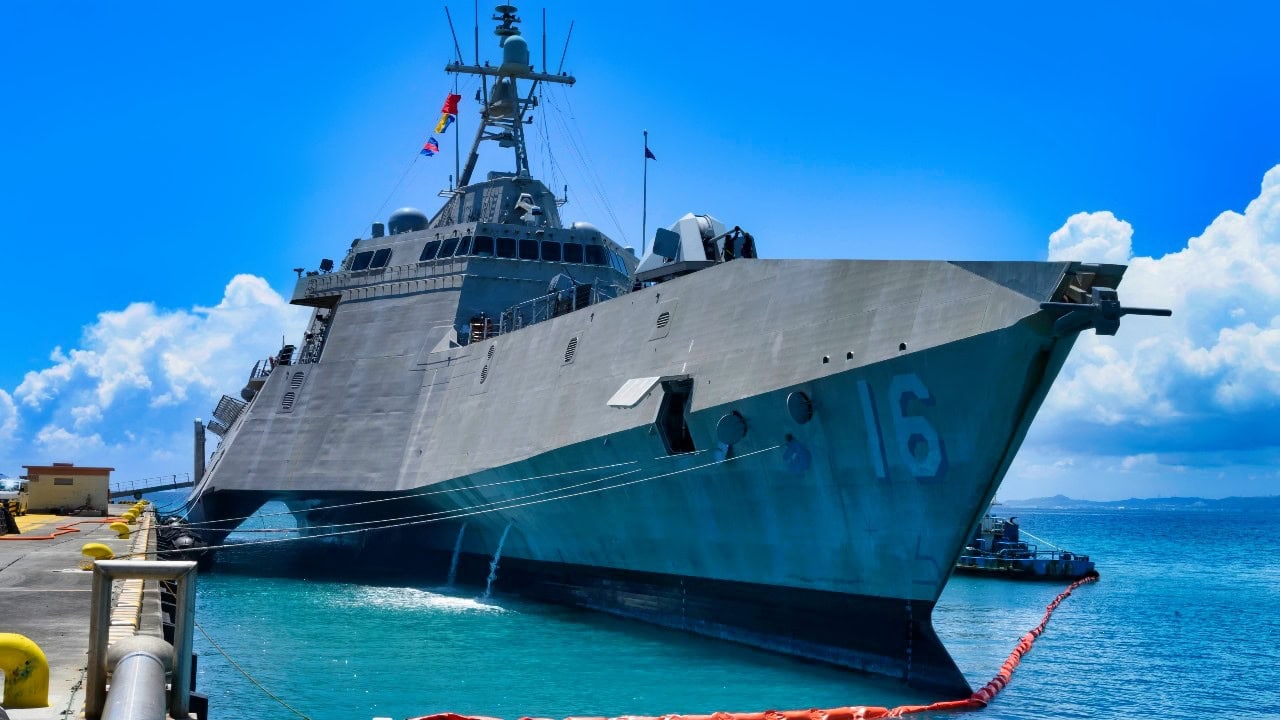
The United States Navy’s Littoral Combat Ship (LCS) is coming to an end, $28 billion later. And what an ignominious end it is set to be. After 20 years, the LCS has not added any real value to the Navy’s post-Cold War capabilities.
In fact, as a ship that was extraordinarily expensive and suffered through a variety of technical complications and mechanical problems–so much so that the sailors serving aboard these boats derided them as “Little Crappy Ships”–these vessels are the embodiment of the word “boondoggle.”
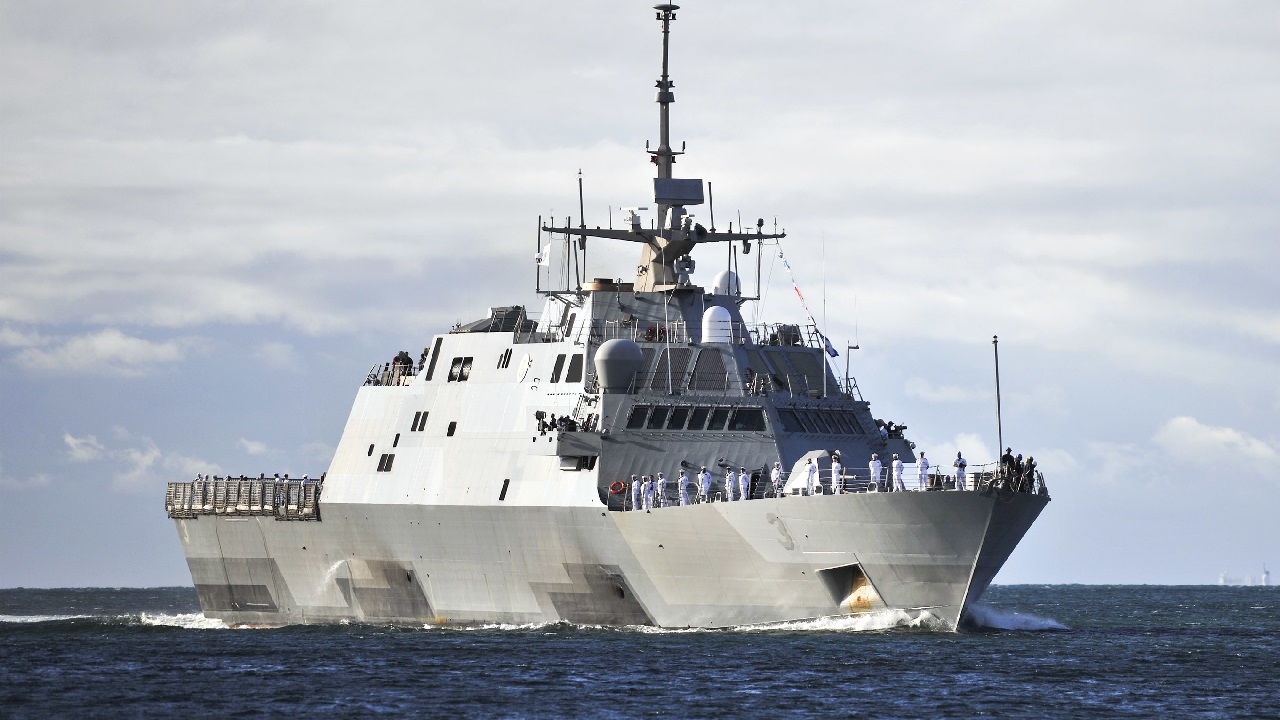
The littoral combat ship USS Fort Worth (LCS 3) arrives to Joint Base Pearl Harbor-Hickam for a scheduled port visit. Fort Worth deployed for a scheduled 16-month rotational deployment to Singapore in support of the Navy’s strategic rebalance to the Pacific. Fort Worth is the first littoral combat ship to deploy under the 3-2-1 manning concept, swapping fully trained crews roughly every four months and extending the littoral combat ship forward presence. (U.S. Navy photo by Mass Communication Specialist 2nd Class Diana Quinlan/Released)
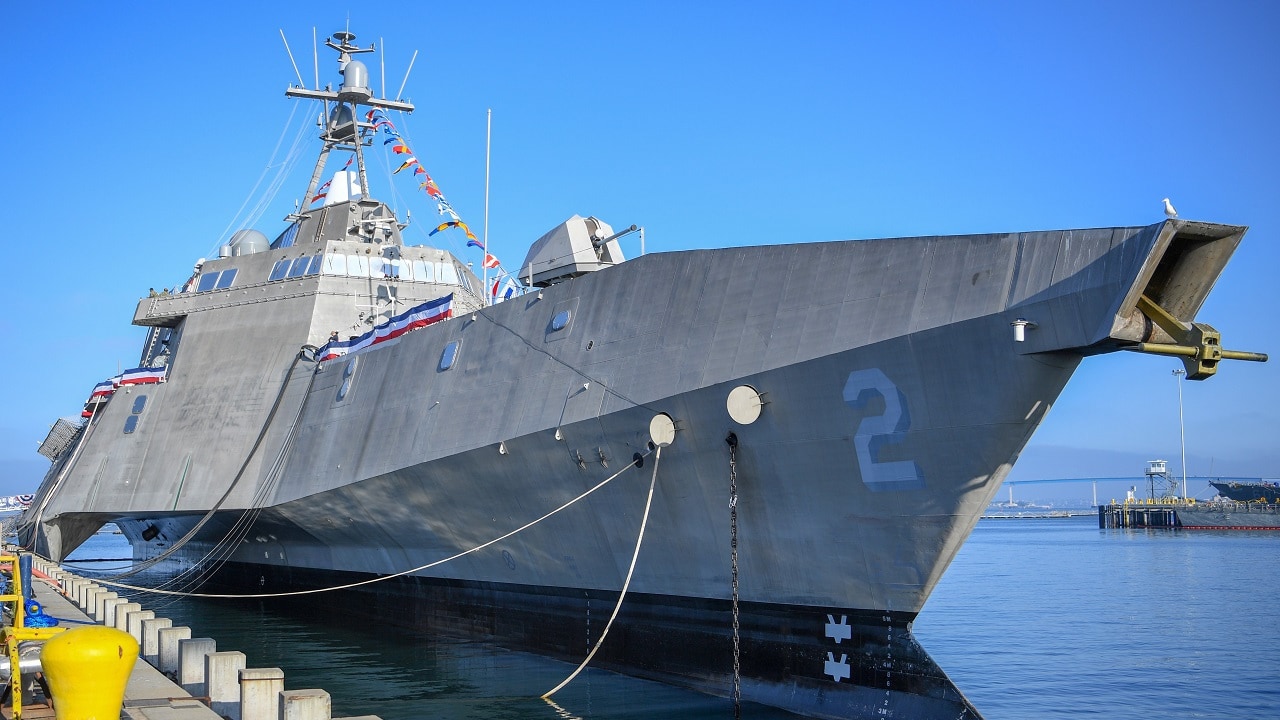
Littoral Combat Ship. Image Credit: U.S. Navy.
The Navy commissioned the USS Pierre (LCS-38), the final Independence-class LCS, in Panama City, Florida, on May 16, formally completing construction of the controversial class.
Thirty-two LCS vessels between 2005 and 2019 were procured for the maritime branch. And some of these ships are already being retired to make room for better, more reliable boats.
And it isn’t just the earliest versions of the ships. It’s units that were built in the middle of the program’s lifespan. The USS Fort Worth (LCS-3) was commissioned in 2012.
It was scheduled for deactivation at the end of July this year. In other words, its lifespan was terminated midway through its originally planned service life. And Fort Worth is no exception to the slow-rolling disaster that has been the LCS program.
A Different Warship For Another Time (That Never Really Existed)
Back when the LCS was first conceived, America was still in the throes of its “unipolar moment” following the Cold War.
Defense budgets were more constrained than they’ve been since the 9/11 terrorist attacks. And the Defense Department assumed that its rivals would be small, isolated, “rogue states” and transnational terror (or criminal) organizations that were not really threats to America’s warships and warplanes.
Because of the nature of these distant threats, the US Navy needed to operate closer to the shoreline. The Navy required cheaper and smaller ships, too.
Rather than build a conventional frigate, the service wanted a modular ship that could rapidly change missions.
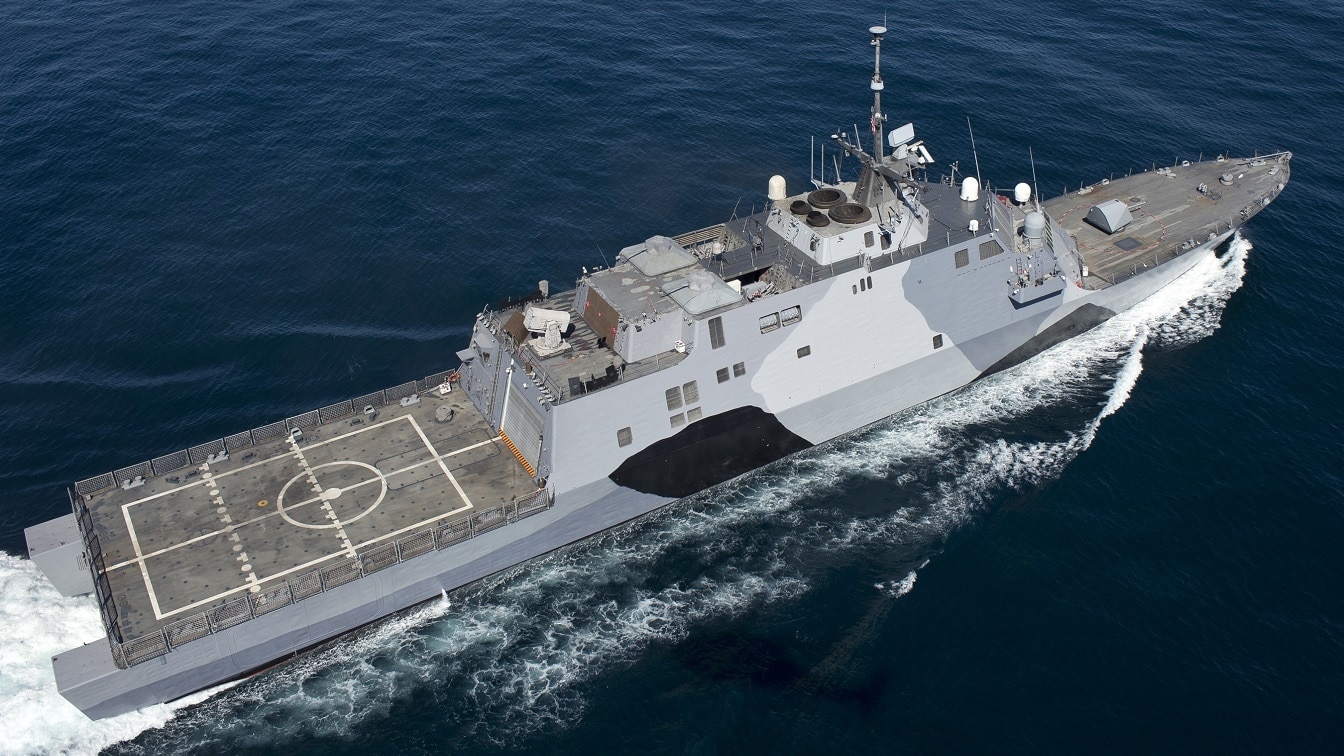
The littoral combat ship USS Freedom (LCS 1) is underway conducting sea trials off the coast of Southern California. Freedom, the lead ship of the Freedom variant of LCS, is expected to deploy to Southeast Asia this spring. (U.S. Navy photo by Mass Communication Specialist 1st Class James R. Evans/Released)
In theory, the LCS would return to its port, exchange equipment, and emerge reconfigured for surface warfare, anti-submarine warfare, or mine countermeasures.
They were less frigate and more Swiss Army Knife. Sadly, though, when one is a Jack-of-all-trades, one usually fails to master any of those tasks. Think of it as being spread too thin.
What’s more, the Navy purchased two very distinct designs.
From Lockheed Martin, the Navy procured the steel-hulled Freedom-class LCS, and from General Dynamics/Austal, the Navy procured the aluminum trimaran Independence-classLCS.
Modularity did not work, sadly. Changeouts were delayed so much that the Navy abandoned the concept altogether.
Indeed, one of the most important proposed functions of the LCS mission was anti-submarine warfare. The Navy cut that module almost immediately.
The maritime branch then decided that their Constellation-class frigates would take on that mission set.
The only problem with that decision, of course, is that the Constellation-class frigates have also been canceled–meaning the Navy’s all-important anti-submarine warfare capacity has been painfully degraded. But that’s another story for another time.
Technical Issues
Then there’s the broader issue of technical problems and limitations the Navy did not anticipate. For starters, the Freedom-class suffered major propulsion woes.
That version of the LCS employed a propulsion plant powered by diesel engines and gas turbines linked by a combining gear.
Breakdowns became so prolific in that class that the Navy eventually stopped accepting new Freedom-class ships altogether until a technical solution was found.
Repairing those combining gears was estimated at millions of dollars per vessel.
Once the strategic environment shifted away from decisive, unipolar global dominance by the US Navy toward the increasingly contested, multipolar world system we find ourselves in today, multiple government reviews questioned the survivability of these tiny, unreliable, increasingly incapable ships.
Hanging On For Dear Life
Of course, the LCS program is coming to an end generally — and it couldn’t come sooner. Yet the Navy is still preserving some LCS units.
At the start of this year, officials indicated that the Navy had reversed its plans to prematurely retire five Freedom-class and two Independence-class vessels (meaning 28 units would remain in service).
Plus, the one mission that the LCS seems to do moderately well is the minesweeping mission set.
So, the Navy wants to maintain a tranche of its Independence-class LCS for minesweeping — especially in light of the Avenger-class minesweepers being up for retirement due to age.
The Death Knell
Meanwhile, the Navy has experimented with using the LCS as unmanned combat platforms.
In some cases, the maritime branch has installed Naval Strike Missiles, 30mm guns, and Hellfire missiles for surface warfare missions.
None of these LCS units experimenting with these capabilities have demonstrated success sufficient to stop the Navy from generally discontinuing its obviously failed LCS program.
And now that the Navy believes modularity is a loser, the maritime branch is returning to more conventional designs for future warships.
That implies the entire 20-year experiment with the LCS has proven a failure. These boats never lived up to their promise. The crews hated them. The mechanics never worked.
Modularity failed.
And the Navy blew through considerable sums of money and other resources on warships that clearly could never deliver as promised–sacrificing the creation of more worthwhile, conventional systems in the process.
How unfortunate that these hard lessons must be learned at a time when peer rivals threaten the United States more than ever, and a period in which the US defense industrial base and its naval shipyards are hopelessly overmatched.
About the Author: Brandon J. Weichert
Brandon J. Weichert is the Senior National Security Editor at 19FortyFive.com. He also manages The Weichert Brief on Substack. Weichert also hosts “National Security Talk” on Rumble. He is the author of four bestselling national security books, the most recent of which is A Disaster of Our Own Making: How the West Lost Ukraine (Encounter Books). Follow him via Twitter/X @WeTheBrandon.