
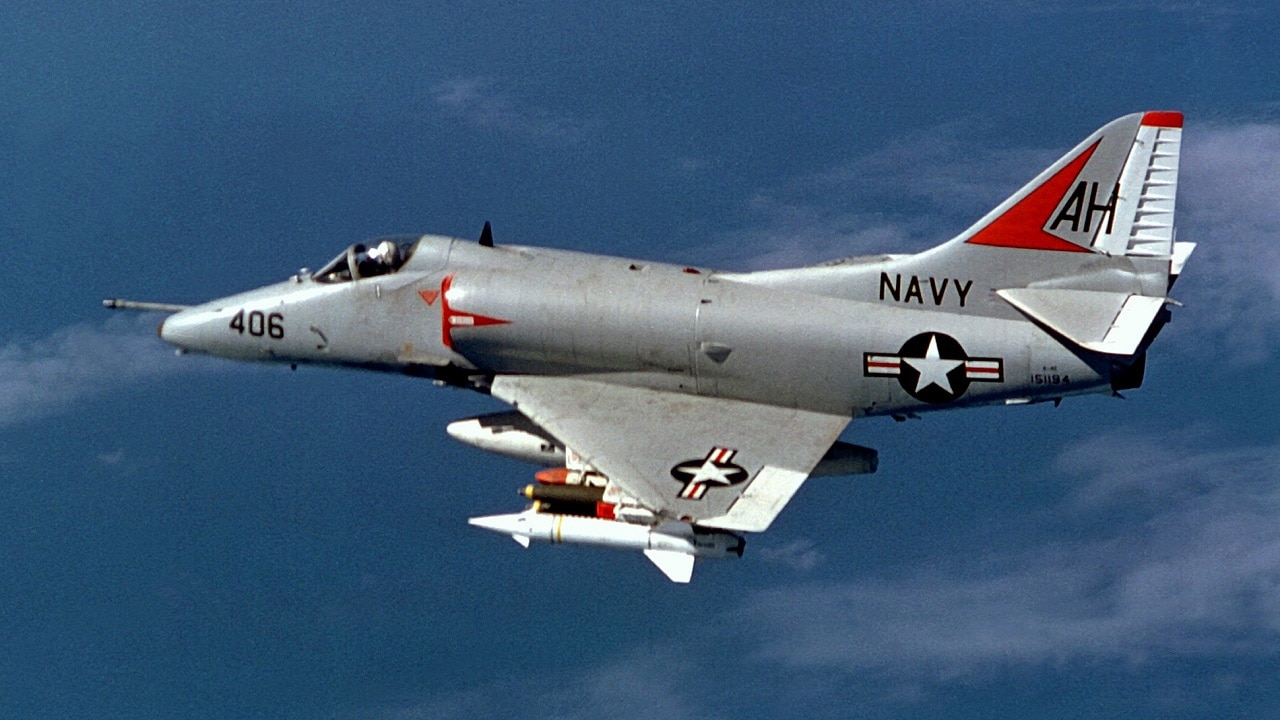
The A-4 Skyhawk Flew From Vietnam to the Falklands and Desert Storm – Douglas built 2,960 A-4 Skyhawks during one of the longest production runs in American combat-aircraft history. The prototype first flew on June 22, 1954. The final aircraft left the line in February 1979, while the U.S. Navy kept the type in service until 2003.
The Skyhawk survived because it rejected the move toward larger, heavier, and more expensive jets. Its compact delta wing fits aboard a carrier without folding. Later models carried up to 8,200 pounds of weapons across five external stations, plus two internal 20 mm cannons.

A-4. Image Credit. Creative Commons.
The aircraft became a central Navy and Marine Corps strike platform in Vietnam, then fought for Israel, Argentina, and Kuwait. It attacked heavily defended targets in North Vietnam, supported Israeli ground forces, struck British ships in the Falklands, and returned to combat during Operation Desert Storm.
That record came at a price. The National Naval Aviation Museum counts 195 carrier-based Skyhawks lost to enemy fire in Vietnam. Surface-to-air missiles, antiaircraft guns, and enemy fighters repeatedly tested an aircraft built around simplicity rather than heavy protection.
Ed Heinemann Designed Against Weight and Cost Growth
Douglas engineer Ed Heinemann began the project during the Korean War, when new jets were becoming larger and more expensive. His first proposal was a lightweight fighter. The Navy already had other fighter programs, but it needed a jet-powered light attack aircraft. Heinemann revised the concept in about two weeks.
The design removed weight wherever engineers found it. Its small wing eliminated the need for a folding mechanism. The landing gear could fall into position under gravity if hydraulic power failed. A wind-driven generator replaced a heavy battery. The aircraft earned the nicknames “Heinemann’s Hot Rod,” “Scooter,” and “Tinker Toy,” and then set a 500-kilometer speed record of 695.163 mph in 1955.
The Skyhawk Carried More Than Its Size Suggested
A typical later Skyhawk measured about 40 feet long with a wingspan of 27 feet 6 inches. Maximum takeoff weight reached roughly 24,500 pounds. Pratt & Whitney J52-powered versions approached 670 mph while retaining the low-speed handling needed for carrier operations.
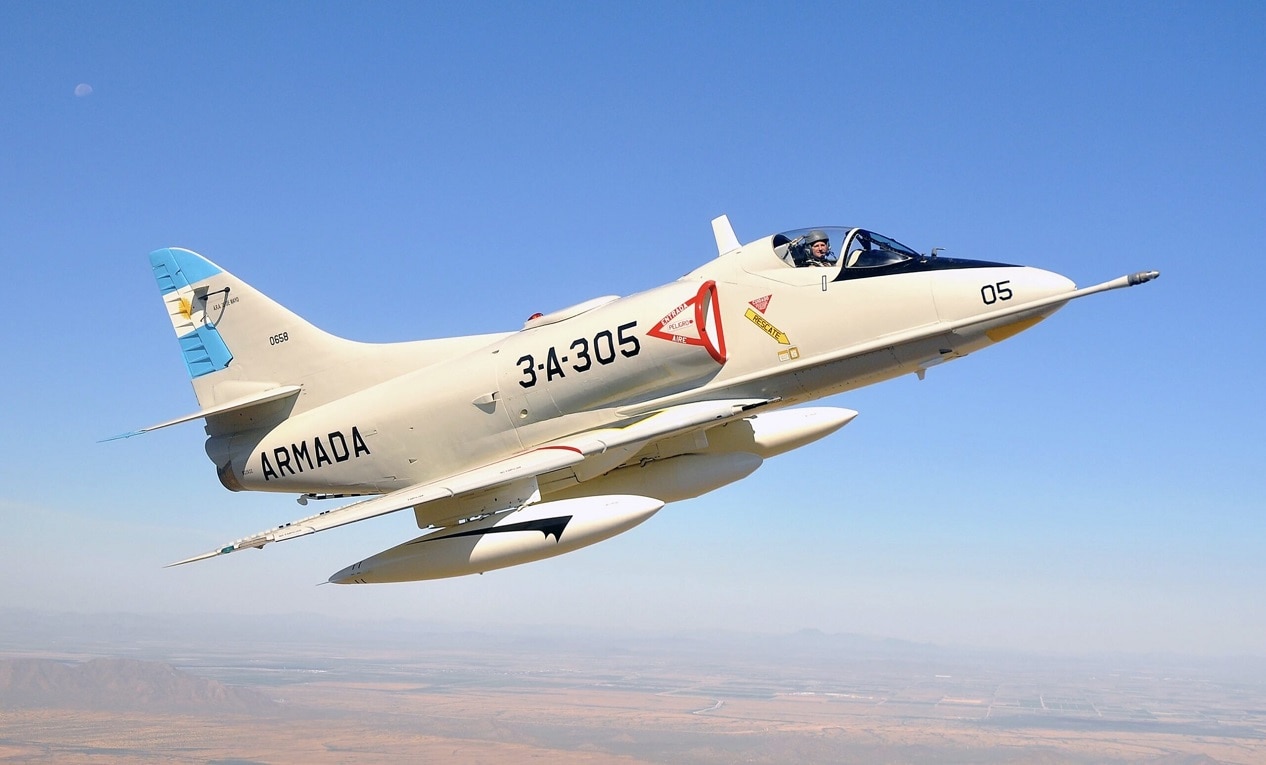
A-4 Skyhawk. Creative Commons Image.
The five hardpoints accepted bombs, Zuni rockets, Bullpup air-to-ground missiles, Shrike anti-radiation missiles, Sidewinders, and external fuel tanks. A buddy-refueling store allowed one A-4 to transfer fuel to another. The A-4E added the J52 engine and two weapons stations, while the Marine Corps A-4M emphasized close air support. Two-seat TA-4s trained thousands of aviators.
Vietnam Made the A-4 a Naval Aviation Workhorse
Skyhawks joined the first U.S. strikes against North Vietnam after the Gulf of Tonkin incidents in August 1964. They attacked bridges, power plants, roads, storage sites, and surface-to-air missile positions. Marine A-4s delivered close air support in South Vietnam. The museum says the Skyhawk flew more combat missions in the war than any other naval aircraft.
The aircraft also scored an improbable air-to-air victory. On May 1, 1967, Lt. Cmdr. Theodore Swartz of VA-76 downed a North Vietnamese MiG-17 using cannon fire and Zuni rockets. Lt. Cmdr. Michael Estocin received the Medal of Honor posthumously for attacks on missile sites near Haiphong. James Stockdale, John McCain, and Everett Alvarez were among the A-4 pilots captured during the war.
The small footprint allowed older Essex-class carriers and larger attack carriers to embark substantial strike forces, a practical advantage evident in the Skyhawk’s long Navy service. Its pilots still had to fly directly into some of the world’s densest missile and anti-aircraft defenses.
Israel Turned the Skyhawk Into the Ayit
Israel began receiving A-4s in 1967 and called the aircraft Ayit, or Eagle. The A-4H carried two 30 mm cannons and up to 3,720 kilograms of weapons. It gave Israel an economical platform for close support and interdiction.
Israeli Skyhawks fought in the War of Attrition, the 1973 Yom Kippur War, and in Lebanon. The 1973 conflict exposed them to dense Egyptian and Syrian missile coverage. Additional A-4s arrived from the United States during the war as Israel replaced losses. Newer fighters later took over combat duties, but Israel retained the compact “Tinker Toy” for training until December 2015.
Argentine Skyhawks Hit the Royal Navy at Wave-Top Height
Argentina took the A-4 into a different war in 1982. Air Force A-4Bs and A-4Cs, plus naval A-4Qs, flew long missions over the South Atlantic with limited fuel. Pilots approached British ships only a few meters above the sea to remain below radar and missile coverage.
On May 25, A-4Bs attacked HMS Coventry after the destroyer’s Sea Dart system and HMS Broadsword’s Sea Wolf system failed to stop the low-level strike. Three bombs hit Coventry. Nineteen sailors died, and the destroyer sank within 30 minutes.
On June 8, Argentine Skyhawks bombed RFA Sir Galahad and RFA Sir Tristram. Three bombs struck Sir Galahad, starting fires that killed 48 men aboard. Other A-4 attacks damaged HMS Glasgow and additional vessels, though several bombs failed to explode after release at extremely low altitude.
The campaign showed both sides of the Navy’s “mini bomber”. A non-stealth aircraft could penetrate modern ship defenses through low flying, surprise, and determined crews. Argentine Skyhawks also suffered heavy losses to Sea Harriers, missiles, and anti-aircraft fire.
Kuwait Returned the Skyhawk to Combat in 1991
Kuwaiti A-4KUs attacked Iraqi forces during the August 1990 invasion, then escaped to Saudi Arabia. Operating as part of the Free Kuwaiti Air Force, the Skyhawks flew 1,361 sorties during Desert Storm and lost one aircraft.
Kuwait replaced them with F/A-18 Hornets after the war. Brazil acquired surviving A-4KUs and TA-4KUs, giving the same airframes a second career as AF-1 naval fighters. Argentina followed a separate path in 1997 with the A-4AR Fightinghawk, which combined rebuilt A-4M airframes with updated avionics and weapons systems.
U.S. Retirement Came in Stages
The A-7 Corsair II and later the F/A-18 Hornet replaced the Skyhawk in frontline Navy attack squadrons. Marine units retained specialized variants longer, while trainers and adversary aircraft continued after combat units moved on. The Blue Angels used the A-4F from 1974 through 1986, and TOPGUN valued its agility as a threat surrogate.
The Navy retired its last Skyhawk in 2003. Private contractors later used upgraded aircraft for adversary training, while Argentina retained the A-4AR. The aircraft’s long afterlife supports the broader history of an attack jet that remained useful across several generations.
In June 2025, Brazil’s Navy was still flying the AF-1 for practice bombing, 20mm gunfire, low-level navigation, maritime surveillance, and simulated attacks.
About the Author: Harry J. Kazianis
Harry J. Kazianis (@Grecianformula) was the former Senior Director of National Security Affairs at the Center for the National Interest (CFTNI), a foreign policy think tank founded by Richard Nixon based in Washington, DC. Harry has over a decade of experience in think tanks and national security publishing. His ideas have been published in the NY Times, The Washington Post, The Wall Street Journal, CNN, and many other outlets worldwide. He has held positions at CSIS, the Heritage Foundation, the University of Nottingham, and several other institutions related to national security research and studies. He is the former Executive Editor of the National Interest and the Diplomat. He holds a Master’s degree focusing on international affairs from Harvard University.