
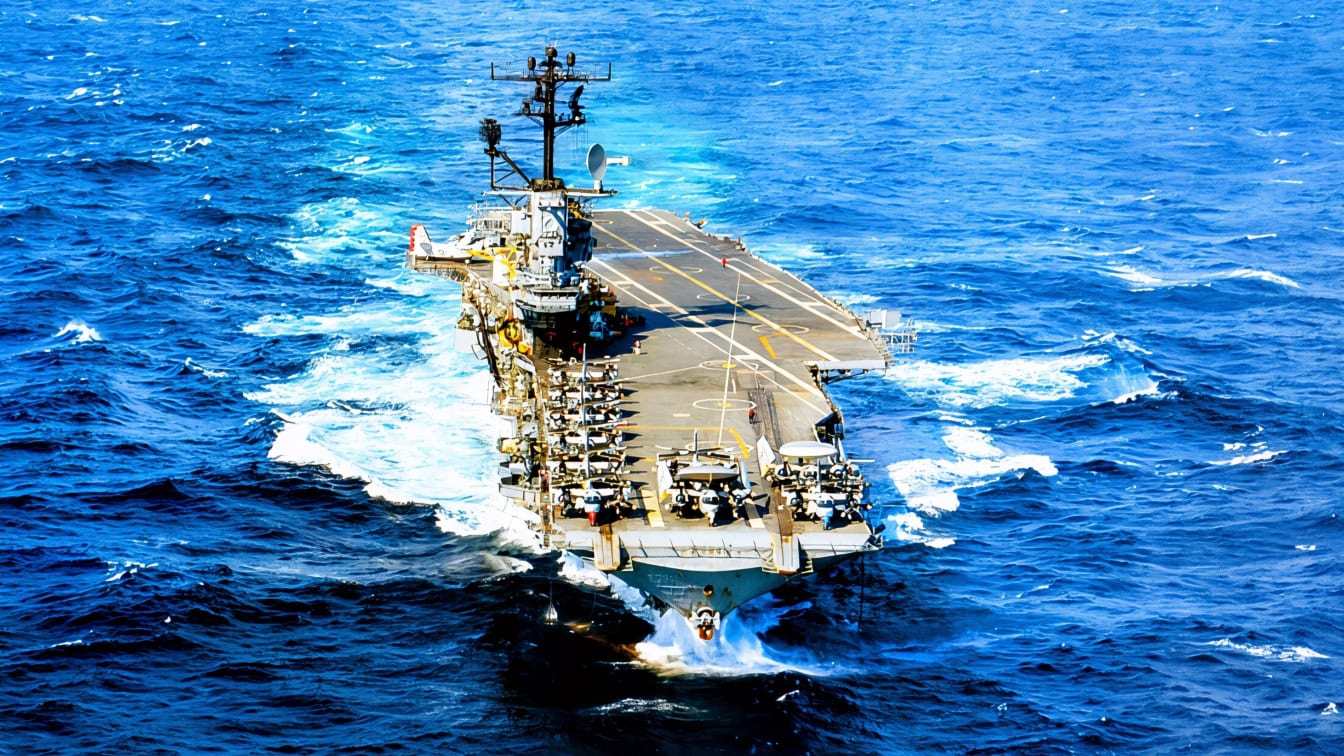
USS Wasp Leads the 5 Worst U.S. Navy Aircraft Carriers Ever Built – USS Wasp entered service in 1940 with almost no torpedo protection. The U.S. Navy had used most of its carrier allowance under the Washington Naval Treaty, leaving 14,700 tons for one more ship. Wasp fit the number, but the weight savings came out of armor, machinery, and underwater defenses, according to the U.S. Naval Institute’s history of the ship.
On September 15, 1942, Japanese submarine I-19 fired six torpedoes at Wasp’s task force. Two struck the carrier, followed by a major internal blast. Aviation gasoline fed uncontrollable fires, and damage to power and fire mains crippled the response. Wasp was abandoned and scuttled. The loss killed 193 men and wounded 366.
Combat loss alone does not make an aircraft carrier bad. USS Lexington, USS Yorktown, and USS Hornet were all sunk in 1942 after delivering major combat results. The standard here is the gap between what a carrier cost or promised and the useful air power, survivability, and fleet service it delivered.
Below are what I would consider the five worst US Navy aircraft carriers ever. The ranking judges ships and programs, not their crews. Sailors extracted real value from several flawed designs below. One entry never entered service. Another succeeded as an experiment but failed to meet the standards of a fleet combat carrier.
#5: USS Langley Was a Laboratory, Not a Combat Carrier
USS Langley began life as the collier USS Jupiter. The Navy converted the ship after World War I and commissioned it as CV-1 on March 20, 1922, creating the first American aircraft carrier.
Langley’s contribution to naval aviation was immense. Pilots and deck crews used it to develop arresting systems, landing signals, launch procedures, and aircraft-handling routines. The ship helped prove the carrier was more than an auxiliary attached to a battleship fleet.

USS Langley (CV-1) underway in June 1927
As a combat carrier, Langley was badly limited. Its top speed was about 15 knots, far below the speed needed to maneuver with modern capital ships or generate wind over the flight deck in marginal conditions. It normally carried about 34 to 36 aircraft, according to the Naval History and Heritage Command.
The Navy removed Langley from the carrier force and converted it into a seaplane tender in 1937. On February 27, 1942, Japanese bombers fatally damaged the ship while it was carrying 32 P-40 fighters toward Java. American destroyers later scuttled it.
Langley ranks fifth because it succeeded as a laboratory. Its experiments helped write the procedures used aboard later carriers, but its speed, protection, and aviation capacity left little combat value once purpose-built carriers arrived.
#4: USS Liscome Bay Sank 23 Minutes After One Torpedo Hit
USS Liscome Bay was a Casablanca-class escort carrier, one of the small, mass-produced ships built to provide air support where a fleet carrier was unavailable. It displaced about 10,400 tons at full load, measured 512 feet, made roughly 19 knots, and operated about 28 aircraft.
The carrier was commissioned on August 7, 1943. Its first combat assignment came during the invasion of Makin in the Gilbert Islands. Before dawn on November 24, Japanese submarine I-175 penetrated the screen and fired at the American formation.
One torpedo struck Liscome Bay near the aircraft-bomb magazine. The detonation tore apart the stern, destroyed steam and fire-main pressure, and threw burning debris across nearby ships. The carrier sank 23 minutes after the hit, according to the official Navy account.
The loss killed 644 men. Only 272 survived. Liscome Bay’s fate does not make the entire Casablanca class a failure. Fifty were built, and the class performed escort, anti-submarine, amphibious-support and transport missions on a scale no other navy matched. The torpedo also struck the worst possible location.
The individual ship still belongs here. Its commissioned career lasted 109 days, and its first combat operation exposed how little margin an escort carrier possessed once fire reached bombs, aviation fuel and machinery spaces. The Navy’s war-damage report recorded a ship destroyed by one hit and more than 70 percent of the people aboard lost.
#3: USS Ranger Proved a Small Fleet Carrier Had Too Little Margin
USS Ranger was the first American carrier designed and built as a carrier from the keel up. Commissioned in 1934, it displaced about 14,500 tons, measured 769 feet, and reached approximately 29 knots.
Those figures reflected an effort to build more flight decks within treaty limits. The Navy obtained useful aircraft capacity from a small hull but accepted weak underwater protection, limited armor, poor heavy-weather behavior, and less speed than later fleet carriers. A U.S. Naval Institute assessment described Ranger as burdened by too many compromises.
Ranger was not useless. During Operation Torch in November 1942, its aircraft flew 496 combat sorties in three days against Vichy French forces in North Africa. In October 1943, it launched attacks on German shipping along the Norwegian coast as part of Operation Leader, as recorded in the official Navy history.
The Navy did not send Rangers into the central Pacific carrier battles, where speed, sea-keeping, and resistance to bomb and torpedo damage mattered most. A major modernization was considered and postponed. The ship spent much of the later war transporting aircraft and training aircrews.
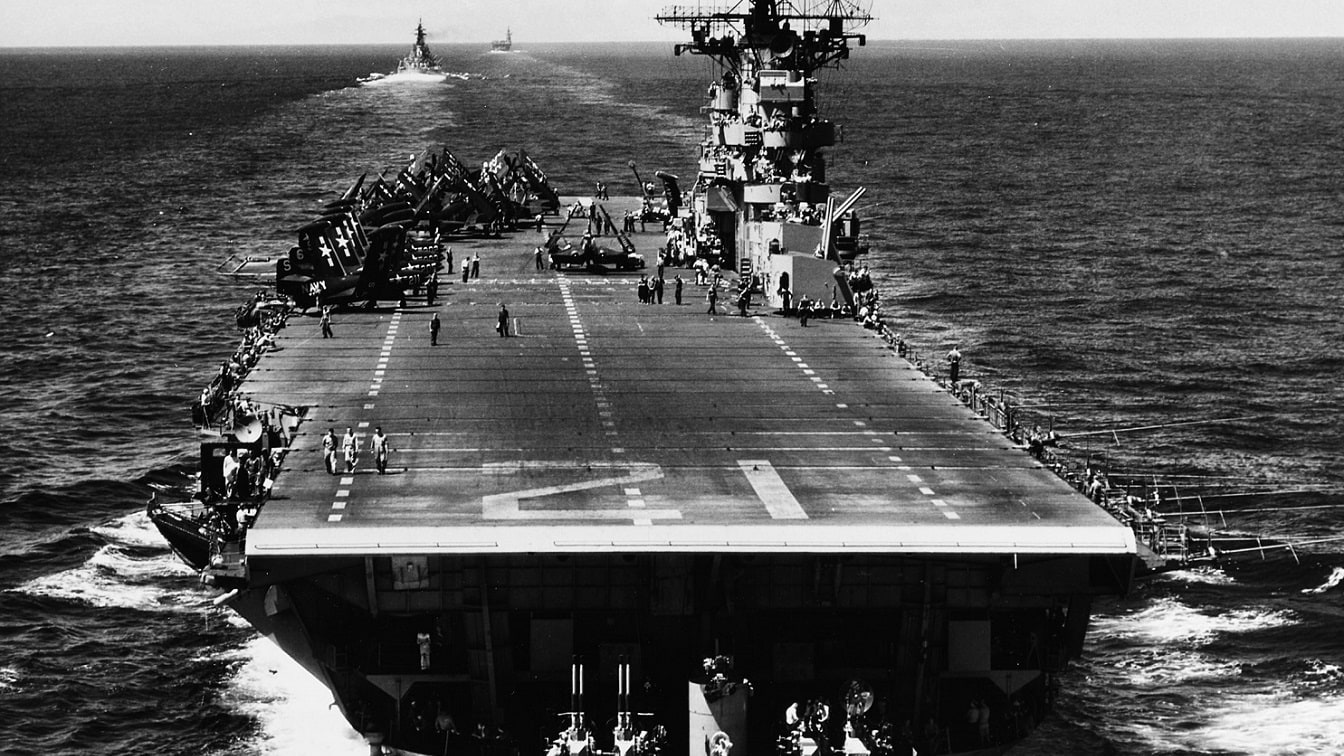
Essex-class. Image Credit: US Navy Archives.
Ranger’s crews produced two successful combat operations. The design still showed why a fleet carrier needed more hull, power and protection. Yorktown and Enterprise corrected many of their shortcomings, while the later 24-ship Essex class delivered the size and survivability required for sustained Pacific war.
#2: USS United States Was Canceled Five Days After Its Keel Was Laid=
The USS United States was supposed to provide the Navy with a sea-based nuclear strike force. The design grew toward roughly 60,000 tons at standard displacement and more than 80,000 tons under heavier trial conditions. Its flush flight deck was intended to launch extremely large bombers carrying early atomic weapons.
Newport News Shipbuilding received a $189 million contract for the carrier. That was the contract value, not the amount spent. The keel was laid on April 18, 1949. Defense Secretary Louis Johnson canceled the project on April 23, five days later, according to the U.S. Naval Institute’s shipbuilding history.
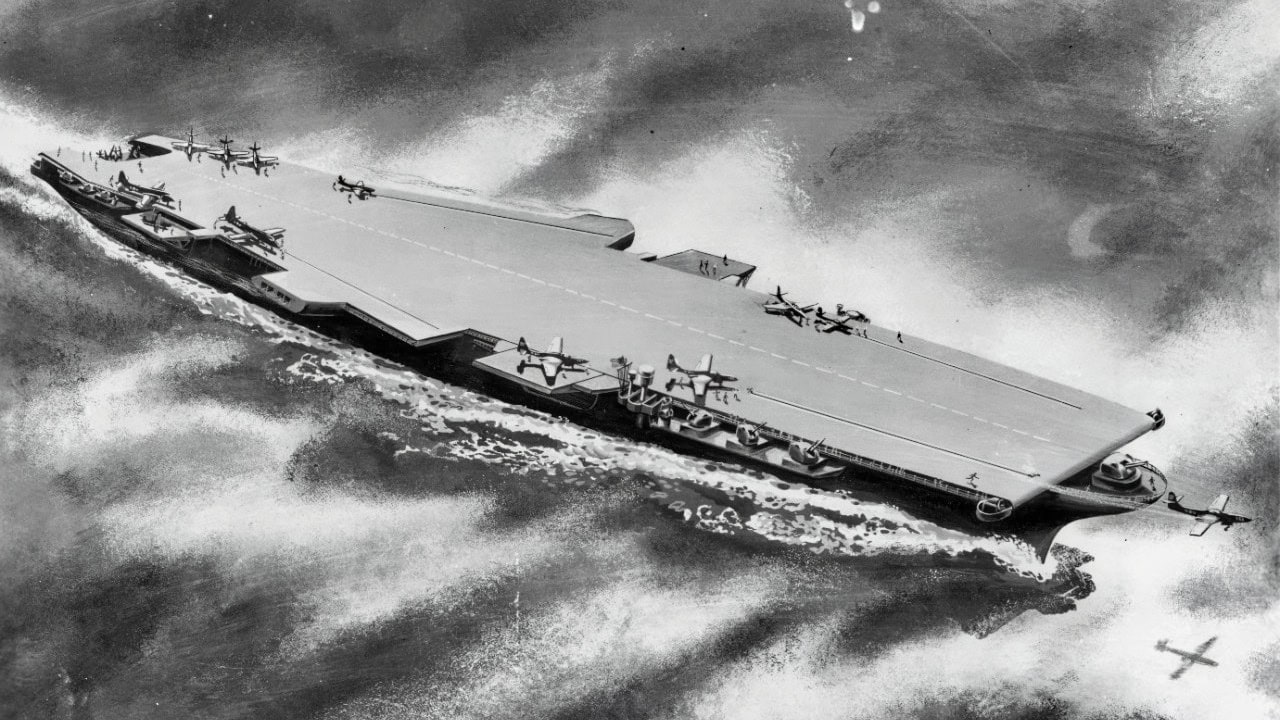
USS United States Aircraft Carrier.
Navy Secretary John Sullivan resigned after not having been consulted. The decision helped trigger the Revolt of the Admirals, a public fight over whether Air Force bombers or naval aviation should carry the strategic nuclear mission.
The carrier concept had serious weaknesses. Its bombers would have been extremely heavy, difficult to recover on a straight deck, and limited in number. The flush-deck arrangement removed a conventional island, complicating command, exhaust handling, and flight operations. Some concepts depended on other carriers for fighter protection.
The Navy soon proved smaller carrier aircraft could deliver nuclear weapons, while angled decks, steam catapults, and improved landing systems reshaped naval aviation. Cancellation prevented a larger expense, but the program still consumed years of design work and produced no ships, sorties, or trained crews. The 82,000-ton USS United States became one of the Navy’s clearest carrier dead ends.
#1: USS Wasp Carried Treaty Compromises Into Combat
USS Wasp was not an experimental conversion or a cheap escort carrier. It was built as a fleet carrier and sent into a war where its missing protection mattered.
After Lexington, Saratoga, Ranger, Yorktown, and Enterprise, the Navy had 14,700 treaty tons left. Wasp was designed to fit the remainder. It came in about 5,100 tons lighter than a Yorktown-class carrier, measured 741 feet, and reached 29.5 knots.
The weight reduction produced another flight deck at a severe price. Wasp had little armor and almost no torpedo-defense system. Its compact machinery arrangement, aviation-grade gasoline systems, and vulnerable fire mains left it with limited ability to absorb underwater damage.
The carrier still performed important missions. It supported Atlantic neutrality patrols, ferried British Spitfires toward Malta twice in 1942, and then transferred to the Pacific. Wasp covered the movement of aircraft and reinforcements into Guadalcanal when every American carrier mattered.
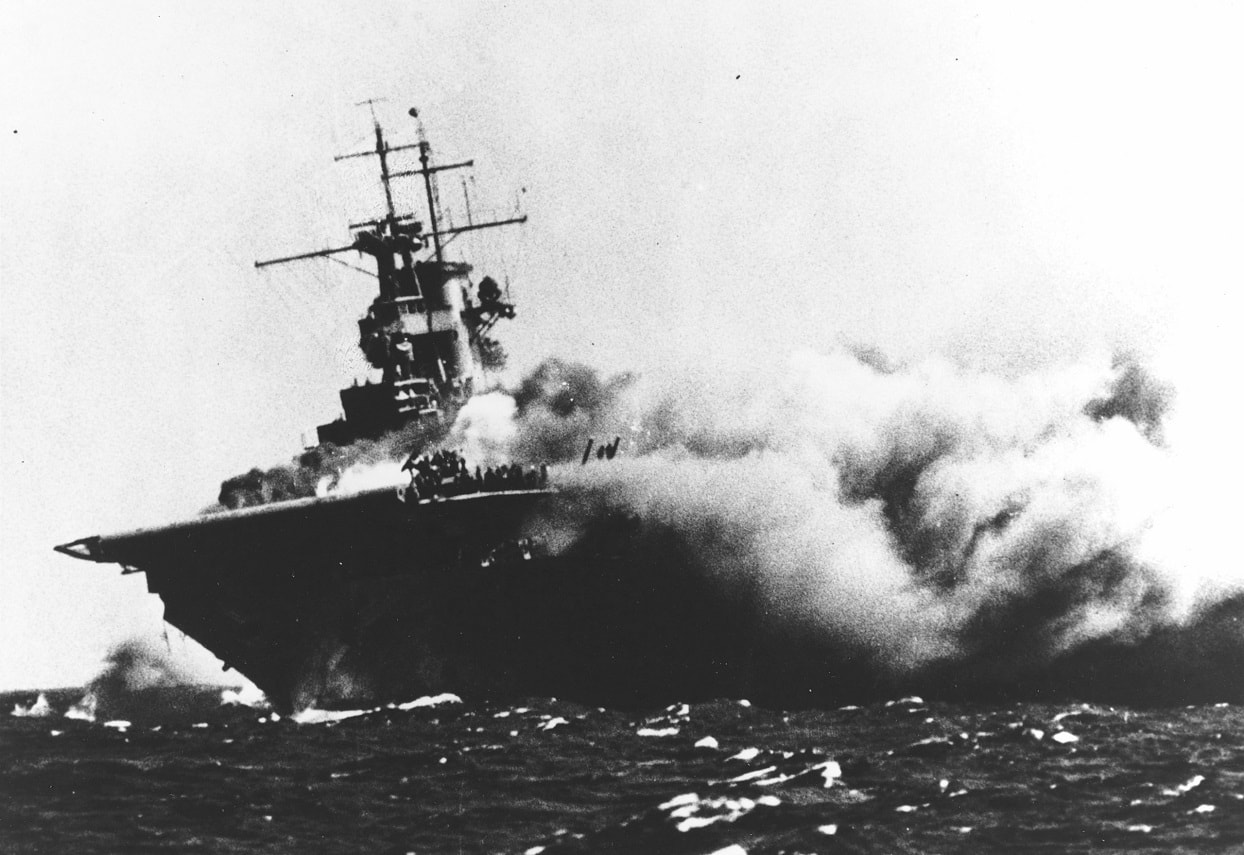
The U.S. Navy aircraft carrier USS Wasp (CV-7) burning and listing after she was torpedoed by the Japanese submarine I-19, on 15 September 1942, while operating in the Southwestern Pacific in support of forces on Guadalcanal. Note that the wartime censor has removed the CXAM-1 radar antenna, only its lower frame is still visible.
On September 15, I-19 found Wasp maneuvering with Task Force 18 and launched six torpedoes. Two struck the starboard side, and investigators later concluded a third violent blast came from inside the ship. Other torpedoes from the same spread struck the battleship USS North Carolina and the destroyer USS O’Brien.
The hits opened fuel tanks and started fires near gasoline and ammunition spaces. Electrical power failed in damaged areas, fire-main pressure disappeared, and flames moved through the hangar deck. Captain Forrest Sherman ordered the ship abandoned after the crew lost the means to contain the fire. The Naval History and Heritage Command’s account records 193 dead and 366 wounded.
Destroyer USS Lansdowne removed survivors and later fired torpedoes into the burning carrier. Wasp sank that night, less than two and a half years after entering service.
Wasp did more useful work than USS United States and had greater combat value than Langley. It ranks first because the fatal weakness was known when the design left the drawing board. The Navy accepted inadequate underwater protection to obtain another fleet carrier, then sent it into waters patrolled by Japanese submarines. The carrier’s 1942 loss became the wartime bill for those treaty-era compromises.
On January 14, 2019, the research vessel Petrel found USS Wasp upright on the floor of the Coral Sea, nearly 14,000 feet below the surface.
About the Author: Harry J. Kazianis
Harry J. Kazianis (@Grecianformula) was the former Senior Director of National Security Affairs at the Center for the National Interest (CFTNI), a foreign policy think tank founded by Richard Nixon based in Washington, DC. Harry has over a decade of experience in think tanks and national security publishing. His ideas have been published in the NY Times, The Washington Post, The Wall Street Journal, CNN, and many other outlets worldwide. He has held positions at CSIS, the Heritage Foundation, the University of Nottingham, and several other institutions related to national security research and studies. He is the former Executive Editor of the National Interest and the Diplomat. He holds a Master’s degree focusing on international affairs from Harvard University.

