
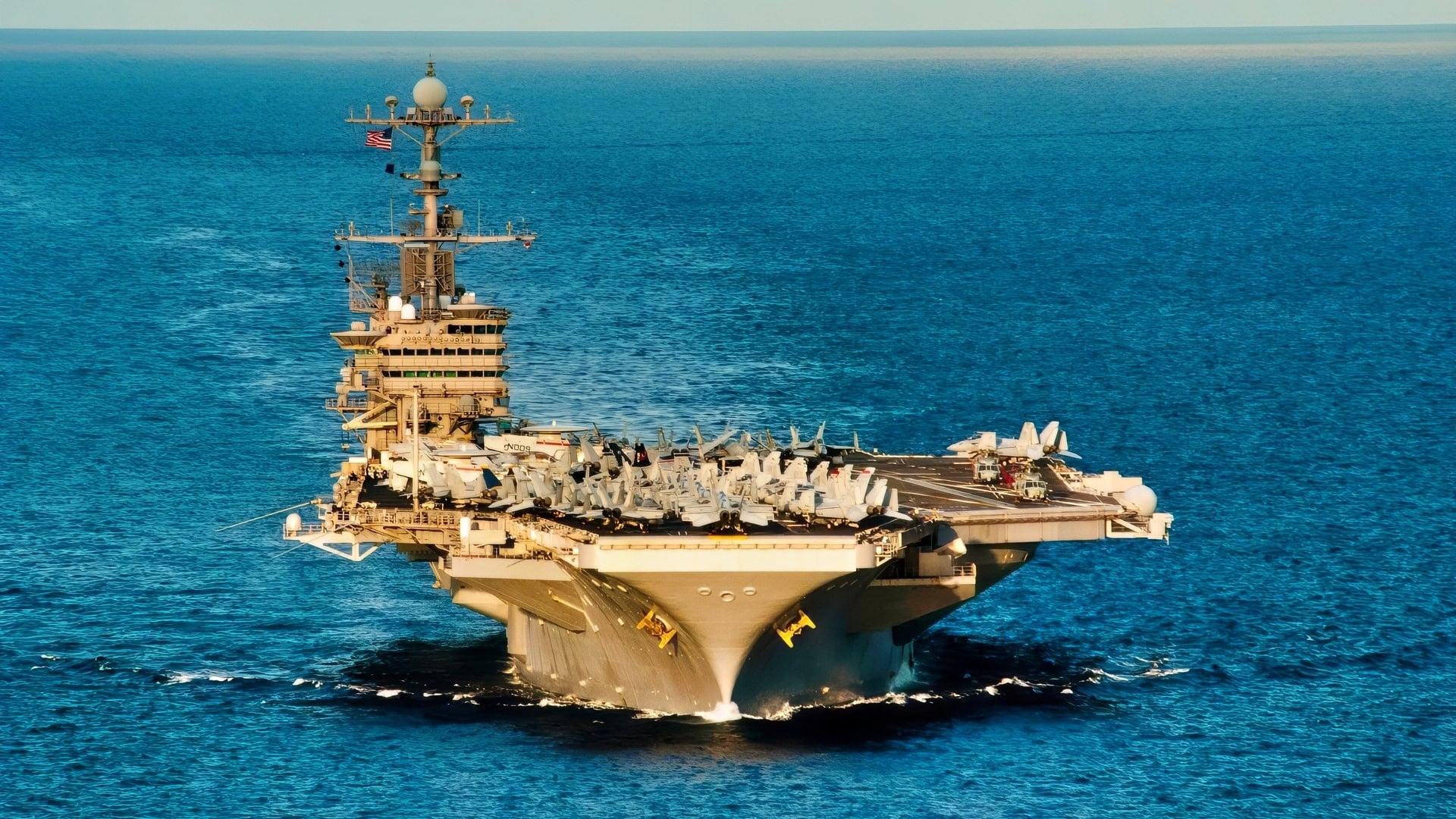
China has a credible route to sink a U.S. Navy aircraft carrier in a war. In fact, it was this very topic that led me to change careers back in 2011, as I was fascinated by the subject and went back to finish my formal education and head to graduate school to learn as much as I could about China’s armed forces. But know this much after years of research: It does not have a guaranteed way to sink a supercarrier. The Pentagon’s 2025 report on Chinese military power lists anti-ship roles for the DF-21 family at 1,500 to 2,000 kilometers, the DF-26 at 3,000 to 4,000 kilometers, and the DF-27 at 5,000 to 8,000 kilometers. Those ranges cover huge areas of the Pacific. Range alone does not produce a firing solution.
China’s Missiles vs. US Navy Aircraft Carriers: What That Looks Like In Reality
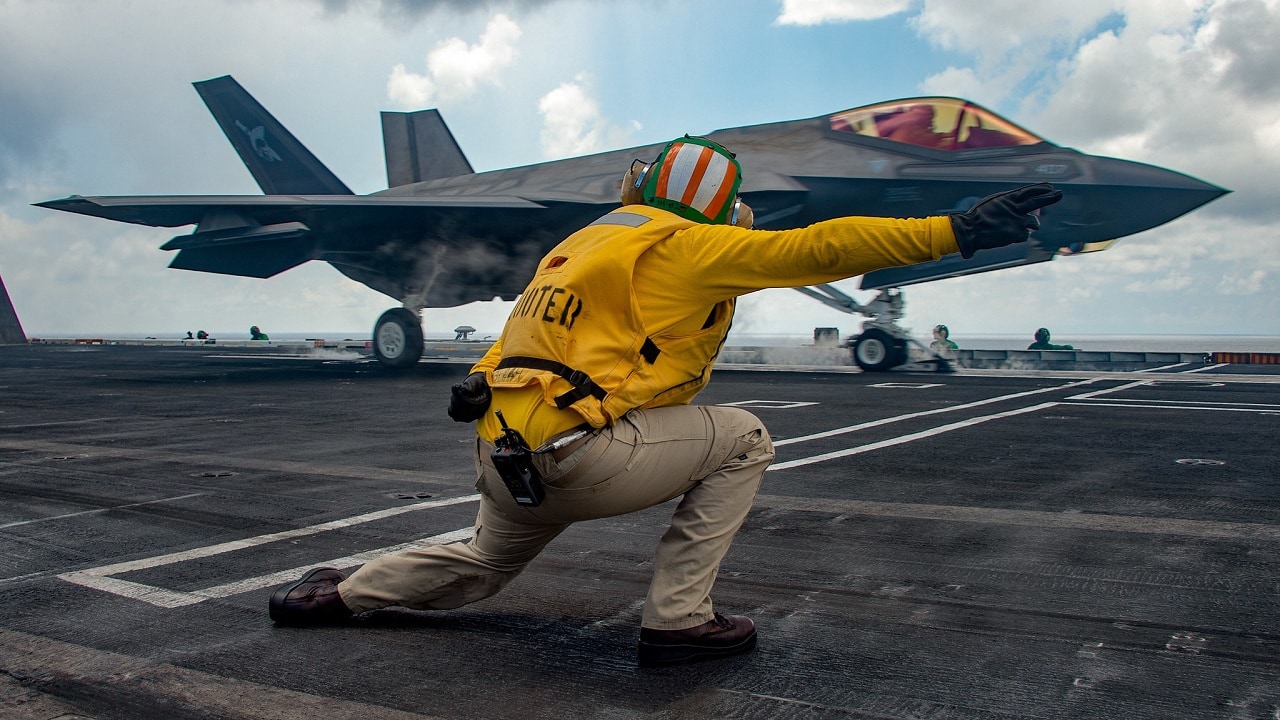
SOUTH CHINA SEA (Oct. 25, 2021) Lt. Nicholas Eppler, from Exeter, Calif., directs flight operations as an F-35C Lightning II assigned to the “Argonauts” of Strike Fighter Squadron (VFA) 147 launches from the Nimitz-class aircraft carrier USS Carl Vinson (CVN 70), Oct. 25, 2021. The Carl Vinson Carrier Strike Group is on a scheduled deployment in the U.S. 7th Fleet area of operations to enhance interoperability through alliances and partnerships while serving as a ready-response force in support of a free and open Indo-Pacific region. (U.S. Navy photo by Mass Communication Specialist Seaman Emily Claire Bennett) 211025-N-TY704-1241
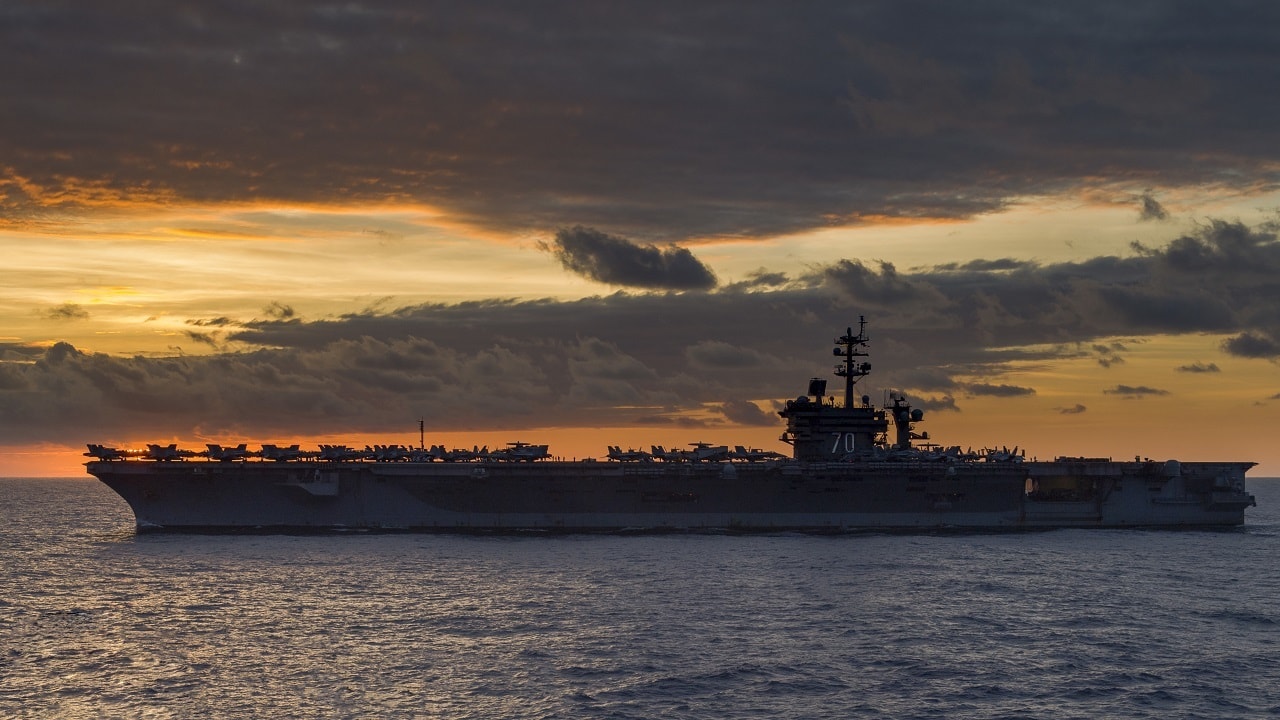
(Feb. 10, 2018) The Nimitz-class aircraft carrier USS Carl Vinson (CVN 70) transits the South Chna Sea. The Carl Vinson Strike Group is currently operating in the Western Pacific as part of a regularly schedule deployment. (U.S. Navy photo by Mass Communication Specialist Third Class Jasen Morenogarcia/Released)
To sink a nuclear aircraft carrier, the People’s Liberation Army must detect the strike group, identify the carrier among escorts and commercial traffic, maintain a precise track, pass coordinates to a launcher, calculate the shot, update the weapon during flight, defeat layered defenses, hit the correct ship, and inflict enough damage to send a roughly 100,000-ton hull beneath the sea.
A break anywhere in the sequence defeats the attack.
Movement complicates every step. Over any 20-minute gap between the last reliable position fix and terminal acquisition, a carrier steaming at 25 to 30 knots moves 8.3 to 10 nautical miles, or roughly 15 to 18.5 kilometers.
A turn expands the uncertainty.
A terminal seeker offers a chance to correct stale coordinates, but the carrier must remain within its search area, and the seeker must distinguish the correct target from sea clutter, electronic warfare, and decoys.
The DF-21D is China’s original “carrier killer,” fitted with a maneuverable reentry vehicle and a range exceeding 1,500 kilometers. The anti-ship DF-26 variant, often referred to as DF-26B in open reporting, extends the threat range to roughly 4,000 kilometers.
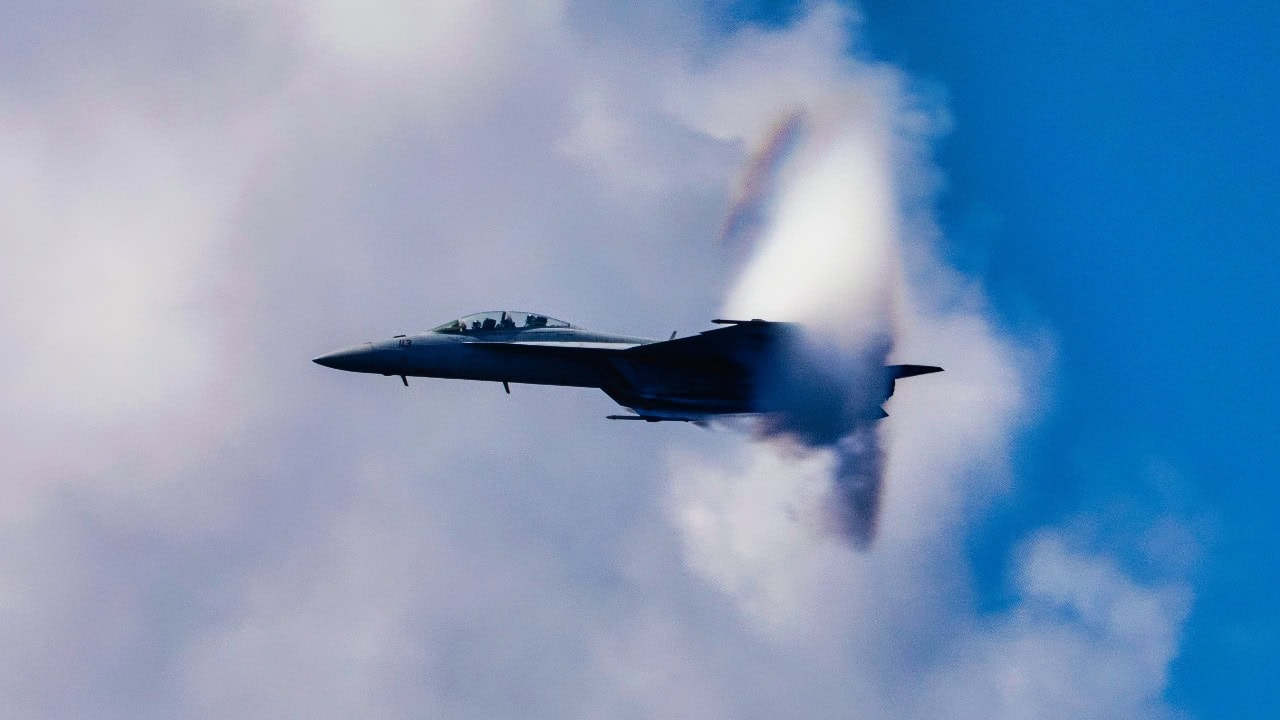
(June 18, 2023) An F/A-18F Super Hornet from the “Fighting Redcocks” of Strike Fighter Squadron (VFA) 22 breaks the sound barrier during flight operations near the aircraft carrier USS Nimitz (CVN 68). Nimitz is underway conducting routine operations. (U.S. Navy photo by Mass Communication Specialist 3rd Class Kevin Tang)

Nimitz-class aircraft carrier USS Carl Vinson (CVN 70) transits the Bay of Bengal as part of Maritime Partnership Exercise (MPX), Oct. 16, 2021. MPX 2021 is a multilateral maritime exercise between the Royal Australian Navy, Japan Maritime Self-Defense Force, U.K. Royal Navy, and U.S. maritime forces, focused on naval cooperation, interoperability and regional security and stability in the Indo-Pacific and is an example of the enduring partnership between Australian, Japanese, U.K. and U.S. maritime forces, who routinely operate together in the Indo-Pacific, fostering a cooperative approach toward regional security and stability. (U.S. Navy photo by Mass Communication Specialist 2nd Class Russell Lindsey)
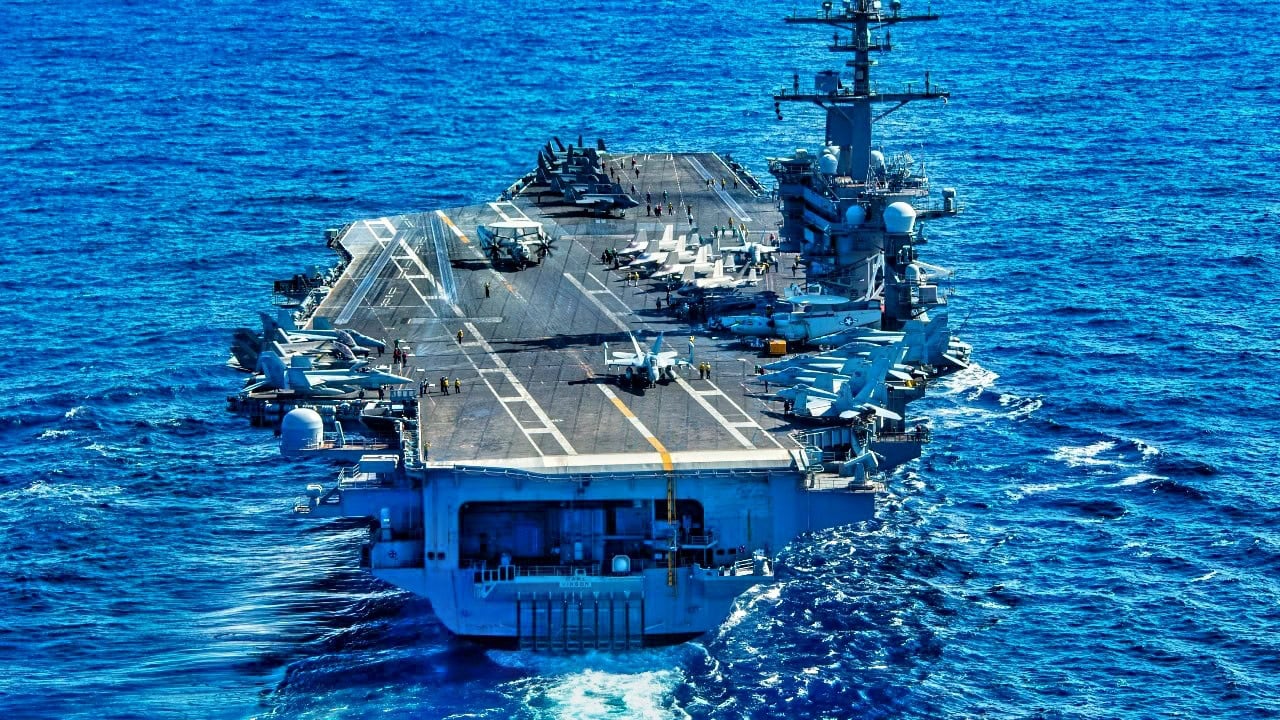
The Nimitz-class aircraft carrier USS Carl Vinson (CVN 70) transits the Philippine Sea with six additional F-35C Lightning II aircraft assigned to the “Argonauts” of Strike Fighter Squadron (VFA) 147, part of Carrier Air Wing FIVE, Dec. 13, 2024. VFA-147 operates from Marine Corps Air Station Iwakuni, Japan. U.S. Indo-Pacific Command forces perform operations in and around critical sea passages and trade thoroughfares to deter threats that create regional instability and impinge on the free flow of goods, people, and ideas. (U.S. Navy photo by Mass Communication Specialist Seaman Apprentice Pablo Chavez)
Far less is public about the DF-27. The Pentagon assesses a 5,000-to-8,000-kilometer range, an anti-ship mission, and a hypersonic glide-vehicle option. Greater reach also creates a harder surveillance, communications, and terminal-guidance problem.
China Must Find the Carrier Before It Launches
Beijing has built a formidable ocean-surveillance network. The Pentagon counted more than 500 Chinese intelligence, surveillance, and reconnaissance-capable satellites by the end of 2024. China also operates over-the-horizon radars, airborne early-warning aircraft, electronic-intelligence systems, unmanned aircraft, surface ships, and submarines.
Those sensors do not produce one continuous picture. Visible-light satellites struggle under cloud cover and rely on adequate illumination. Radar satellites offer different coverage and revisit times. Electronic-intelligence satellites need useful emissions. Over-the-horizon radar supplies broad warning over immense distances, but detection is not the same as a weapons-quality track. Aircraft and drones were sent closer to face carrier fighters and shipboard missiles.
Finding the carrier once is insufficient. China needs custody of the target from detection through impact. A U.S. force would try to break the chain through emissions control, course changes, jamming, false targets, attacks on reconnaissance aircraft, and disruption of communications. The launcher might survive on the mainland while the attack fails because a reliable position update never reaches the weapon.
China’s 2020 Missile Test Did Not Reproduce a Carrier Battle
The Pentagon says China fired anti-ship ballistic missiles against a moving target in the South China Sea in 2020. Public reporting provides no full account of the target’s speed, maneuvers, defensive systems, electronic warfare, decoys, or the sensors used to maintain its track. A cooperative range target does not shoot down reconnaissance aircraft, jam data links, or place Aegis destroyers between itself and the launch point.
The test showed that China had integrated sensors, command systems, launchers, and missiles sufficiently to strike a moving vessel under controlled conditions. It did not prove that the same chain would survive combat. A longer DF-27 shot gives the target more time to move and creates more opportunities to interrupt the network. A maneuvering glide vehicle complicates interception, yet it still needs accurate navigation and terminal target acquisition over open water.
U.S. carriers are officially rated at more than 30 knots and routinely alter course and speed during flight operations. The carrier air wing’s range problem forces the Navy to respect China’s missile rings. Near Taiwan, Chinese sensors operate close to home and benefit from denser coverage. Farther into the Pacific, the DF-26 and DF-27 retain the range, but maintaining a precise maritime track grows more difficult.
A Carrier Strike Group Defends Itself in Layers
An aircraft carrier does not fight alone. The E-2D Advanced Hawkeye provides airborne warning and battle management. Fighters intercept reconnaissance aircraft and missile-carrying bombers. EA-18G Growlers attack radars and communications. Aegis-equipped destroyers add sensors, electronic warfare, and interceptor missiles.
No interceptor provides certainty. In March 2023, an Aegis destroyer used two SM-6 Dual II missiles to intercept a medium-range ballistic target in its terminal phase. Other defensive layers include Evolved Sea Sparrow Missiles, Rolling Airframe Missiles, close-in guns, jammers, and decoys. A maneuvering ballistic or hypersonic threat presents a harder engagement than many cruise missiles, but the incoming weapon does not face an undefended flight deck.
China’s strongest option would be a coordinated salvo rather than one celebrated missile. Ballistic weapons, cruise missiles, bombers, submarines, drones, decoys, cyberattacks, and electronic warfare might arrive together. The “bolt from the blue” saturation problem matters because destroyers carry finite vertical-launch magazines and divide them among several missions. Defenders also fire multiple interceptors against the most dangerous tracks.
The survivability case for the modern supercarrier rests on networked sensors, aircraft, electronic warfare, and escort ships rather than armor alone. The opposing case points to the gap between the range of Chinese missiles and that of carrier aircraft. Both conditions shape the same fight.
A Direct Hit Is Not Automatically a Sinking
A direct hit from a maneuvering reentry vehicle would be catastrophic. The impact might tear through the flight deck, ignite aviation fuel or ordnance, damage catapults and elevators, destroy sensors, and kill large numbers of sailors. One strike might halt flight operations and force the carrier out of the war. A mission kill would carry strategic consequences even if the ship remained afloat.
Sinking the carrier poses a greater physical challenge. Nimitz- and Ford-class ships have extensive compartmentation, redundant systems, and large damage-control organizations. A warhead descending onto the upper hull does not create the same flooding mechanism as a heavyweight torpedo exploding beneath the keel. Multiple hits, a strike near the waterline, or a cascading fire reaching fuel and magazines would increase the danger of losing the ship.
As of today, no DF-21D, anti-ship DF-26 variant, or DF-27 has been fired in combat. Let’s hope it never does.
About the Author: Harry J. Kazianis
Harry J. Kazianis (@Grecianformula) was the former Senior Director of National Security Affairs at the Center for the National Interest (CFTNI), a foreign policy think tank founded by Richard Nixon based in Washington, DC. Harry has over a decade of experience in think tanks and national security publishing. His ideas have been published in the NY Times, The Washington Post, The Wall Street Journal, CNN, and many other outlets worldwide. He has held positions at CSIS, the Heritage Foundation, the University of Nottingham, and several other institutions related to national security research and studies. He is the former Executive Editor of the National Interest and the Diplomat. He holds a Master’s degree focusing on international affairs from Harvard University.

