
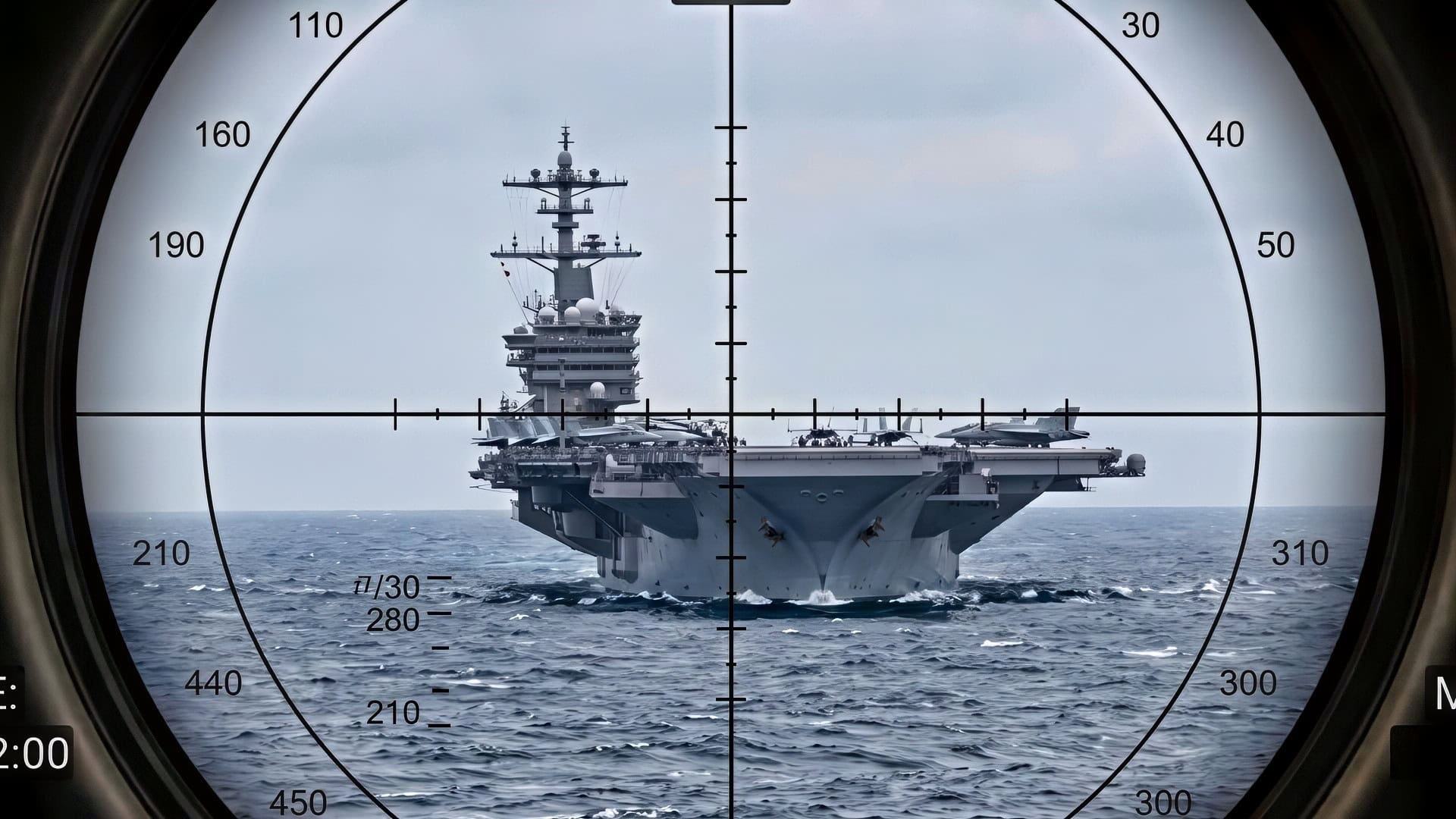
The aircraft carrier exists to project power from a safe distance, and in the Western Pacific, that premise no longer holds. China’s anti-ship missiles now reach farther than the carrier’s aircraft can fly, which means that to get its jets within striking range of a defended target, a carrier has to sail inside the missile envelope first. The ship designed to strike from beyond reach has to enter the danger zone to do its job. That is a geometry problem, not a hardware problem, and it may not be one the U.S. Navy can out-engineer — because extending a missile’s range is faster and cheaper than building a longer-range jet, and China already fields the longest-range layer. The Navy’s answer is the F/A-XX, a sixth-generation fighter designed to push the air wing’s reach beyond the rings. It is running years behind schedule, and the missiles are not waiting.
The Geometry: A Carrier Strikes As Far As Its Aircraft Fly
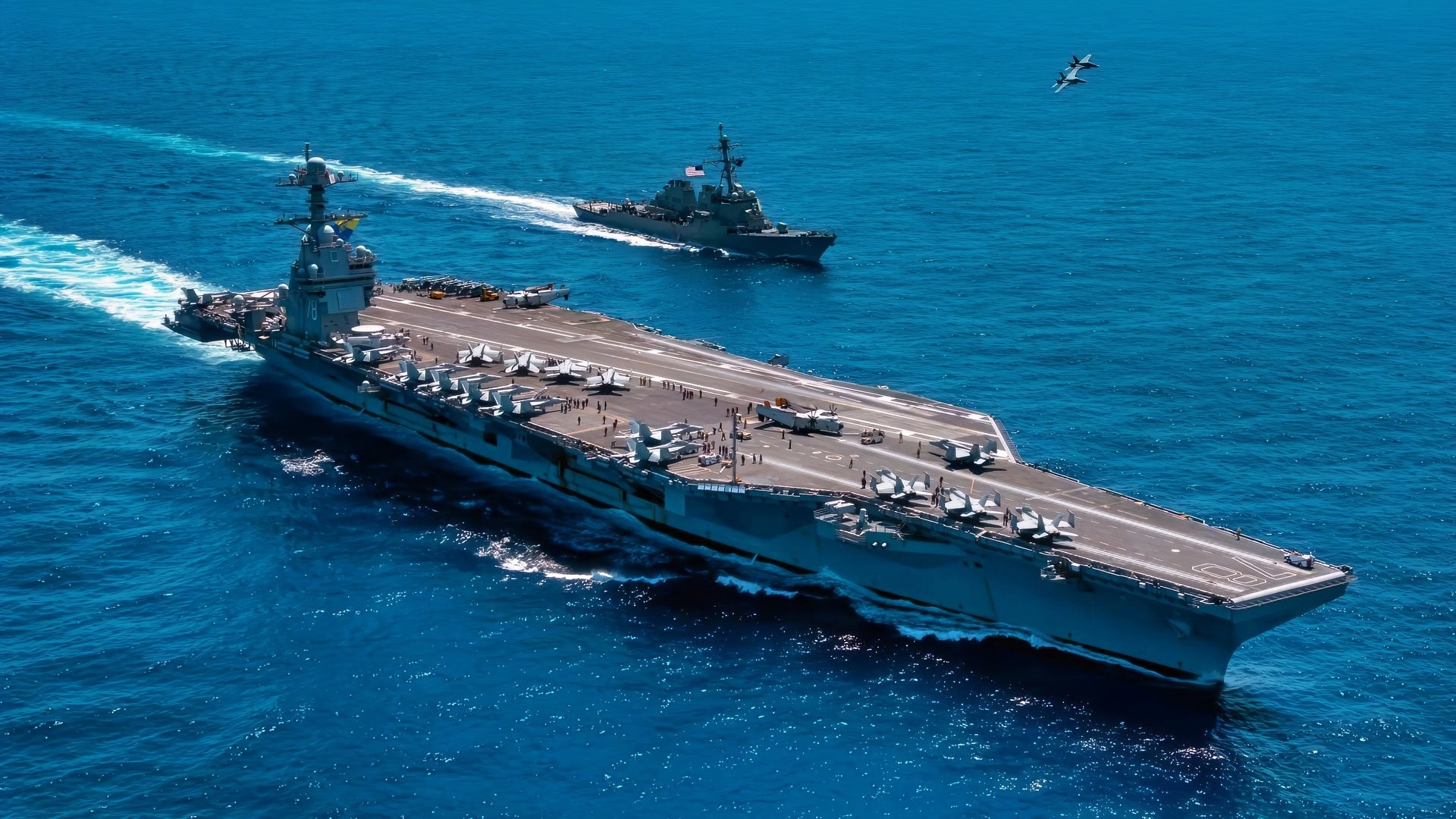
An F/A-18F Super Hornet, attached to the “Blacklions” of Strike Fighter Squadron (VFA) 213 and a F/A-18E Super Hornet, attached to the “Golden Warriors” of Strike Fighter Squadron (VFA) 87 fly over the world’s largest aircraft carrier, USS Gerald R. Ford (CVN 78), the Arleigh Burke-class guided-missile destroyer USS Mahan (DDG 72), April 11, 2025. The Gerald R. Ford Carrier Strike Group is underway in the Atlantic Ocean completing integrated naval warfighting training. Composite Training Unit Exercise (COMPTUEX) is the Joint Force’s most complex integrated training event and prepares naval task forces for sustained high-end Joint and combined combat. Integrated naval training provides America’s civilian leaders and commanders highly-capable forces that deter adversaries, underpin American security and economic prosperity, and reassure Allies and partners. (U.S. Navy photo by Mass Communication Specialist 2nd Class Maxwell Orlosky
A carrier’s striking reach is not the range of the ship. It is the combat radius of the aircraft on its deck, and those numbers are smaller than most people assume.
The F/A-18E/F Super Hornet, the backbone of the carrier air wing, has a combat radius of roughly 390 to 450 nautical miles. The stealthier F-35C reaches farther, around 600 to 670 nautical miles, but the Navy bought relatively few of them, so the bulk of the air wing is still fourth-generation Super Hornets. Carrier-based aerial refueling — the new MQ-25 Stingray tanker drone, expected to reach initial operational capability later in 2026 — extends that reach, but it stretches the radius rather than transforming it, and tankers are scarce and vulnerable assets in their own right.
Set those numbers against the threat. To put an aircraft over a defended target in the Western Pacific, a carrier has to close to within a few hundred miles of it, and a few hundred miles is well inside the range of the missiles China has built specifically to kill aircraft carriers.
The result is a choice with no good answer: stay far enough out to be safe, and the air wing cannot reach the target; or close enough to be within strike range, and the carrier itself becomes the target. The aircraft carrier was built to escape exactly that dilemma, and in the one theater that matters most, it can no longer escape it.
The Layered Gauntlet: Four Rings, Not One Tripwire
The popular image of the “carrier killer” is a single missile, a tripwire the carrier either crosses or avoids.
The reality is a series of concentric rings, each opening fire at a different distance, so the carrier runs a tightening gauntlet from the moment it sails west. Andrew Erickson, a professor of strategy at the Naval War College and the analyst whose early work established that China was serious about anti-ship ballistic missiles, has spent fifteen years documenting how this architecture was built, which is why each new ring arrives as an expected step rather than a surprise.
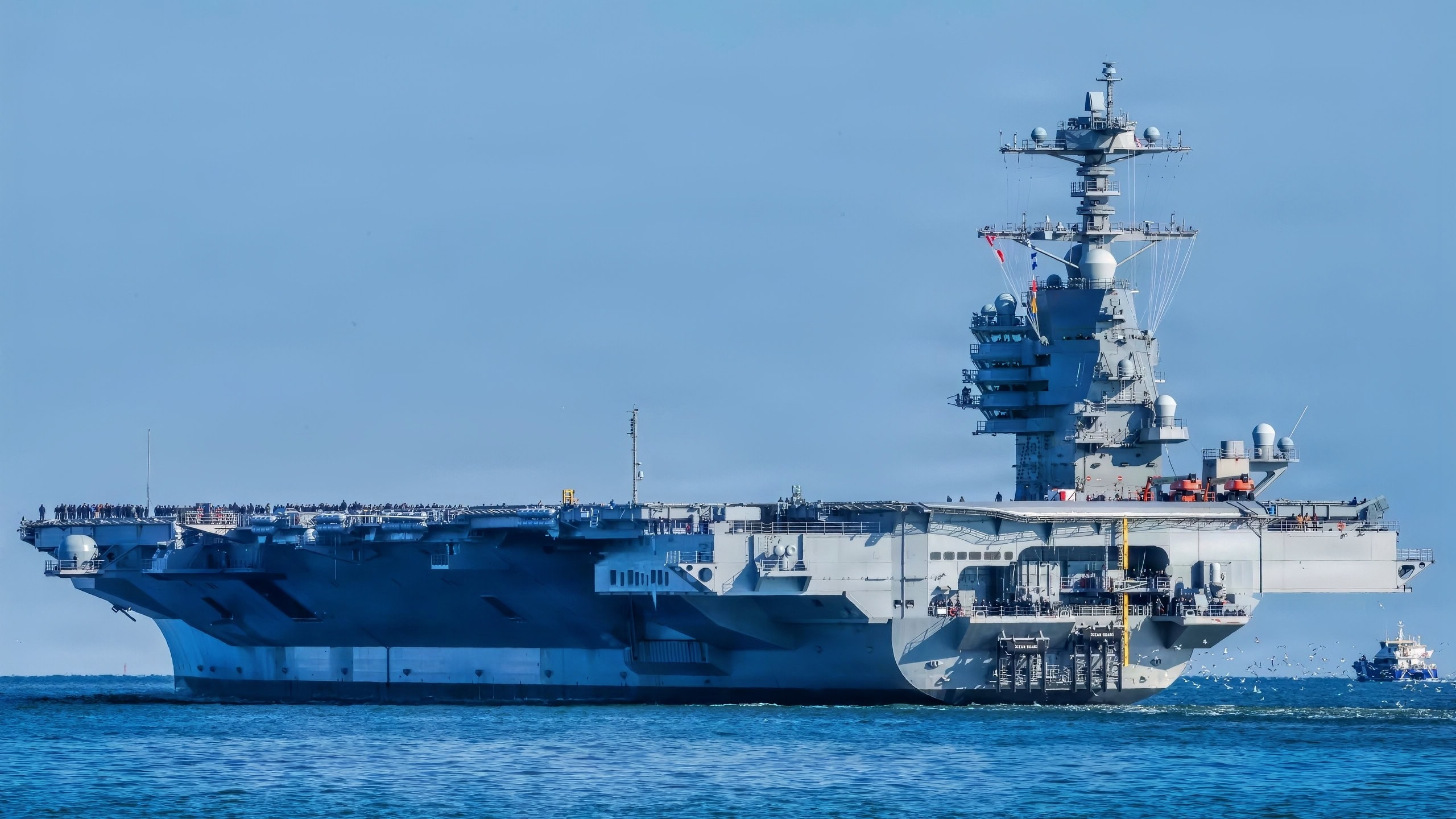
Pre-Commissioning Unit John F. Kennedy (CVN 79) transits the James River as the ship departs for Builder’s Trials, Jan. 28, 2026. Builder’s Trials provide an opportunity to test ship systems and components at sea for the first time, and make required adjustments prior to additional underway testing. (U.S. Navy photo by Mass Communication Specialist Seaman Jayden Howard)
The outer ring is the newest and the most consequential. In its most recent China Military Power Report, the Pentagon confirmed for the first time that China has fielded the DF-27, an anti-ship ballistic missile with a range of 5,000 to 8,000 kilometers carrying a hypersonic glide vehicle, in both land-attack and anti-ship variants. The Pentagon’s own graphic showed the DF-27 covering the entire Indo-Pacific and much of the U.S. West Coast, and the report assessed that it lets Beijing hold ships at risk at distances beyond its existing cruise, supersonic, and hypersonic inventory.
As Erickson noted, that confirmation was one of the most significant revelations in the report. China may not field many DF-27s, but it does not need many to change the math: the outer ring opens the engagement at extreme range, so the carrier is being shot at long before it nears the point from which its aircraft could launch.
Inside that sits the DF-26, the “Guam killer,” with a range of roughly 3,000 to 4,500 kilometers — road-mobile, solid-fueled, and dual-capable with both nuclear and conventional warheads, a combination that creates dangerous ambiguity because a defender cannot tell which kind is incoming before deciding whether to intercept. A newer DF-26D variant was unveiled in September 2025.
Closer still is the DF-21D, the original carrier killer, the most mature ring, and the one that first proved an ASBM could target a moving carrier strike group from land. By the time a carrier’s air wing is close enough to strike, the ship is deep inside the DF-21D’s envelope.
And beneath the ballistic missiles is a terminal saturation layer — the hypersonic DF-17 glide vehicle, fielded around 2020, plus a thicket of cruise missiles launched from ships, submarines, and aircraft, including the YJ-21 hypersonic missile fired from Type 055 destroyers — designed to come in low, fast, and from multiple directions at once to overwhelm the finite number of interceptors a carrier’s escorts can carry.
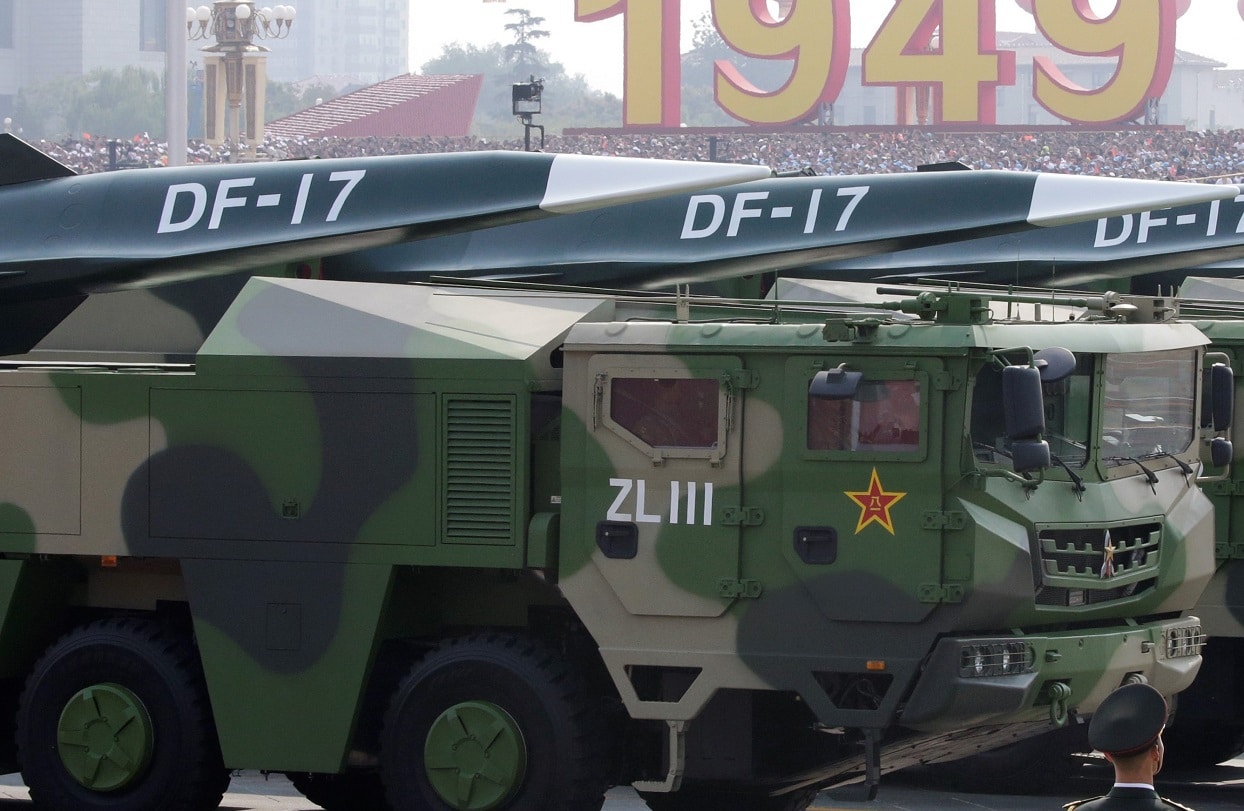
Image of DF-17 missile. Image: Creative Commons.
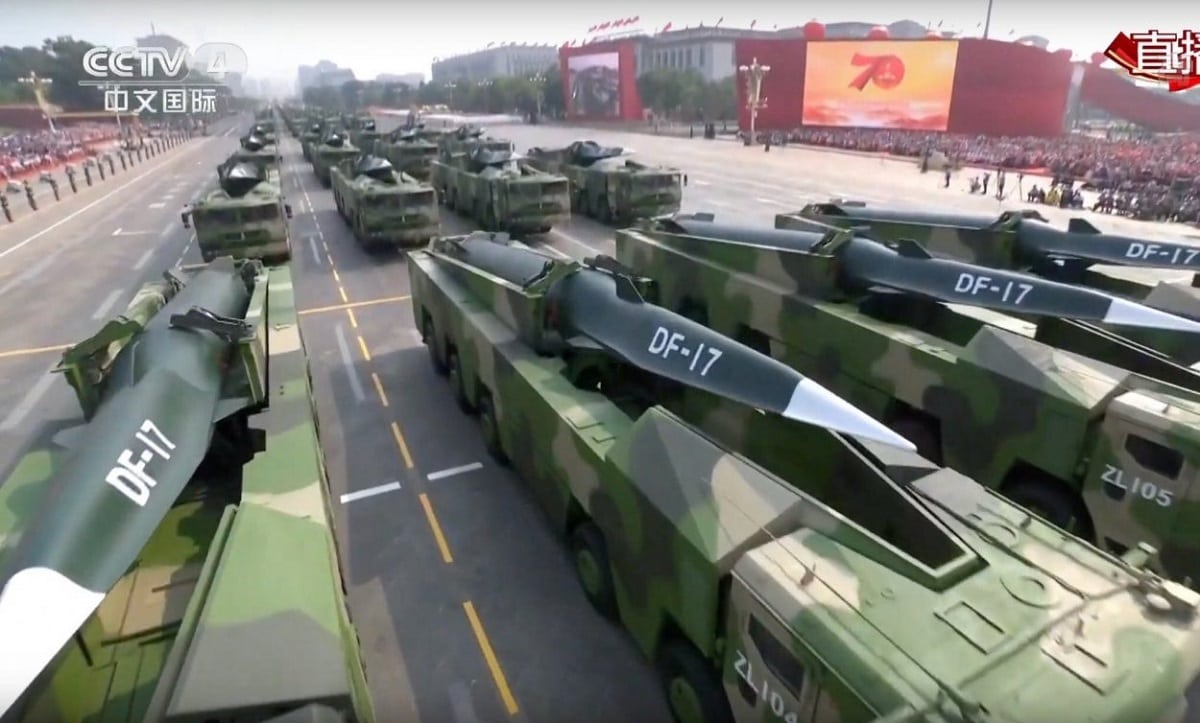
DF-17 Missiles
The F/A-XX: The Carrier’s Answer, And Why It Matters So Much
The Navy understands the geometry problem precisely, and the F/A-XX is its answer.
The program is the service’s sixth-generation carrier fighter, the eventual replacement for the Super Hornet, and it is built around the one variable that matters here: reach. Navy officials have said the aircraft will offer roughly 25 percent greater range than the F-35C, along with advanced stealth for deeper penetration and the ability to control longer-range unmanned combat drones from the cockpit. Paired with the MQ-25 tanker, the logic is to push the air wing’s reach back outside the missile rings and restore the geometry the carrier has lost. The Chief of Naval Operations framed the tanker drone bluntly in terms of making the air wing effective based on the range at which the carrier can operate safely.
That is why the F/A-XX is arguably the most important naval-aviation program of the era. It is not a better dogfighter; it is the proposed fix for the carrier’s existential range problem. And it is in trouble. The fiscal 2026 budget stripped the contract-award funding, forcing the Navy to place the roughly $1.4 billion atop its unfunded priorities list, and some Pentagon officials sought to delay the program by up to three years over concerns about running two sixth-generation fighter programs at once alongside the Air Force’s F-47.
The award, once expected in early 2025, has slipped repeatedly; Navy leadership now targets a decision in August 2026, and even then, jets would not reach carrier decks for years.
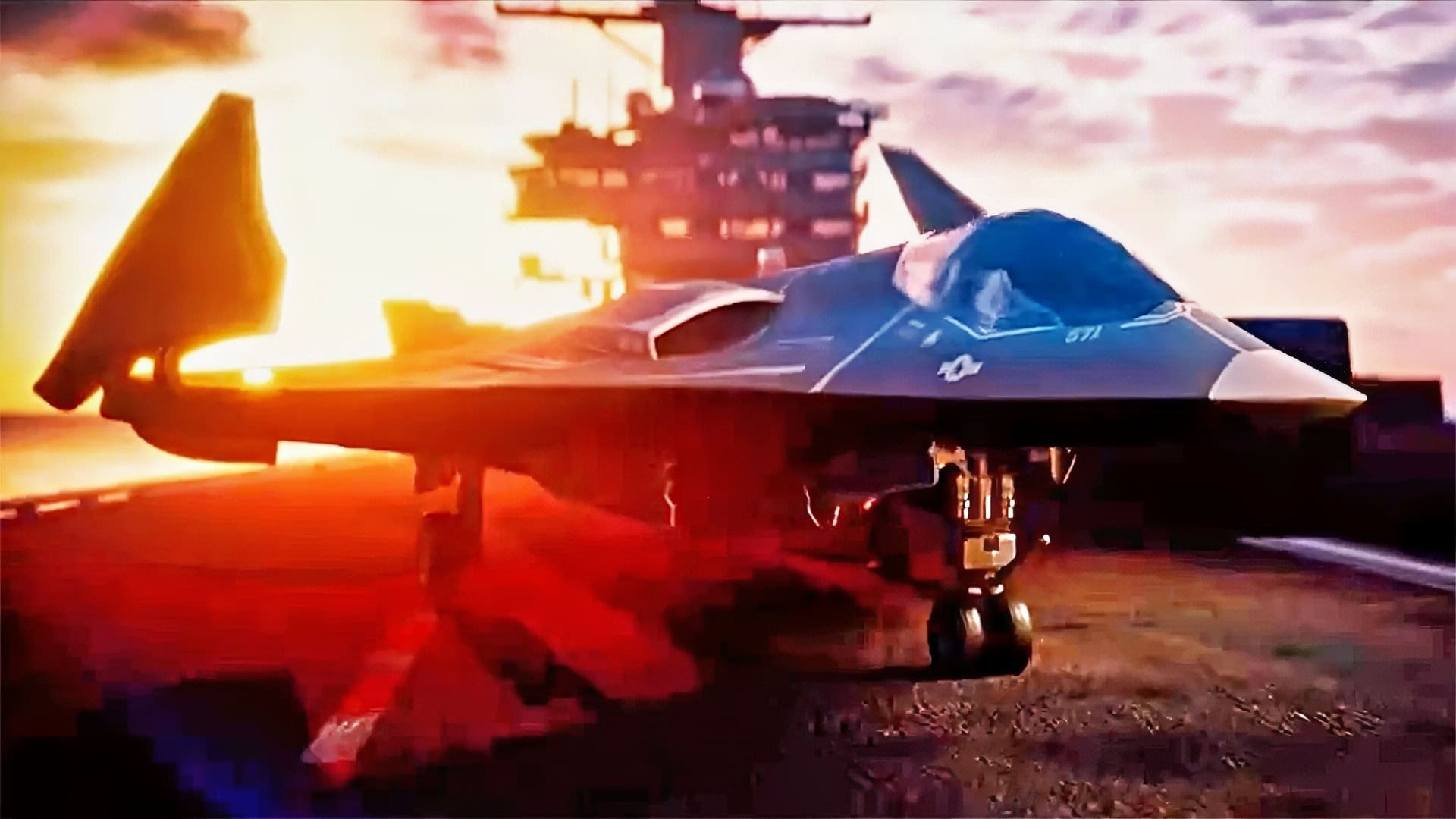
FA-XX Fighter Screenshot from X
The fighter meant to save the carrier from the missile is itself behind schedule, while the missiles keep arriving on time. And keep getting better with better ranges.
The Kicker: A Range Race The Carrier Cannot Out-Build
Here is the asymmetry that makes the problem so hard. Extending the range of a missile is a faster and cheaper engineering task than extending the combat radius of a crewed aircraft. The F/A-XX is a decade-long, multibillion-dollar program of brutal technical difficulty that is already slipping years before a contract is even signed. A longer-range anti-ship ballistic missile is a cheaper, faster development cycle by comparison — and China is not starting from scratch, because it already fields the DF-27 at intercontinental range and keeps pushing the rings outward, as the September 2025 DF-26D unveiling showed.
So the timelines run against the carrier. By the time the F/A-XX finally extends the air wing’s reach enough to matter, China can extend its outer ring further still, for less money and in less time, and the carrier is no closer to escaping the envelope than it was before.
The F-22 is the cautionary precedent every naval planner cites: a program that institutional drift and budget fights cut from a planned fleet of hundreds down to 187 jets, leaving too few of the best fighter ever built. The carrier is in a range race against an opponent who can move the finish line cheaper and faster — and who already holds the longest-range layer. That asymmetry, more than any single missile, is what is closing the supercarrier era in the Pacific.
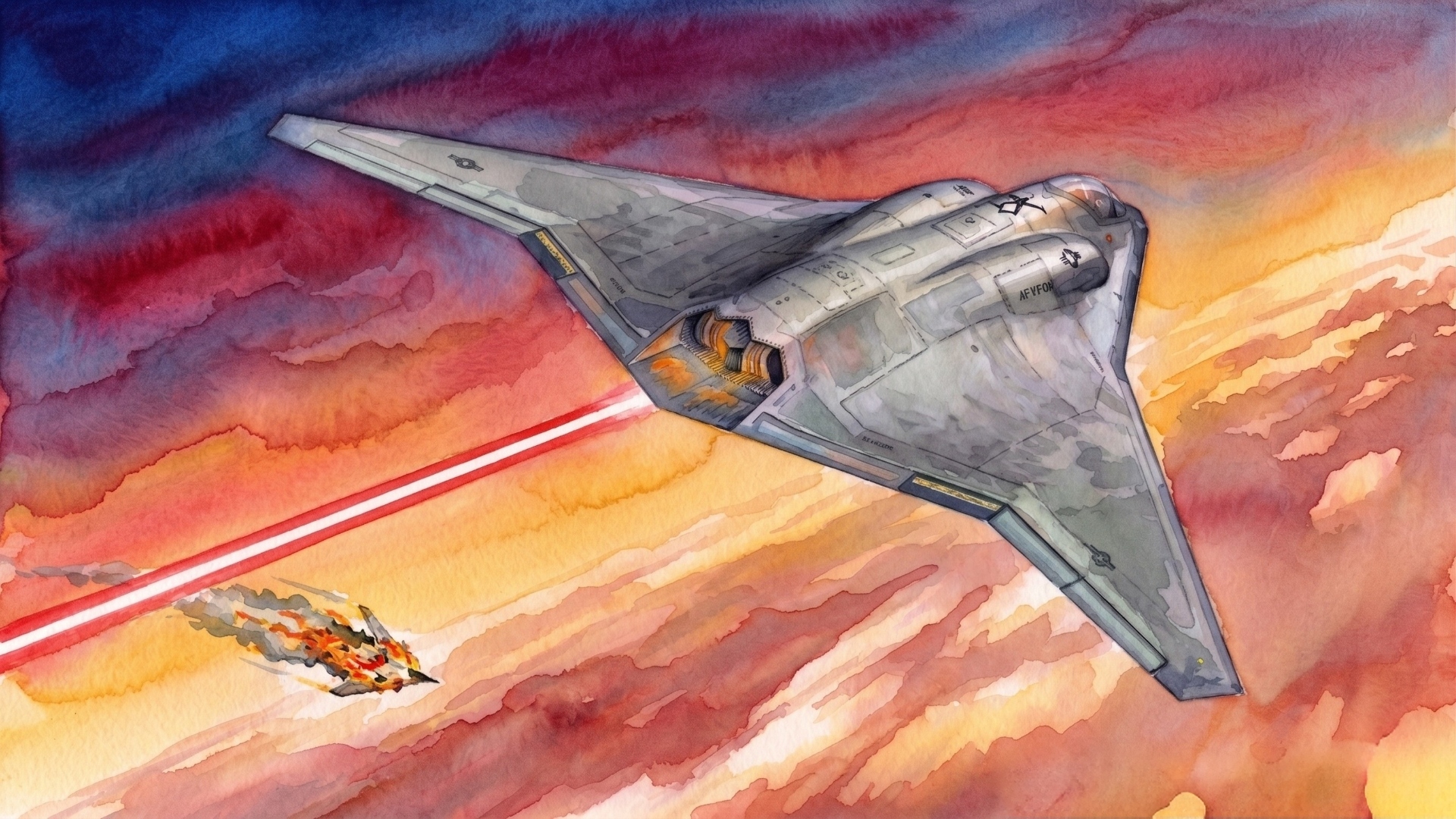
F/A-XX Artist Rendition Mock-Up. Image Credit: Banana Nano.
The Honest Balance: A Maturing Threat, Not A Finished Wall
The case against the carrier can be overstated, and the honest version has a crucial caveat. Possessing a missile with an 8,000-kilometer range is not the same as hitting a maneuvering aircraft carrier at 8,000 kilometers.
The longer the shot, the harder the kill chain — the unbroken sequence of detecting the carrier, tracking it, maintaining custody of its position through the missile’s flight, and guiding the warhead onto a ship that is moving, jamming, blinding sensors, and shooting down the satellites, drones, and radars trying to find it. The 2020 Chinese test that reportedly struck a target in the South China Sea was, by the best open assessments, fired against what was almost certainly a stationary target, with no electronic warfare, no decoys, and no defensive missiles — proof the launch sequence works, not proof the system can hit a defended, maneuvering carrier in wartime.
That produces an honest tension worth stating plainly: the outer rings are the most strategically alarming and the least proven against a maneuvering ship in contested conditions, while the inner DF-21D is the most mature but requires the carrier to already be close. The threat is a maturing trajectory, not a finished wall, and the carrier is not dead tomorrow.
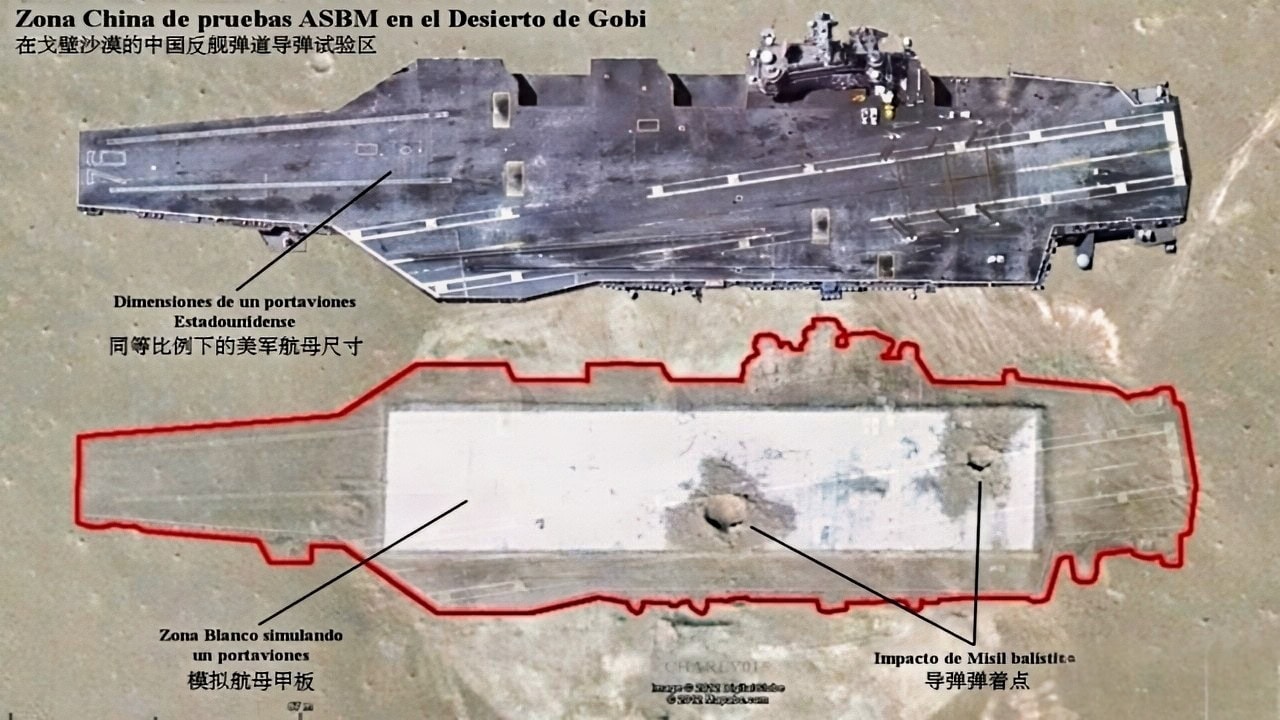
DF-21D image. Creative Commons.
Erickson himself, who did more than anyone to establish the threat, is measured about it: the U.S. Navy takes the danger seriously and is pacing it with hard-kill and soft-kill systems — Aegis ballistic-missile defense, the SM-6 interceptor, and electronic-warfare systems that can generate false targets to confuse incoming missiles. The enemy gets a vote, in his phrase, but so does the United States. And the geometry problem is specific to a peer fight inside the first and second island chains; the carrier remains enormously useful everywhere else — against Iran, against the Houthis in the Red Sea, across the Atlantic and Mediterranean. What is eroding is not the carrier in general but the supercarrier in the one fight that matters most.
What Comes Next: Distributed Lethality
If putting five thousand sailors and seventy aircraft on a single hull inside a missile gauntlet is becoming the wrong bet, the Navy’s hedge is to spread its firepower out.
The concept, broadly called distributed lethality or distributed maritime operations, scatters offensive power across many smaller surface ships, submarines, and unmanned vessels, presenting an adversary’s targeting network with a diffuse, low-signature set of targets rather than a single enormous, high-value one. Submarines, which remain the hardest platforms to find and can operate within the missile envelope without being seen, and land-based anti-ship fires that complicate China’s own calculations, are central to that hedge. The Navy is already investing in electronic attack and emissions control measures designed to break the kill chain at its weakest link, and in unmanned systems that allow it to fight without concentrating everything on one deck.
None of this means the carrier is being scrapped. The United States is still building Ford-class supercarriers and will operate them for decades. But the direction of travel is unmistakable, and it is a hedge against precisely the future this piece describes — one in which the carrier’s central role in a peer war is no longer assured, and the smart money spreads the risk.
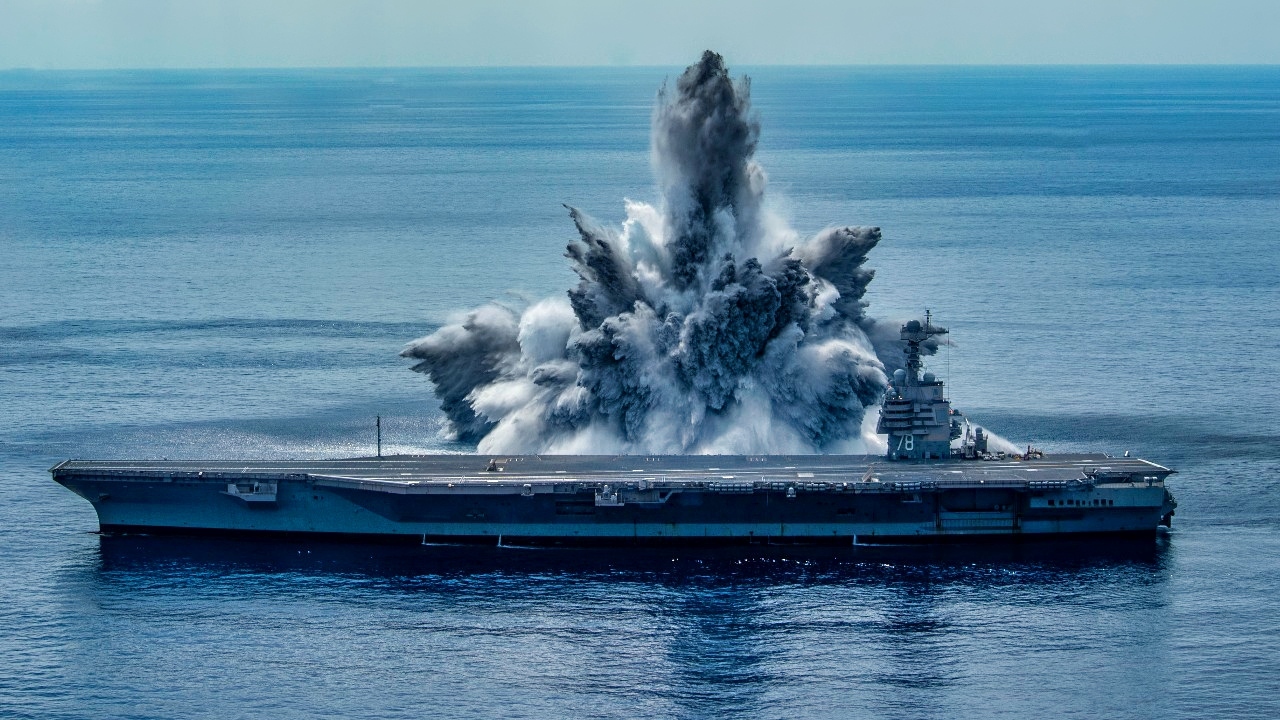
The aircraft carrier USS Gerald R. Ford (CVN 78) successfully completes the third and final scheduled explosive event of Full Ship Shock Trials while underway in the Atlantic Ocean, Aug. 8, 2021. The U.S. Navy conducts shock trials of new ship designs using live explosives to confirm that our warships can continue to meet demanding mission requirements under harsh conditions they might encounter in battle. (U.S. Navy photo by Mass Communication Specialist 3rd Class Novalee Manzella)
The Verdict: Eroding In The Pacific, And The Math Favors The Missile
The aircraft carrier is not obsolete, and anyone who says it is has overshot the evidence. It remains the most flexible instrument of American power in most of the world, and the kill chains needed to sink one at extreme range in a contested environment are not yet proven.
But in the western Pacific, against the one opponent who has built an entire missile architecture to defeat it, the supercarrier’s core value is eroding — because its aircraft are outranged, because the missiles come in layers that open fire long before the air wing can strike, and because the fix is slower and dearer to build than the threat it is chasing.
The F/A-XX is the Navy’s best answer, and it may not be a sufficient one, arriving late into a race where the other side can keep extending its lead for less.
The supercarrier era is not ending everywhere, and it is not ending tomorrow. But in the fight the U.S. Navy most needs to be ready for, both the defensive math and the cost math favor the missile over time, and the carrier is being asked the hardest question a weapon can face: whether it can still do the one thing it was built to do. China is betting heavily that the answer is no. The F/A-XX is America’s best, but it can still be yes — and that bet is already running behind.
About the Author: Harry J. Kazianis
Harry J. Kazianis (@Grecianformula) was the former Senior Director of National Security Affairs at the Center for the National Interest (CFTNI), a foreign policy think tank founded by Richard Nixon based in Washington, DC. Harry has over a decade of experience in think tanks and national security publishing. His ideas have been published in the NY Times, The Washington Post, The Wall Street Journal, CNN, and many other outlets worldwide. He has held positions at CSIS, the Heritage Foundation, the University of Nottingham, and several other institutions focused on national security research and analysis. He is the former Executive Editor of the National Interest and the Diplomat. He holds a Master’s degree focusing on international affairs from Harvard University.

