
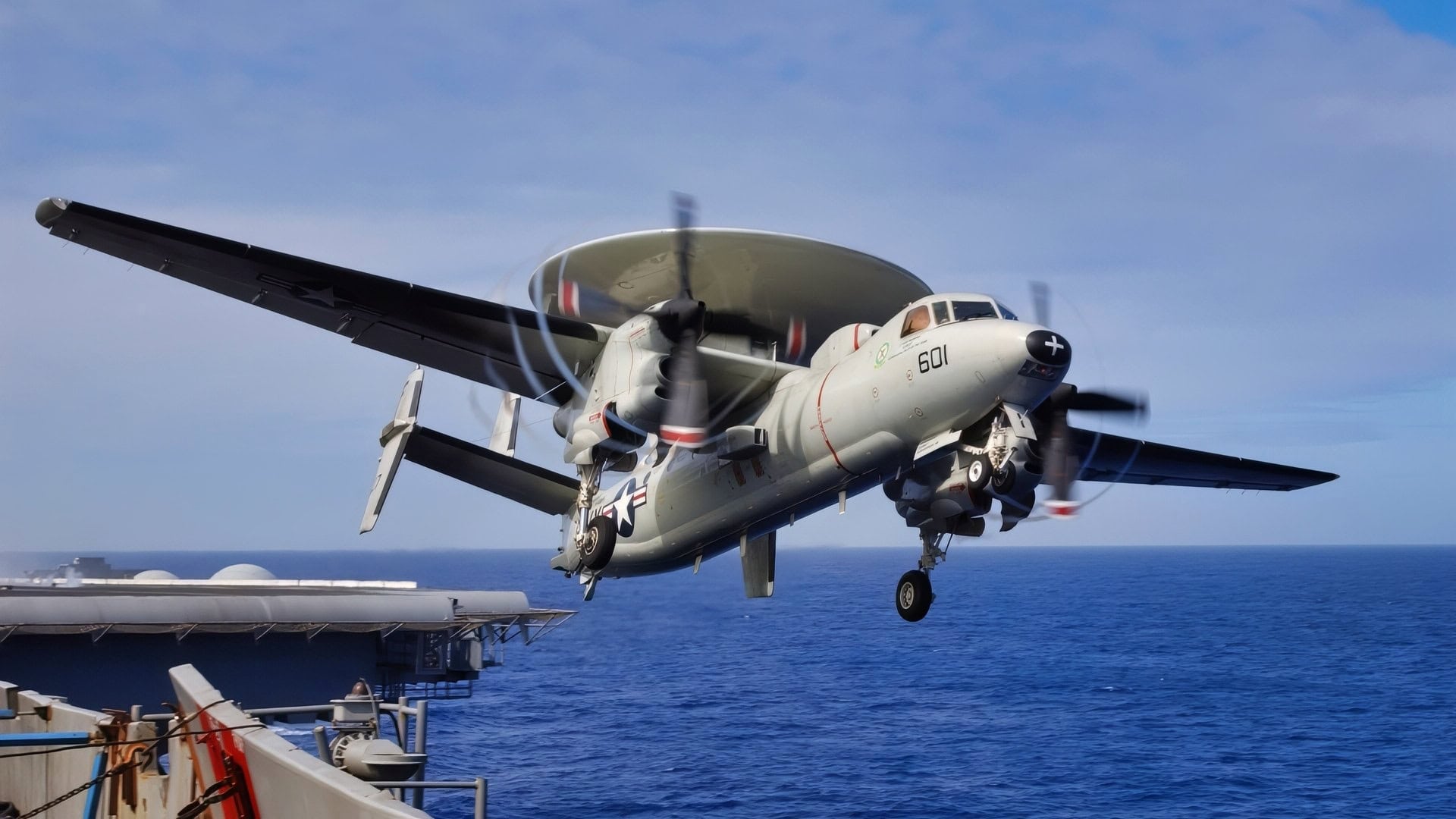
On March 18, 2016, an E-2C Hawkeye landing aboard USS Dwight D. Eisenhower caught the carrier’s No. 4 arresting wire and kept rolling. The wire parted, whipped across the flight deck, and injured eight sailors. The Hawkeye ran off the landing area, dropped below flight-deck level, and came within 10 to 20 feet of the Atlantic before climbing away. A Navy investigation placed the resulting damage above $200,000.
Eisenhower was operating off Virginia during its final pre-deployment training cycle. Three Hawkeyes from the “Screwtops” of Airborne Early Warning Squadron 123 were conducting carrier qualifications as part of Composite Training Unit and Joint Task Force exercises. The carrier and Carrier Air Wing 3 were preparing to leave for operations in Europe and the Middle East.

ATLANTIC OCEAN (Aug. 30, 2018) An MH-60S Sea Hawk helicopter assigned to Carrier Air Wing (CVW) 7 flies by the Nimitz-class aircraft carrier USS Abraham Lincoln (CVN 72) during dual-carrier sustainment operations with the Nimitz-class aircraft carrier USS Harry S. Truman (CVN 75). In addition to demonstrating the Navy’s inherent flexibility and scalability, this evolution provides the opportunity to conduct complex, multi-unit training to enhance maritime interoperability and combat readiness; prepare the Navy to protect our homeland; and preserve and promote peace anywhere around the world. (U.S. Navy photo by Mass Communication Specialist 3rd Class Juan Sotolongo/Released)
An aircraft carrier’s arresting system compresses a runway landing into a few hundred feet. Heavy steel cross-deck pendants stretch across the angled deck. Purchase cables to connect each pendant to an arresting engine below deck. When an aircraft’s tailhook catches a wire, the engine pays out cable under controlled resistance, absorbing the aircraft’s energy. Naval Air Systems Command describes the system as stopping an aircraft in approximately 340 feet.
The Hawkeye made a successful approach and engaged the fourth and final wire. Its crew heard a loud bang and felt the aircraft shudder. The tailhook struck the deck again, yet the aircraft continued toward the end of the landing area. The arresting engine had released too much cable and failed to apply the resistance needed to stop the aircraft.
A Fault Code Left USS Eisenhower’s No. 4 Arresting Engine Misprogrammed
The failure began after an earlier landing produced a fault code on the No. 4 arresting-gear engine. Three qualified maintenance personnel used an approved Navy procedure to troubleshoot the problem and return the system to service. Investigators found they missed at least one, and possibly two, critical steps.
The missed steps inadvertently programmed a valve controlling arresting-engine pressure and energy absorption. During the Hawkeye landing, the valve failed to seat rapidly enough. The engine exceeded its intended stroke length and reached its mechanical limit, a condition known as two-blocking. The landing load then passed directly into the cross-deck pendant.
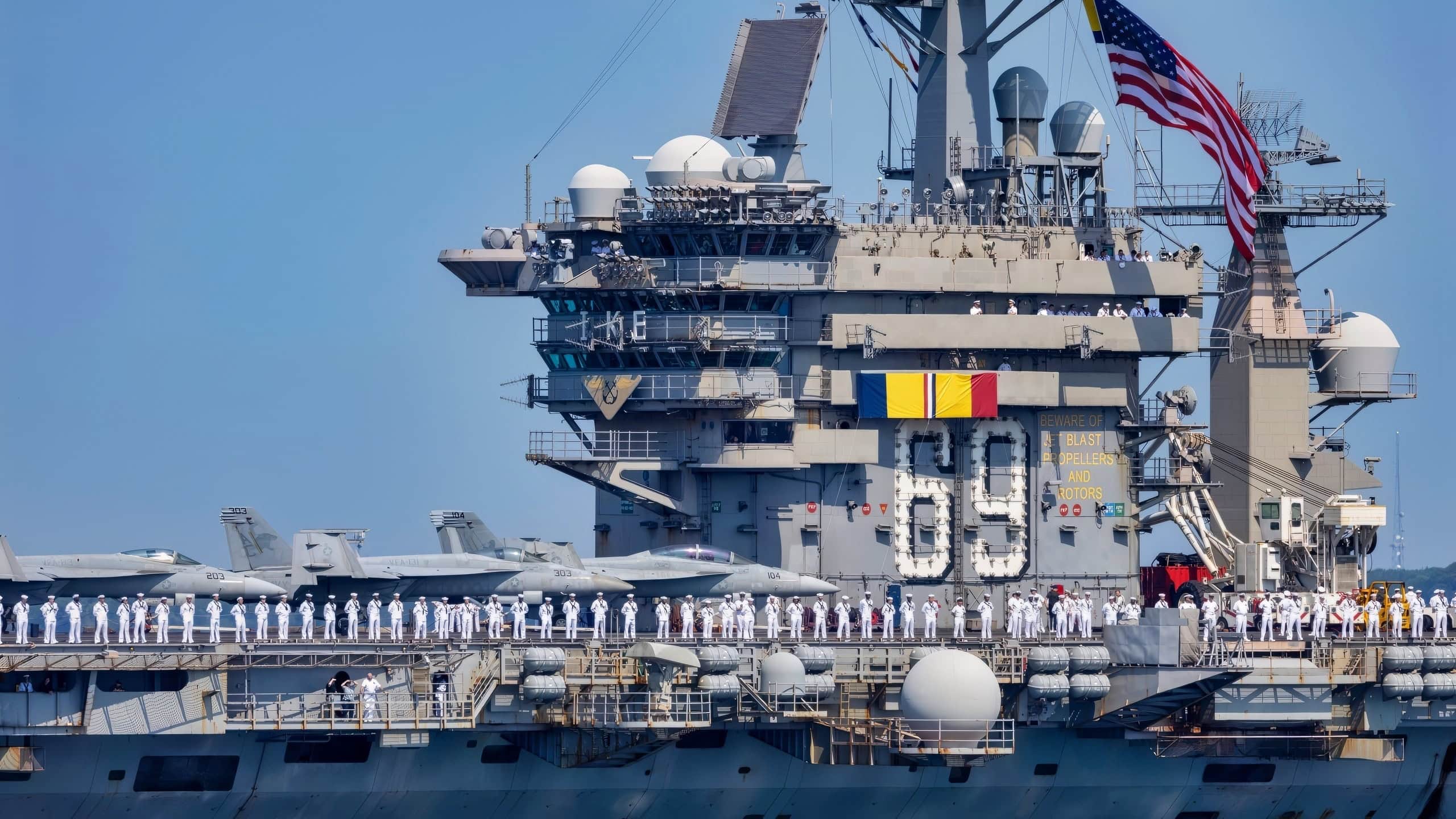
(July 14, 2024) The Nimitz-class aircraft carrier USS Dwight D. Eisenhower (CVN 69) returns to Naval Station Norfolk, July 14, 2024, concluding a nine-month deployment to the Atlantic. Eisenhower, the flagship of the Ike Carrier Strike Group, departed Norfolk October 14, 2023 to conduct a scheduled deployment to U.S. 5th and 6th Fleet area of operations in support of maritime security operations, theater security cooperation efforts, and enhanced vigilance activities operations with NATO Allies and Partners. (U.S. Navy Photo by Mass Communication Specialist 2nd Class Hunter Day)
The force exceeded the pendant’s breaking strength. It parted at or near the point where the Hawkeye’s tailhook had engaged it.
The command investigation attributed the root cause to a maintenance error and criticized the troubleshooting instructions. Investigators described the procedure as overcomplicated, difficult to perform in an operational environment, and lacking warnings about the consequences of an incorrect valve setting. It offered no supervisory control for the most important steps.
The Navy found no willful dereliction of duty or culpable negligence. The sailors believed they had completed the approved procedure correctly. The finding distributed responsibility between the missed steps and a maintenance process that gave technicians little indication that one incorrect setting might destroy an arresting wire during the next landing.
The E-2C Hawkeye Fell to Within 20 Feet of the Atlantic
Lt. Matthew Halliwell, Lt. Cmdr. Kellen Smith, and Lt. Cmdr. Thomas Browning had only seconds to respond. The Hawkeye rolled off the flight deck and entered a deep descent. Unlike tactical fighters, the E-2C has no ejection seats. Once the aircraft cleared the deck, the crew’s survival depended on maintaining enough power and control to prevent the turboprop from striking the water.
Smith later estimated that the Hawkeye bottomed out about 10 feet above the ocean. The investigation placed the low point between 10 and 20 feet. The crew restored a positive climb and returned to Chambers Field at Naval Station Norfolk. The aircraft landed safely, and none of the aviators suffered injuries.
The flight deck presented a different scene. The broken wire recoiled across the deck with enormous energy. Two Eisenhower sailors and six VAW-123 maintainers were struck. Injuries included lacerations, broken ankles, fractured arms and legs, facial fractures, a fractured pelvis, and a cracked skull. One sailor suffered a possible traumatic brain injury.
Aviation Machinist’s Mate Second Class Jason Cummings sustained a broken right leg, a dislocated left leg, and a collapsed artery behind his knee. Surgeons replaced part of the damaged artery with tissue taken from his thigh. His injuries included serious nerve and ligament damage, and doctors initially feared he would lose the leg.
Six sailors were evacuated from Eisenhower by an MH-60S helicopter. Four went to Naval Medical Center Portsmouth, while two with more serious trauma were taken to Sentara Norfolk General Hospital. Another sailor went ashore two days later after symptoms raised concerns about a brain injury.
The recoiling cable also struck a C-2A Greyhound transport and an MH-60S helicopter parked on the flight deck. The command investigation found that the damage to the carrier and the aircraft exceeded $200,000. No one was killed, and the Hawkeye itself returned without major reported damage.
The US Navy Changed the Procedure Behind the Arresting-Gear Failure
The investigation recommended retraining arresting-gear personnel, adding warnings and cautions to the troubleshooting instructions, strengthening quality-assurance requirements, and creating shipboard operating procedures for similar fault codes. The three maintainers underwent retraining, qualification reviews and administrative action.
The accident showed how much aircraft carrier aviation depends on machinery hidden below the flight deck. Pilots see a steel wire. Beneath it sits a system of cables, sheaves, hydraulic equipment, valves, and controls adjusted for the weight and speed of each arriving aircraft. A maintenance setting entered after one landing remained dormant until the next aircraft placed thousands of pounds of force into the system.
The Navy later introduced the Advanced Arresting Gear aboard the Ford class, designed to recover a broader range of aircraft while reducing stress and maintenance demands. The difficult development of that system became part of the Ford class’s wider struggle with new carrier technology. Eisenhower continued using the proven Mk 7 system, whose reliability still depended on precise maintenance.
Aircraft Carrier USS Eisenhower Deployed 75 Days After the Accident
The cable failure did not cancel Eisenhower’s deployment. The carrier strike group left Norfolk on June 1, 2016, 75 days after the mishap. Carrier Air Wing 3 began striking Islamic State targets from the eastern Mediterranean on June 28 and later operated from the Arabian Gulf.
Eisenhower remained in service through demanding deployments during the following decade. Its 2023-2024 cruise produced one of the most sustained periods of American carrier combat operations in years. The ship completed another major maintenance period in 2026 and returned to the fleet despite plans to retire Eisenhower in fiscal 2030.
On August 11, 2016, Halliwell, Smith, and Browning received the Armed Forces Air Medal aboard Eisenhower. The award citation credited them with maintaining positive control and preventing the Hawkeye from being lost after the arresting wire broke.
About the Author: Harry J. Kazianis
Harry J. Kazianis (@Grecianformula) was the former Senior Director of National Security Affairs at the Center for the National Interest (CFTNI), a foreign policy think tank founded by Richard Nixon based in Washington, DC. Harry has over a decade of experience in think tanks and national security publishing. His ideas have been published in the NY Times, The Washington Post, The Wall Street Journal, CNN, and many other outlets worldwide. He has held positions at CSIS, the Heritage Foundation, the University of Nottingham, and several other institutions related to national security research and studies. He is the former Executive Editor of the National Interest and the Diplomat. He holds a Master’s degree focusing on international affairs from Harvard University.