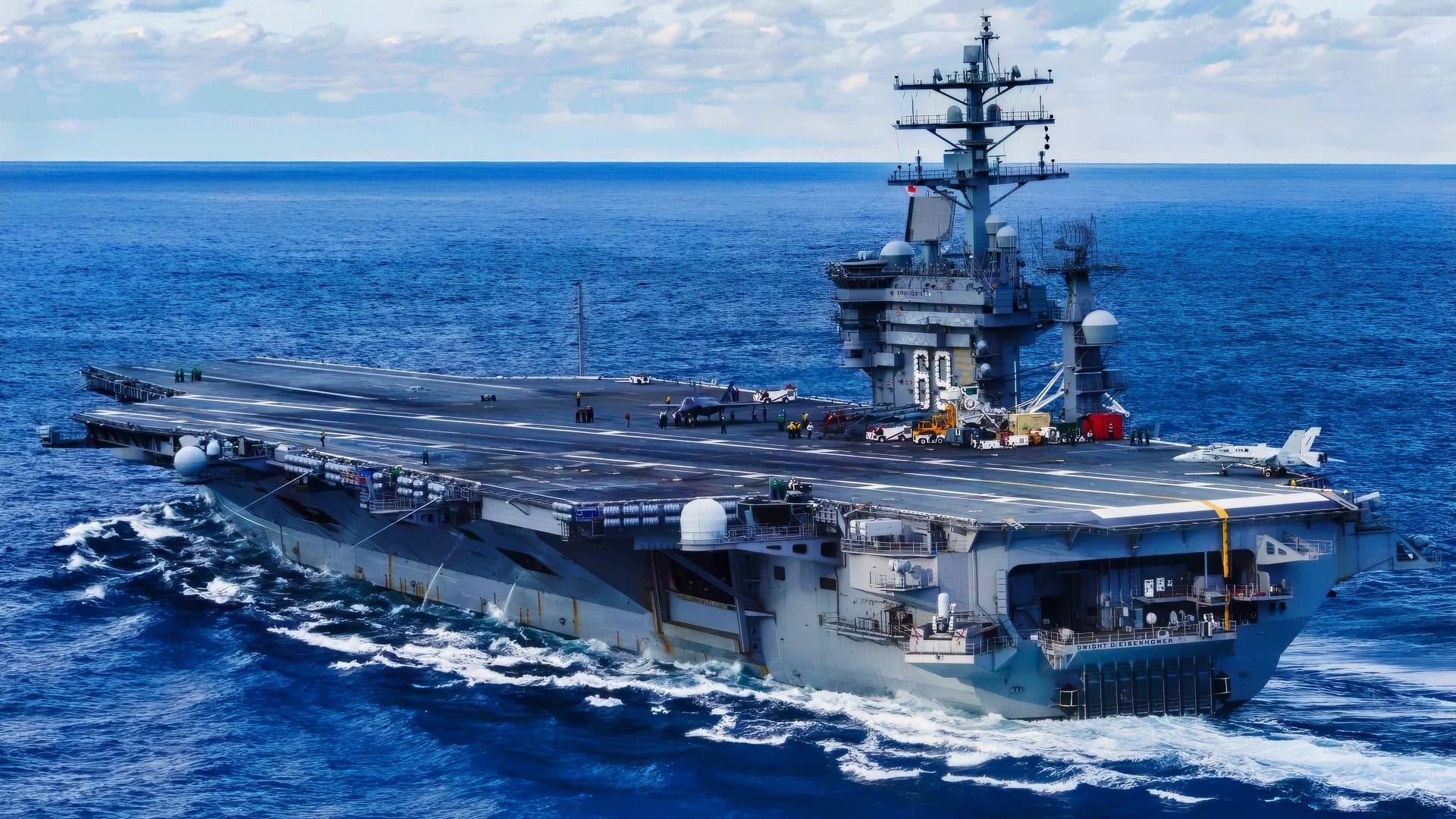
Should aesthetics trump functionality? When it comes to American warships at least, the American president certainly seems to think so, and the United States Navy is mulling a redesign of the Gerald R. Ford-class aircraft carriers to make them more visually appealing to the Commander-in-Chief.
The visually-offending member in question is the Ford-class’ island, in essence the command tower where coordination for the ship’s navigation, the launch and recovery of aircraft, and other vital parts of carrier operations are conducted.
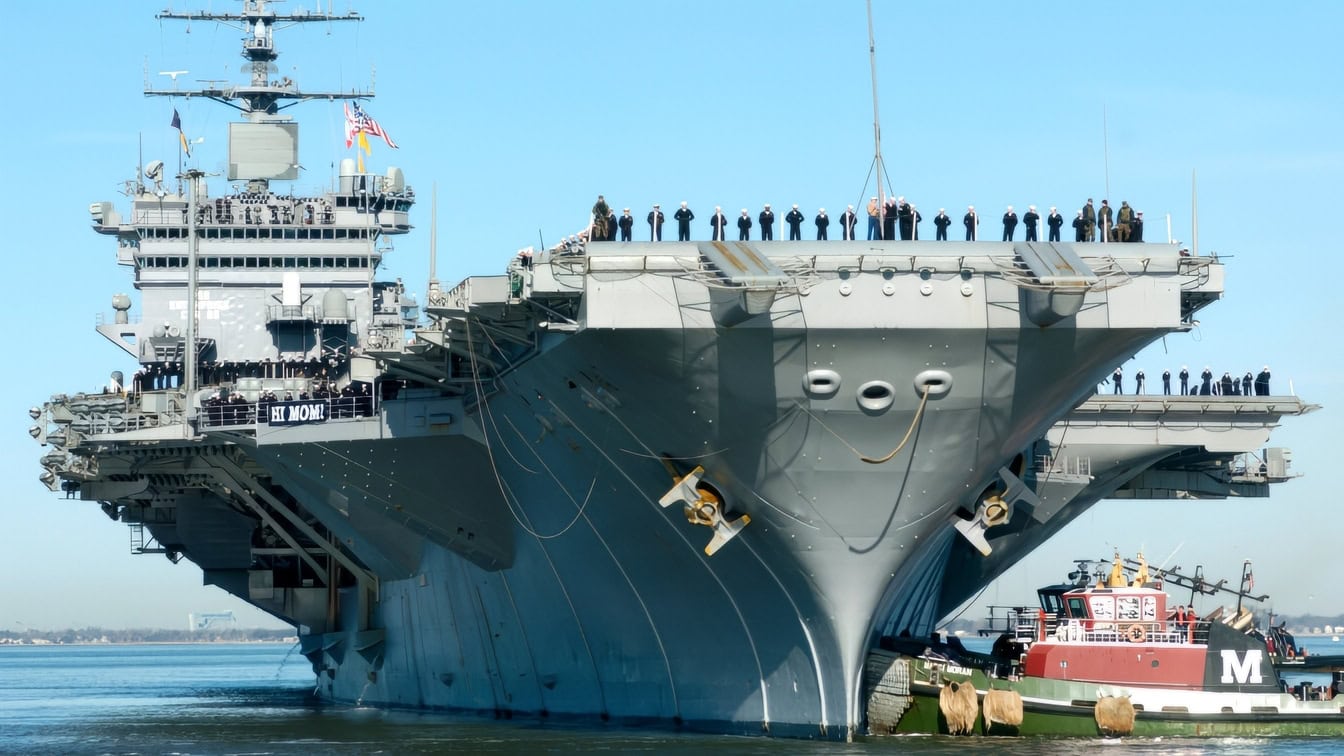
Naval Station Norfolk, Va. (Feb. 29, 2004) – The crew “mans the rails” aboard the nuclear powered aircraft carrier USS Enterprise (CVN 65) as she approaches pier 12 where thousands of family members await. The carrier completed a six-month deployment in support of the global war on terrorism. U.S. Navy photo by Chief Journalist (SW/AW) Dave Fliesen, Fleet Combat Camera, Atlantic. (RELEASED)
Located toward the stern of the ship on the starboard, or right-hand, side of the carrier, President Trump has taken issue with the island’s location, preferring a more central island position.
World War II Reboot?
Aircraft carrier islands were more centralized during World War Two, but have since moved farther back as warships have matured.
Moving the island would require redesigning the ship’s internal arrangement to balance the redistributed weight, maintain the ship’s center of gravity, and ensure buoyancy.
The Washington Post was the first to report on the proposed Ford-class island redesign.
Other Ford-class Redesigns
It is not, however, the first time that President Trump has taken issue with the world’s largest, most advanced class of aircraft carriers.
Key features of the new aircraft carriers include design-integrated technologies that optimize carrier operations by increasing sortie generation, such as new electromagnetic aircraft launch systems and advanced weapons elevators.
While these new technologies have faced significant teething issues, experts maintain that, in the long run, they will increase carrier lethality.
But in stark disagreement, Trump ordered a pivot back to the steam-powered catapults that launched airplanes off of Navy flight decks and into the air beginning during the Second World War — which, should the president’s wishes come to fruition, would increase the costs of the Ford-class and delay their service entry dates.
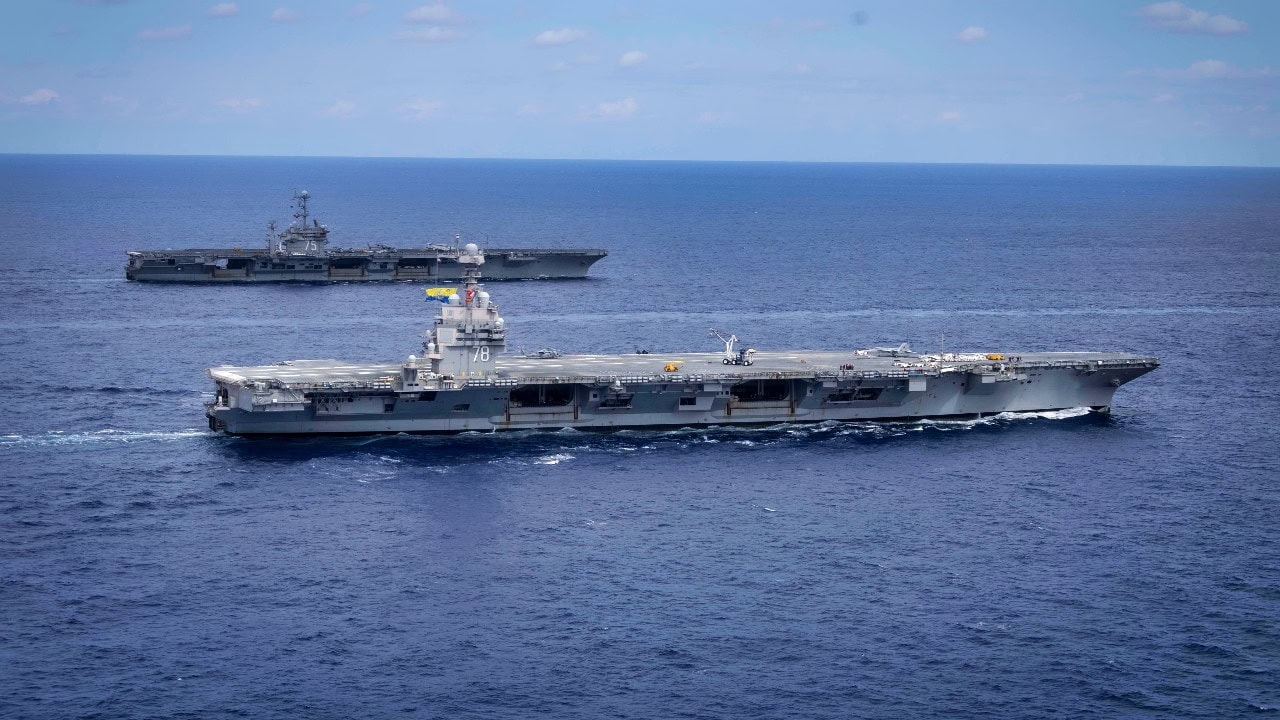
ATLANTIC OCEAN. (Aug. 24, 2024) The Nimitz-class aircraft carriers USS Harry S. Truman (CVN 75), back, and the world’s largest aircraft carrier, USS Gerald R. Ford (CVN 78), sail in formation in the Atlantic Ocean, Aug. 24, 2024. USS Gerald R. Ford is the flagship of the Gerald R. Ford Carrier Strike Group. The aircraft carrier is underway in the Atlantic Ocean to further develop core unit capabilities and skills such as fuels certification and ammunition on-load during its basic phase of the optimized fleet response plan. (U.S. Navy photo by Mass Communication Specialist 2nd Class Maxwell Orlosky).
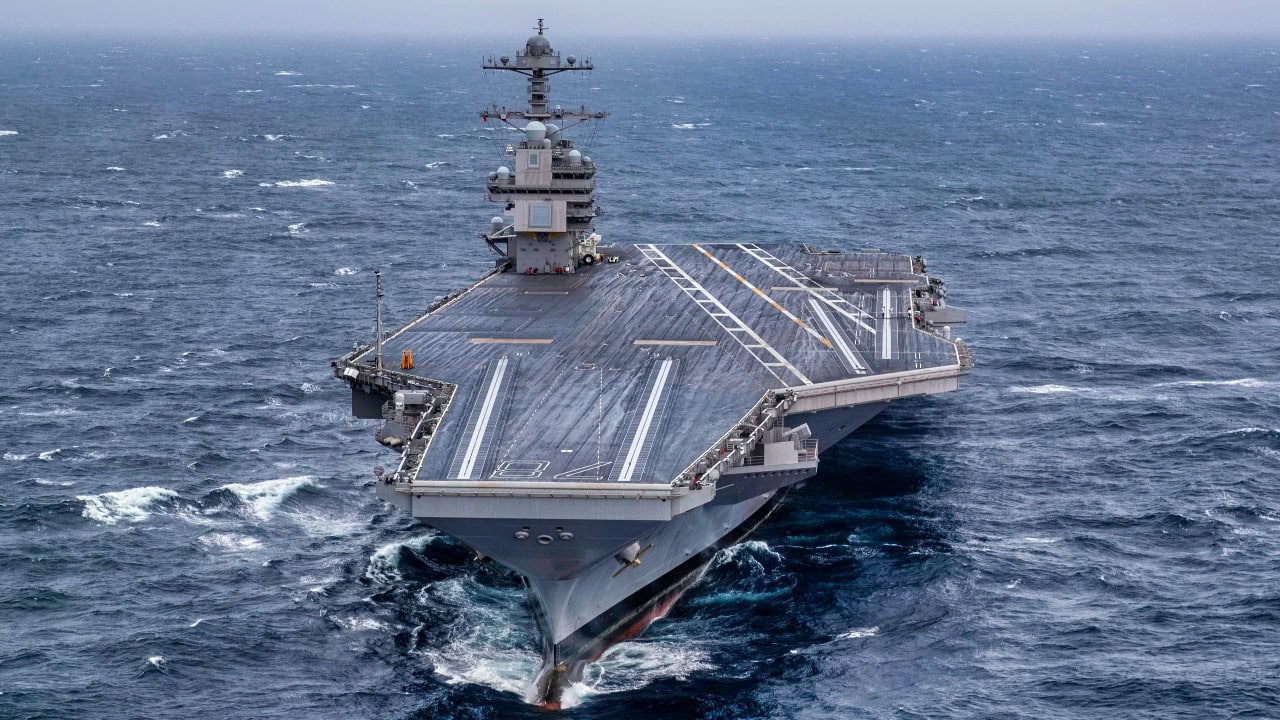
ATLANTIC OCEAN (Oct. 27, 2019) USS Gerald R. Ford (CVN 78) steams in the Atlantic Ocean for the first time since July 2018. Ford is conducting sea trials following its 15 month post-shakedown availability. (U.S. Navy photo by Mass Communication Specialist 3rd Class Connor Loessin)
Experts view the likelihood that the president’s wishes will be realized as rather low, however. “I think the idea with this and with the electromagnetic catapult is to do the studies and maybe do some of the redesign work, but not actually incorporate it into the ships, because the actual construction part of those ships is far enough in the future that they could wait it out, right, and wait until the president’s out of office and then just not implement the change,” Bryan Clark, a senior fellow at the Hudson Institute, in an interview with The Hill.
In the meantime, the next two Ford-class aircraft carriers, the USS Doris Hill and the USS Enterprise, are under construction, and Newport News Shipbuilding, the shipyard building the carriers, recently completed sea trials for the USS John F. Kennedy, the next Ford-class carrier.
More World War II Vibes Than 2026 US Navy Fleet
One of the earlier instances of President Trump’s insistence on aesthetics and titles over functionality is the Trump-class battleships that will — supposedly — be built and designed for the U.S. Navy.
Those ships, according to the overwhelming majority of naval experts, will present an adversary with an incredibly dense concentration of firepower, a highly visible, high-value target.
Their design is also directly opposed to the U.S. Navy’s distributed firepower strategy, which aims to spread firepower broadly across the fleet to prevent the kind of knock-out blow that the loss of a Trump-class battleship would represent.
But the class also runs counter to modern naval design trends, which eschew the enormous, heavily armed, and heavily armored leviathans that defined naval warfare in bygone wars like the Second World War in favor of small, highly lethal unmanned vessels.
They would also be enormously expensive. The Congressional Budget Office, a federal oversight body, tabulated the class’s lifetime costs.
With a price tag of $275 billion over the course of three decades. “The first ship would cost about $23 billion, and the next 14 ships would average $18 billion,” and the ships will be some of the most expensive vessels ever built for the United States Navy. In the end, most believe that the battleships “will never sail.”
MORE – Australia’s Aircraft Carrier Collided with a US Navy Warship and Cut It in 2
About the Author: Caleb Larson
Caleb Larson is an American multiformat journalist based in Berlin, Germany. His work covers the intersection of conflict and society, with a focus on American foreign policy and European security. He has reported from Germany, Russia, and the United States. Most recently, he covered the war in Ukraine, reporting extensively on the war’s shifting battle lines from Donbas and writing on the war’s civilian and humanitarian toll. Previously, he worked as a Defense Reporter for POLITICO Europe. You can follow his latest work on X.