
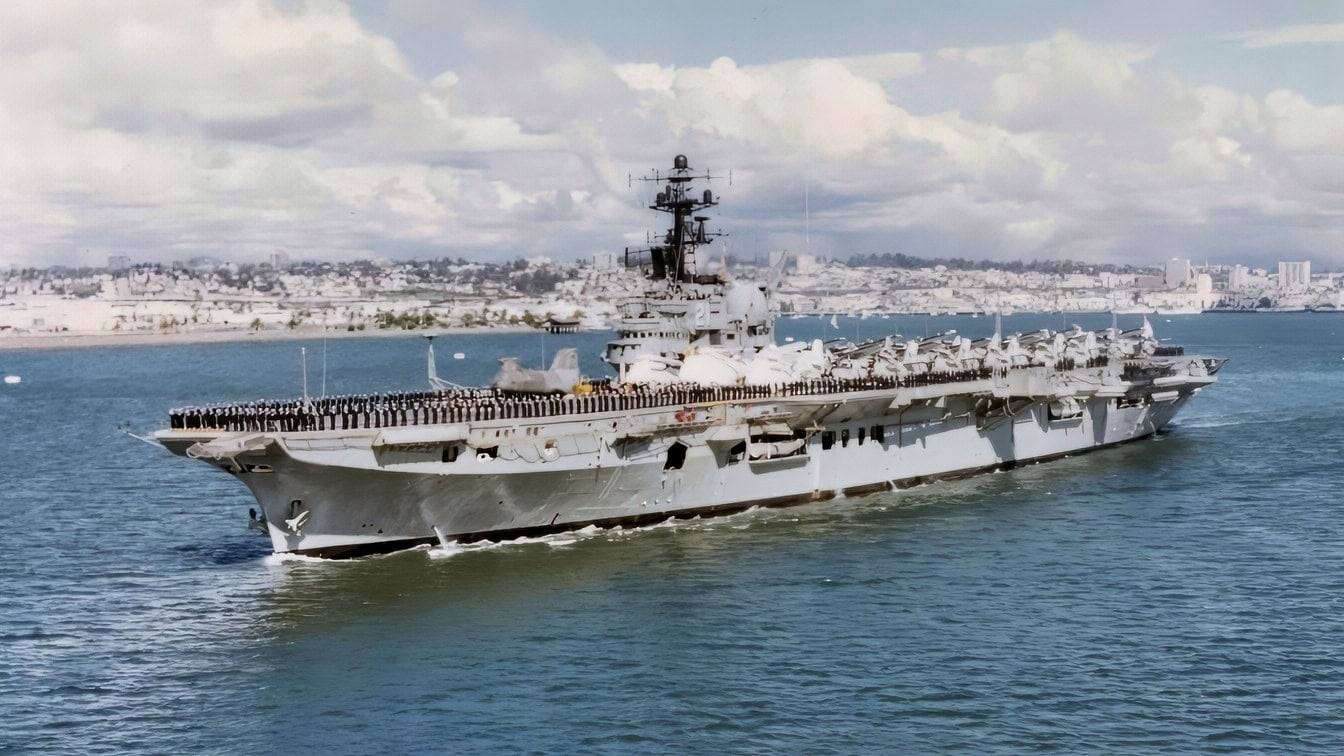
At 3:15 a.m. on June 3, 1969, the bow of HMAS Melbourne struck USS Frank E. Evans at 18 knots in the South China Sea. The Australian aircraft carrier cut the US Navy destroyer in two. Evans’s forward section sank in less than two minutes, carrying 74 sailors to their deaths. No enemy weapon was involved. The sea was calm, visibility was good, and both ships were taking part in the multinational SEATO exercise Sea Spirit.
Frank E. Evans was an Allen M. Sumner-class destroyer commissioned in February 1945. It had fought in World War II, Korea, and Vietnam. Melbourne was a light aircraft carrier conducting operations with destroyers assigned to work close to its stern. Those ships served as plane guards, ready to recover aircrew following a failed launch or landing.
Shortly after 3 a.m., Melbourne prepared to launch an S-2 Tracker. Evans was ordered from a screening position on the carrier’s port bow to a station 1,000 yards astern. The safe route involved turning away from Melbourne and passing behind it. According to the reconstructed maneuver sequence, Evans began a starboard turn toward the carrier.
The destroyer’s commanding officer, Cmdr. Albert S. McLemore, was asleep in his sea cabin. Lt. j.g. Ronald Ramsey held the deck, assisted by Lt. j.g. James Hopson. Their understanding of the formation had broken down. They disagreed over the carrier’s course and Evans’s speed, failed to seek a clear recommendation from the combat information center and did not call McLemore. Hopson took no visual bearing before starting the turn.
USS Frank E. Evans Turned Toward HMAS Melbourne
Melbourne was steaming on course 260 degrees at 18 knots. The carrier signaled its course and warned Evans it was on a collision course. Confusion on the American bridge persisted. One account recorded Ramsey interpreting Melbourne’s course as 160 degrees. Hopson saw the carrier’s bearing move in a way he did not expect and briefly ordered left rudder.

Aircraft Carrier HMS Melbourne. Creative Commons Image.
Captain John Stevenson watched Evans close from Melbourne’s bridge. He ordered the carrier’s navigation lights brought to full brilliance and transmitted another warning. With the destroyer still crossing ahead, Stevenson ordered hard port. Evans ordered hard starboard. The two emergency turns tightened the geometry instead of opening the distance.
Melbourne’s bow struck Evans on the port side near the rear of its forward funnel. The impact folded steel, severed steam and electrical lines, and split the destroyer across its width. One sailor on Evans’s signal bridge was thrown onto Melbourne’s flight deck. Men in forward berthing spaces had seconds to escape as the bow rolled and disappeared.
The forward section took almost all the dead with it. Australian government records place 198 survivors aboard Melbourne by 3:45 a.m. Some crossed directly from the floating stern after sailors lashed it to the carrier. Boats and Wessex helicopters collected others. Australian sailors jumped into the water to help. Several American survivors waved rescue craft toward shipmates in greater danger.
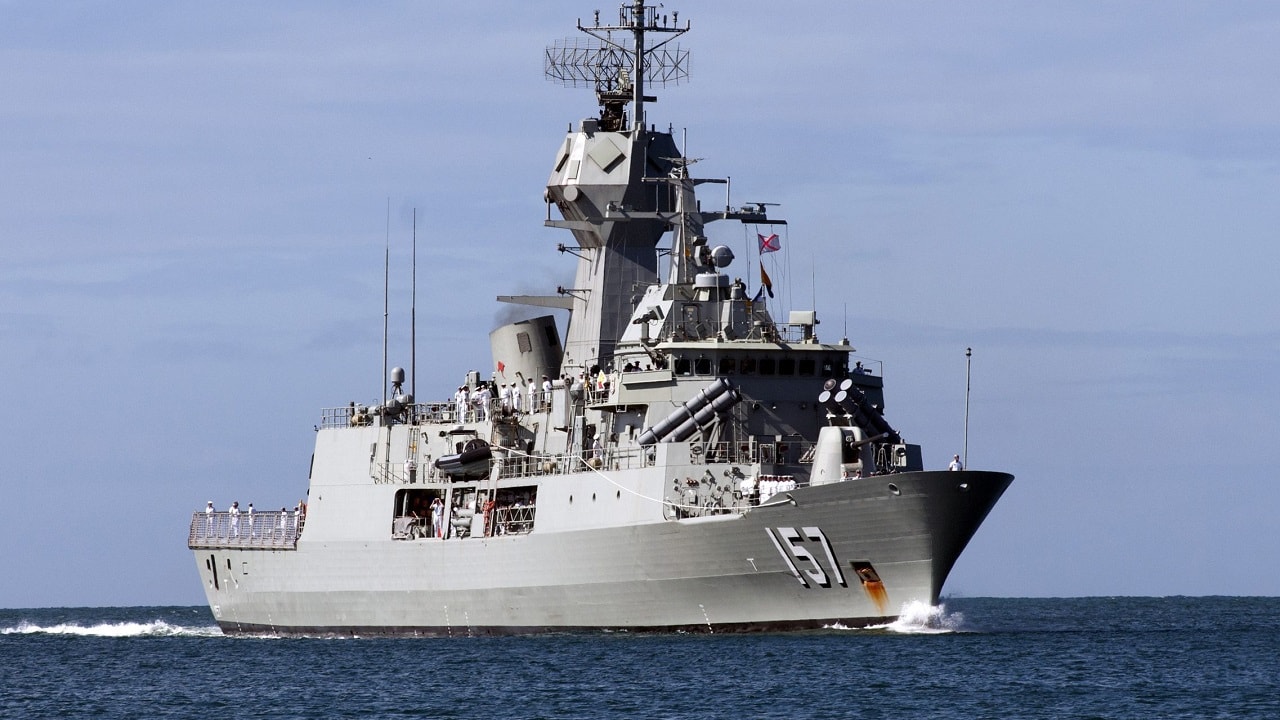
PEARL HARBOR (Jun. 28, 2012) – The Anzac class frigate HMAS Perth (FFH 157) of the Royal Australian Navy pulls into Joint Base Pearl Harbor-Hickam to support Rim of the Pacific (RIMPAC) 2012 exercise.
Only one body was recovered. Sailors in the forward engine room suffered cuts and scalding after ruptured steam lines filled the space. Melbourne lost no crew members.
HMAS Melbourne Needed a New Bow
Melbourne suffered severe damage forward of its collision bulkhead. The bow was holed, trim tanks flooded and damage-control teams installed emergency shoring. The carrier regained enough stability to proceed slowly and reached Singapore on June 6 with its flags at half-mast.
Temporary work allowed Melbourne to sail for Sydney. It entered Cockatoo Island Dockyard for permanent repairs and a replacement bow, remaining there until November. The carrier returned to service, though the accident deepened a grim reputation created five years earlier when Melbourne cut HMAS Voyager in two and 82 people died. The wider history of HMAS Melbourne became inseparable from the two destroyers lost beneath its bow.
Evans’s stern refused to sink. Salvage teams boarded it, and the fleet tug USS Tawasa towed the wreck to Subic Bay. The Navy decommissioned the surviving half on July 1, 1969, after stripping usable equipment.
The Collision Inquiry Damaged Careers and Strained an Alliance
A combined American-Australian board heard more than 100 hours of testimony from 79 witnesses. Its findings placed heavy responsibility on Evans’s bridge team while arguing Melbourne should have acted sooner. Australian officers challenged the process because Rear Adm. Jerome King, who presided over the inquiry, also held operational authority over forces involved in Sea Spirit.
Stevenson faced an Australian court-martial for failing to direct Evans more positively and failing to order full astern. The court cleared him of both charges. His naval career still suffered, and he resigned after receiving a shore assignment. In 2012, Australia’s defense minister acknowledged Stevenson had not been treated fairly.
Ramsey pleaded guilty to dereliction of duty and negligently hazarding a vessel. McLemore was convicted of the same offenses. The captain’s absence from the bridge formed only one part of the failure. The watch team lacked a shared tactical picture, missed basic cross-checks and continued maneuvering after its assumptions stopped matching the view outside.
The Navy Turned USS Frank E. Evans Into a Watchstanding Lesson
The central navigation lesson involved relative motion. A large ship on a steady bearing with decreasing range is closing, even when its movement across the horizon appears slow. Radar plotting, visual bearings, and information from the combat information center offered separate ways to test the bridge team’s assumptions. Evans used none effectively before the final turn.
The command lesson concerned authority. A junior officer unable to understand the tactical picture must slow the ship, move away from danger, summon the captain, or surrender the watch.
Rank offers no protection from geometry. Melbourne’s warnings provided several chances to interrupt the sequence.
Similar failures have appeared across generations. An unannounced maneuver caused the 1944 collision between USS Washington and USS Indiana. A watch team’s incomplete contact picture contributed to the 2009 collision between USS Hartford and USS New Orleans.
Modern sensors change the available tools. Command discipline, visual bearings and a willingness to challenge a faulty assumption still determine whether warning signs receive action.
The Navy later produced a training film titled I Relieve You, Sir for junior watch officers. On October 10, 1969, USS John R. Craig sank Evans’s stripped stern during target practice off Subic Bay. The forward half remained in the South China Sea, with 73 sailors unrecovered.
About the Author: Harry J. Kazianis
Harry J. Kazianis (@Grecianformula) was the former Senior Director of National Security Affairs at the Center for the National Interest (CFTNI), a foreign policy think tank founded by Richard Nixon based in Washington, DC. Harry has over a decade of experience in think tanks and national security publishing. His ideas have been published in the NY Times, The Washington Post, The Wall Street Journal, CNN, and many other outlets worldwide. He has held positions at CSIS, the Heritage Foundation, the University of Nottingham, and several other institutions related to national security research and studies. He is the former Executive Editor of the National Interest and the Diplomat. He holds a Master’s degree focusing on international affairs from Harvard University.

