
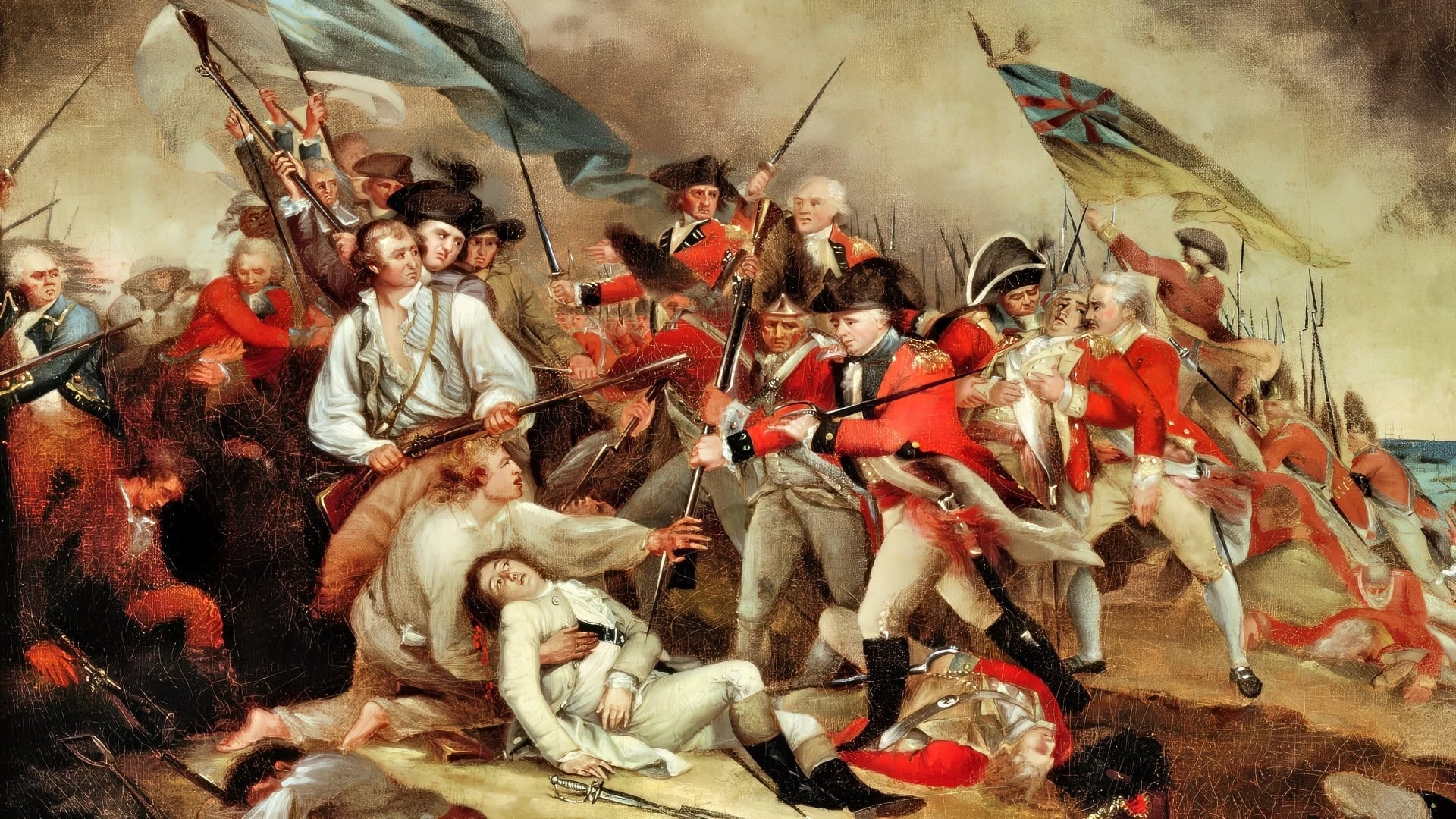
Every American knows the order: don’t fire until you see the whites of their eyes. It is the most famous command in the country’s history, and here is the honest truth about it, stated up front because the uncertainty is the story: nobody knows who said it, nobody wrote it down at the time, and the phrase itself is decades older than the battle it made famous. Tradition credits Colonel William Prescott with commanding the dirt fort on the hill. An older strain of testimony credits General Israel Putnam, who was probably never at the fort at all. Some aged veterans remembered Colonel John Stark saying it at the fence line.
And the deeper you dig, the further the words recede, until what remains is the thing they were always pointing at: a line of farmers with almost no gunpowder, holding their fire against the best infantry on Earth until the range was murder.
That happened. It is in every record. This is the story of the words, and of the day that earned them, 251 years on.
Who Said It?
The investigation reads like a detective story with no arrest.
No account written in 1775 contains the order.
The Revolution’s own first historians never mention it, and when Putnam’s authorized biography appeared in 1788, it said not a word about the most famous sentence supposedly ever spoken by its subject; the phrase entered popular history decades later, pushed along by Mason Weems, the same storyteller who invented George Washington and the cherry tree.
When the historian Richard Frothingham combed the veterans’ depositions in the nineteenth century, he found the fatal pattern and confessed it in a footnote: the famous phrases kept appearing, “the same one being often ascribed to different officers.”
Then came the embarrassment from abroad: Thomas Carlyle’s biography of Frederick the Great revealed Prussian commanders ordering men not to shoot till they saw the whites of their enemies’ eyes at Mollwitz in 1741, at Jagerndorf in 1745, and at Prague in 1757, a generation before Bunker Hill, and similar words are attributed to British General James Wolfe.
The verdict of modern scholarship is nearly unanimous: it was a common fire-discipline idiom of eighteenth-century armies, probably spoken in some form by several officers that day and coined by none of them.
Nor was it an exact measurement; at true whites-of-the-eyes range, a musket line would be overrun before it could shoot.
The documented orders were homelier: aim low, aim at the waistbands, pick off the officers in the handsome coats, wait for the splash guards on their legs, which led the historian Nathaniel Philbrick to observe that “Don’t fire until you see the whites of their half-gaiters” simply doesn’t have the same ring.
And yet the phrase attached itself to this battle and no other, for one excellent reason. Here, it describes something true.
The Night of Shovels
Two months after Lexington and Concord, thousands of New England militiamen had penned the British army inside Boston. In mid-June 1775, word reached the colonial command that the British planned to seize the high ground ringing the city, and on the night of June 16, Colonel Prescott marched roughly 1,200 men onto the Charlestown peninsula with orders to fortify Bunker Hill.
In the dark, for reasons argued about ever since, Prescott, Putnam, and the engineer Richard Gridley put the main fort on Breed’s Hill instead, lower but closer to Boston, a decision that guaranteed a battle.
Working in silence with picks and shovels, the men raised a square earthen redoubt in about six hours, and when dawn broke on June 17, the British woke to a fort that had not existed at sunset.
Warships opened fire; the British command, unwilling to let the challenge stand, chose a frontal assault to make an example, and by early afternoon, some 2,400 regulars, later reinforced, had been ferried across under Major General William Howe.
Three Assaults
It was a brutally hot day, and the British infantry advanced uphill through knee-high grass and over fences in wool coats and full packs.
On the American left, Stark’s New Hampshiremen threw up a stone wall on the Mystic River beach and lined a rail fence stuffed with hay; in the redoubt, Prescott’s exhausted diggers waited with perhaps a few rounds apiece, which is the fact underneath the famous words: with almost no powder, holding fire was not rhetoric but survival.
The first assault came in parade order, and the American line let it approach to point-blank range before the volleys tore it apart; the dead lay in rows in the grass.
The second assault, minutes later, ended the same way. Before the third, the regulars dropped their packs, some shed their coats, and came on with the bayonet as the American powder gave out entirely; the defenders met them throwing stones and swinging musket butts, and the redoubt fell in a bayonet melee.
In the retreat died the revolution’s first great martyr: Dr. Joseph Warren, president of the Massachusetts Provincial Congress, commissioned a major general days earlier, who had insisted on fighting in the redoubt as a common volunteer, killed by a ball as the position was overrun.
The Butcher’s Bill
The British held the hill, and the arithmetic of the victory horrified them.
Of some 2,400 engaged they counted 1,054 casualties, including 89 officers, killed or wounded, proportionally the bloodiest day the British army would suffer in the entire eight-year war; American losses were about 450.
British General Henry Clinton wrote afterward that another such victory would have ruined them, and London soon recalled the commanding general in Boston. The strategic lesson landed on both sides at once: untrained American militia, dug in and disciplined, could stand against regulars and make ground cost more than it was worth.
Two and a half weeks later, George Washington arrived at Cambridge to take command of what was now, demonstrably, an army.
251 Years
On Breed’s Hill today, where nearly all the fighting happened, stands the 221-foot granite obelisk of the Bunker Hill Monument, its cornerstone laid by Lafayette on the battle’s fiftieth anniversary, misnamed with perfect American stubbornness after the hill the battle was not fought on.
And the command still stands guard over the story, quoted in every classroom and barracks despite everything the historians have proved about it.
That is the right ending, because the words were never the point. Whether Prescott said them, or Putnam, or Stark, or several officers borrowing a phrase old soldiers had carried across the Atlantic, or no one at all, the men in the redoubt did the thing the sentence demands.
Out of powder, facing bayonets, they held their fire until the killing range, twice, and broke the two proudest assaults the British army ever marched up a hill.
The attribution is unsettled after 251 years.
The discipline was witnessed by everyone on the field, on both sides, and the British casualty rolls are its signature.
About the Author: Harry J. Kazianis
Harry J. Kazianis (@Grecianformula) was the former Senior Director of National Security Affairs at the Center for the National Interest (CFTNI), a foreign policy think tank founded by Richard Nixon based in Washington, DC. Harry has over a decade of experience in think tanks and national security publishing. His ideas have been published in the NY Times, The Washington Post, The Wall Street Journal, CNN, and many other outlets. He has held positions at CSIS, the Heritage Foundation, the University of Nottingham, and several other institutions related to national security research and studies. He is the former Executive Editor of the National Interest and the Diplomat. He holds a Master’s degree focusing on international affairs from Harvard University.

