
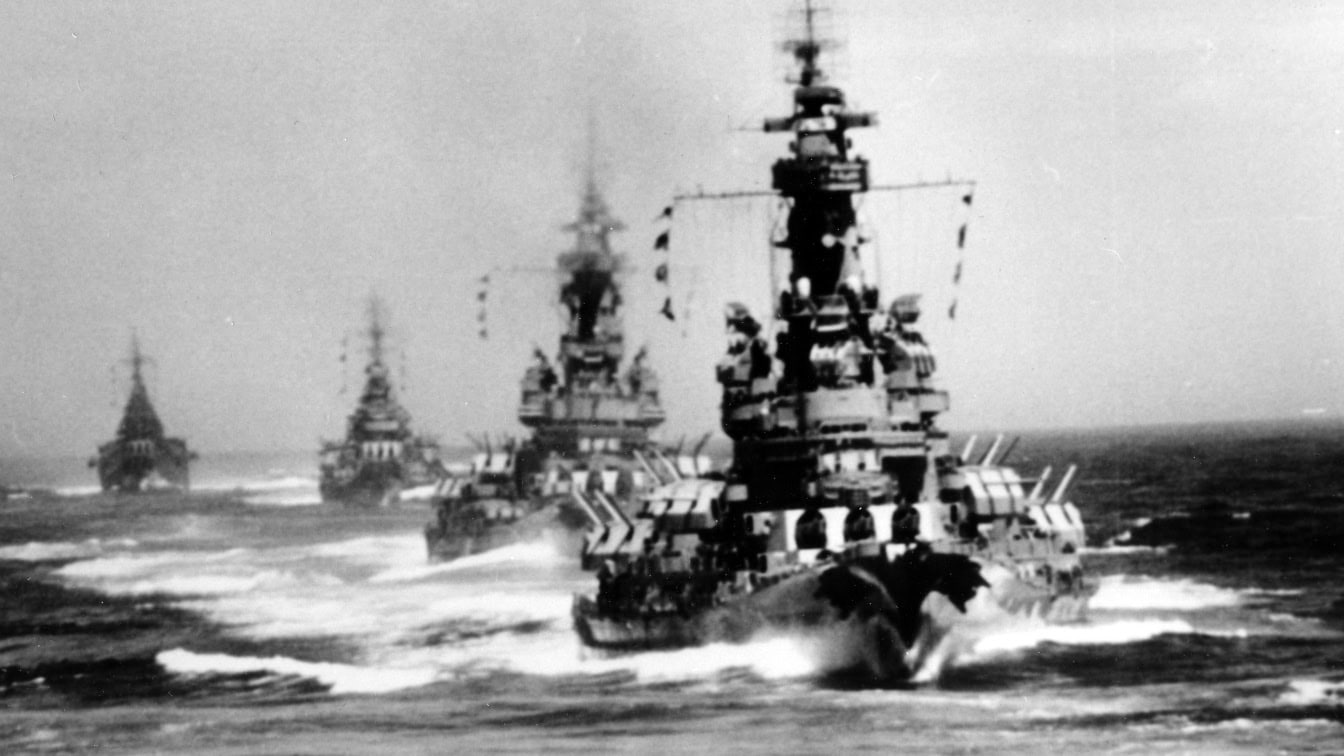
Summary and Key Points: The US Navy battleship USS Indiana was laid down at Newport News on 20 November 1939 and launched on 21 November 1941 — sixteen days before Pearl Harbor. She was the second of four South Dakota-class fast battleships, 680 feet long, 45,233 tons fully laden, carrying nine 16-inch/45 Mark 6 rifles behind a main belt 12.2 inches thick, and capable of 27.5 knots. What she actually did for most of the war was shoot at aircraft.
Meet the USS Indiana Battleship
Indiana is known as the “Hoosier” State, and in addition to being the home of the defending national champions of college football, it’s also a very military-friendly state—as evidenced by Camp Atterbury, which is where this writer did his pre-deployment training for his second Iraq stint—and despite not being a coastal state, it became the namesake of four United States Navy warships.
Today, we shall discuss the third such ship, which was not only the biggest and most famous of the bunch but indeed l: the World War II battleship USS Indiana (BB-58).
WWII Indiana (BB-58) Initial History, Premise, and Vital Stats
The WWII iteration of USS Indiana was the second vessel of the four-ship-strong South Dakota-class of fast battleships, along with the eponymous lead warship USS South Dakota (BB-57), USS Massachusetts (BB-59), and USS Alabama (BB-60).
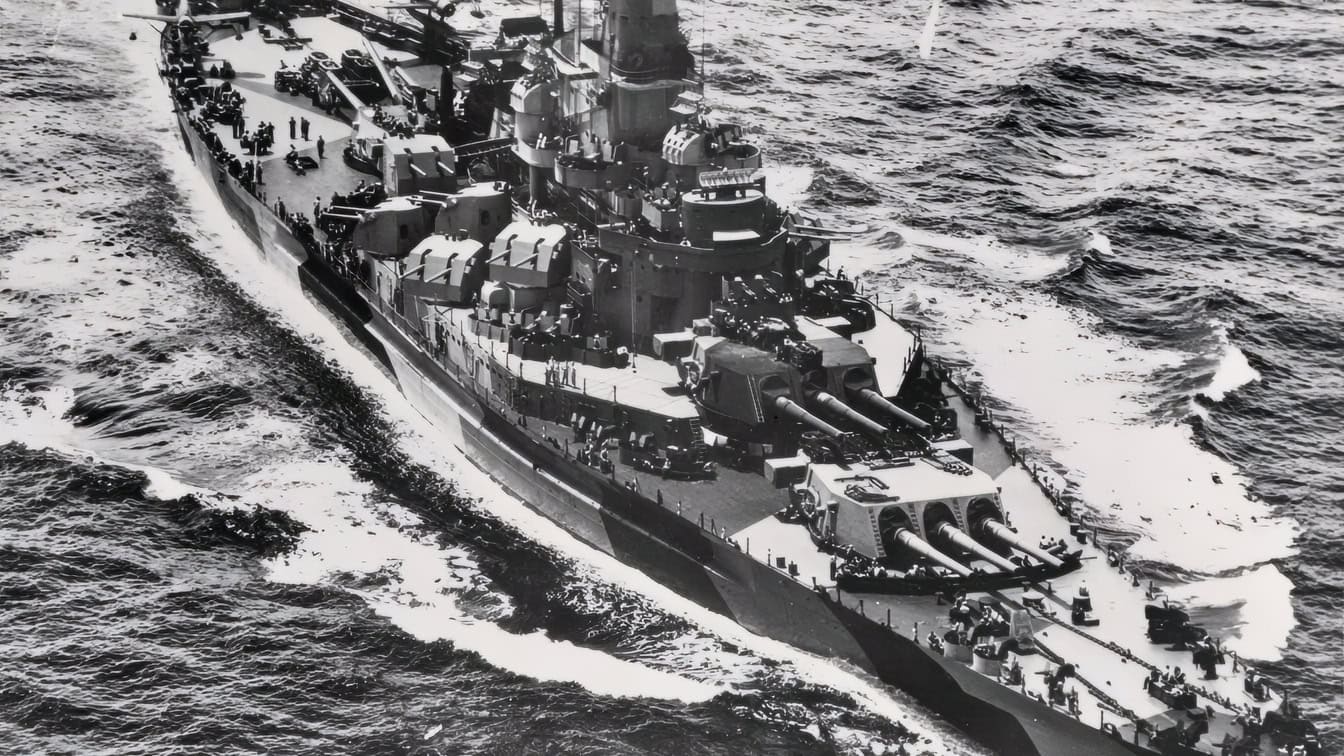
USS Indiana Image Credit Creative Commons
She was built by Newport News Shipbuilding—now a division of Huntington Ingalls Industries (HII)—in Newport News, Virginia; her keel was laid on 20 November 1939, she was launched on 21 November 1941—less than a month before America’s official entry into WWII via the Pearl Harbor raid—, and she was commissioned on 30 April 1942.
The Indiana’s main battery consisted of nine 16-inch (406 mm)/45 caliber Mark 6 guns, with two triple-gun turrets fore, one such turret aft.
Secondary armament consisted of 20 5-inch (127 mm)/38 caliber Mark 12 guns, and tertiary armament was 76 Bofors 40 mm and 67 × Oerlikon 20 mm anti-aircraft guns.
Additional key stats included a hull length of 680 feet, a beam width of 108 feet 2 inches, a draft of 36 feet 2 inches, and a fully laden displacement of 45,233 tons.
Max speed was 27.5 knots. 2,634 commissioned officers and 1,772 enlisted seamen comprised the crew complement. At its thickest point, the main armor belt was 12.2 inches.
Operational History in Brief
BB-58 was first “blooded” in combat during the Marcus Island Raid of 31 August 1943. That’s where she earned the first of her eventual nine battle stars, with the remaining eight earned thusly:
-1 Star/Gilbert Islands Operation, 13 Nov-8 Dec 1943
-1 Star/Marshall Islands Operation: Occupation of Kwajalein and Majuro Atolls, 29 Jan-8 Feb 1944
-1 Star/Asiatic-Pacific Raids: Truk, Satawan, Ponape Raid, 29 Apr-1 May 1944
-1 Star/Marianas Operation: Capture and Occupation of Saipan, 11 Jun-10 Aug 1944
-Battle of the Philippine Sea, AKA the “Great Marianas Turkey Shoot,” 19-20 Jun 1944
-Capture and Occupation of Guam: 12 Jul-15 Aug 1944
-Palau. Yap, Ulithi Raid: 25-22 Jul 1944
-1 Star/Western Caroline Islands Operation:
Capture and Occupation of the Southern Palau Islands, 6 Sep-14 Oct 1944; Assaults on the Philippine Islands, 9-24 Sep 1944
-1 Star/Iwo Jima Operation: Fifth Fleet raids against Honshu and Nansei Shoot, 15 Feb-16 Mar 1945; Bombardments of Iwo Jima: 11 Nov 1944-24 Jan 1945
-1 Star/Okinawa Gunto Operation: Fifth and Third Fleet raids in support of Okinawa Gunto
Operation, 17 Mar-11 Jun 1945
– 1 Star/Third Fleet operations against Japan: 10 Jul-15 Aug 1945
As for the Indiana’s specific kill tallies, her unofficial history page notes that “She bombarded Saipan 13-14 June and brought down several enemy aircraft while fighting off concentrated air attacks June 15.
As the Japanese fleet closed the Marianas for a decisive naval battle, INDIANA steamed out to meet them as part of Rear Admiral Lee’s battle line.
The great fleets approached each other on 19 June 1944 for the biggest carrier engagement of the war, and as four large air raids hit the American formations, INDIANA, aided by other ships in the screens and carrier planes, downed hundreds of the attackers…INDIANA shot down several planes, and sustained only two near torpedo misses.”
For good measure, BB-58 was also entitled to the Navy Occupation Service Medal for the occupation of Japan from 2-15 September 1945.
BB-58 was decommissioned on 11 September 1947, but remained in the Pacific Reserve Fleet—which, along with the Atlantic Reserve Fleet, formed the so-called “Mothball Fleet”—for 15 years. She was sadly and ignominiously consigned to the scrapyard, stricken from the Naval Register on 1 June 1962, and broken up the following year.
Thankfully, she wasn’t a total loss, as her mast and anchor have been saved: the former is erected at the University of Indiana at Bloomington, and the latter rests at Fort Wayne; other relics of hers are displayed in various museums and schools throughout the state of Indiana.
Two of Indiana’s sister ships *were* preserved for posterity as floating museums: (1) USS Alabama at Battleship Memorial Park in Mobile, Alabama; and (2) USS Massachusetts (” Big Mamie”) at Battleship Cove in Fall River, Massachusetts.
Meanwhile, the USS Indiana naming legacy continues with the Virginia-class attack submarine SSN-789, commissioned on 29 September 2018 and currently homeported in Pearl Harbor.
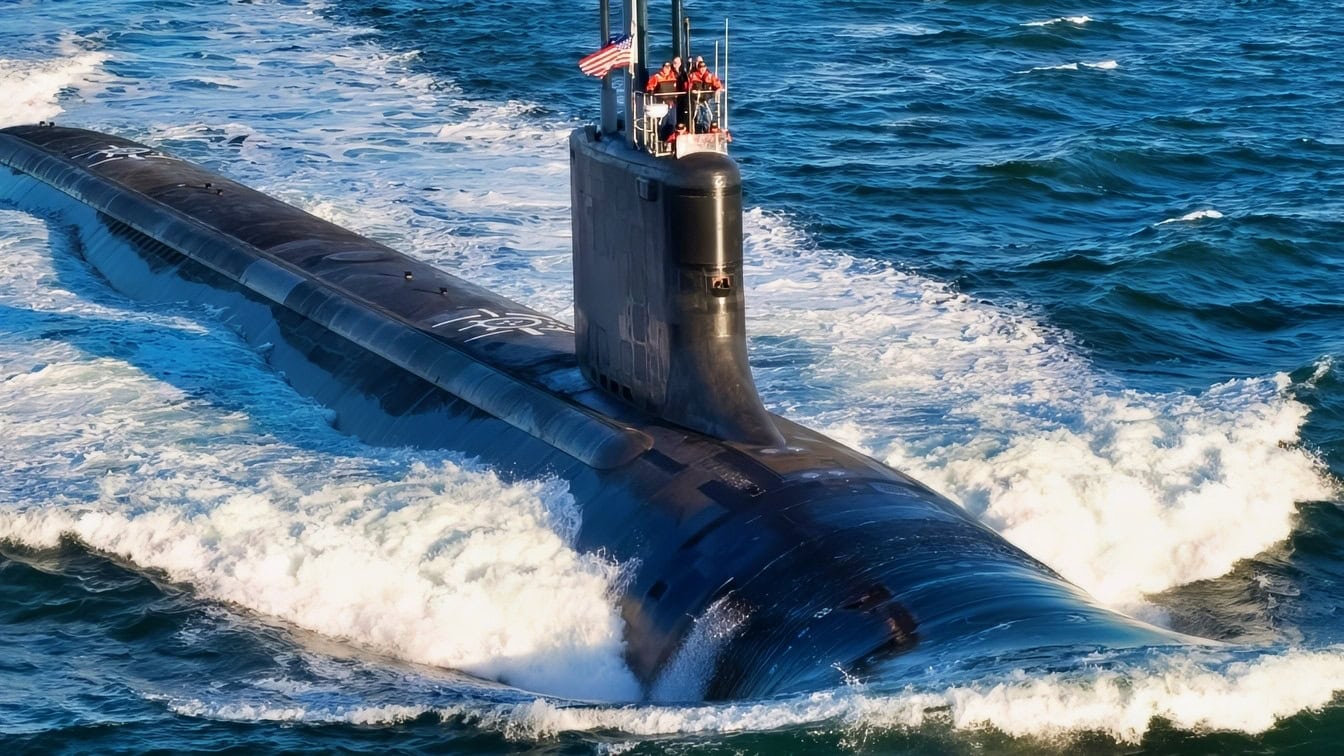
Virginia-Class Submarine SSN Creative Commons
About the Author: Christian D. Orr
Christian D. Orr is a Senior Defense Editor. He is a former Air Force Security Forces officer, Federal law enforcement officer, and private military contractor (with assignments worked in Iraq, the United Arab Emirates, Kosovo, Japan, Germany, and the Pentagon). Chris holds a B.A. in International Relations from the University of Southern California (USC) and an M.A. in Intelligence Studies (with a concentration in Terrorism Studies) from American Military University (AMU). He is also the author of the book “Five Decades of a Fabulous Firearm: Celebrating the 50th Anniversary of the Beretta 92 Pistol Series,” the second edition of which was recently published.