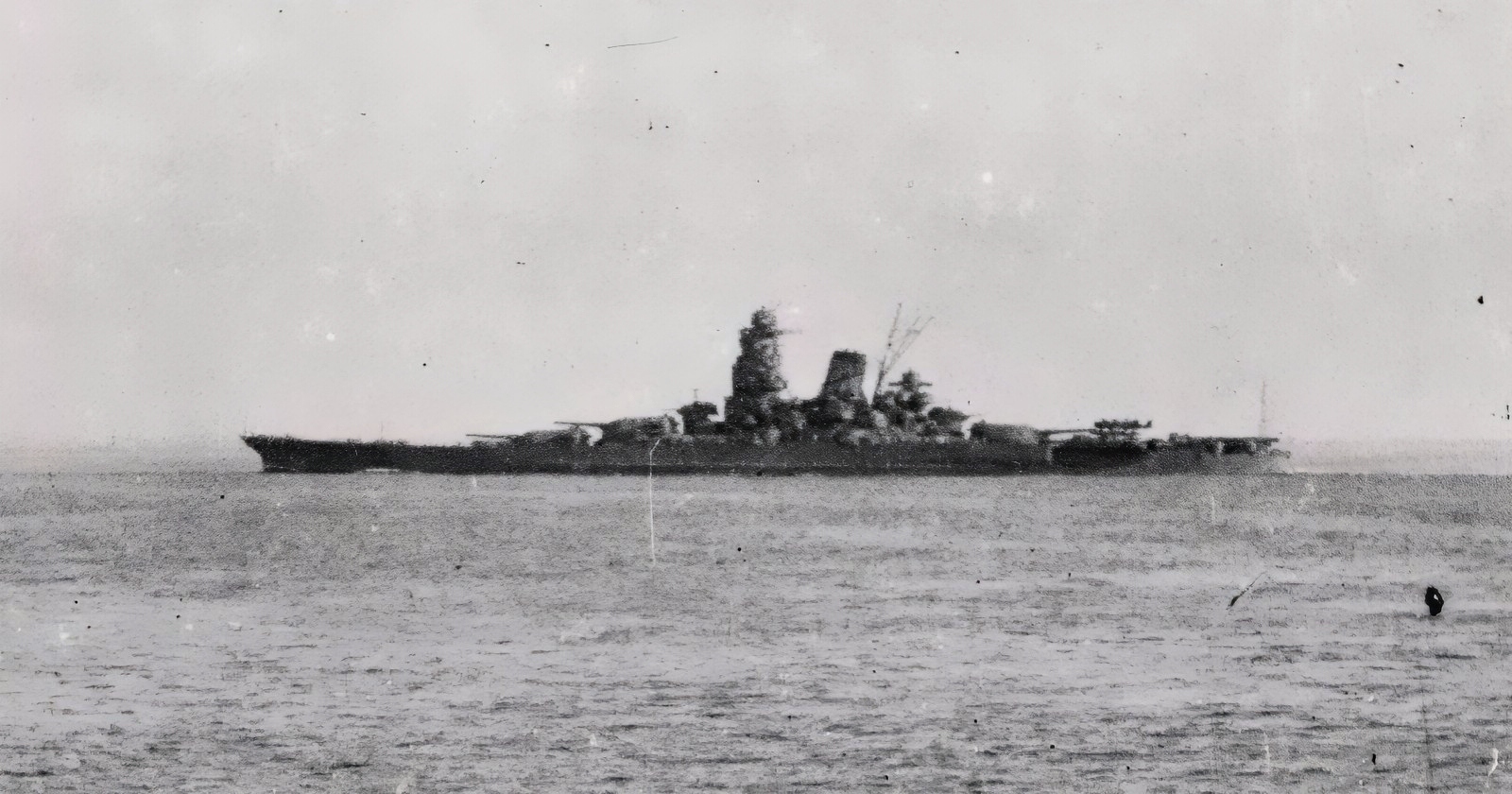
Japan’s most famous battleship is back in the spotlight more than 80 years after it disappeared beneath the East China Sea. The Yamato Museum in Kure, Hiroshima Prefecture, officially reopened in April this year after its first major renovation since opening in 2005. The museum, in the city where the Japanese Navy’s Yamato was originally built, has added hundreds of new exhibits and refurbished the centerpiece of its exhibition: a 26.3-meter-long, 1:10 scale model of the famous warship.
The ship displaced roughly 72,000 tons at full load and carried the largest guns ever mounted on a warship. It was designed to destroy American battleships in a surface engagement – but on April 7, 1945, American carrier aircraft destroyed her before she could even complete a one-way mission to Okinawa.
Japan Built the Biggest Battleship Ever: Meet the Yamato
Japan began designing Yamato in the 1930s, when naval planners recognized that the country could not compete with the industrial capacity of the United States’ industrial capacity.
Japanese designers theorized they could achieve superiority in individual ships, and work on the Yamato began in 1937 under extreme secrecy.
Work began at the Kure Naval Arsenal, and the shipyard itself required substantial modifications to accommodate the massive new vessel.
When complete, Yamato measured 863 feet long.
Her main battery consisted of nine 18.1-inch guns arranged in three triple turrets, each capable of firing a roughly 3,200-pound projectile over 20 miles.
And it wasn’t just built for firepower — it was made to withstand enormous punishment.
It had thick steel armor protecting the ship’s sides, and even heavier armor protecting its giant gun turrets.
The idea was that the Yamato could survive hits from enemy battleships while using its much larger guns to destroy them at long range.
In theory, it was a mighty piece of equipment, and the Japanese had high hopes for the vessel.
Yamato entered service in December 1941, only days after Japan attacked Pearl Harbor. But the war quickly proved that the kind of naval battle Yamato was designed for was becoming unlikely.
Aircraft Changed Naval Warfare
Initially, Japan expected battleships to play a major role in a future conflict with the United States Navy.
Instead, aircraft carriers became especially important during the Pacific War, allowing ships to attack each other from hundreds of miles away.
Yamato therefore saw little action in the first years of the conflict, even as the battleship served as the flagship of Japan’s Combined Fleet. It took part in major operations, but its massive guns were rarely used against any American ships.
That finally changed during the Battle of Leyte Gulf in October 1944, when Yamato fired its main guns at American forces.
That battle proved just how vulnerable massive battleships had become, with Yamato’s sister ship, Musashi, being repeatedly attacked by American carrier aircraft and sunk on October 24 after it was hit by a number of bombs and torpedoes. By 1945, Japan’s position was so weakened of was desperate.
Yamato Sent to Okinawa
American troops landed on Okinawa on April 1, 1945.
This meant a major U.S. force was now only hundreds of miles from Japan’s home islands.
Japan responded by launching Operation Ten-Go, with Yamato leaving Japan on April 6, accompanied by Yahagi, a light cruiser, and eight destroyers.
The ships were to sail to Okinawa and attack the invading American fleet — but they had virtually no protection from Japanese aircraft.
It was a one-way mission, and the Japanese knew it.
If Yamato survived long enough to reach Okinawa, the operation called for the battleship to deliberately run onto the shore and, from there, its crew would keep firing its guns at American forces until they ran out of ammunition.
Any of the surviving sailors were then expected to leave the ship and fight alongside the Japanese troops already on the island. But Yamato never even got close.
American Subs Discovered Yamato
Soon after Yamato departed, American submarines spotted it, and U.S. aircraft tracked the ship as it headed south.
On April 7, American aircraft carriers then sent hundreds of planes to attack the ship.
Yamato’s crew fought back with the ship’s anti-aircraft guns, but without sufficient Japanese fighters to support them, they had little to do.
Torpedoes struck the ship, and Yamato began to list. Eventually, the damage became impossible to control.
Yamato Explodes
At around 2:20 pm, Yamato rolled onto its side.
When the ship’s ammunition storage areas detonated, the ship exploded and sent a huge cloud of smoke into the air. The battleship then sank.
The incident resulted in the deaths of more than 3,000 members of the Yamato crew. Fewer than 300 survived.
The cruiser and four Japanese destroyers were also sunk during the same attack.
Yamato was built to do something much bigger, and while it failed in combat, Japan did prove it could build something enormous.
Planners simply built the wrong thing.
About the Author: Jack Buckby
Jack Buckby is a British researcher and analyst specializing in defense and national security, based in New York. His work focuses on military capability, procurement, and strategic competition, producing and editing analysis for policy and defense audiences. He brings extensive editorial experience, with a career output spanning over 1,000 articles at 19FortyFive and National Security Journal, and has previously authored books and papers on extremism and deradicalization.