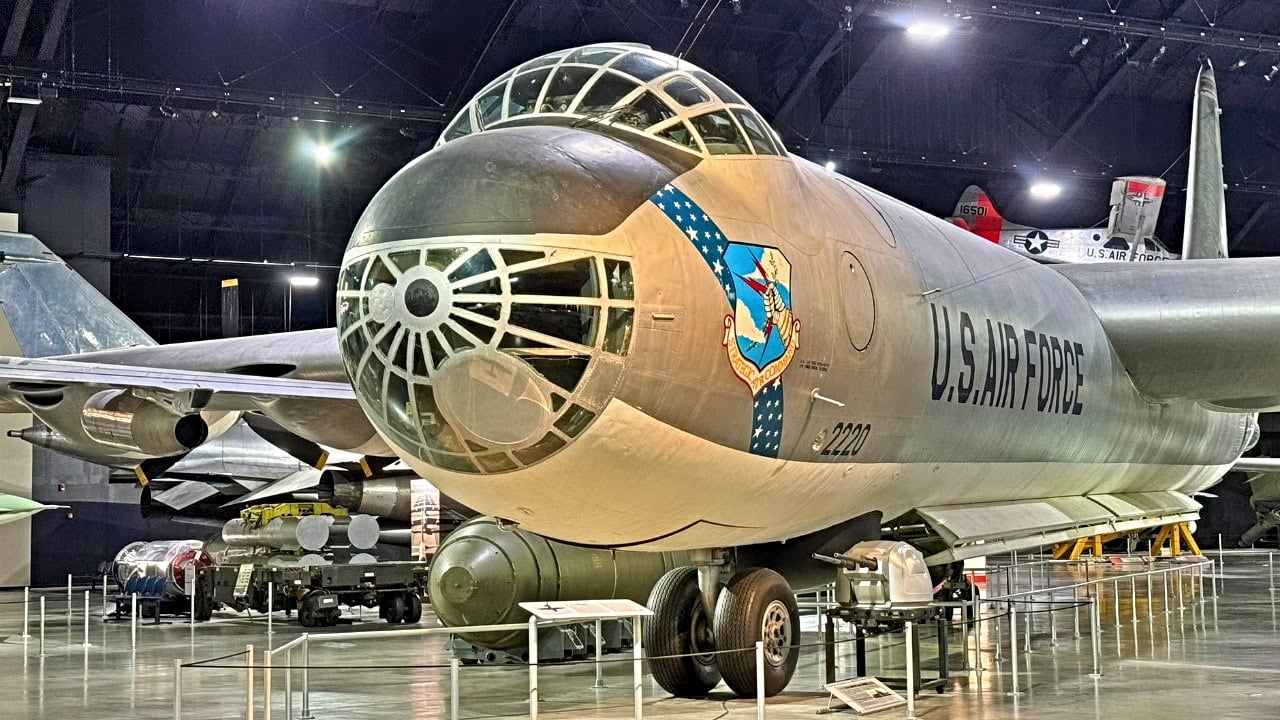
The United States Air Force’s Convair B-36 Peacemaker was an expensive, slow early Cold War bomber. It was wildly expensive for its time, too (contributing to the controversy). The plane was massive, and throughout its long service life, many American officials doubted its relevance to the modern battlefield. But the Air Force persisted in building more of these planes.
Five Attempts on the B-36’s Life
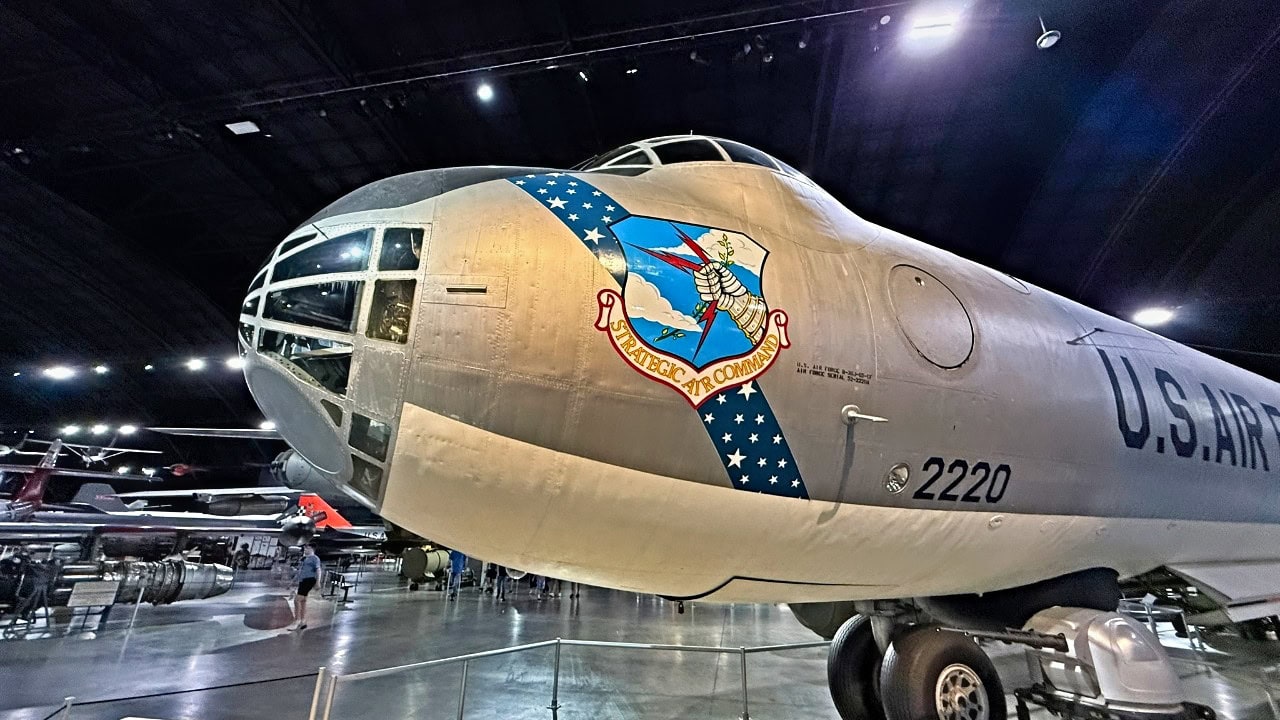
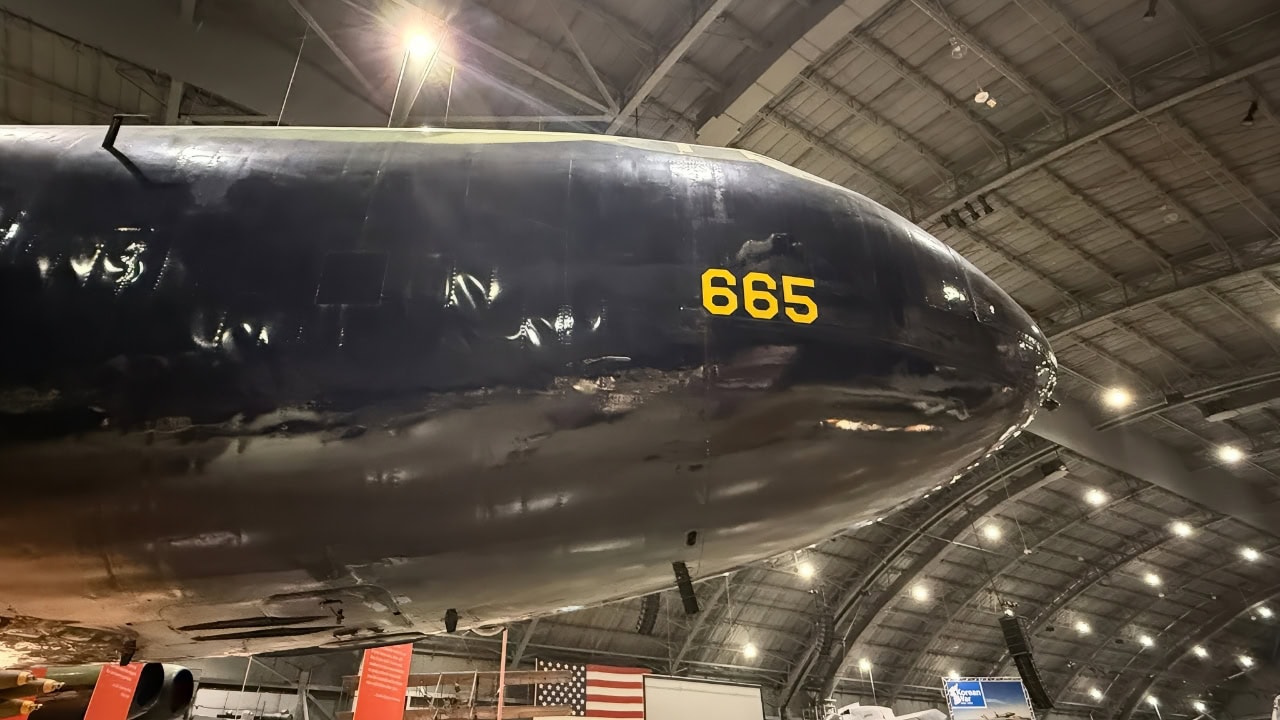
B-36. 19FortyFive.com Original Photo from 2025.
In fact, the B-36 endured about five serious attempts to cancel it between the Second World War and the early Cold War years.
Despite resistance, the military kept this unpopular plane because it lacked any alternative at the time.
It also makes sense that in the early days of the Cold War, the Air Force kept the B-36 Peacemaker flying to ensure it had something to counter the Soviets.
That’s especially because the B-36 Peacemaker had something that no other plane at the time had.
That came from a 1941 requirement the US military put in for the plane’s design. At the time the B-36 was being developed, there were major fears in Washington, D.C., that the British Empire was going to fall to the Nazi onslaught throughout Europe.
With that in mind, the Army Air Forces (the precursor to the modern Air Force) needed a plane that could strike targets in Europe from bases across the Western Hemisphere.
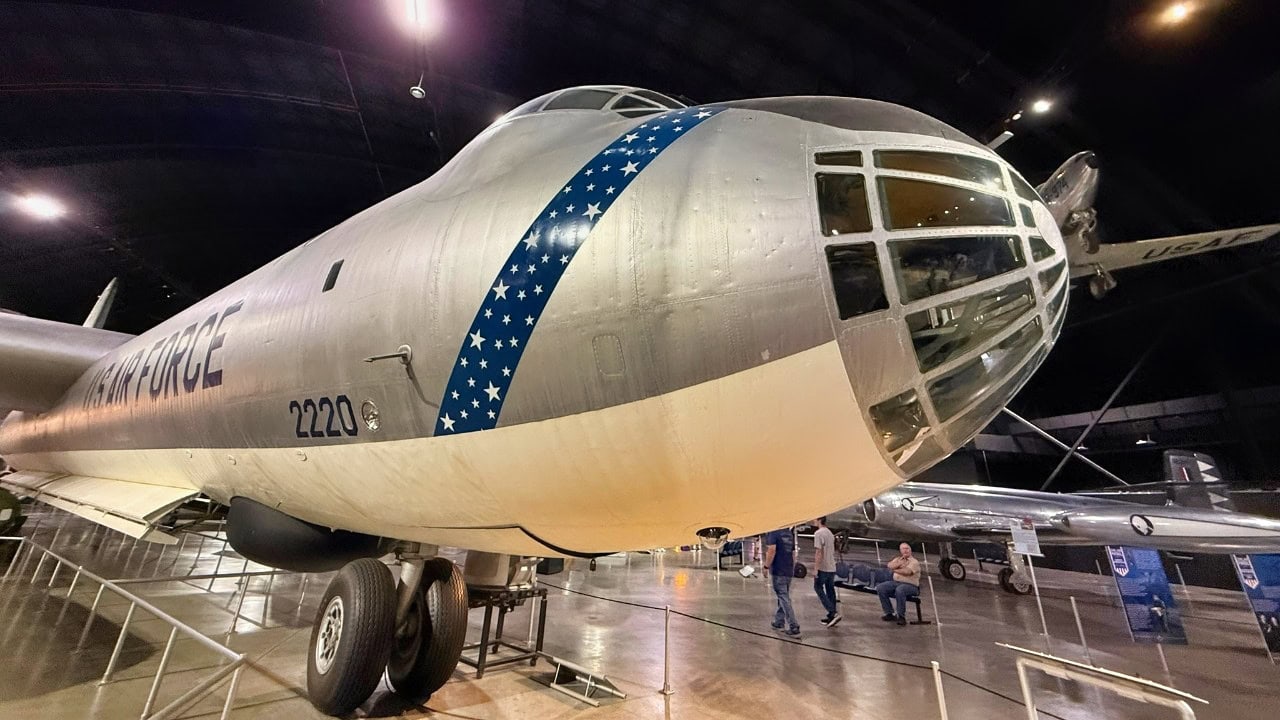
B-36 Bomber 19FortyFive Image.
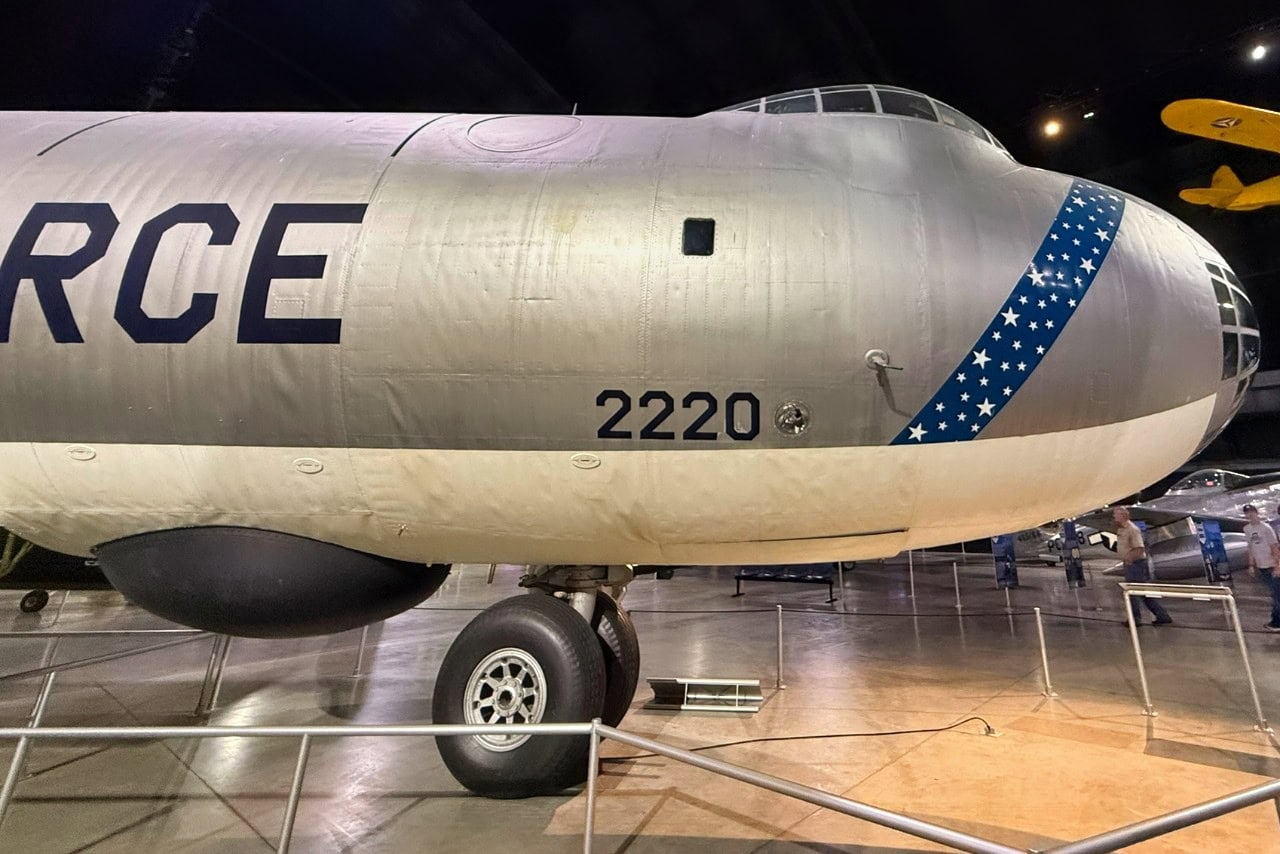
B-36 Bomber Dayton, Ohio USAF Museum. Image Credit: 19FortyFive.com/Harry J. Kazianis
So, the B-36 was the largest mass-produced piston-powered aircraft ever built.
It had a 230-foot wingspan. Eventually, the Peacemaker was upgraded with six Pratt & Whitney R-4360 piston engines and four General Electric J47 turbojets.
Those who maintained and flew the aircraft called the B-36’s unique engine design “six turning and four burning.” The monstrous plane could carry up to 86,000 pounds of bombs—all while still having a range of nearly 10,000 miles.
A Powerhouse
Too bad for World War II-era bomber jockeys, the B-36’s development was slower than anticipated.
As a result, the prototype of the plane — the XB-36 — didn’t hit the unfriendly skies until 1946, a year after WWII ended in a decisive Allied victory.
Jet engines were already becoming common, meaning the “new” B-36 Peacemaker risked becoming obsolete before the US military even deployed it.
In fact, the first attempt to end the B-36 came as early as 1945.
At the time, the Army Air Forces were contracted for 100 B-36s. As victory neared, though, Washington was already viciously slashing the United States’ defense budget.
Wartime production was slowing, and people were talking about returning to civilian-level production. On May 25, 1945, the military reduced its overall aircraft production by nearly 17,000 planes.
The B-36 was very much on the chopping block.
General Henry “Hap” Arnold personally intervened and approved an Air Staff recommendation to preserve the program on the same day that the atomic bomb was dropped on Hiroshima.
That extremely long-range requirement paired with a massive bomber load made it irresistible for the Army Air Forces to cut–especially as early talk was underway about the rising threat of the Soviet Union to the United States and the postwar order that was being established.
A year later, in December 1946, Gen. George Kenney, commander of Strategic Air Command (SAC), wanted to reduce the 100-plane B-36 Peacemaker fleet to just a handful.
He considered the B-36 too slow and doubted its stated combat range.
Instead, Kenny wanted the B-50, which was an augmented B-29.
But Lt. Gen. Nathan Twining disagreed.
Twining believed the plane’s massive range made it worth whatever headaches its early development might have caused.
Gen. Carl Spaatz sided with Twining and countermanded Kenney’s wishes.
Too Big a Gap to Fill
A year thereafter, in 1947, the Air Force Aircraft and Weapons Board contemplated canceling the program again.
They fixated on the fact that the plane was piston-driven in the jet-and-nuclear age.
The panel disagreed about whether faster jet bombers or the B-50 bomber would have better met the Air Force’s needs.
At the time, however, jet engines lacked the intercontinental range that the B-36 already possessed.
Eventually, jet engines would become capable of intercontinental travel.
In 1947, however, that was still years away.
Convair then proposed the B-36C, which the firm billed as possessing more powerful variable-discharge turbine engines.
But the firm never made the engines.
So, the Air Force contemplated killing that program once more.
The Air Force had already invested so much in the program that, by the Spring of 1948, flight testing showed the plane performed better than critics claimed, prompting the Air Force to hold off again.
In fact, when the Soviet Union initiated the infamous Berlin Blockade, the B-36 became very important.
Although the B-36C, with its proposed variable-engine-discharge turbine engines, never materialized, necessity made the B-36 Peacemaker a vital deterrent.
The B-36B was configured as an augmented variant of the B-36As already in service.
Then came the final battle in 1949.
Defense budgets were strained.
The Air Force wanted land-based strategic bombers to be the centerpiece of America’s growing nuclear triad.
The Navy, however, wanted its carrier-based planes to conduct nuclear strikes.
The media was ganging up on the B-36 Peacemaker, and prominent congressmen took up the cause.
A massive congressional investigation into accusations that the B-36 existed solely because of political favoritism ensued.
Congress ultimately cleared both the Air Force and Convair of these baseless claims.
Nevertheless, the congressional investigations triggered a wider debate about whether nuclear bombing should be as essential for the Air Force as the Air Force desired.
Ultimately, the Air Force won the day.
The B-36 remained in production until 1954.
The Air Force built nearly 400 units from the end of WWII to 1954. Interestingly, the plane never dropped a bomb while in service.
The B-52 Finally Replaced the B-36
By the 1960s, the B-36 Peacemaker was replaced by the B-52 Stratofortress, a jet-powered bomber that finally provided the combination of range, speed, and payload the Air Force had wanted since the late 1940s.
B-52D Bomber at USAF Museum. Photo by Harry J. Kazianis for 19FortyFive.
But the Peacemaker was actually a good plane.
It just had the problem of existing at a time of radical technological change and capabilities within the United States Armed Forces.
While it never dropped a bomb in combat, had it been required to do so, the B-36 would have been a devastating plane against the Soviets.
The Air Force’s later acquisition of the jet-powered B-52 bomber shows how essential the B-36 was in the early Cold War.
Had the critics prevailed, the United States would have remained highly vulnerable to the Soviet threat for a long time.
About the Author: Brandon J. Weichert
Brandon J. Weichert is the Senior National Security Editor at 19FortyFive.com. He also manages The Weichert Brief on Substack. Weichert also hosts “National Security Talk” on Rumble. He is the author of four bestselling national security books, most recently A Disaster of Our Own Making: How the West Lost Ukraine (Encounter Books). Follow him via Twitter/X @WeTheBrandon.