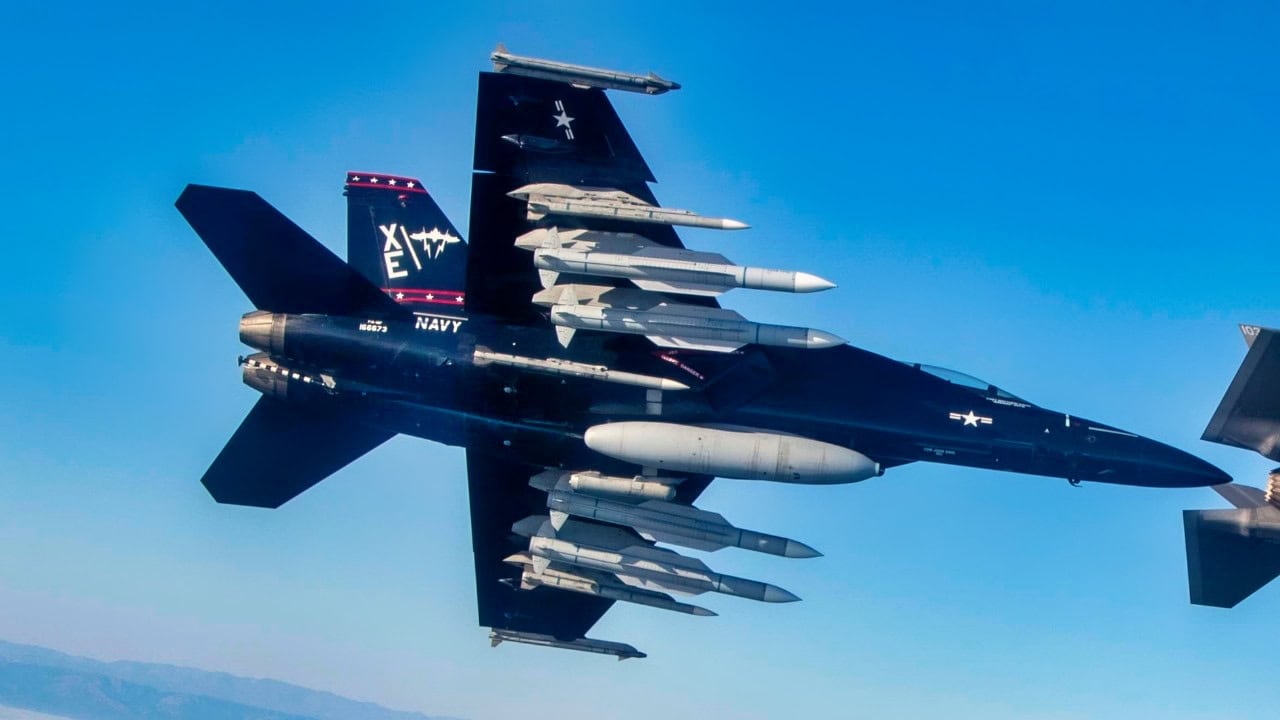
Summary and Key Points: On March 25, 2026, the IRGC claimed it downed a US Navy F/A-18 Super Hornet Block III near Chabahar, 100 miles inland; its own video shows a Chinese QW-12 or FN-16 MANPADS missing as the jet turned into the shot; CENTCOM denied any loss. Block III upgrades took the Super Hornet from 6,000 to 10,000 flight hours, added 3,500 pounds of conformal fuel, DTP-N sensor fusion, and a reduced radar signature across 13,000 Iran sorties.
What Makes the F/A-18 Block III Super Hornet Special
On March 25th, 2026, the Iranian Revolutionary Guards Corps claimed they shot down a US Navy F/A-18 Block III near Chabahar in eastern Iran near their border with Pakistan.
The IRGC released a low-resolution video showing the Navy jet close to the ground, strafing an unseen ground target with its 20mm cannon.
The footage shows the F/A-18 turning into the missile, dropping its tail to reduce the heat signature of its jet exhaust.
The missile approaches at a right angle to the Super Hornet, and its proximity fuse detonates the shaped-charge warhead, spewing shrapnel behind the aircraft to the right and away from its turn.
A clean miss.
The Super Hornet leveled out and continued its mission.
CENTCOM was quick to rebut the IRGC claims on social media, stating no F/A-18 Super Hornet had been shot down or even damaged.
One Of The Latest Chinese Missiles Couldn’t Touch One Of The Oldest US Aircraft
The missile that missed was likely a Chinese-made QW-12 or FN-16 man-held portable missile, or MANPADS.
Both systems entered service between 2008 and 2012 and aren’t considered obsolete, but after missing that clear shot at a US Navy strike aircraft that dates back to 1975, perhaps that assessment should be revisited.
It’s also worth noting that this Super Hornet over Chabahar, Iran, was more than 100 nm from the sea. That’s pretty far inland for Navy aircraft, which first have to come from a carrier hundreds of miles offshore.
The Hornet Was Made To Replace Several Aircraft
The original F-18 Hornet was built to replace several Navy strike aircraft in service, like the A-4 Skyhawk, A-6 Intruder, and F-4E Phantom, and to fill in for the F-14 Tomcat, which was a maintenance hog when it came to getting into the air.
The Navy considered what became the F-16 Falcon, which the Air Force adopted, but the F-16 had a single engine, and the F-18 had two.
The Navy had an old saying about jets flying long distances over water: “Better to lose an engine over water than to lose THE engine.”
The retirement of the F-14 and delays in the F-35 program left a yawning chasm that the Hornet stepped in to fill.
It was tasked not only with carrier defense, but also with light strike, then two-seat precision strike, and even electronic warfare.
Like an aging Hollywood starlet with so much plastic surgery that it becomes unrecognizable, the F/A-18 Block III is now almost an entirely different aircraft, as its retirement coincides with more F-35B and C models entering the fleet.
The Super Hornet Block III Got Its Licks In During The Iran Conflict
The US has flown about 13,000 combat sorties in the Iran war so far, and given the number of Hornets on the five Navy aircraft carriers that have launched combat sorties in the conflict, the Super Hornet has gotten its fair share, and more.
A picture circulating online recently showed an F/A-18 Super Hornet from VFA-41 sporting a painted kill tally of an Iranian submarine on its fuselage.
The last time any Navy aircraft made such a boast was in WWII.
Keeping The “Super” in Super Hornet
The current and latest version of the many upgrades and enhancements to the original F-18 Hornet has a name as long as a 17th-century German archduke;
The F/A-18E/F Super Hornet Block III.
What did it take to keep this fifty-year-old jet design relevant and survivable on the modern battlefield?
First, its in-flight lifespan was expanded from 6,000 to 10,000 hours.
Rather than designing an entirely new airframe for the Block III, they precisely reinforced certain stress points from bomb loads, G forces, and landing shock.
To extend operational range, they added two conformal fuel tanks above the engine intakes, adding 3,500lbs of fuel.
This is a very useful addition. They minimize the drag tradeoff of underwing drop tanks and do not have to be jettisoned in combat.
The Super Hornet received an advanced cockpit system with a customizable 10×19-inch touchscreen and a large display area for maps and targeting information.
DTP-N Distributed and Tactical Targeting Network Technology for fast sensor fusion.
Technical details aside, this lets a ship, drone, or other aircraft feed targeting data directly to the Block III computer.
Instead of the pilot using the sensors to find targets to shoot at, the sensors find the targets and ask the pilot if he wants to expend ordnance on them.
They also tried to reduce the Super Hornet’s considerable radar signature.
All those right angles and bombs slung under the wings make the aircraft huge on a radar screen.
While they couldn’t make the Super Hornet stealthy, they reduced its signature to something more bird-sized with conformal fuel tanks, radar-absorbing coatings, aligned flight-surface edges, saw-tooth panels to break up radar-return signals, and efforts to eliminate radar-wave-trapping right angles on the fuselage.
The F-35s will gradually replace the Block III Super Hornet in the fleet.
Undefeated in the air, they will at last succumb to the only unstoppable foe in the universe, the march of Time.
Primary Function: Multi-role attack and fighter aircraft
Contractor: McDonnell Douglas (now The Boeing Company)
Date Deployed: First flight in November 1995.
Unit Cost: $67.4 million (FY21)
Propulsion: Two F414-GE-400 turbofan engines. 22,000 pounds (9,977 kg) static thrust per engine
Length: 60.3 feet (18.5 meters)
Height: 16 feet (4.87 meters)
Wingspan: 44.9 feet (13.68 meters)
Weight: Maximum Takeoff Gross Weight is 66,000 pounds (29,932 kg)
Airspeed: Mach 1.8+
Ceiling: 50,000+ feet
Range: Combat: 1,275 nautical miles (2,346 kilometers), clean plus two AIM-9s
Ferry: 1,660 nautical miles (3,054 kilometers), two AIM-9s, three 480-gallon tanks retained
Crew: A, C, and E models: One
B, D, and F models: Two
Armament: One M61A1/A2 Vulcan 20mm cannon; AIM-9 Sidewinder, AIM-9X, AIM-7 Sparrow, AIM-120 AMRAAM, Harpoon, Harm, SLAM, SLAM-ER, Maverick missiles; Joint Stand-Off Weapon (JSOW); Joint Direct Attack Munition (JDAM); Data Link Pod; Paveway Laser Guided Bomb; various general-purpose bombs, mines and rockets(Kitchen Sink).
About the Author: Sean Spoonts
Sean Spoonts is the former Editor-In-Chief of SOFREP.com. He is a military analyst, writer, and commentator whose work has appeared in Newsweek, CNS News, Ukrinform, and various military/veteran media networks and professional publications, including the Military Intelligence Professional Bulletin. He is a U.S. Navy veteran, having served as an Aviation Anti-Submarine Warfare Operator and Search and Rescue Helicopter Aircrewman.