
Summary and Key Points: Expert Christian D. Orr recounts USS Illinois (BB-65), the Iowa-class battleship laid down at Philadelphia Naval Shipyard on December 6, 1942: 887 feet, 58,460 tons, 32.5 knots, nine 16-inch Mark 7 guns. The Bureau of Ships sketched a Shinano-style carrier conversion before choosing Essex-class carriers; the Navy canceled her at 20-25 percent complete, struck her August 12, 1945, and scrapped her on the slipway in 1958. Her bell rings for Illini touchdowns; SSN-786 carries the name.
Iowa-Class Battleship USS Illinois Is Lost Military History
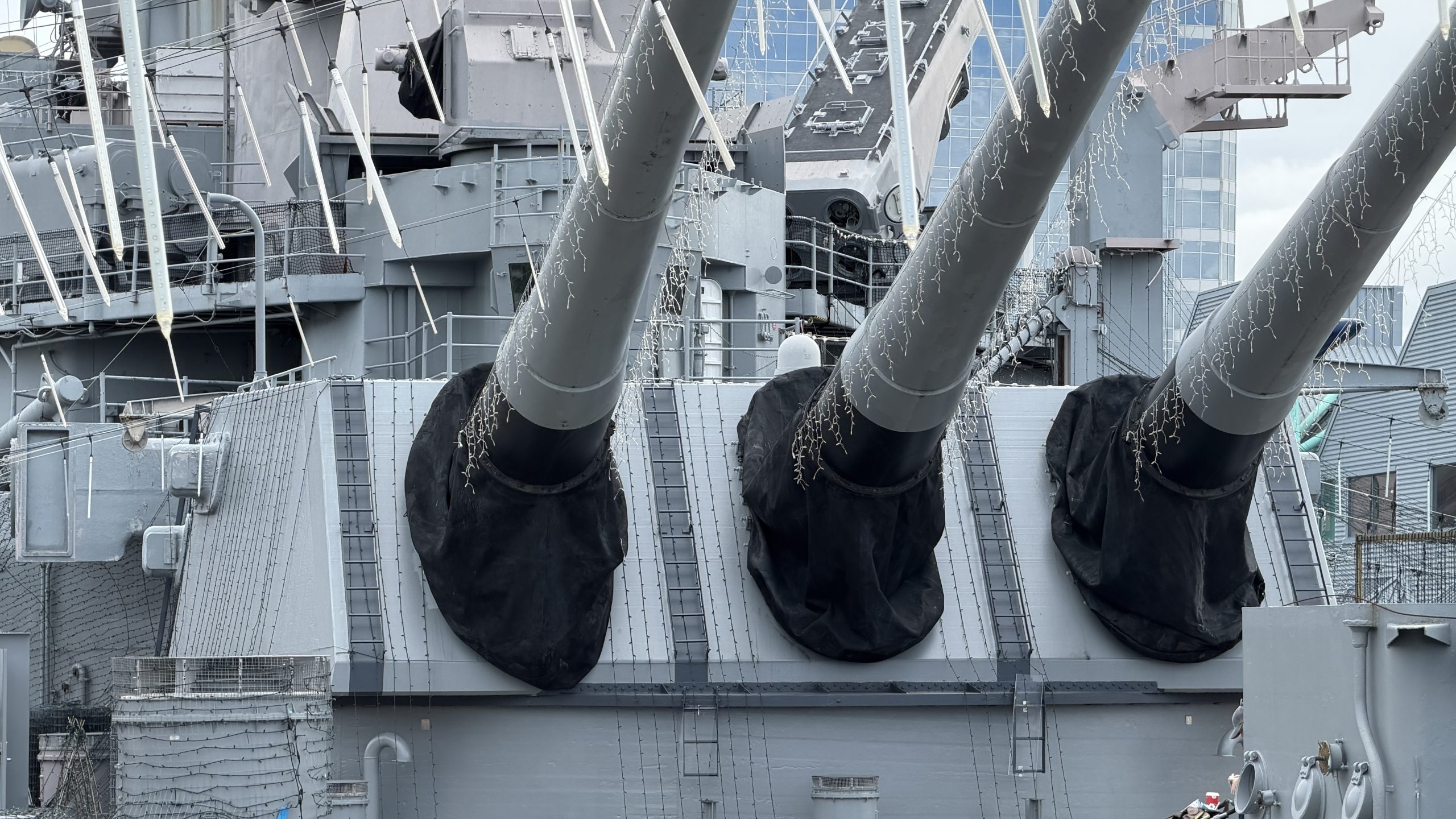
USS Wisconsin Iowa-Class Battleship Tour. Photo by 19FortyFive Reporter Christian D. Orr.
The State of Illinois is known as the “Land of Lincoln,” a commander-in-chief under whom the United States Navy made major technological strides, so it’s entirely appropriate that the Navy bestowed the USS Illinois moniker on multiple warships throughout the service’s prestigious history.
Alas, the most famous USN warship to bear that name never reached completion or commissioning: the would-be Iowa-class battleship USS Illinois (BB-65), which ranks right up there with the never-built Montana-class battleships as one of the U.S. Navy’s great “What if?” stories of the U.S. Navy.
Backstory: What’s In a Name, i.e., USS Illinois Namesake
Had BB-65 come to fruition, she would not only have been the fifth ship of the Iowa class, but also the second battlewagon to bear the name of the State of Illinois.
The first was USS Illinois (BB-7), which was launched on October 4, 1898—coincidentally two months after the Spanish-American War ended—commissioned on September 16, 1901, renamed USS Prairie State—which is the state’s more official nickname—on 23 January 1941, and sold for scrap on 18 May 1956.
What Might’ve Been Part I: USS Illinois (BB-65)
BB-65 did in fact make it as far as her keel laying; she had been ordered on 9 September 1940 under the provisions of the Two-Ocean Navy Act, AKA the Vinson-Walsh Act, and was laid down at the Philadelphia Naval Shipyard on December 6, 1942…one day shy of the 1st anniversary of the Pearl Harbor bombing, no less.
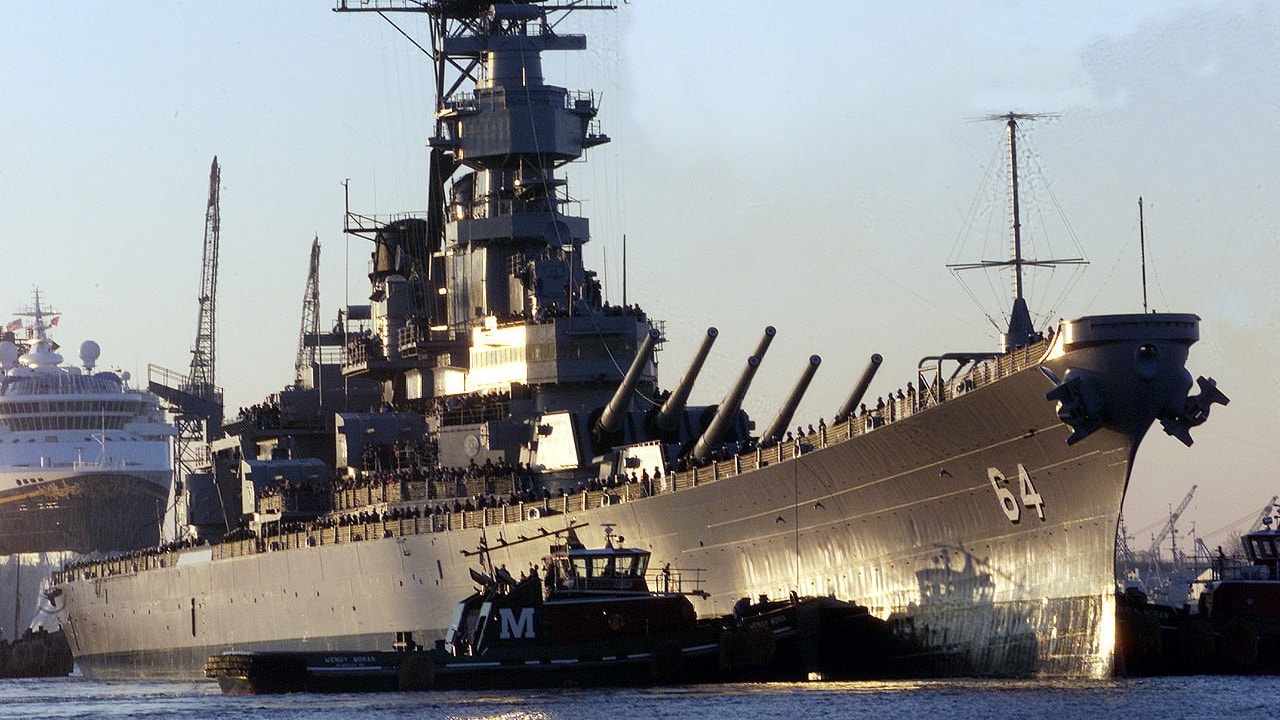
Had she come fully to fruition, USS Illinois would have sported the same impressive technical specifications as her extant sister ships, such as a hull length of 887 feet 3 inches, a fully-laden displacement of 58,460 tons, a top speed of 32.5 knots, and nine 16-inch (406 mm)/50 caliber Mark 7 main guns divvied amongst three triple-gun turrets: two such turrets fore, one aft. These 16-inchers could lob a 2,700-lb. shell up to 24.05 miles.
Alas, by the time the U.S. entered WWII, the aircraft carrier was already gaining primacy over the battleship—a point the Battles of the Coral Sea and Midway in mid-1942 drove home—so building dreadnoughts became less of a priority.
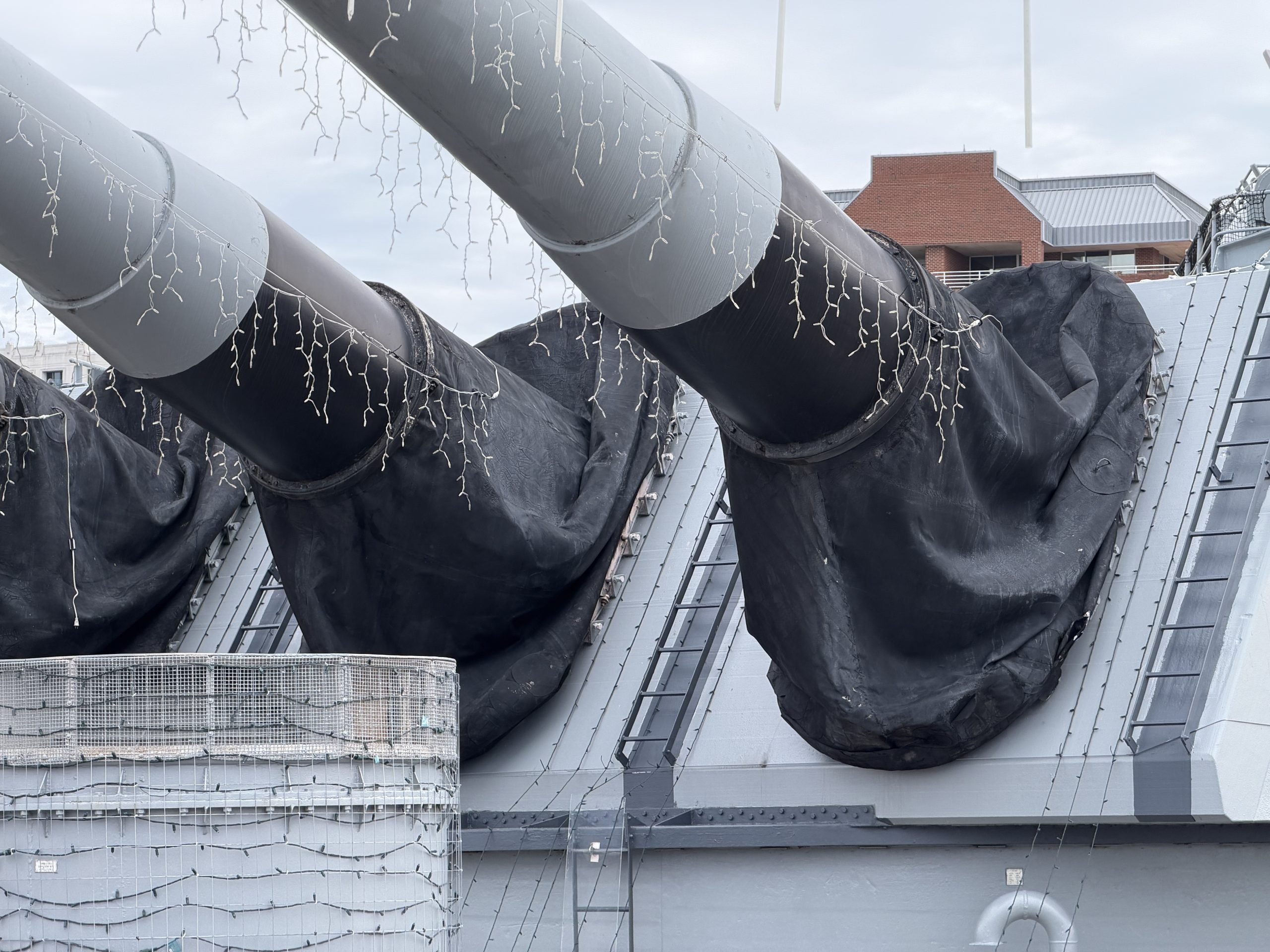
USS Wisconsin Iowa-Class Battleship Tour. Photo by 19FortyFive Reporter Christian D. Orr.
What Might’ve Been Part Deux: USS Illinois as an Aircraft Carrier?
With shipbuilding priorities shifting to carriers, BB-65 could have conceivably found a new lease on life through conversion to a flattop.
The idea isn’t as wild as it may sound at first.
Bear in mind that the Imperial Japanese Navy (IJN) did so with the Shinano, which had started life as a sister ship to the super-battleships Yamato and Musashi—with a 72,809-ton displacement and nine 18-inch guns—before being converted to the world’s first supercarrier; Shinano’s displacement dropped to 65,800 tons as a result of this conversion.
Mind you, Shinano was sunk during her sea trials by the submarine USS Archerfish [SS-311], but that’s a different story in and of itself.
In addition, the IJN converted two other dreadnoughts, Ise and Hyuga, into hybrid battleship-carriers.
Indeed, the U.S. Navy brain trust studied the notion of converting the Illinois into a makeshift carrier.
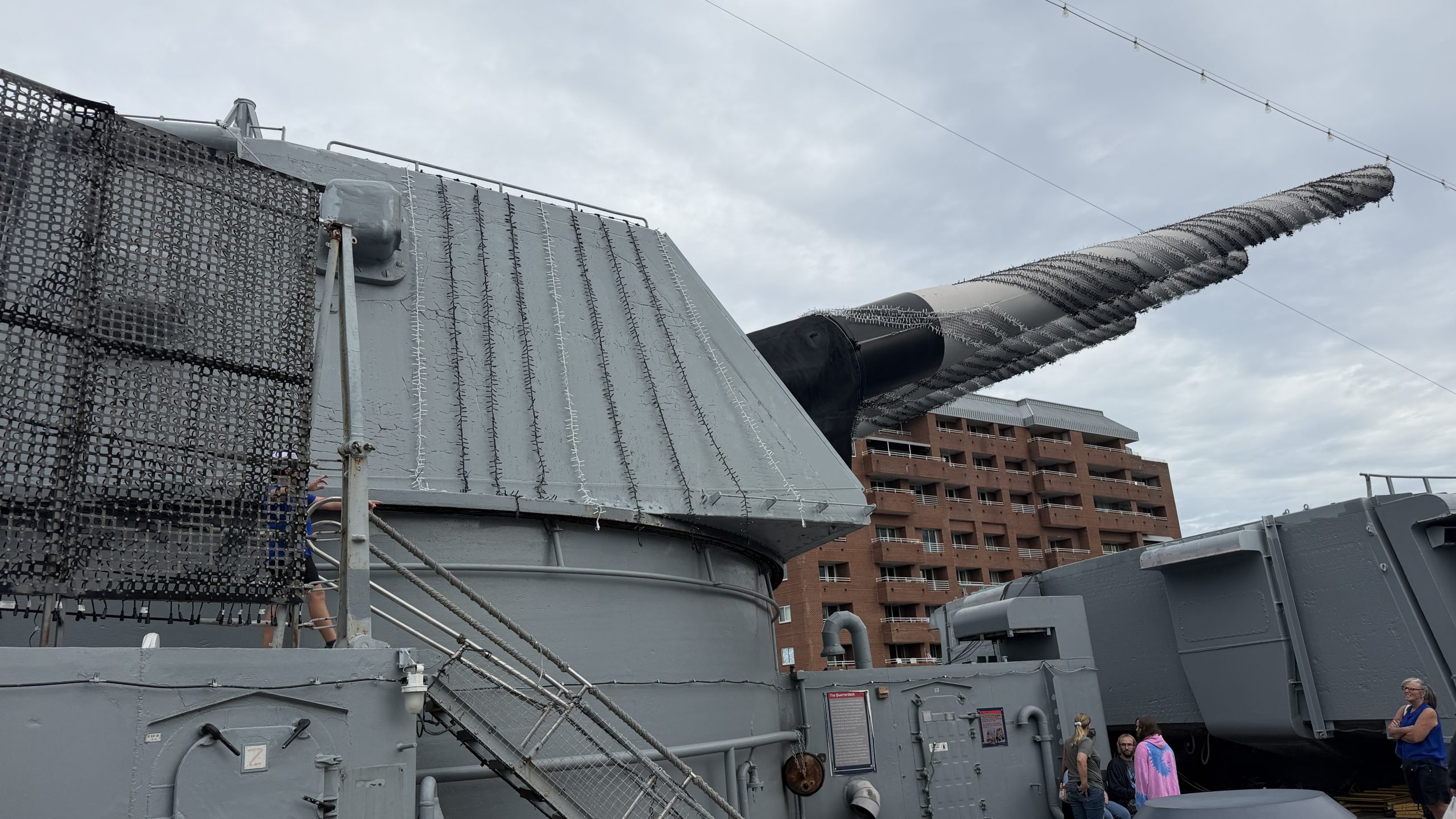
USS Wisconsin Iowa-Class Battleship Tour. Photo by 19FortyFive Reporter Christian D. Orr.
The study included concept drawings—part of the Bureau of Ships’ “Spring Styles” project books—depicting an elongated, slender flight deck on a battleship hull.
However, the Navy passed on this intriguing idea in favor of the more practical, purpose-built Essex-class carriers, which were less expensive and labor-intensive to build and carried more aircraft.
Thus, karma ensured the Navy canceled the USS Illinois while she was roughly 20-25 percent complete.
She was stricken from the roster on 12 August 1945—three days after the second atomic bomb was dropped on Nagasaki and three days before the Japanese surrender—and dismantled on the slipway in September 1958.
BB-65’s Legacy and Military History
Fortunately, at least one part of USS Illinois was preserved for posterity: her ship’s bell. Inscribed “USS Illinois 1946” and housed at Memorial Stadium at the University of Illinois at Urbana–Champaign, the bell is rung by the school’s Naval Reserve Officer Training Corps (NROTC) midshipmen whenever the Fighting Illini football team scores a touchdown.
Meanwhile, since four other vessels of the Iowa class were not only fully built and commissioned but also converted into floating museums, maritime history buffs can still get an up-close-and-personal experience of what Illinois coulda-shoulda-woulda looked like, felt like, and smelled like. Those museum ships are:
–USS Iowa (BB-61), located in San Pedro’s Downtown Harbor within the Port of Los Angeles, California
-USS New Jersey (BB-62), docked at Penn’s Landing in Camden, New Jersey. In fact, the photos in this article come from a visit I made last weekend to the USS Wisconsin in Norfolk, Virginia.
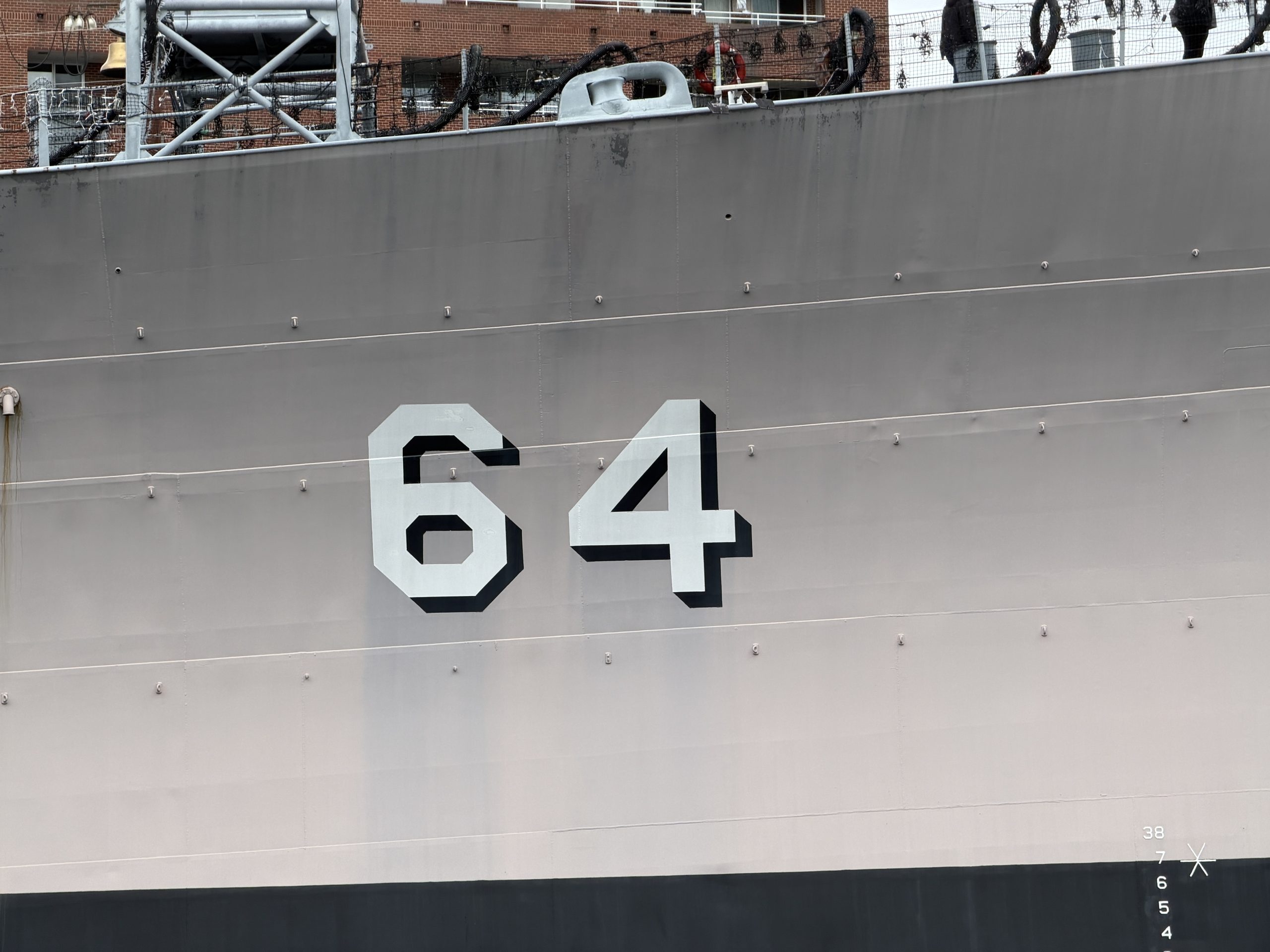
USS Wisconsin Iowa-Class Battleship Tour. Photo by 19FortyFive Reporter Christian D. Orr.
–USS Missouri (BB-63), moored at Pearl Harbor, Hawaii
-USS Wisconsin (BB-64), berthed at the Nauticus maritime-themed science center and museum located on the downtown waterfront in Norfolk, Virginia; this writer will have the honor and privilege of being the guest speaker at her reunion dinner this coming Columbus Day weekend!
Meanwhile, the USS Illinois moniker lives on in a current U.S. Navy warship, albeit one that lurks beneath the waves rather than atop them: the Virginia-class nuclear-powered attack submarine USS Illinois (SSN-786), commissioned on October 29, 2016.
About the Author: Christian D. Orr
Christian D. Orr is a Senior Defense Editor. He is a former Air Force Security Forces officer, Federal law enforcement officer, and private military contractor (with assignments worked in Iraq, the United Arab Emirates, Kosovo, Japan, Germany, and the Pentagon). Chris holds a B.A. in International Relations from the University of Southern California (USC) and an M.A. in Intelligence Studies (with a concentration in Terrorism Studies) from American Military University (AMU). He is also the author of “Five Decades of a Fabulous Firearm: Celebrating the 50th Anniversary of the Beretta 92 Pistol Series,” whose second edition of which was recently published.