
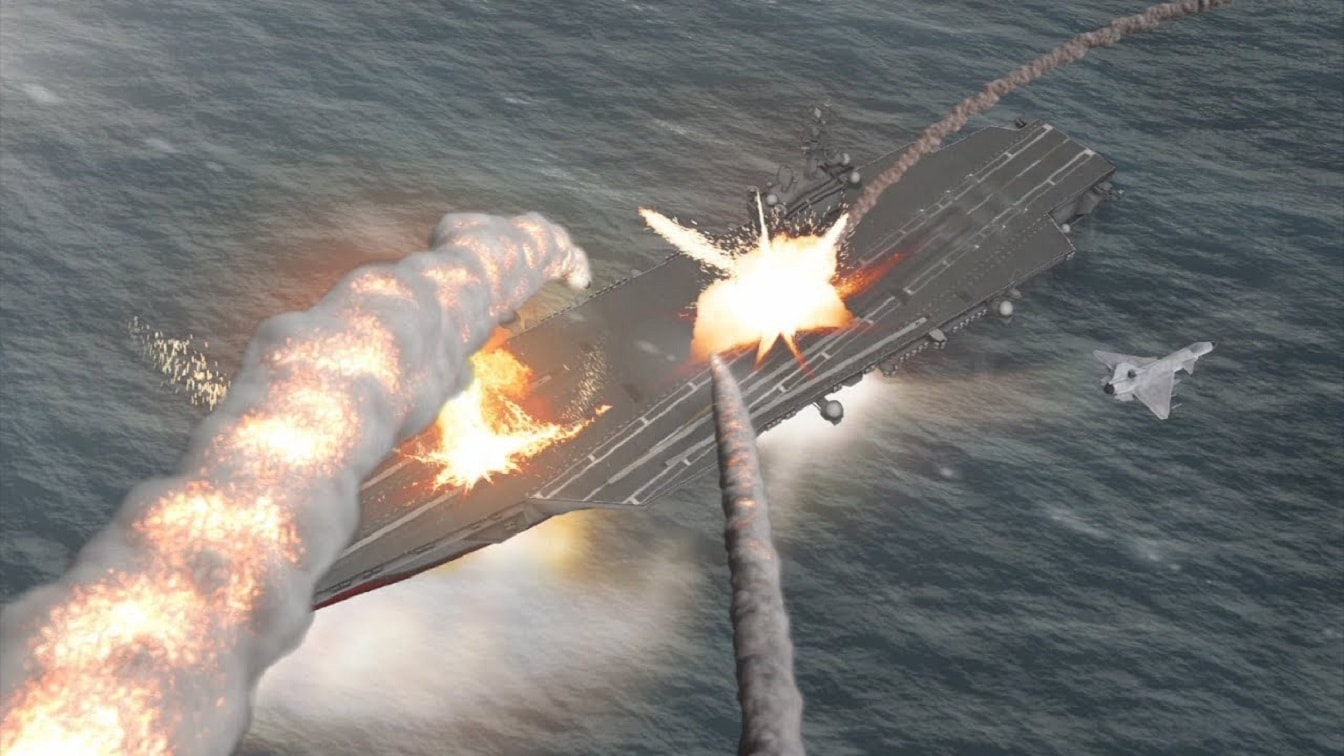
Key Points and Summary – A New York Times editorial cites a Pentagon “Overmatch” brief arguing China has built decisive redundancy in key military technologies, especially hypersonic weapons.
-It says Beijing now fields about 600 hypersonic missiles while the United States has not yet deployed one.

Depiction of Chinese missiles attacking the U.S. Navy. Image: Chinese Internet.
-The story points to China’s parade debut of new anti-ship systems and to reporting that PLA-linked labs benefited from Western academic partnerships.
-Analysts argue U.S. hypersonic offense is progressing, but defenses and acquisition speed are lagging.
-Dark Eagle and the Navy’s prompt-strike variant are framed as near-term fixes, with officials citing roughly 3,500 km range from Guam in crisis.
600 vs. 0: The Hypersonic Missile Gap That Could Shape the Pacific
The New York Times Editorial Board last week published a lengthy piece titled “Overmatched,” claiming the United States’ military capabilities are falling behind those of China and other potential geopolitical rivals.
The Times editorial cited a document called “the Overmatch brief,” which it described as “a comprehensive review of U.S. military power prepared by the Pentagon’s Office of Net Assessment and delivered most recently to top White House officials in the last year.”
The story added that when a Biden national security official received a version of the brief in 2021, “he turned pale as he realized that ‘every trick we had up our sleeve, the Chinese had redundancy after redundancy.’”
The Hypersonic Deficit
According to the Times, the brief noted that China has a huge lead in hypersonic weapons.
“China in recent years has amassed an arsenal of around 600 hypersonic weapons, which can travel at five times the speed of sound and are difficult to intercept,” the Times editorial said. The U.S., on the other hand, “has yet to deploy a single hypersonic missile.”
It’s been known for a while that China enjoys a huge lead over the U.S. in hypersonics, but the Overmatch brief crystallizes the issue.
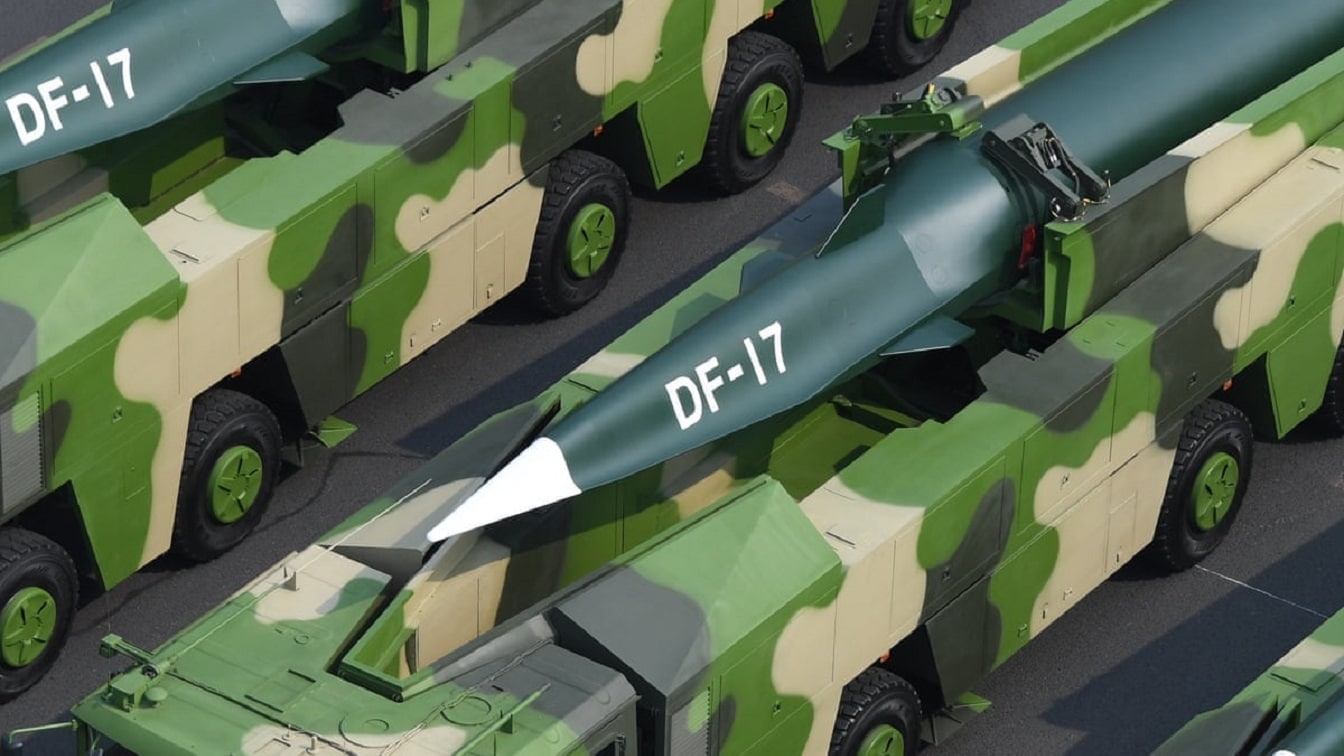
DF-17 Chinese Missile. Image Credit: Creative Commons.
At its military parade in early September, China showed off its hypersonic missiles, among many other weapons.
“The parade showcased for the first time the YJ-15, YJ-17, YJ-19 and YJ-20 anti-ship missiles, all capable of operating at long ranges and hypersonic, making them difficult to intercept,” an AP story said at the time.
Naval News offered more details about what the missiles can do.
“The YJ-17 appears to be a hypersonic glider vehicle mounted on top of a large first stage-booster, ” Naval News said of the missiles in the parade. “The YJ-19 appears to be a high supersonic or plausibly hypersonic missile, depending on the exact mode of propulsion. The intake design is reminiscent of the scramjet-powered American X-51 Waverider.”
Interesting Engineering in November took a look at the JL-1, in a report citing a Chinese online news portal:
“A recent analysis claims it is the world’s only long-range hypersonic missile able to carry nuclear warheads, giving China an edge over the US and Russia. With a reported range of 8,000 km and extended bomber reach, the system significantly expands China’s strike capacity.”
The Secret to Hypersonic Innovation
A couple of recent news stories dug into how China has developed these weapons.
Kharon reported last week that between 2011 and 2014, Chinese military officials stationed observers at Shanghai Jiao Tong University, which is described as “China’s self-styled MIT.”
“The lab’s assignment from the People’s Liberation Army was urgent and its challenge steep: developing parts for an aircraft lightweight enough to fly at five times the speed of sound, fast enough to evade U.S. defenses and strike naval carriers before they could respond,” Kharon reported.
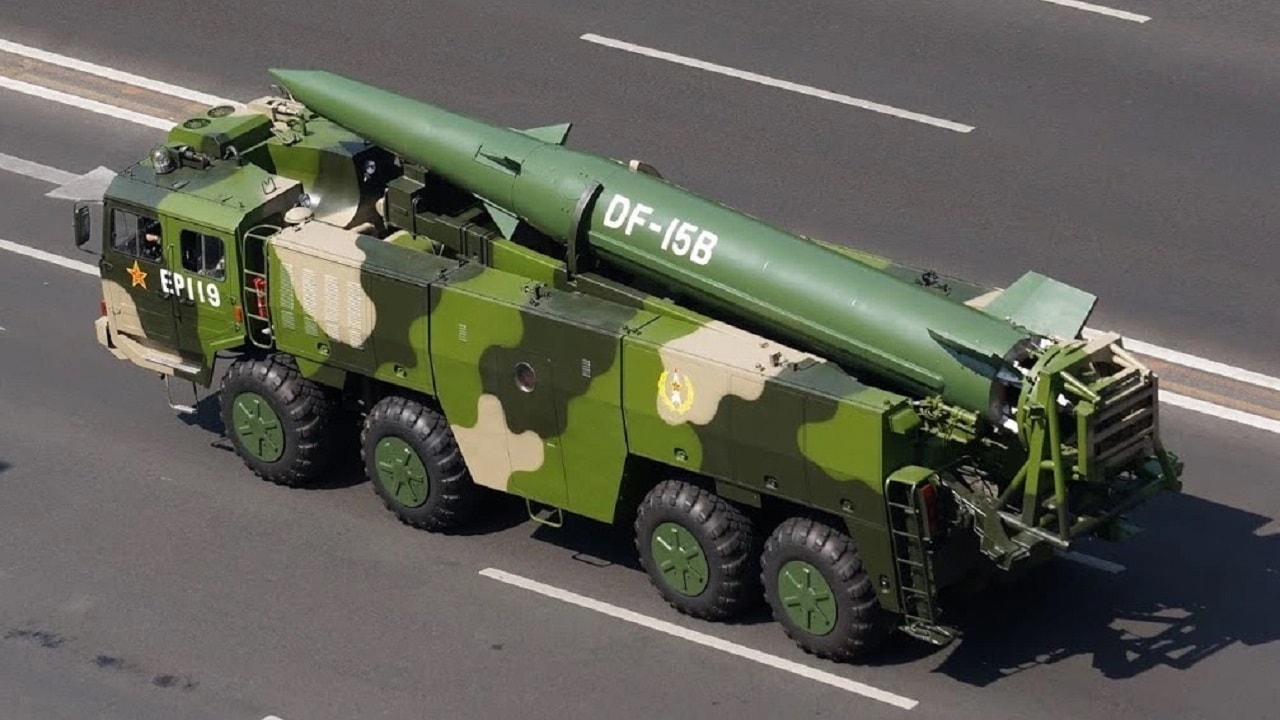
DF-15B missile from China
It proved a successful project, “producing a scientific breakthrough that Wu said contributed to China’s successful test of a hypersonic missile vehicle in early 2014.”
While this was happening, according to Kharon, the lab was closely entwined with American institutions in efforts that included “working with a joint engineering institute their school ran with the University of Michigan, partnering on a research center with General Motors, and collaborating with a host of other researchers and institutions in the U.S., Europe, and Australia.”
The University of Michigan has since abandoned the partnership following scrutiny from Congress.
As noted by Kharon, the episode raises questions about such international academic partnerships.
“Even if an individual [Chinese] researcher isn’t interested in military applications, the university is,” Jeffrey Stoff, founder and president of the Virginia-based Center for Research Security & Integrity, said. “They want to collaborate globally and attract top talent, but any work they do abroad must ultimately serve the state’s strategic goals: modernizing the military and dominating critical technologies.”
Meanwhile, a Chinese firm has announced that it is producing a new hypersonic missile.
According to Business Insider, the company is called Lingkong Tianxing, or Space Transportation, and its missile is the Yukong Ji-1000. It represents a rare innovation in this category from a private company—especially one based in China.

Explosive Ordnance Disposal 1st Class Christopher Courtney assigned to Explosive Ordnance Disposal Mobile Unit Six (EODMU-6), Det. 16 assist his team members during Special Purpose Insertion Extraction (SPIE) training from an SH-60 Seahawk helicopter. The Nimitz-class aircraft carrier USS Dwight D. Eisenhower (CVN-69) is deployed in support of Maritime Security Operations (MSO) and the global war on terrorism.
“The promotional video shows a test launch of the missile in a desert, with Space Transportation saying the Yukong Ji-1000, or YKJ-1000, has a range of about 310 miles to 807 miles,” Business Insider reported.
Why Did the U.S. Fall Behind?
Rear Admiral Mark Montgomery and Bradley Bowman wrote an op-ed in Defense News in January 2024 to describe the U.S. struggles to develop hypersonic missiles.
“The good news is that the United States is making progress on its own offensive hypersonic weapons,”the authors wrote. “The bad news is that American efforts to develop systems that can defend against Chinese hypersonic capabilities are not keeping pace. If Washington does not act quickly to expedite the Pentagon’s fielding of hypersonic missile defense capabilities, deterrence may fail in the Pacific.”
At that point, the U.S. had spent $8 billion in the previous two years on hypersonic missile development.
There is hope on the horizon, however. The War Zone reported this week about “Dark Eagle,” a project described as a “hypersonic boost-glide vehicle weapon system.
TWZ describes the Dark Eagle as a “trailer-launched hypersonic boost-glide vehicle system that can travel long distances at hypersonic speeds (velocities in excess of Mach 5) while maneuvering erratically through Earth’s atmosphere.”
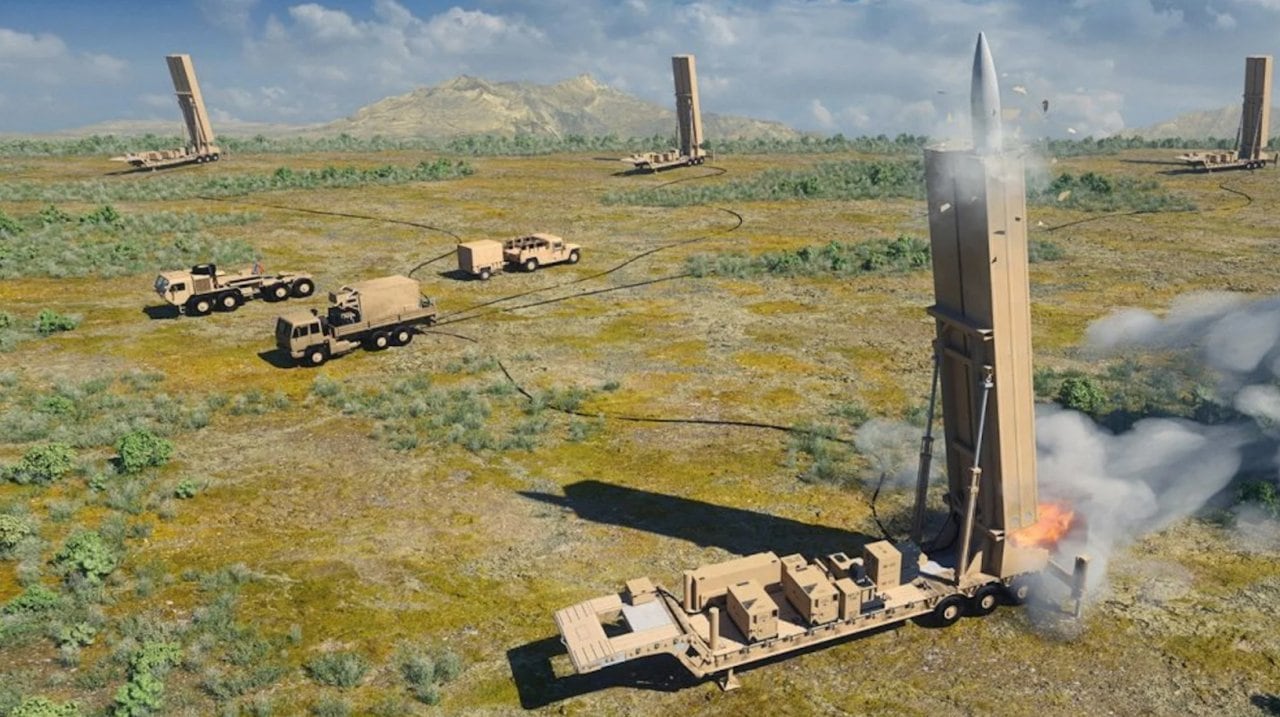
Dark Eagle. Image Credit: Lockheed Martin.
The U.S. Navy, TWZ added, is using the same missile architecture for its Intermediate Range Conventional Prompt Strike weapon system.
Lieutenant General Francisco Lozano, Director of Hypersonic, Directed Energy, Space and Rapid Acquisition, said during a recent visit by Defense Secretary Pete Hegseth that Dark Eagle boasts a 3,500-kilometer range and can strike “mainland China from Guam.”
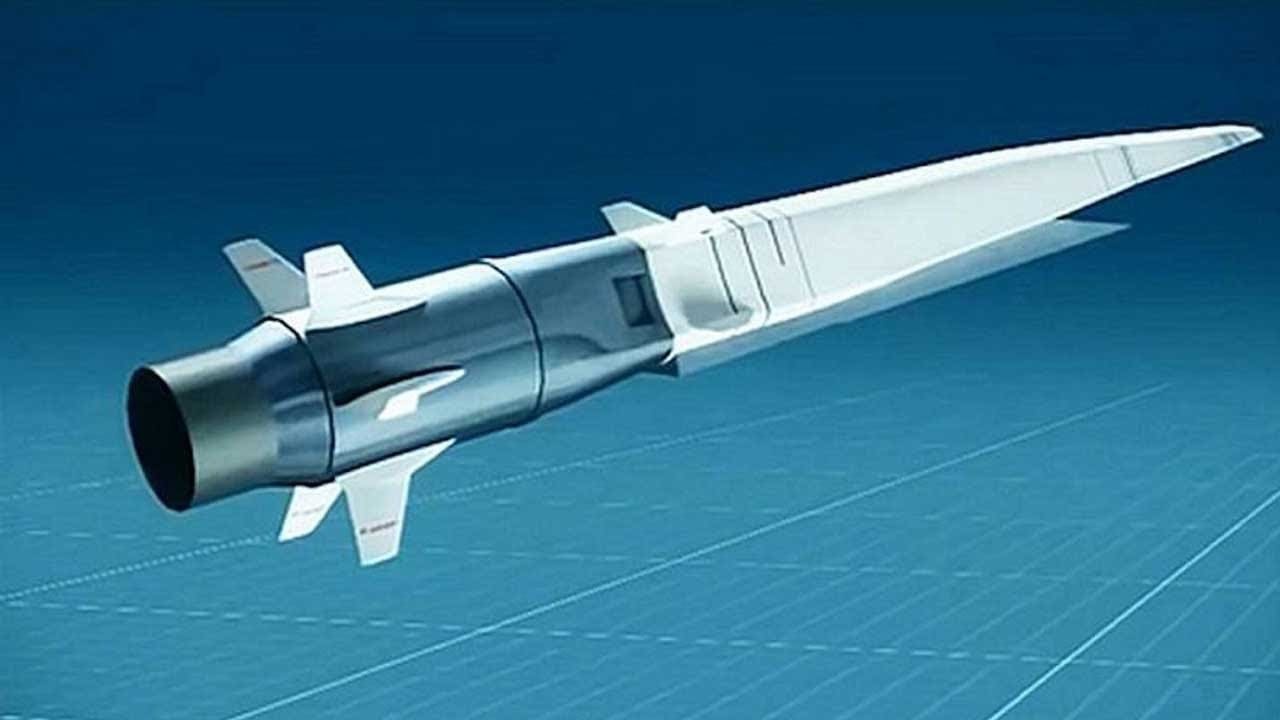
Tsirkon Hypersonic Missile. Image Credit: Creative Commons.
“The importance of getting Dark Eagle up and running goes beyond tactical and strategic considerations, as the U.S. has lagged behind its peers in areas of hypersonic development, most notably when it comes to China,” TWZ said.
About the Author: Stephen Silver
Stephen Silver is an award-winning journalist, essayist, and film critic, and contributor to the Philadelphia Inquirer, the Jewish Telegraphic Agency, Broad Street Review, and Splice Today. The co-founder of the Philadelphia Film Critics Circle, Stephen lives in suburban Philadelphia with his wife and two sons. For over a decade, Stephen has authored thousands of articles that focus on politics, national security, technology, and the economy. Follow him on X (formerly Twitter) at @StephenSilver, and subscribe to his Substack newsletter.