
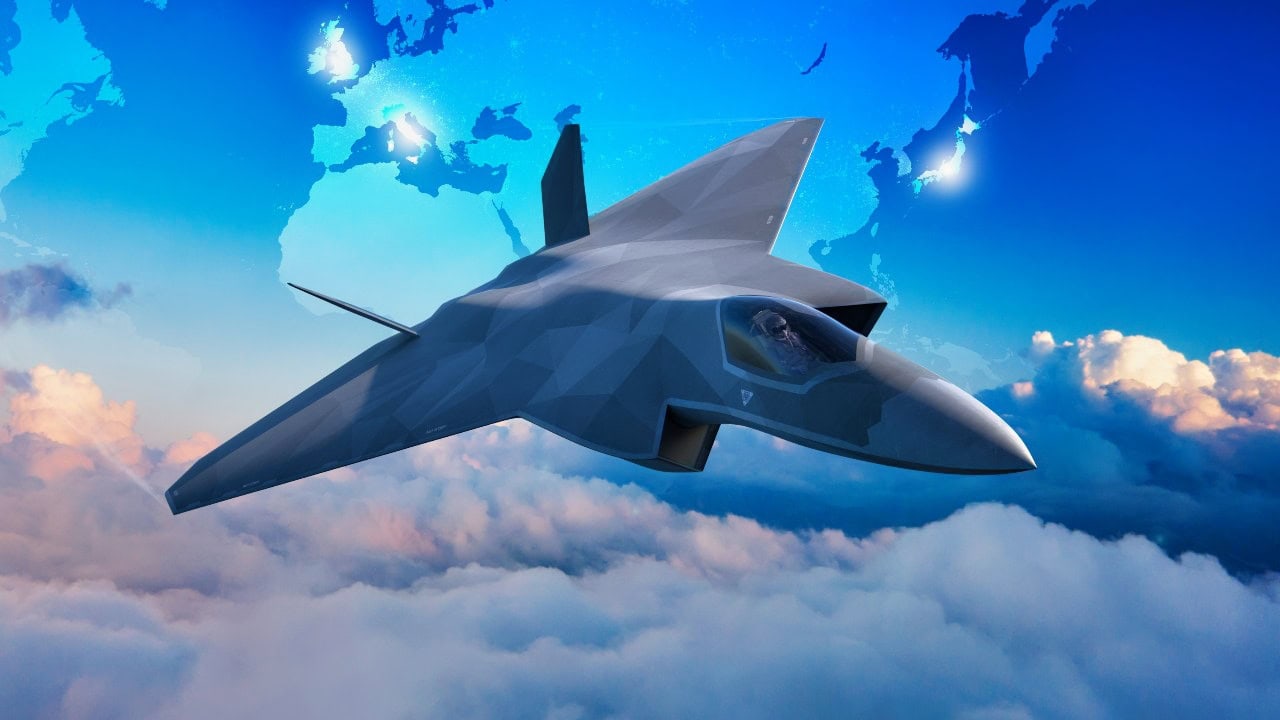
Key Points and Summary – The Global Combat Air Program (GCAP) and America’s NGAD F-47 are rival sixth-generation projects with very different approaches.
-GCAP spreads cost and risk across the UK, Japan and Italy and aims for an exportable stealth fighter that can plug into allied networks.
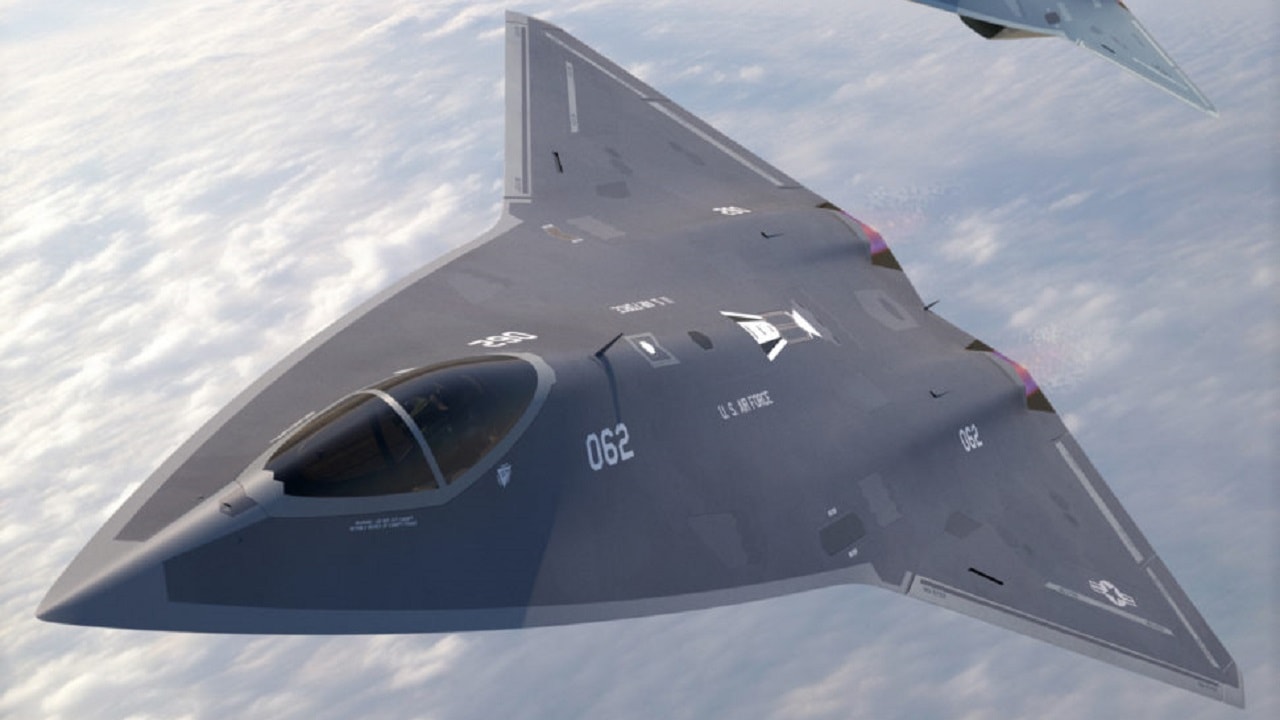
NGAD 6th Generation Fighter: Original artwork courtesy of Rodrigo Avella. Follow him on Instagram for more incredible aviation renders.
-NGAD is a far more expensive “exquisite” U.S. system-of-systems built around the F-47 and loyal wingmen, optimized for Pacific ranges and payload.
-With NGAD already in limited production and GCAP still pre-prototype, Washington is likely to field its jet first—but both programs are being designed to operate together, not just compete.
-That balance could shape airpower for decades.
How Does The GCAP Compare To The US F-47 NGAD Fighter?
The GCAP (Global Combat Air Program), comprising the UK, Japan, Italy, and the F-47 sixth-generation stealth fighter, NGAD (Next Generation Air Dominance – US), are competing/complementary 6th-generation fighter programs.
The programs differ mainly in collaboration scope (GCAP is international, NGAD is primarily US) and cost/approach, with GCAP aiming for broad interoperability and potential exports.
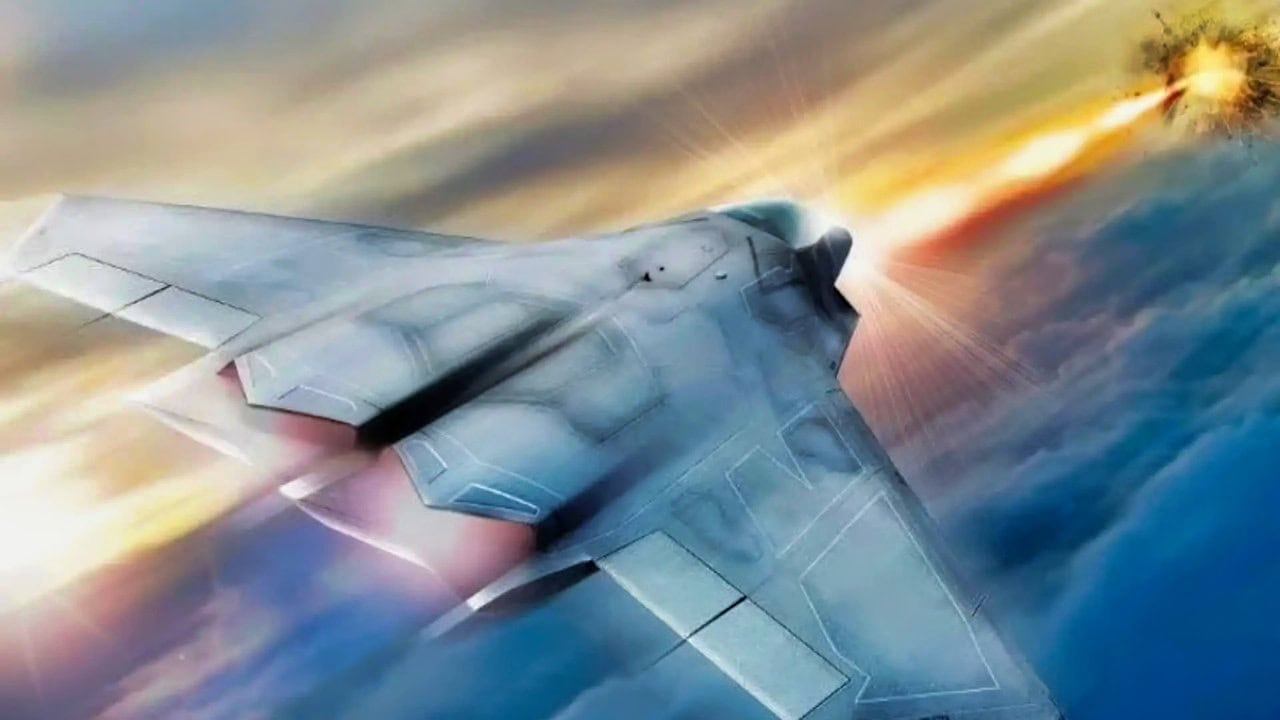
NGAD image. Image Credit: Creative Commons.
At the same time, NGAD focuses on a “system of systems” (manned + loyal wingman drones) with high-end capabilities. However, both aim for advanced AI, networking, and unmanned integration, with GCAP seeking to leverage partners for cost-sharing and market reach.
US Secretary of War Pete Hegseth praised the F-47, saying the jet “sends a very direct, clear message to our allies that we’re not going anywhere and to our enemies that we can, and we will, be able to project power around the globe, unimpeded, for generations to come.”
Costs Differ Between the Programs
Douglas Barrie, senior fellow for military aerospace at the UK-based International Institute for Strategic Studies (IISS), wrote in 2024 that the NGAD F-47 will cost “between $200-300 million per unit. The US is the only country in the world that could afford to do that.”
While Barry stated that the GCAP will be “a very capable aircraft,” the F-47 will take it a step further: “NGAD was going to be a step beyond,” focusing on a much more expensive, “exquisite” platform.
“All of the threat analysis that the US has put out there about the Indo-Pacific and the challenge from China [has led to a focus on] certain capabilities,” he said, mainly because the F-35 and other in-service Air Force fighter jets “don’t have a particularly long-range or can’t carry a particularly heavy weapons load.”

NGAD. Image Credit: Artist Rendering.
The F-22 Wasn’t Offered For Sale, The F-47 May Be Sold To Allies
While the F-35 has achieved immense commercial success worldwide, the F-22 Raptor was notably excluded from the export market due to its advanced technology.
The question remains whether the F-47 will take the F-35 or F-22 route. The F-47 is designed to be the most advanced aircraft ever built and the successor to the F-22.
In an attempt to draw Japan away from the GCAP, President Trump reportedly offered the F-47 to Japan during a phone call with Prime Minister Shigeru Ishiba. The offer has some merit because Japan is allegedly concerned that the GCAP will not meet its planned 2035 operational deadline. Citing two senior sources, a Reuters report suggested that Japan may consider acquiring more F-35s.
If the US decides to sell the F-47 to Japan and other key allies (Australia, Israel, and perhaps others), this would no doubt bring the price down to more affordable levels.
Would this cause the GCAP program to break apart and fail? Not necessarily. But it certainly won’t help. Part of the draw of the GCAP and FCAS programs is that countries are trying to break away from reliance on the United States.
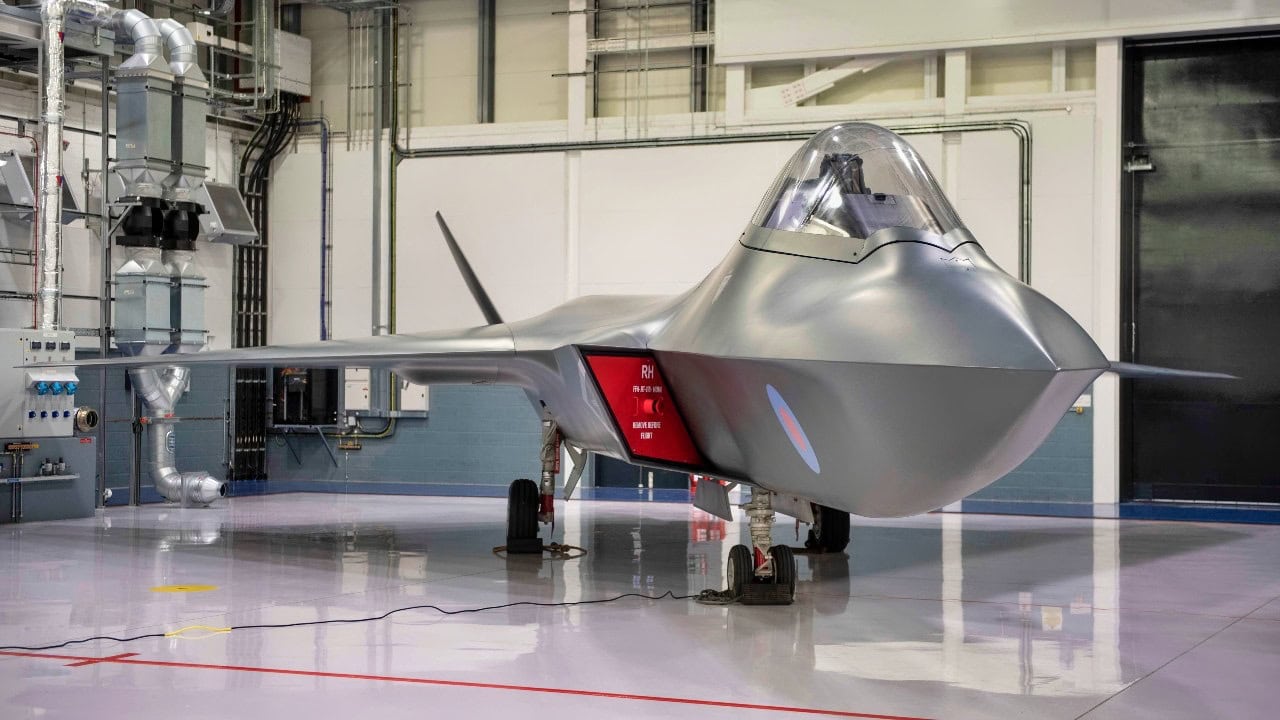
Image of the UK’s concept model for the next generation jet fighter “Tempest”, which was unveiled by Defence Secretary, at Farnborough International Air Show back in 2018.
Separate But Equal?
The hope among European partners is that the GCAP and the F-47 NGAD will not compete but work in concert.
According to Italian Air Force General Giandomenico Taricco, the joint “GCAP” jet is expected to work in tandem with the US-made F-47 and not as a competitor.
“What we want is for the GCAP to be interoperable with the F-47, to make them two elements in an integrated system,” Taricco stated, adding that “The F-47 will be principally a U.S. fighter and not a competitor to the GCAP.”
The NGAD Is Further Along In Development Than The GCAP
The GCAP partners–the United Kingdom, Japan, and Italy- unveiled a new concept design for their collaborative next-generation aircraft at the Farnborough International Airshow last year.
The new design is an enormous aircraft with a larger wingspan and a far more advanced aerodynamic design compared to previous concepts, including the Tempest, unveiled by London in 2018.
The GCAP aircraft is being designed with a tailless delta-wing configuration. Twin Rolls-Royce/IHI engines will propel it. Designers and engineers believe this foundation will equip the jet to be extremely stealthy, with quality radar-absorbing coatings that will minimize its radar cross-section.
While the GCAP development is progressing, and contracts for Leonardo Electrics Italy, ELT Group, Mitsubishi Electric, and Leonardo UK for delivering the Integrated Sensing and Non-Kinetic Effects and Integrated Communications System package for the fighter are close to fruition, the timeline for fielding the aircraft by 2035 is growing increasingly unlikely, as seen by Japan’s concerns.
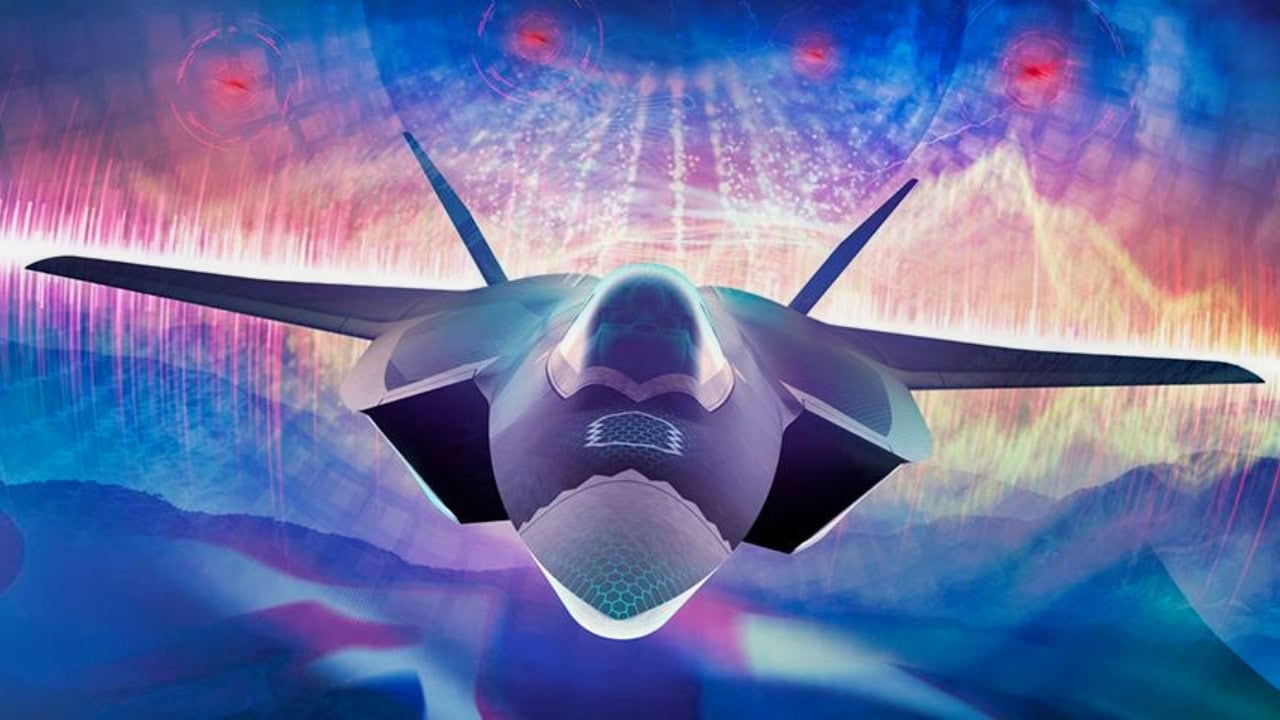
GCAP Fighter. Industry Handout Image.
The partners have yet to build a prototype for testing purposes.
In comparison, the Air Force’s NGAD is further along, with Boeing already engaging in limited production of the aircraft. While the production aircraft have yet to fly, Boeing has flown prototype demonstrator aircraft since 2019-2020.
The F-47 will have a blended body. It will also be tailless and travel at Mach 2 or Mach 3. Thrust-vectoring engines—and two contractors (Pratt and Whitney and General Electric) are producing the engines already—will make for a highly competent dogfighter.
“It’s the platform that, along with all of the rest of the systems, is going to ensure dominance into the future. We’ve got to go fast,” Air Force Chief of Staff General David Allvin said. “I’ve got to tell you, team, it’s almost 2026. The team is committed to getting the first one flying in 2028.”
“In the few short months since we made the announcement, they are already beginning to manufacture the first article,” Allvin said, referring to the first F-47. “We’re ready to go fast. We have to go fast.”
The US will field the NGAD F-47 long before the GCAP, which promises to be a very capable aircraft. And if everything progresses well, the two aircraft will work alongside one another for decades to come.
About the Author: Steve Balestrieri
Steve Balestrieri is a National Security Columnist. He served as a US Army Special Forces NCO and Warrant Officer. In addition to writing on defense, he covers the NFL for PatsFans.com and is a member of the Pro Football Writers of America (PFWA). His work was regularly featured in many military publications.