
Europe Can Handle Russia—But Asia Cannot Handle China Alone
Much of the discussion about the Trump administration’s National Defense Strategy has focused on Europe. The document formalizes this administration’s drive to disengage from Europe and push more of the burden of regional security onto European countries.
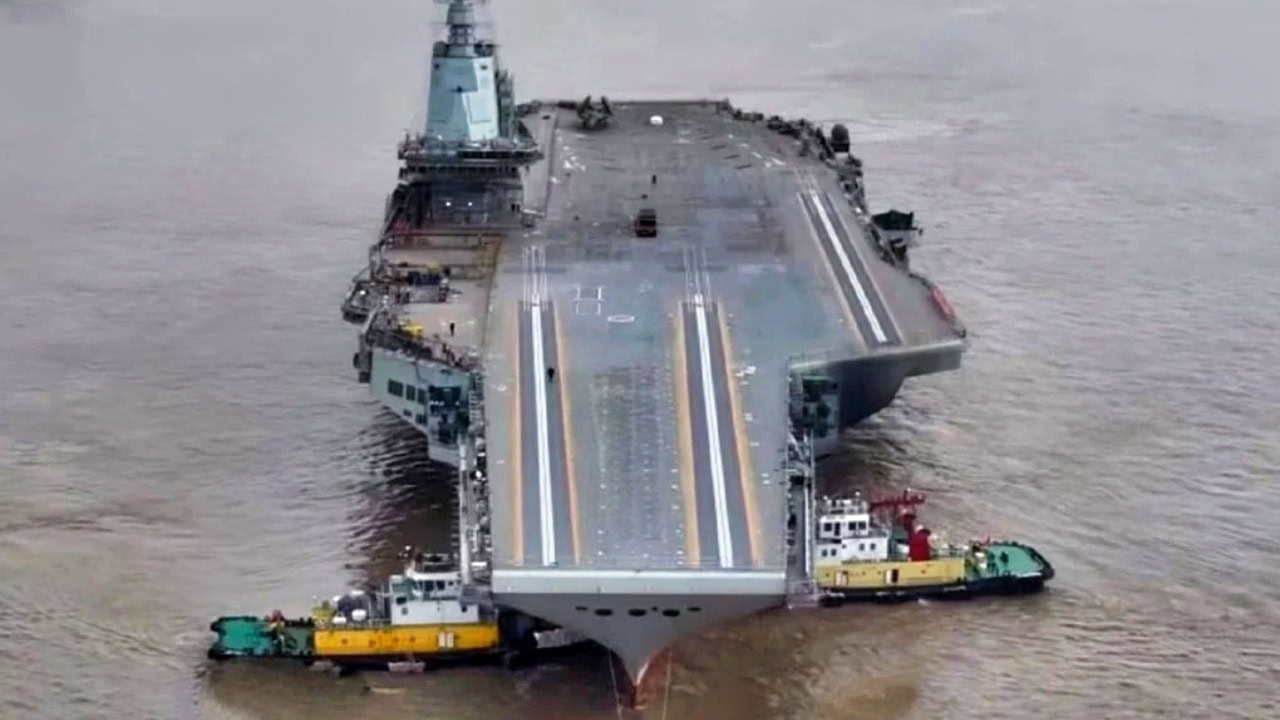
China Aircraft Carrier. Image Credit: Chinese State Media.

The Nimitz-class aircraft carrier USS Carl Vinson (CVN 70) transits the South China Sea during a Maritime Cooperative Activity with the Philippine Navy, Jan. 17, 2025. The U.S. and Philippines work together as allies, enhancing the interoperability of maritime forces and supporting their shared goal of a free and open Indo-Pacific. Carrier Strike Group ONE, is underway conducting routine operations in the U.S. 7th Fleet area of operations. (U.S. Navy photo by Mass Communication Specialist 3rd Class Brianna Walker)
But more important is the mixed signaling it sends on China. Beijing is a significantly greater challenge to the United States and the world’s democracies than Russia is. Its economy is much larger, and its military more capable, especially with Russia badly mired in Ukraine.
The United States’ democratic European partners can almost certainly handle Russian revanchism without much direct U.S. support. By contrast, Washington’s democratic partners in Asia almost certainly cannot handle China alone. They are scattered in a thin, long ring around China’s periphery running from India all the way to South Korea. None of them has the economic weight to compete directly with China. And their ability to cooperate to balance China is hampered by political and cultural differences. If the United States draws a separate peace with China, then so will its allies in East Asia, opening a path for Chinese regional hegemony.
Let Europe Handle Russia
U.S. presidents and secretaries of defense have complained about European free-riding for decades. European NATO members cut their defense spending too rapidly after the Cold War, seemingly convinced that the Soviet Union’s collapse indeed marked the “end of history.” Hard power was not as necessary anymore. European militaries atrophied, which increased their reliance on the United States in a crisis.
The Ukraine war has illustrated that decisively. A major war broke out on Europe’s doorstep, and the continent’s first impulse was to push assistance to Ukraine onto the Americans. This was both absurd and unsustainable.
Trump has alienated Europe unnecessarily with his contemptuous rhetoric, but his basic belief that Europeans should be responsible for their region’s security affairs is right. This year’s National Defense Strategy continues to reduce the U.S. commitment in order to push greater discipline on Europe.
The Pivot to Asia, at Long Last
China has been strategically ascendant for 20 years now, and the last three U.S. presidents have all sought to “pivot to Asia.” This pivot has repeatedly short-circuited as U.S. commitments in the Middle East pull U.S. presidents, usually against their will, back into that volatile region. The Russian invasion of Ukraine in 2022 similarly blunted the focus on China.
This shift toward Asia can no longer be forestalled. China’s language about Taiwan has become significantly more belligerent in recent years. China’s economy is close enough in size to the United States’ that the world is probably bipolar now, rather than unipolar. U.S. allies in Asia are less geographically compact, less politically and culturally aligned, and less militarily capable than U.S. allies in Europe. If the United States is going to prevent Chinese hegemony in its region, the forces drawn down from Europe should, finally, go to East Asia.
Trump’s Dilemma: Hemispheric Focus, or Take On China?
Yet, instead of pivoting to Asia at last, the new defense strategy shows mixed views on China and the U.S. role in East Asia. The new priority is homeland defense, which increasingly looks to mean dominance over the Western Hemisphere. Trump’s snatching of Venezuela’s president, Nicholas Maduro, and his threats against Greenland, suggest that his administration sees weak regional neighbors as targets for hegemonic domination, or even territorial expansion.
If Trump actually follows through on this—which is hard to predict because he often bluffs or reverses himself—this would significantly sap the U.S. power available for deterring China. Washington’s neighbors will not assent to neo-imperial American domination.
Latin American countries particularly have a long history of struggling against U.S. intrusion. A U.S. effort to build a regional semi-empire will meet resistance. America would likely get bogged down in insurgencies and other medium-term distractions, creating an opening for China to dominate East Asia.
Latin America or China?
For decades, the U.S. foreign policy community has hoped Europe would take greater strategic responsibility for its affairs. Trump, to his credit, has finally forced this outcome. But the expectation has long been that pivoting out of Europe would enable a pivot into Asia. China, the conventional wisdom suggests, is America’s big competitor of the future.
Trump is rejecting that logic for his strange new quest to dominate the Western Hemisphere. This is a mistake; there is almost no interest or support for this in the U.S. foreign-policy class, and for good reason. Most countries in this hemisphere are already U.S. allies or partners.
None has the economic weight or military capability of China, but all resist U..S bullying. Meanwhile, U.S. partners in Asia will draw a separate peace with China if they believe the United States is unwilling to fight.
In pursuing an illusory hemispheric hegemony, Trump risks surrendering East Asia to China.
Author: Dr. Robert Kelly, Pusan National University
Dr. Robert E. Kelly is a professor of international relations in the Department of Political Science and Diplomacy at Pusan National University in South Korea. His research interests focus on Security in Northeast Asia, U.S. foreign policy, and international financial institutions. He has written for outlets including Foreign Affairs, the European Journal of International Relations, and the Economist, and he has spoken on television news services such as the BBC and CCTV. His personal website/blog is here; his Twitter page is here.