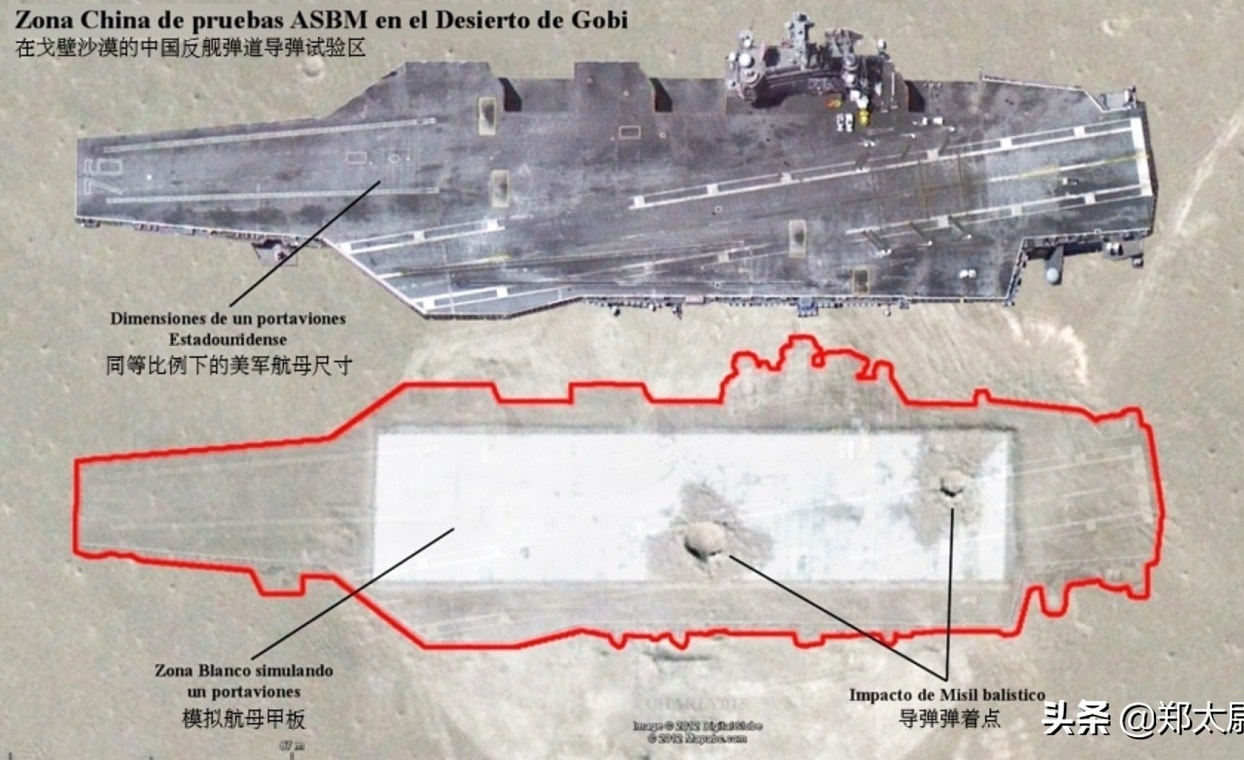
Key Points and Summary – China’s Rocket Force is portrayed as built for scale: large inventories, mobile launchers, and layered ranges designed to saturate targets across Taiwan, Japan, the Philippines, and beyond.
-The piece argues that systems like the DF-26 already stretch the fight to Guam and carrier operating areas, while newer hypersonic weapons push the problem further.

Dec. 4, 2017) Sailors man the rails as the Navy’s forward-deployed aircraft carrier, USS Ronald Reagan (CVN 76), arrives at Commander, Fleet Activities Yokosuka after a scheduled patrol. The Ronald Reagan Carrier Strike Group conducted 87 days of strike group operations in the Western Pacific, including the waters south of Japan, the Philippine Sea and the South China Sea. Ronald Reagan provides a combat-ready force, which protects and defends the collective maritime interests of the U.S. and its allies and partners in the Indo-Asia-Pacific region. (U.S. Navy photo by Mass Communication Specialist 2nd Class Janweb B. Lagazo/Released)
-The DF-27 is framed as a major escalation in conventional reach—potentially extending hypersonic glide vehicle strikes across thousands of kilometers and widening the threat envelope for U.S. forces and partners.
-It also highlights a core risk: long-range conventional strikes could be misread as nuclear.
DF-17 vs. DF-27: The Hypersonic Jump That Could Threaten Carriers Farther Out
The Chinese arsenal of land-fired ballistic missiles is quite extensive and well-positioned to blanket Taiwan, Japan, or the Philippines with large numbers of incoming projectiles.
Many of them operate with mobile launchers and can reposition as needed to avoid air attacks and become less detectable to overhead satellites, drones, and other sensors.
The People’s Liberation Army Rocket Force has a large number of short-, intermediate-, and long-range ballistic missiles, and several of its anti-ship missiles, such as the DF-26, are being configured for dual-use, meaning they can carry both conventional and nuclear payloads.
These weapons can easily hold areas at risk up to and slightly beyond the first island chain, as they can reach ranges of 2,000 miles and beyond.
Chinese Ballistic Missiles
China’s short-range ballistic missiles, such as the DF-15 and DF-16, can travel up to 1,000km; its medium-range weapons, such as the DF-26, can travel 2,000 miles and hold Guam and US Navy carriers at risk at great distances from the Chinese mainland.
The PLA also operates long-range ICBMs capable of targeting the continental US from China, such as the DF-31, DF-41, and DF-4, which travel 7,000 to 15,000km. These weapons can clearly hold the US homeland at risk of nuclear attack.
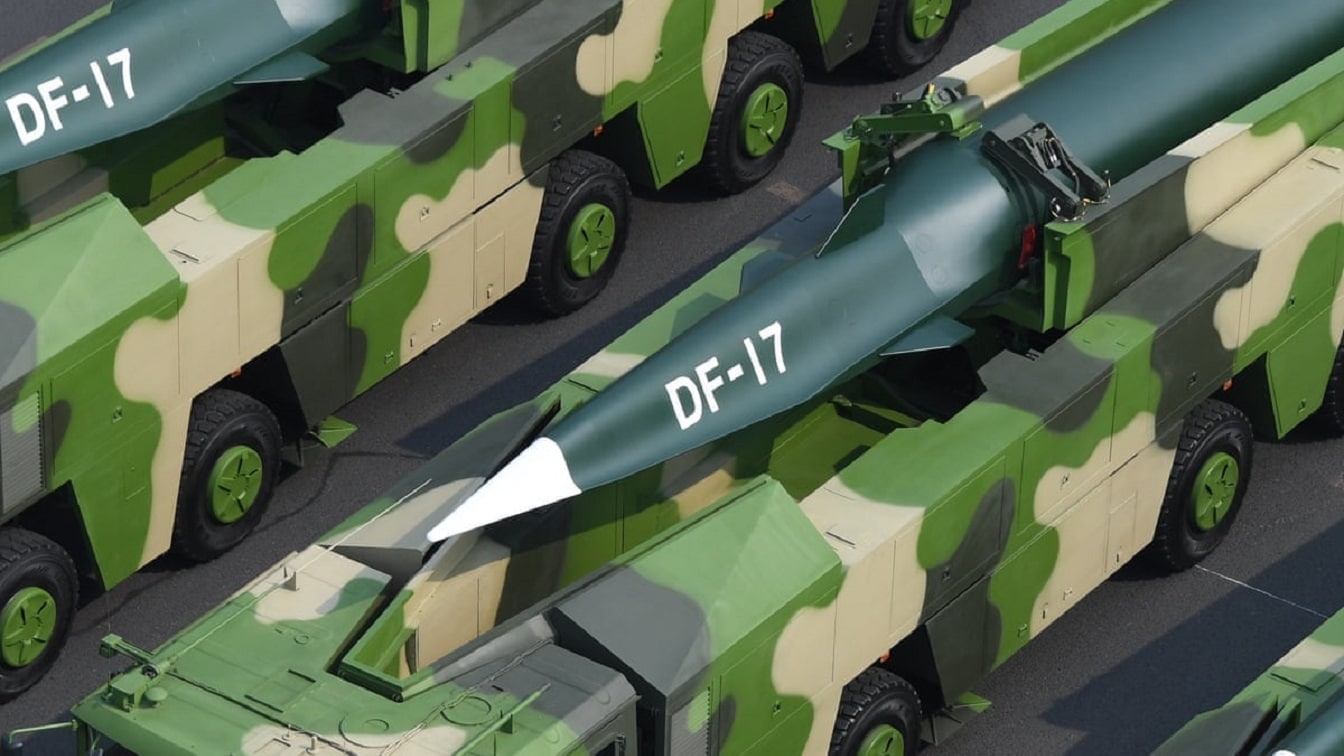
DF-17 Chinese Missile. Image Credit: Creative Commons.
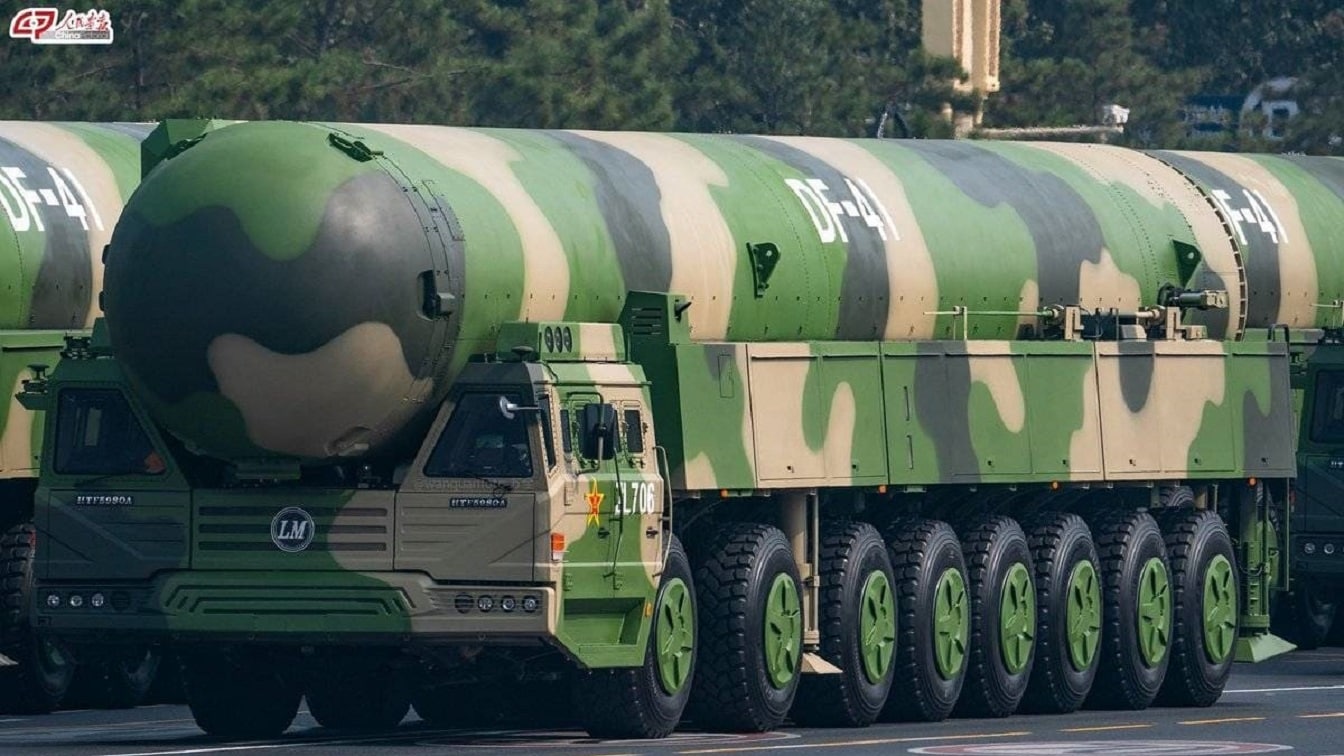
DF-41. Image Credit: Chinese Internet.
The DF-41, for example, can carry Multiple Re-Entry Vehicles, weapons capable of striking numerous targets from a single host missile.
These Chinese ICBMs are well known, yet the PLA is now adding a “conventional” missile able to travel the same distances as an ICBM, meaning non-nuclear weapons could travel across the Pacific between continents to target the US homeland.
China’s new hypersonic DF-27, for instance, is said to be capable of reaching distances up to 8,000km.
This not only introduces the risk of attacking at hypersonic speed, but also introduces a new threat variable as it appears capable of threatening Hawaii and the West Coast of the US with conventional weapons from mainland China.
The other element of this relates to US Navy carriers, as a weapon of that range could hold carriers and warships at risk from thousands of miles beyond the first island chain in the Pacific.
Chinese Hypersonics
The DF-27 gives the PLA conventional attack reach in an unprecedented fashion and also expands its ability to attack with hypersonic weapons.
China’s existing hypersonic DF-17 is cited as capable of traveling up to 2,000 miles at Mach 10, yet the hypersonic DF-27 can reach at least twice that distance and hit targets at hypersonic speeds out to 8,000km.
Both the DF-27 and DF-17 fire hypersonic glide vehicles, high-speed, maneuvering projectiles that do not follow the traditional parabolic trajectory of most ballistic missiles. Hypersonic Glide Vehicles IHGVs) are boosted up to the boundary of the earth’s atmosphere and then use the pure speed of descent to close in upon a target.
HGVs maneuver extensively and can be pre-programmed with software to make specific maneuvers.
This makes them very difficult to track or defend against, as the projectiles travel too quickly from one radar aperture or field of view to another, complicating any effort to establish a continuous track. The US Navy also operates HGVs and will deploy hypersonic Conventional Prompt Strike weapons from its warships and submarines over the next few years.
Nuclear vs Conventional
There is yet another element of complexity associated with this kind of weapon, as a long-range conventional ICBM would easily or quickly be mistaken for a nuclear attack and inspire or prompt a nuclear response. Some argue that this kind of ambiguity or “dual-use” phenomenon could “lower the threshold” to nuclear war and potentially introduce new levels of danger to global security.
At the very least, the arrival of the DF-27 appears to give the PRC an ability to strike the US with conventional weapons in an entirely new fashion from its mainland.
About the Author: Kris Osborn
Kris Osborn is the President of Warrior Maven – Center for Military Modernization. Osborn previously served at the Pentagon as a highly qualified expert in the Office of the Assistant Secretary of the Army—Acquisition, Logistics & Technology. Osborn has also worked as an anchor and on-air military specialist at national TV networks. He has appeared as a guest military expert on Fox News, MSNBC, The Military Channel, and The History Channel. He also has a Masters Degree in Comparative Literature from Columbia University.