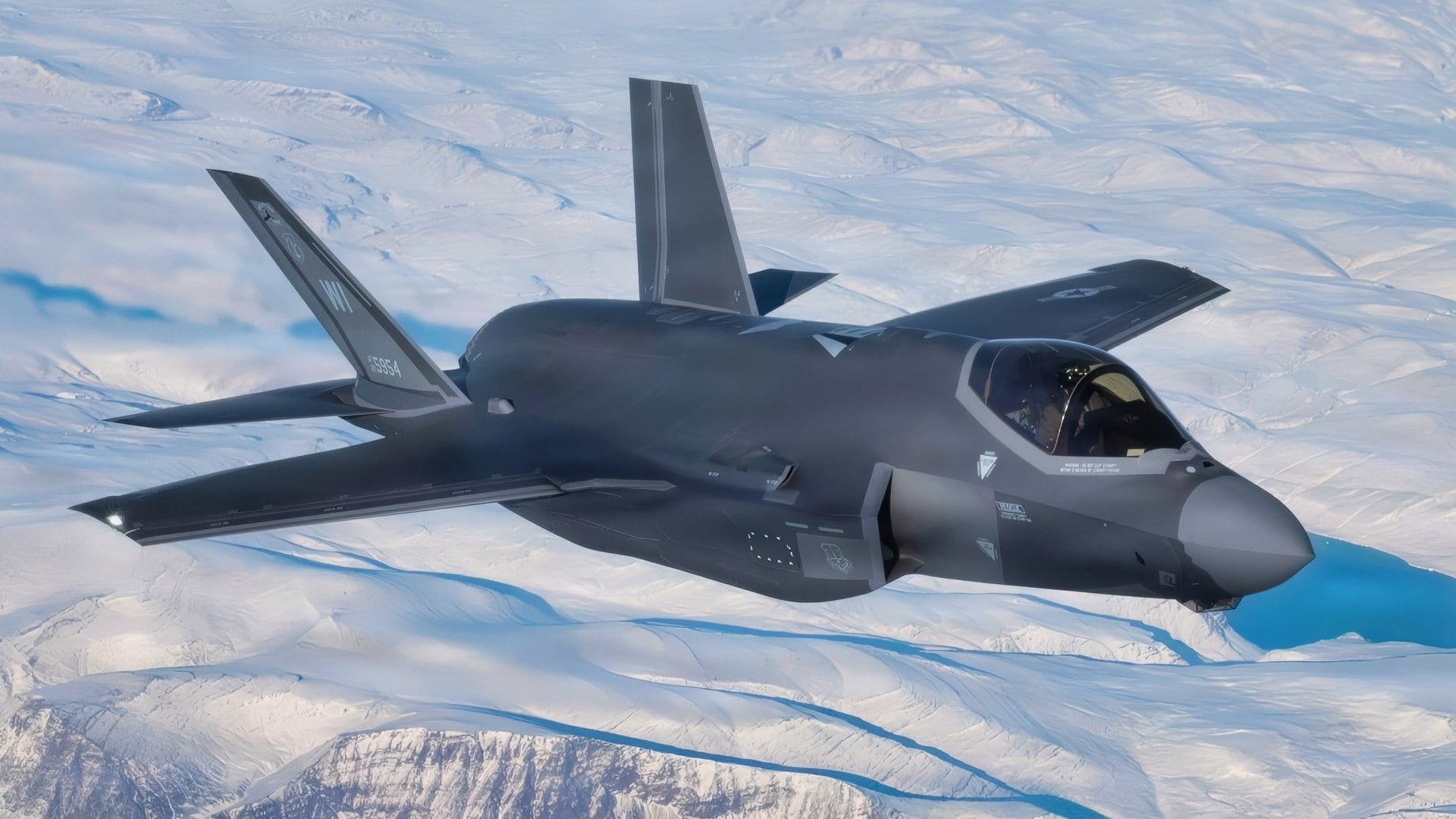
Danish F-35s Patrol Greenland—As Allies Fear a “Spare Parts Kill Switch”
Recent footage circulated online showing a pair of Danish F-35 stealth fighters on patrol over Greenland’s airspace, part of Europe’s recent push to bolster the island’s defense posture in light of what American President Donald Trump has dubbed Europe’s inability to defend the island from nefarious Russian and Chinese designs.
The brief video shows F-35As, the conventional take-off and landing variant of the jet, flying with a French tanker jet along Greenland’s east coast.
Though certainly inadequate to patrol the entirety of Greenland, let alone blunt a hypothetical American annexation, the reliance on the F-35 for the patrol comes at a particularly fraught time for the F-35 program.
F-35 Backlash
The American-led F-35 stealth fighter program is the most successful multinational fifth-generation fighter program to date. Twenty countries — close friends and allies of the United States — operate the F-35.
Many of them are in NATO, though a few outliers, including Israel, Japan, South Korea, and Australia, are also parties to the F-35 program. But there have been some notable rejections of the stealth fighter project, too.
Both Spain and Portugal reneged on their initial interest in the F-35 program, citing President Trump’s bellicosity toward allies and citing security concerns about reliance on the American-supplied stealth fighter.
It was a sentiment also expressed by the Chairman of the Danish Defense Committee, Rasmus Jarlov.
Jarlov explained that he fears there is a hidden kill switch embedded in F-35s that could allow Washington to turn the stealth fighters off.
Lockheed Martin, one of the primary contractors behind the F-35 program, denied that such a switch exists. But, Jarlov explained, the existence of a physical or software switch hardly matters.
Spare Part Kill Switch
“The USA can certainly disable the planes by simple stopping the supply of spare parts,” Jarlov wrote on X. “They want to strengthen Russia and weaken Europa and are showing that they are willing to do tremendous damage to peaceful and loyal allies like Canada just because they insist on existing as a country.”

An Italian air force F-35A Lightning II assigned to the 32nd Wing, Amendola Air Base, Italy, taxis while participating in Astral Knight 2021 (AK21) at Aviano Air Base, Italy, May 21, 2021. The aircraft that participated in AK21 include the U.S. Air Force F-15E Strike Eagle, HH-60 Pave Hawk and C-130J Super Hercules aircraft, Italian air force F-35 Lightning II aircraft, Hellenic air force F-16 and Emb-145 Erieye aircraft, and Croatian air force MiG-21 BisD/UMD aircraft. (U.S. Air Force photo by Airman 1st Class Brooke Moeder)

U.S Air Force Captain Kristin “BEO” Wolfe, F-35A Lightning II Demonstration Team Commander, flies during a demonstration at the Oregon International Airshow in McMinnville, Ore., Aug. 20, 2022. The F-35 Demo team travels around the United States and around the world, showcasing the world’s most technologically advanced fifth-generation fighter jet. (U.S. Air National Guard photo by Master Sgt. John Winn)
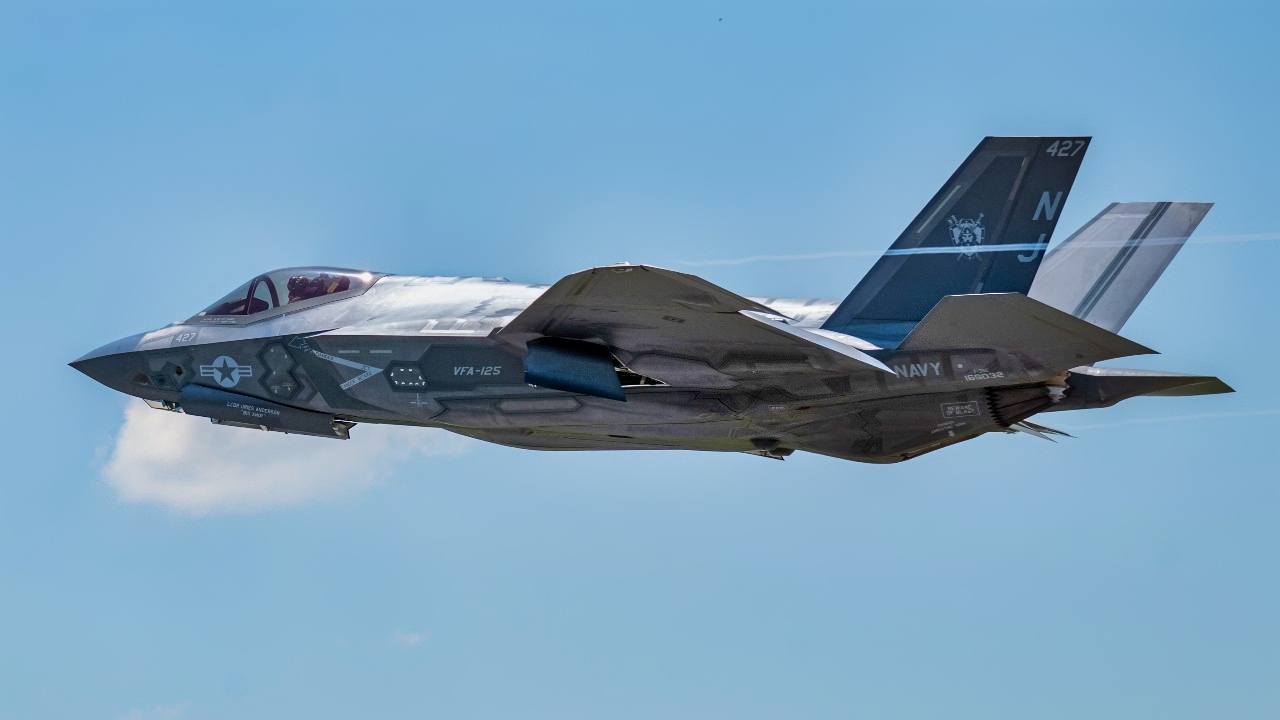
U.S. Navy Lt. Dave Hinkle, F-35C Lightning II Demonstration Pilot, performs during the 2021 Atlanta Air Show, Atlanta Regional Airport-Falcon Field, Ga., May 23, 2021. The U.S. Navy and Marine Corps’ carrier variant has larger wings and more robust landing gear than the other F-35 variants, making it suitable for catapult launches and fly-in arrestments aboard naval aircraft carriers. (U.S. Air Force photo by Staff Sergeant Thomas Barley)
“I can easily imagine a situation where the USA will demand Greenland from Denmark and will threaten to deactivate our weapons and let Russia attack us when we refuse (which we will even in that situation),” he added. “Therefore, buying American weapons is a security risk that we can not run. We will make enormous investments in air defence, fighter jets, artillery and other weapons in the coming years, and we must avoid American weapons if at all possible.”
The Canadian Question
America’s northern neighbor is also questioning the wisdom of acquiring additional F-35 jets. Ottawa currently operates 16 F-35s, part of a larger order of 88 total stealth jets that were to replace their Cold War-era CF-188 Hornets, the Royal Canadian Air Force variant of the closely related F/A-18 Hornet, an American naval fighter.
Those Canadian Hornets are rapidly approaching the end of their usefulness, given their advanced age, and provided the impetus for Ottawa to source a successor.
Rage in Canada against the United States is significant enough that the country is believed to be reassessing the JAS 39 Gripen E, a Swedish jet that placed second in a competition run by the Canadian Department of Defence.
But a bombshell report published in Canadian media showed that the Swedish jet was greatly outclassed by the F-35, leading some to ask if Canada is cutting off its nose to spite its face.
In that report, published by CBC News, a Canadian outlet, the Defence Department was revealed to have used five categories to evaluate both jets: mission performance, upgradability, sustainment, technical criteria, and capability delivery.
The results were not even close. The F-35 garnered a whopping 95 percent of possible points, handily beating the Gripen in every category. Saab’s Gripen E racked up a measly thirty-three percent of possible points.
Sniffing an opportunity, Saab has tried to sweeten the terms of their Gripen E pitch by offering to build the jets in Canada, likely leveraging Canadian aerospace firm Bombardier’s expertise. Combined with the potential sale of six Saab GlobalEyes Airborne Early Warning & Control (AEW&C) aircraft, the firm says that up to 12,500 jobs could be created in Canada.
Back to Reality
A path forward through the Greenland impasse may, however, have been secured. Writing on Truth Social, President Trump explained that a tentative agreement on the island had been agreed upon in principle following a meeting with NATO Secretary General Mark Rutte during the World Economic Forum, held annually in Davos, Switzerland.
“We have formed the framework of a future deal with respect to Greenland and, in fact, the entire Arctic Region,” President Trump wrote. “This solution,” he explained, “if consummated, will be a great one for the United States of America, and all NATO Nations.” The president also stated that the additional tariffs he threatened to levy against NATO allies would be rescinded.
A Twist of Irony
Europe’s consternation over President Trump’s rhetoric about Greenland is entirely understandable — a forced union, even a bloodless Anschluss — would spell the end of the credibility of the NATO alliance. But there is a certain twist of irony in the Danes using the American-designed F-35 stealth fighter to patrol the island, given the previous doubts the country has raised about the fighter jet.
What will be Greenland’s future? And what will be the future of the F-35 in Europe and amongst other American allies further afield?
About the Author: Caleb Larson
Caleb Larson is an American multiformat journalist based in Berlin, Germany. His work covers the intersection of conflict and society, focusing on American foreign policy and European security. He has reported from Germany, Russia, and the United States. Most recently, he covered the war in Ukraine, reporting extensively on the war’s shifting battle lines from Donbas and writing on the war’s civilian and humanitarian toll. Previously, he worked as a Defense Reporter for POLITICO Europe. You can follow his latest work on X.