
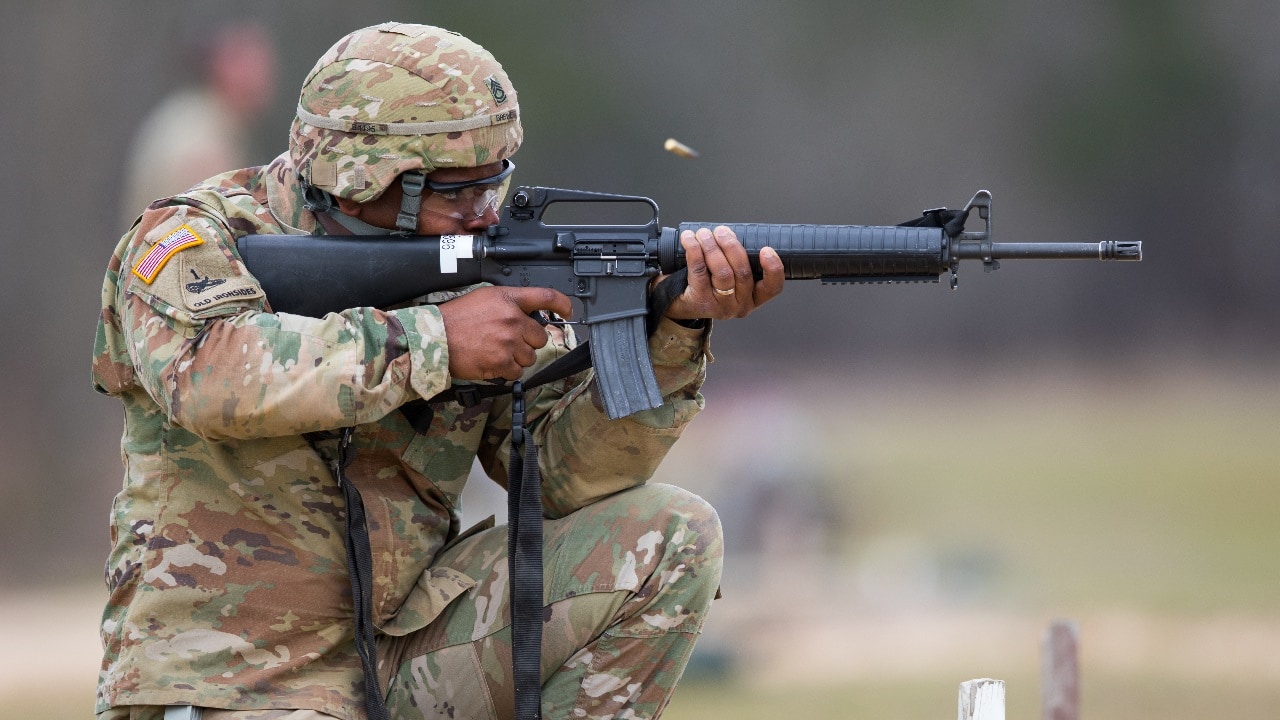
Key Points and Summary – Gen. William C. Westmoreland is often treated as the face of America’s Vietnam failure, but his own maxim—politicians start wars—underscores how constrained his command could be.
-After a standout West Point record and combat service in WWII and Korea, he led U.S. forces in Vietnam with an attrition strategy meant to grind down the Viet Cong and North Vietnamese Army.
-Tet in 1968 ended as a tactical setback for the communists but became a decisive propaganda moment at home, cementing Westmoreland as the fall guy.
-Replaced by Abrams, he later served as Army Chief of Staff and helped oversee the transition toward an all-volunteer force.
Westmoreland Said It Best: “Politicians Start Wars”
“The military don’t start wars. Politicians start wars.” – William Westmoreland, Military Quote of the Day
That quote belongs to U.S. Army General William C. Westmoreland, who commanded U.S. forces in the Vietnam War from 1964 to 1968.
Because the United States lost that war, Westmoreland is one of the least beloved general officers in U.S. history.
In fairness, the withdrawal of American combat troops from South Vietnam happened five years after Westmoreland’s Vietnam tenure ended—General Frederick Carlton Weyand was in his shoes by then—and what’s more, going back to that opening quote, it was the politicians who forced Westmoreland to fight the war with one hand tied behind his back.
William Westmoreland’s life and career deserve a more nuanced review.
Early Life
William Childs “Westy” Westmoreland was born in Spartanburg, South Carolina, on March 26, 1914, to Eugenia Talley Childs and James Ripley Westmoreland. At the age of 15, William became an Eagle Scout in his Boy Scouts of America local council’s Troop 1, and that taste for rugged adventure would soon lead to the pursuit of a military career.
He spent a year at The Citadel in 1932 and then received an appointment to the U.S. Military Academy at West Point from Senator James F. Byrnes.
West Point
Cadet “Westy” excelled at West Point, graduating at the top of his Class of 1936. That class also included future generals Creighton Abrams and Benjamin Oliver Davis Jr. Westmoreland was commissioned as an artillery officer.
Years of Heroism: WWII and Korea
According to his mini-bio on History.Com, “During World War II, Westmoreland fought courageously with a battalion in North Africa and Sicily, and was chief of staff of the U.S. Army’s Ninth Division when it entered Germany in 1944. He also served in the Korean War, as commander of the 187th Regimental Combat Team. In 1955, the 42-year-old Westmoreland was promoted to major general, becoming the youngest man to have achieved that rank in the U.S. Army.”
Between World War II and the Korean War, “Westy” married Katherine (Kitsy) Stevens Van Deusen in May 1947; the couple had three children.
Years of Inauspiciousness: The Vietnam War
In June 1964, Westmoreland pinned his fourth star.
That same month, President Lyndon Johnson tapped him as commander of the U.S. Military Assistance Command in Vietnam.
In this position, Westmoreland adopted a strategy of attrition against the Viet Cong and the North Vietnamese People’s Army of Vietnam (NVA) to drain them of manpower and supplies.
The strategy seemed to go well at first, and the general gave rosy assessments to the Western media.
However, his approach drew criticism as the war dragged on, and it came to a head when the Viet Cong and NVA launched the Tet Offensive on January 30, 1968.
Three months later, the Tet Offensive ended as a crushing tactical defeat for the Communist forces, with the Viet Cong suffering particularly grievous casualties.
However, due to the sheer surprise and ferocity of the attack, it was spun by the media as a Communist victory.
Indeed, it turned out to be a propaganda victory for the North, and the psychological turning point of the war. Westmoreland took the blame.
Going back to what I said in the beginning about General Westmoreland being hamstrung by the politicians back home, consider this passage in the excellent and underappreciated 1999 book Unheralded Victory: The Defeat of the Viet Cong and the North Vietnamese Army, 1961-1973 by Mark W. Woodruff: “General Westmoreland had finalized plans to invade North Vietnam but was consistently refused permission to do so…Westmoreland’s invasion plan also called for an amphibious attack on North Vietnam.”
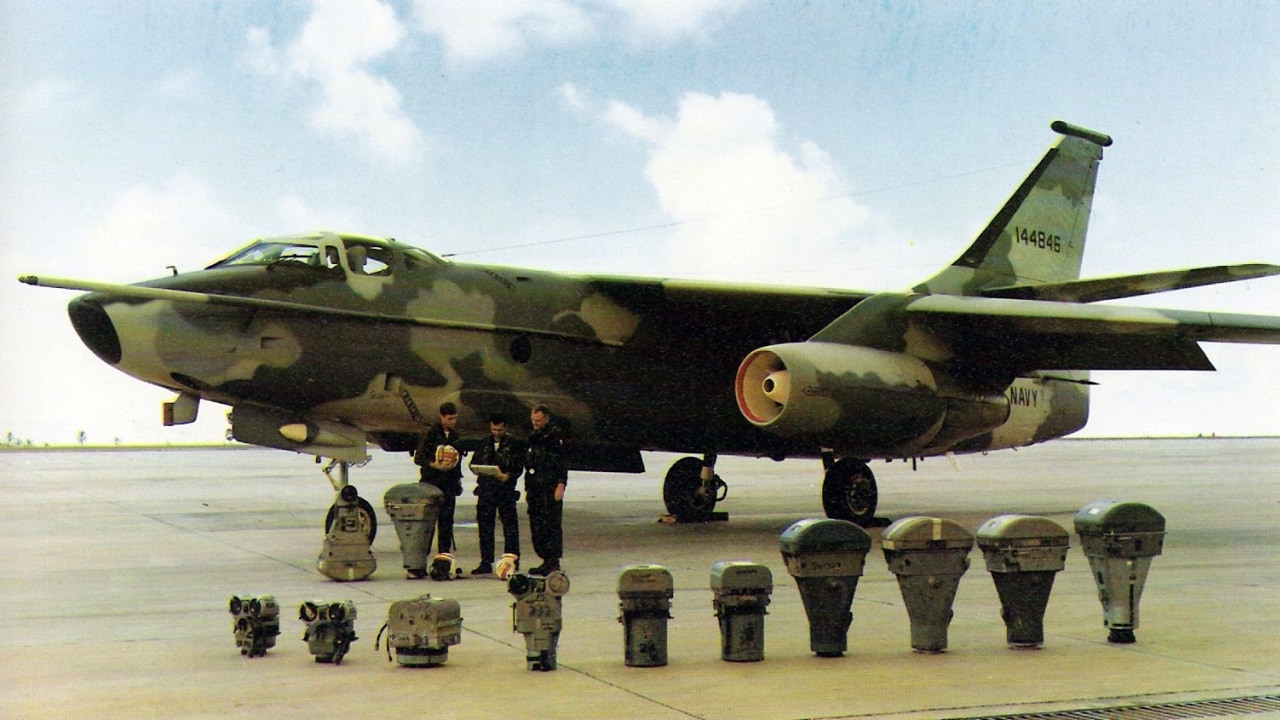
A camouflaged U.S. Navy Douglas RA-3B Skywarrior aircraft of reconnaissance squadron VAP-61 World Recorders (BuNo 144846) at Naval Air Station (NAS) Agana, Guam. Standing beside it are PH1c R. Laurie, LTJG D. Schwikert and LCDR Chas. D. Litford. On the ground in front of them are twelve cameras. VAP-61 was performed reconnaissance missions over Vietnam until it was disestablished on 1 July 1971. 144846 became an ERA-3B in 1982. It was later sold to Hughes Aircraft, inherited by Raytheon, (civil registration N547HA) and finally srcapped in 1999.
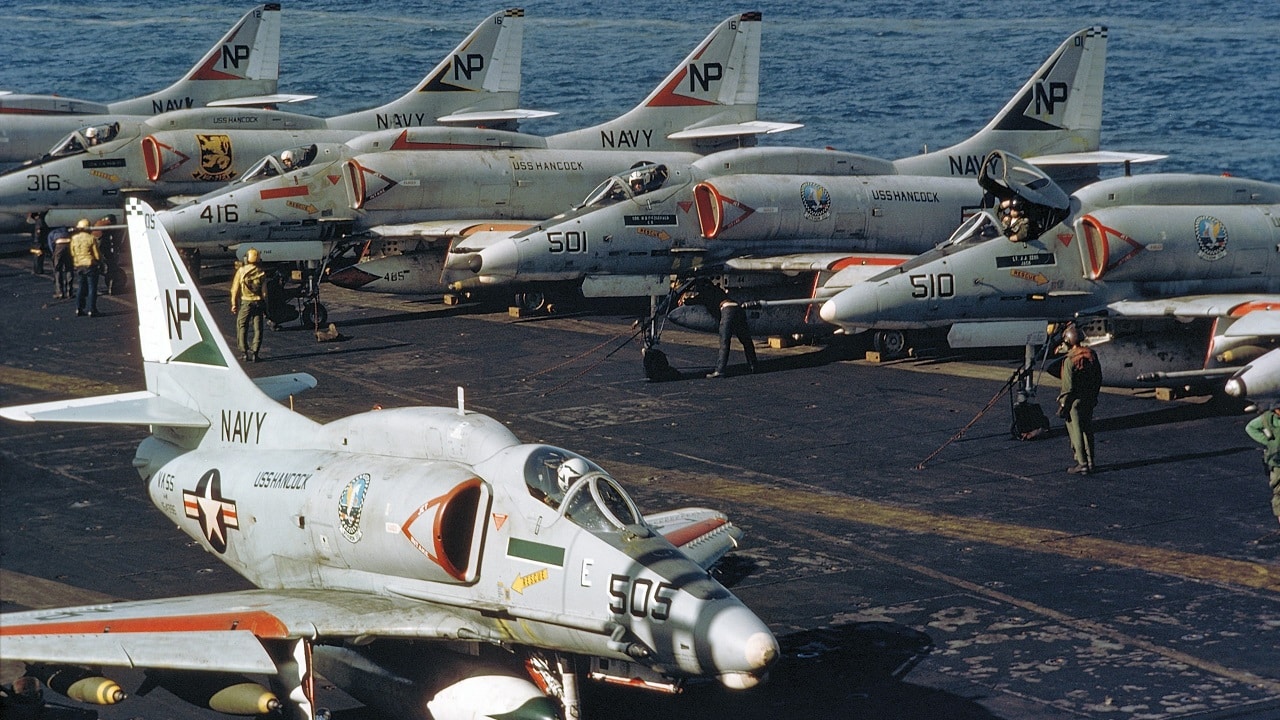
U.S. Navy Douglas A-4F Skyhawk of Attack Carrier Air Wing 21 (CVW-21) are parked on the flight deck of the attack aircraft carrier USS Hancock (CVA-19), armed for a mission over Vietnam on 25 May 1972. Skyhawks NP-501 (BuNo 155046), -505 (BuNo 154996), and -510 were assigned to Attack Squadron 55 (VA-55) “Warhorses”, NP-316 to VA-212 “Rampant Raiders”, NP-412 and NP-416 to VA-164 “Ghost Riders”. The aircraft are armed with Mk 82 (500 lb/227 kg) and Mk 83 (1000 lb/454 kg) bombs. CVW-21 was assigned to the Hancock for a deployment to Vietnam from 7 January to 3 October 1972.
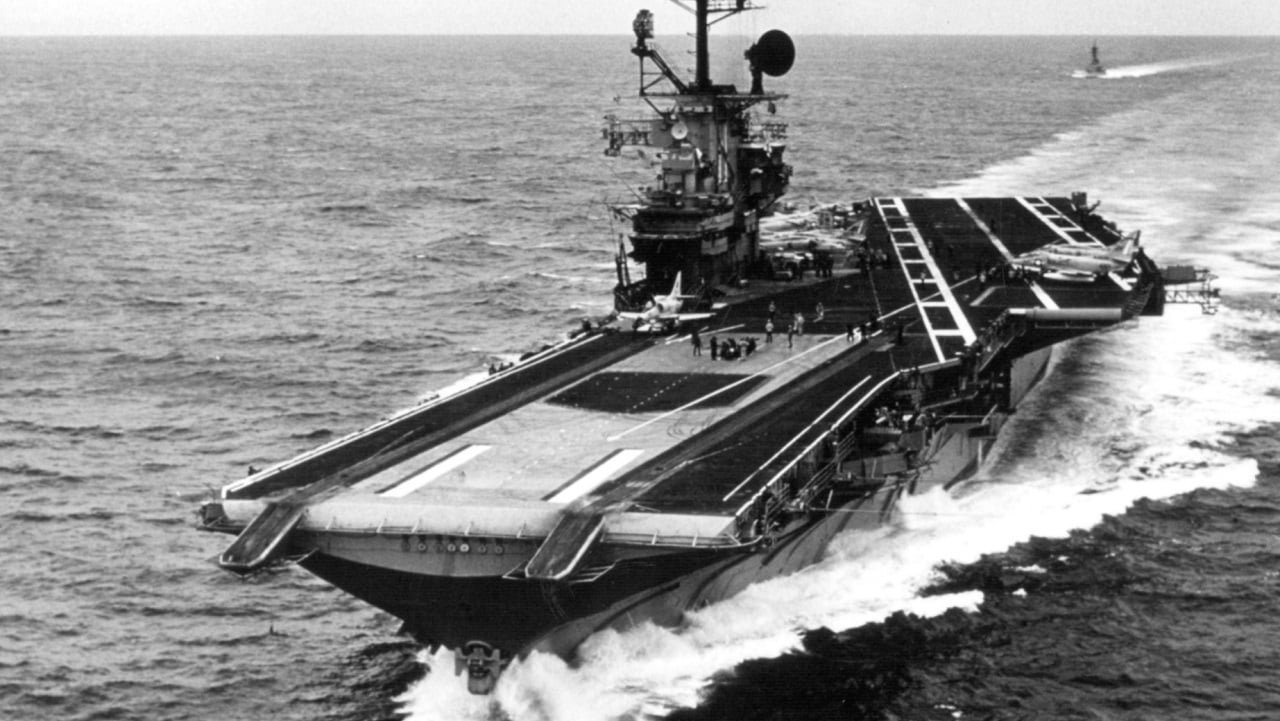
The U.S. Navy aircraft carrier USS Intrepid (CVS-11) underway in the South China Sea en route to Yankee Station off the coast of Vietnam in 1968. Intrepid, with assigned Attack Carrier Air Wing 10 (CVW-10), was deployed to Vietnam from 4 June 1968 to 9 February 1969.
Had that amphibious assault come to fruition, perhaps it could have gone down in history along the lines of General Douglas MacArthur’s Inchon landing during the Korean War.
However, LBJ and Secretary of Defense Robert S. McNamara backed down from an invasion of North Vietnam.
They feared this would drag China into the war—a fear hindsight shows was misplaced, given the longstanding animosity between China and Vietnam.
In June 1968, Westmoreland was replaced by his old West Point classmate, General Creighton Abrams, who served in the role until 1972.
Post-Vietnam
Defeat in Vietnam did not lead to the end of General Westmoreland’s career.
His next assignment was as Army Chief of Staff, and he served in that billet until he retired from the U.S. Army on June 30, 1972, overseeing some significant organizational reforms (including the transition to an all-volunteer Army). President Richard Nixon awarded the general the Army Distinguished Service Medal as a retirement gift.
He ran unsuccessfully for the governorship of South Carolina in 1974 and released a memoir, A Soldier Reports, two years later.
William C. Westmoreland died in Charleston, South Carolina on July 18, 2005, at the age of 91, due to complications from Alzheimer’s disease. He was laid to rest in Section 18, Lot 66 of West Point Cemetery.
Lasting Legacy of William Westmoreland
In 1992, the General William C. Westmoreland Bridge (I-526) in Charleston, South Carolina, was named in his honor; four years later, the National Society of the Sons of the American Revolution (SAR) authorized the annual General William C. Westmoreland Award to honor outstanding SAR volunteers.
Perhaps the most fitting testament to William Westmoreland’s post-Vietnam image rehabilitation took place on May 19, 1991, when the retired general led a group of Vietnam veterans through the streets as part of Hollywood’s Welcome Home Desert Storm Parade.
This made for a particularly profound sense of closure on Vietnam, especially in light of then-President George H.W. Bush’s famous statement about the Gulf War victory that “By God, we’ve kicked the Vietnam syndrome once and for all!”
About the Author: Christian D. Orr, Defense Expert
Christian D. Orr is a Senior Defense Editor. He is a former Air Force Security Forces officer, Federal law enforcement officer, and private military contractor (with assignments worked in Iraq, the United Arab Emirates, Kosovo, Japan, Germany, and the Pentagon). Chris holds a B.A. in International Relations from the University of Southern California (USC) and an M.A. in Intelligence Studies (concentration in Terrorism Studies) from American Military University (AMU). He is also the author of the newly published book “Five Decades of a Fabulous Firearm: Celebrating the 50th Anniversary of the Beretta 92 Pistol Series.”