
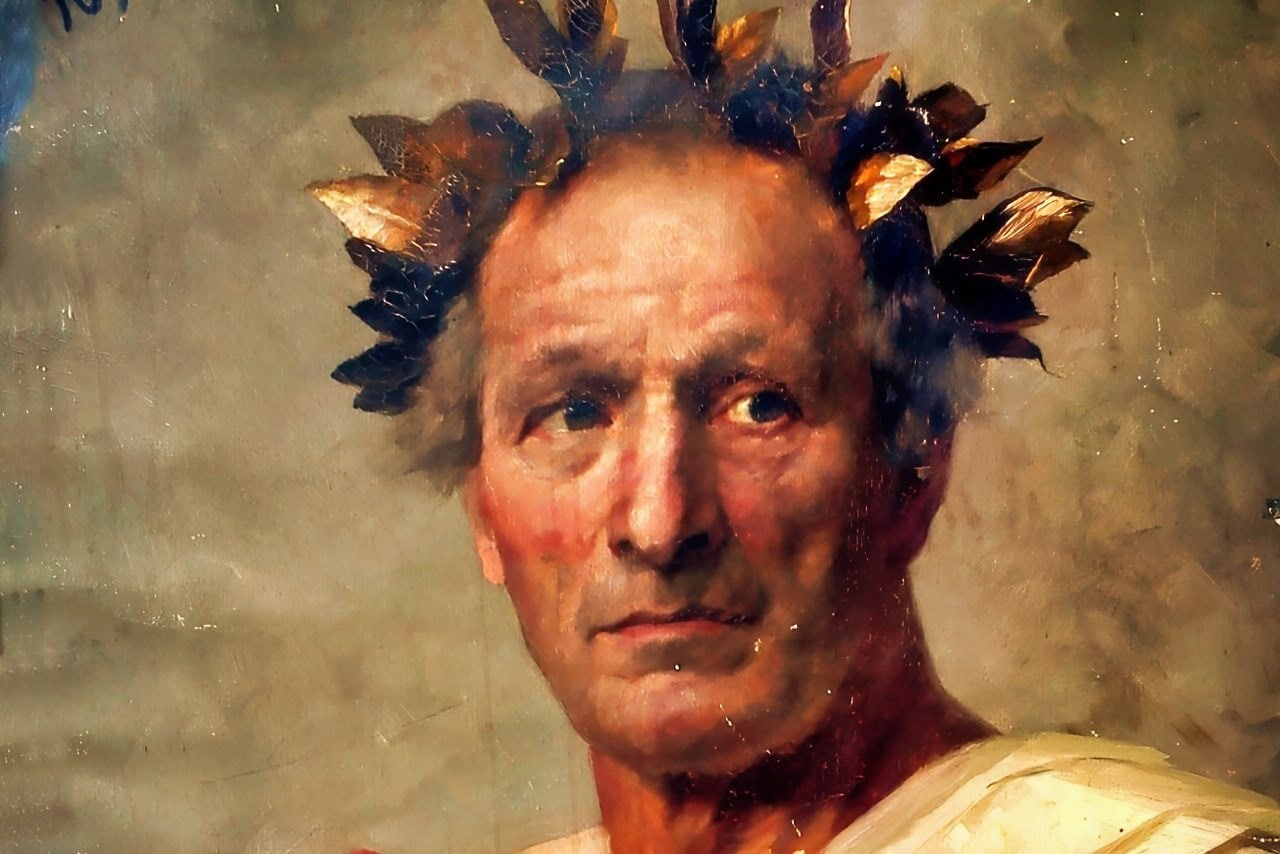
Summary and Key Points: Julius Caesar’s line about patience under pain argues that enduring hardship is a rarer kind of courage than a dramatic willingness to die.
-The quote frames resilience as a test of long-term mental discipline—bearing suffering without complaint, sustaining resolve, and refusing to break under pressure.
-The piece links this idea to Stoic themes of endurance and self-control while noting Caesar was a pragmatist driven by power rather than a devoted Stoic philosopher.
-It also places the quote alongside Caesar’s broader legacy: a brilliant commander and political force whose reforms and ambition accelerated the Republic’s collapse, culminating in his assassination on March 15, 44 BCE.
Military Quote Of The Day: Julius Caesar On Why Endurance Is Rarer Than Heroic Death
‘It Is Easier To Find Men Who Will Volunteer To Die, Than To Find Those Who Are Willing To Endure Pain With Patience’ – Julius Caesar
Caesar’s quote underscores the rarity of endurance. Heroic sacrifice and dying for a cause may seem noble, but the quiet strength of patience in suffering is far harder.
His words remind us that true strength and courage is not only in facing death but in bearing life’s trials with patience, fortitude, and unwavering resolve.
Gaius Julius Caesar (100–44 BCE) was arguably the most significant Roman general, statesman, and author whose military conquests, particularly in Gaul, and political ambition helped dismantle the Roman Republic and pave the way for the Roman Empire, ultimately becoming its first dictator before his assassination by senators on the Ides of March (March 15, 44 BCE).
Caesar was a brilliant strategist known for expanding Rome’s empire and enacting reforms, his rise to absolute power sparked fear among traditional elites among the Roman Senate, leading to his cold-blooded assassination on the steps of the Senate.
Caesar And Stoic Philosophy
Caesar’s quote embodies a Stoic understanding. However, Caesar was not a Stoic in practice, although he drew selectively from many philosophical currents, including Stoic ideas, but did not adopt Stoicism as his guiding school.
Caesar pursued personal power, an unprecedented accumulation of honors, and reforms to centralize authority—actions at odds with Stoic ideals of avoiding domination by passions and fame.
Cato the Younger, a devout practitioner of Stoicism, was a leading opponent of Caesar and a symbol of Stoic integrity. Cato’s life, which prioritized rigid adherence to virtue over political expediency, was often at odds with Caesar’s ambition.
Julius Caesar was a pragmatist focused on power, often acting in ways that contradicted Stoic principles of duty and detachment. While he displayed some Stoic-like restraint in his political “clemency” toward enemies, his driving ambition and lack of philosophical writings distinguish him from the era’s true Stoic philosophers.
Stoics held that virtues such as endurance and self-control should be cultivated in the face of pain and hardship. They taught their followers that by accepting pain without complaint, they could develop inner strength and resilience to overcome life’s obstacles.
Impulsive Courage vs. Enduring Fortitude
Caesar suggests that finding people willing to die in a single moment of passion is easier than finding those who will patiently withstand ongoing struggle.
Caesar may have stated this quote because he saw firsthand that people, like prisoners of war, would rather die than be tortured by an enemy.
Resilience as True Strength: It implies that enduring long-term hardship requires greater mental toughness and, in some contexts, more courage than a quick death.
Application: It serves as a commentary on the rarity of true, patient, and consistent fortitude in both personal life and leadership.
Essentially, it is a statement on the difficulty of finding true, patient endurance compared to the relative ease of finding dramatic, short-lived sacrifice.
Caesar’s Quote At The Battle Of Zela
“Veni, vidi, vici” is a famous Latin phrase by Julius Caesar, meaning “I came, I saw, I conquered,” used to describe his swift and decisive victory at the Battle of Zela in 47 BC against Pharnaces II of Pontus.
By the time of arguably Caesar’s most famous quote, he was already Rome’s most significant personality. He defeated powerful Gnaeus Pompeius Magnus in a civil war, a conflict that ended with Pompey’s assassination on the shores of Egypt in 48 B.C.E. Caesar secured the support of the Egyptians — and their queen, Cleopatra.
The phrase’s terseness and impact highlighted Caesar’s confidence and military prowess, reported in a letter to Rome and displayed during his triumph, symbolizing his absolute power.
After crossing the Rubicon, Caesar quickly defeated Pharnaces II in modern-day Turkey, a campaign that concluded in a single day.

Vercingetorix throws down his arms at the feet of Julius Caesar, painting by Lionel Royer in 1899. Musée Crozatier, Le Puy-en-Velay, France. Imave Credit: Creative Commons.
The Report: Caesar famously communicated this rapid success by writing “veni, vidi, vici” in a letter to the Roman Senate, demonstrating his overwhelming competence.
He also used the phrase as an inscription during his grand victory procession (triumph) in Rome, serving as a powerful political statement.
It became a symbol of Caesar’s exceptional military skill and his rising power, foreshadowing his eventual consolidation of absolute control over the Roman Republic.
Caesar’s most famous quotes had the added virtue of the addition of William Shakespeare’s play “Julius Caesar” which featured quotes that he had never made, but were attributed to him because of the popularity of the play.
About the Author: Steve Balestrieri
Steve Balestrieri is a National Security Columnist. He served as a US Army Special Forces NCO and Warrant Officer. In addition to writing on defense, he covers the NFL for PatsFans.com and is a member of the Pro Football Writers of America (PFWA). His work was regularly featured in many military publications.