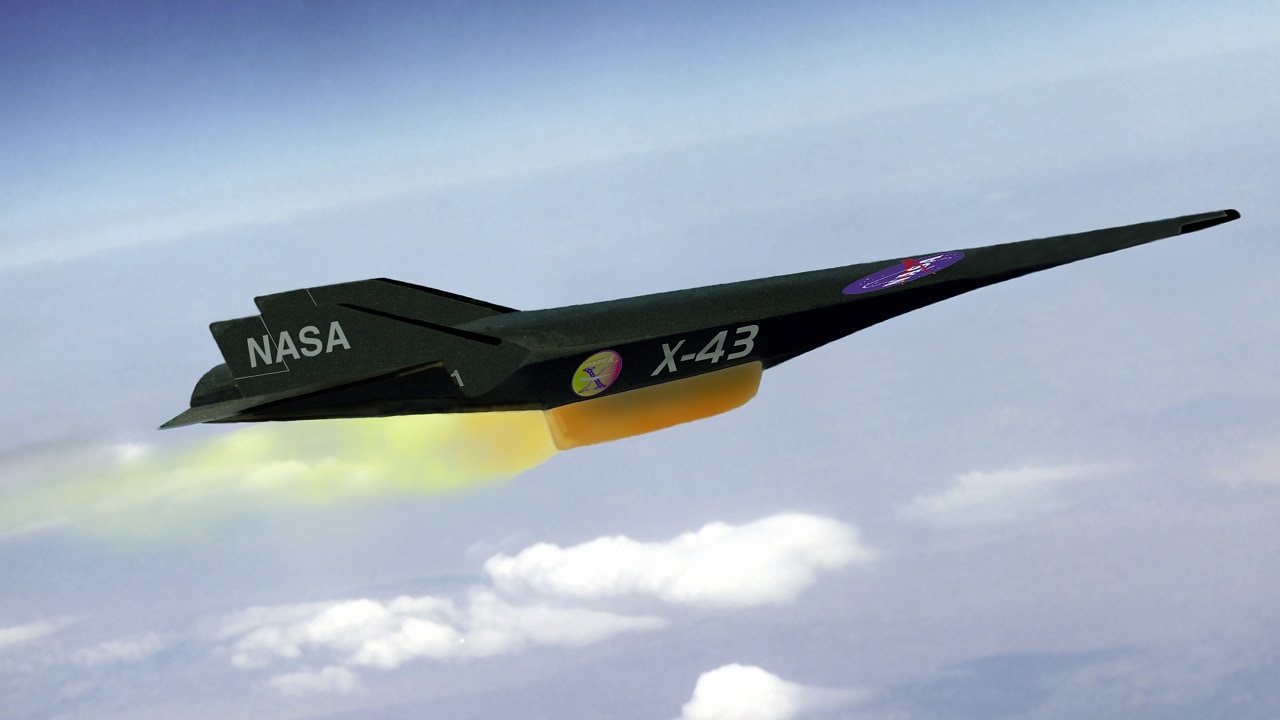
Synopsis: NASA’s unmanned X-43A Hyper-X proved that an air-breathing scramjet could fly at hypersonic speed, riding a B-52 launch and a booster rocket before separating for a brief powered run.
-After a first flight failed, the program delivered breakthrough data, hitting Mach 7 and then a record Mach 9.6 in 2004, earning a Guinness mark for the fastest air-breathing aircraft.
-The effort highlighted why real flight tests were necessary to understand heat, propulsion uncertainty, and separation dynamics.
Its legacy also frames today’s hurdles: tracking moving targets, thermal limits, and the escalation risks of nuclear ambiguity.
Mach 9.6: How NASA’s X-43A Became The Fastest Air-Breathing Aircraft
NASA’s X-43A is a decidedly odd aircraft. Unmanned, launched from a B-52 Stratofortress, and mounted to the top of a rocket, its X-designation indicates it is purely a research vehicle used to gather valuable flight data, not to enter serial production.
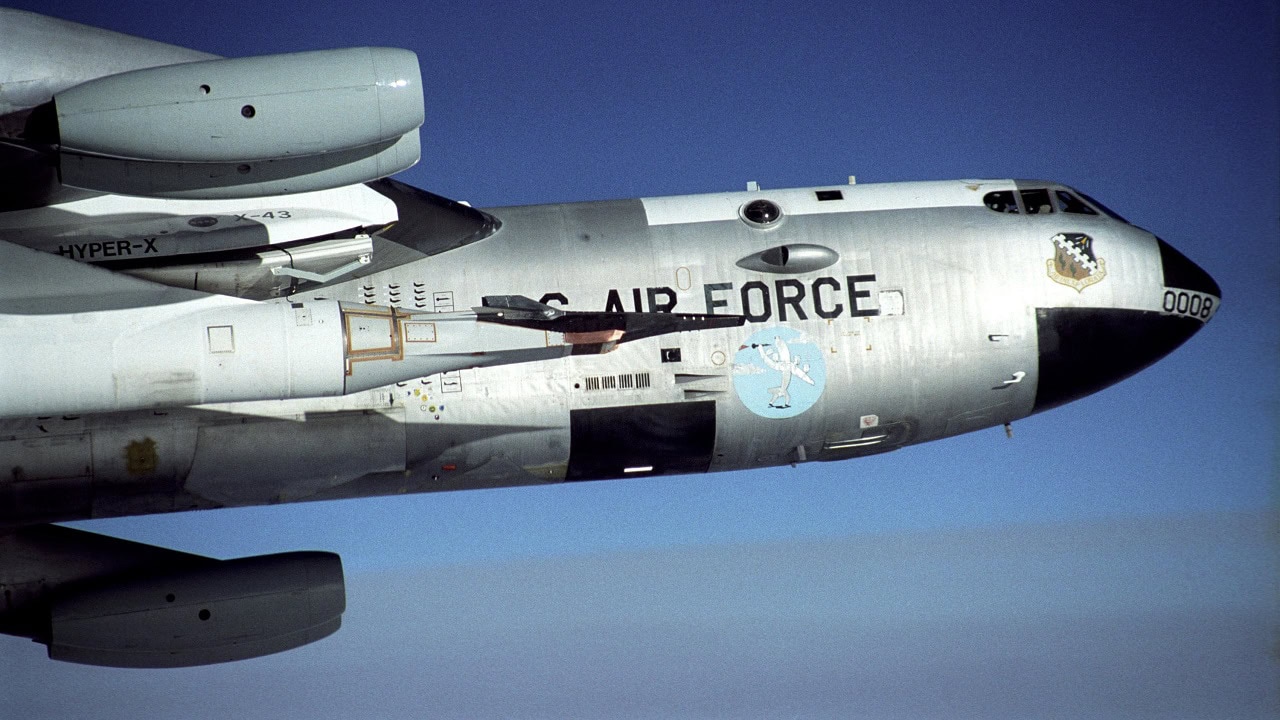
The X-43A was a small experimental research aircraft designed to flight-demonstrate the technology of airframe-integrated supersonic ramjet or “scramjet” propulsion at hypersonic speeds above Mach 5, or five times the speed of sound. Its scramjet engine is an air-breathing engine in which the airflow through the engine remains supersonic.
The aircraft is wildly different from any aircraft in service with the United States military, and though it is no longer in use, the X-43A contributed to other hypersonic flights, despite flying just three times.
X-43A: The Rhyme Behind the Reason
NASA explains that there were three core reasons for wanting to build and test a hypersonic research vehicle like the X-43A.
For starters, “high energy requirement to simulate the mission flight conditions meant fewer ground test options were available,” which led NASA to conclude that “shock tunnel testing was the only option.” Secondly, “short test times only allower single performance points per run, so no fueling or cowl position transitions possible.”
As a consequence, “propulsion database uncertainties increased.”

B-52J Bomber U.S. Air Force. Image Credit: Creative Commons.

A U.S. Air Force B-52H Stratofortress assigned to the 96th Bomb Squadron, Barksdale Air Force Base, Louisiana, sits on the flightline during exercise Prairie Vigilance 25-1 at Minot Air Force Base, North Dakota, April 12, 2025. For more than 60 years, the B-52 has been the backbone of the strategic bomber force of the United States. As a routine training mission, PV 25-1 enhances the safety, security, and reliability of the bomber leg of the U.S. nuclear triad. (U.S. Air Force photo by Senior Airman Kyle Wilson)
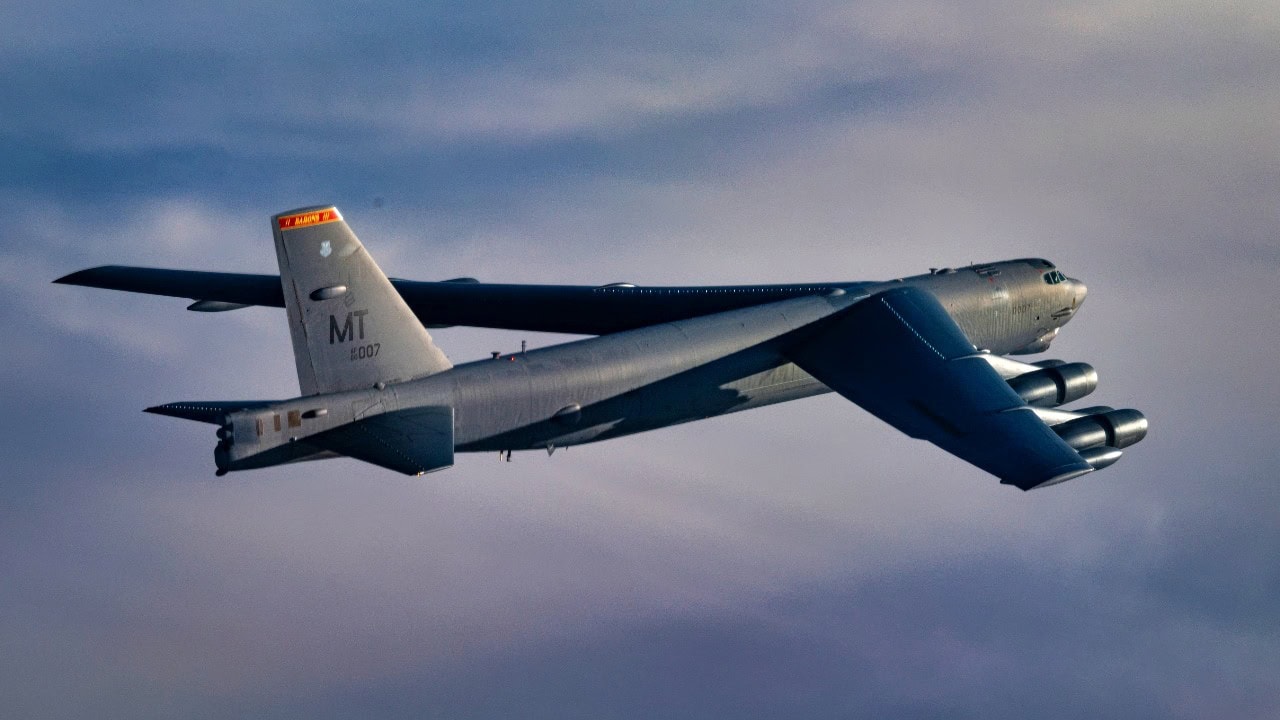
A U.S. Air Force B-52H Stratofortress from the 69th Expeditionary Bomb Squadron flies over the skies of Sweden for their celebration of their acceptance into NATO during Bomber Task Force 25-2, RAF Fairford, United Kingdom, March 11, 2025. These operations demonstrate the ability to rapidly deploy strategic assets in support of global stability. (U.S. Air Force photo by Master Sgt. Chris Hibben)
In sum, NASA needed to put an actual, physical aircraft through its paces if it was to get actionable information that could be applied to other programs. Factors such as intense heat had to be managed, and there were limits to what could be accomplished with computer simulations alone.
High Risk but High Reward
The engineering challenges were prodigious and would require substantial funding to get an air-breathing engine to hypersonic speeds, NASA writes. “The eight-year, approximately $230 million NASA Hyper-X program was a high-risk, high-payoff research initiative that tackled challenges never before attempted. No vehicle powered by an air-breathing engine had ever flown at hypersonic speeds.”
But in addition, “the rocket boost and subsequent separation from the rocket to reach the scramjet test conditions involved complex elements that had to function properly for mission success. Careful analyses and design were applied to reduce risks to acceptable levels; however, some residual risk remained inherent to the program.”
Ultimately, the project would set records, despite an inauspicious start.
The first flight ended in disaster when the X-43A’s booster rocket lost control, ultimately destroying the X-43A mounted to its nose. The second flight, however, was a successful scramjet-powered flight that reached Mach seven, or seven times the speed of sound. But it was the last flight, in 2004, that was groundbreaking: it reached Mach 9.6 — nearly 10 times the speed of sound — and even earned a Guinness World Record for the fastest aircraft with an air-breathing engine.
In a press release covering the world record recognition, NASA explained that “the previous known record for an air-breathing vehicle – but not an airplane – was held by a ramjet-powered missile, which achieved slightly more than Mach 5.”
Still quite fast, but nowhere near the X-43A. Later, “the highest speed attained by a rocket-powered airplane, NASA’s X-15 aircraft, was Mach 6.7. The fastest air-breathing, manned vehicle, the SR-71, achieved slightly more than Mach 3.2.”
Both quite fast, but handily outpaced by the X-43A, which “more than doubled, then tripled, the top speed of the jet-powered SR-71.” Though in a different class of aircraft entirely — the SR-71 Blackbird was a piloted reconnaissance aircraft of Cold War vintage — it was, for many years, the fastest aircraft in existence.
Moving Forward
The Congressional Research Service, a nonpartisan think tank that reports to the United States Congress, notes that early hypersonic weapons, though technically successful in achieving the high speeds for which they are primarily tasked, will likely lack the sophistication to make them more viable for military applications.
One significant issue will be targeting tracking. The CBO writes that “first-generation hypersonic missiles are not expected to have the accuracy or sensors needed to operate effectively in situations in which targets may be moving.”
The technical hurdles to hypersonics are clear and significant: thermal management may ultimately be a limiting factor, one that, in essence, caps speeds. But the operational hurdles may prove to be more challenging — and more significant. Primary among these are nuclear ambiguities.
The Congressional Budget Office takes note of an earlier program that was ended because of nuclear ambiguity, the United States Navy’s Conventional Trident Modification program, an early 2000s initiative that would have attempted to replace some Trident intercontinental ballistic missiles’ nuclear payload with a conventional explosive alternative. Though the modification would have offered greater operational flexibility, an adversary would not be able to distinguish that missile from its original nuclear-tipped configuration.
The risk of a nuclear retaliation to a conventionally-armed weapon was too high, and the project was shuttered.
The X-43A Legacy
While hypersonic weapons are indeed complex, it is not only their engineering particulars that will factor into their use; their incredibly high speeds will narrow the response window of peer adversaries and potentially prompt a response before knowing exactly what kinds of weaponry are incoming — a fearsome prospect indeed.
About the Author: Caleb Larson
Caleb Larson is an American multiformat journalist based in Berlin, Germany. His work covers the intersection of conflict and society, focusing on American foreign policy and European security. He has reported from Germany, Russia, and the United States. Most recently, he covered the war in Ukraine, reporting extensively on the war’s shifting battle lines from Donbas and writing on the war’s civilian and humanitarian toll. Previously, he worked as a Defense Reporter for POLITICO Europe. You can follow his latest work on X.