
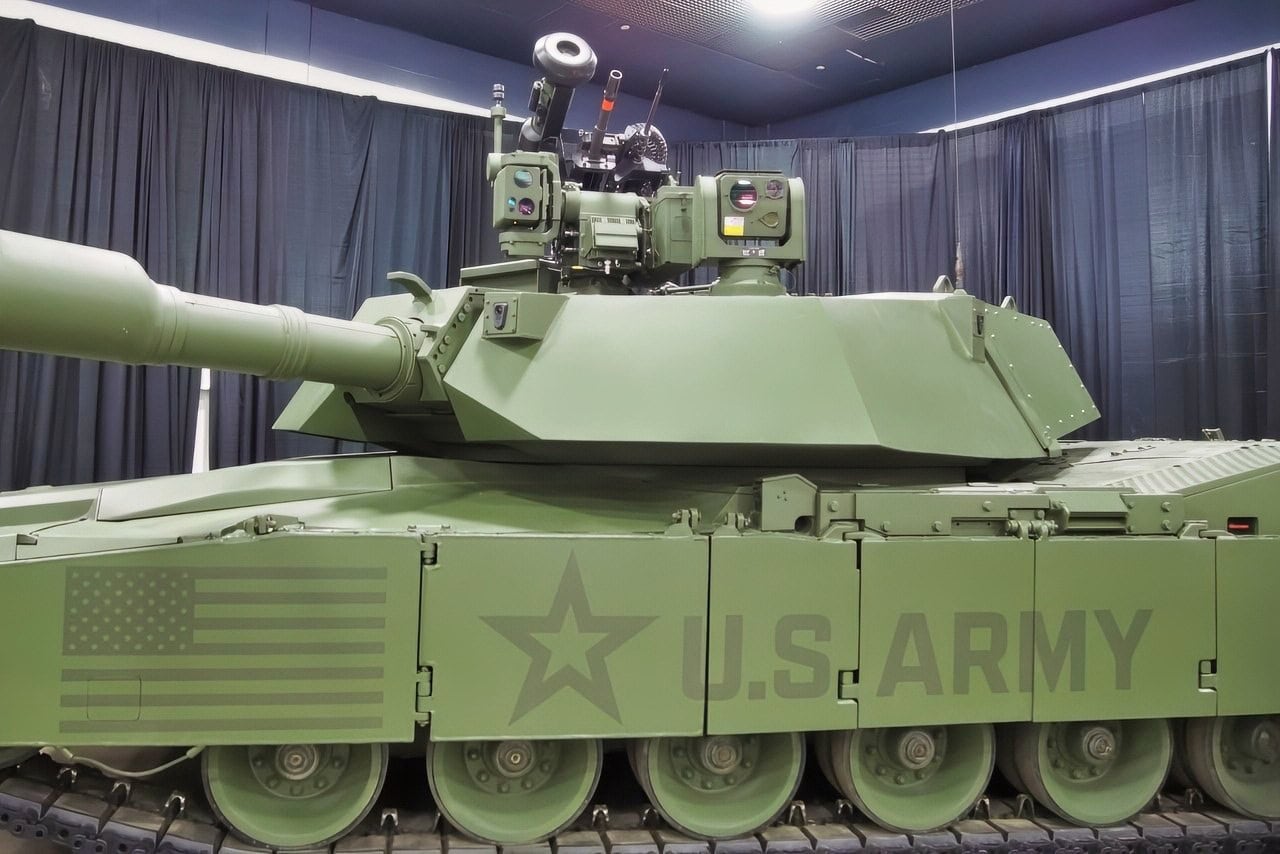
Summary and Key Points: The M1E3 Abrams pre-prototype revealed in January 2026 points to a tank redesigned around survivability and adaptability: an unmanned turret, bustle autoloader, and a three-person crew protected inside a hull cell, plus a hybrid power pack to boost efficiency and expand electrical margin.
-Drone defense is treated as a layered problem, not a single gadget. Instead of a fixed “final” counter-UAS suite, the M1E3 leans on a Modular Open Systems Approach to slot in sensors and effectors as threats evolve.
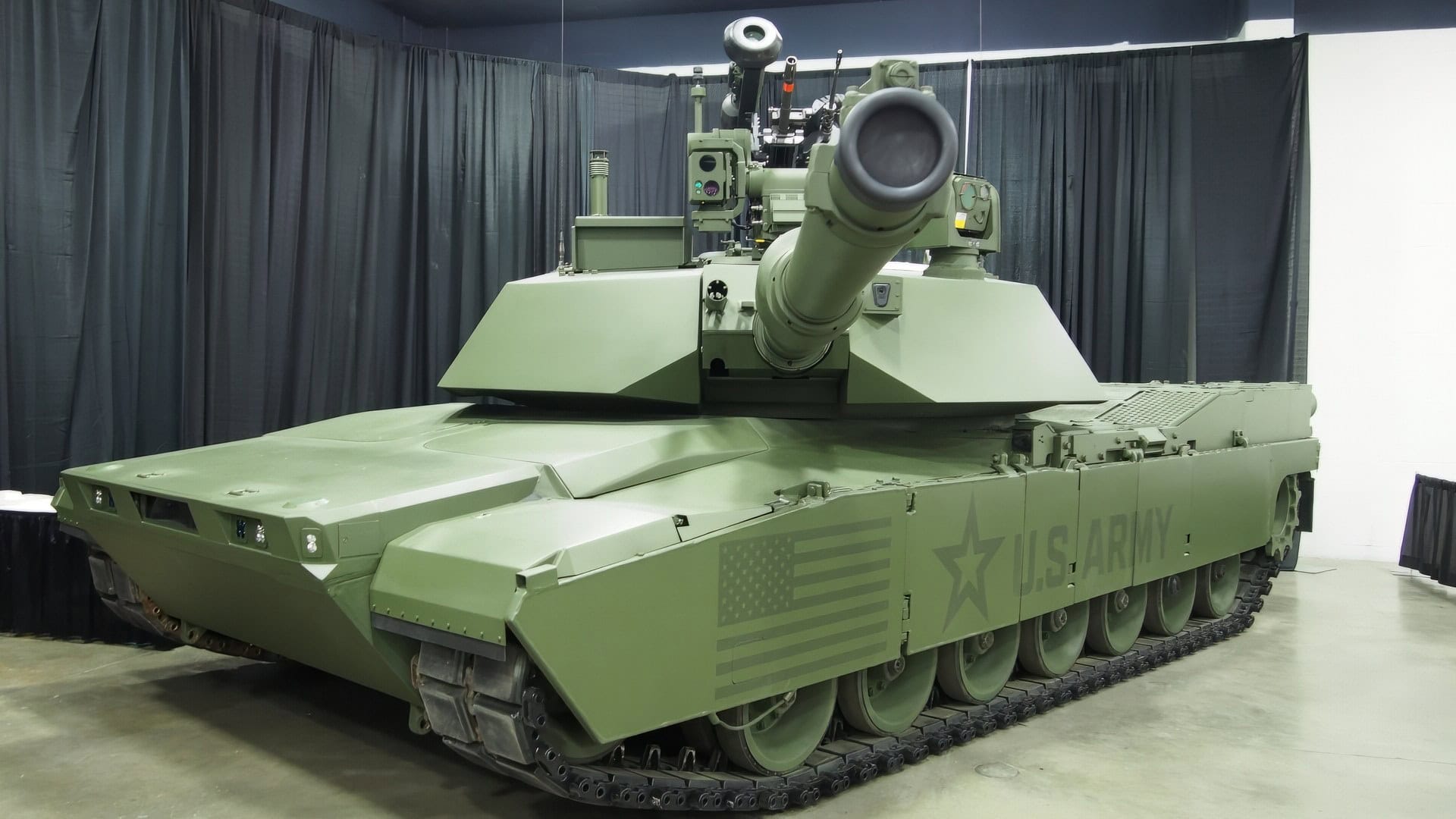
Photo taken on 1/17/2026 of the M1E3 Tank at the Detroit Auto Show. Image by 19FortyFive, All Rights Reserved.
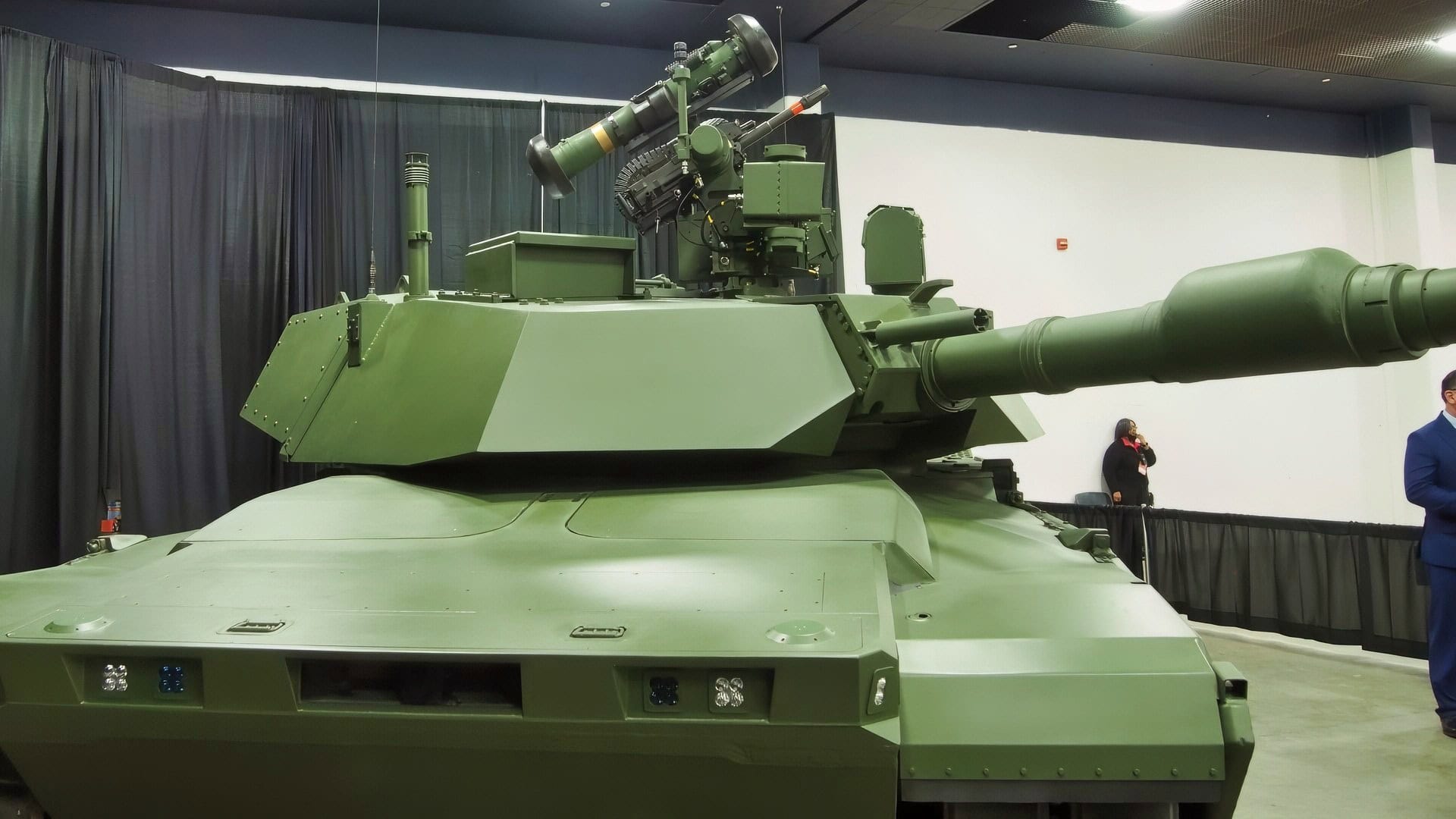
M1E3 Tank from the Detroit Auto Show. Photo Taken By 19FortyFive Staff on 1/17/2026.
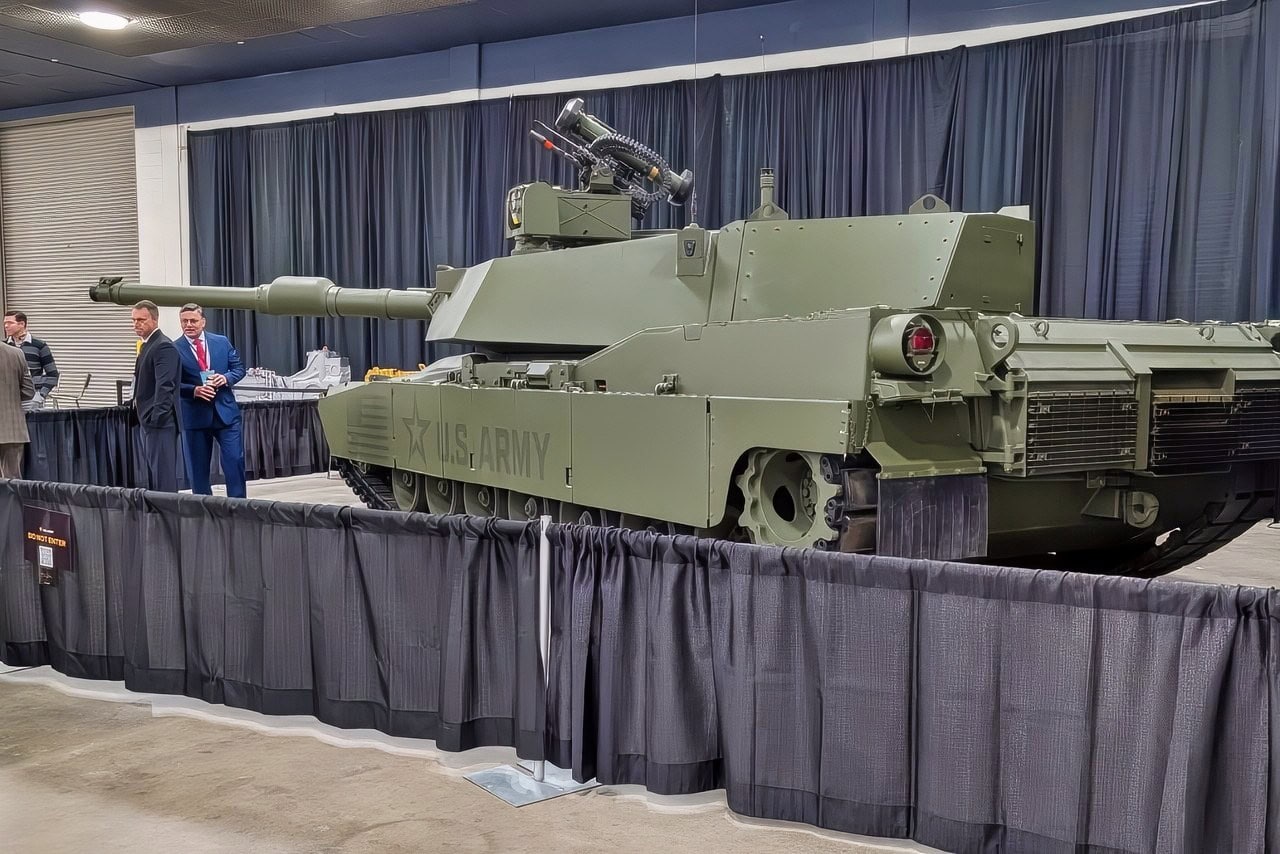
M1E3 Tank at the Detroit Auto Show. Image Credit: 19FortyFive.
-Expect a blend of native integrated APS, soft-kill electronic attack, and short-range kinetic options—tied into the Army’s wider C-UAS network.
Can The M1E3 Stop FPV Drones? The Army’s “Layered” Answer Explained
In January 2026, the public received its first look at the pre-prototype M1E3 Abrams, which featured several changes: an unmanned turret, a bustle autoloader, a three-person crew in a protected hull cell, and a reworked sensor and external camera suite.
While the turret retains the same overall appearance, its interior has been modified to relocate the crew to within the hull and to accommodate new sensors and electronic systems. In addition to the unmanned turret and reduced crew size, the M1E3 implements a new hybrid power pack to increase fuel efficiency.
The M1E3 and the Drone Age
The obvious question is how this new Abrams defends itself against drones. From the outset, the M1E3 has been advertised as a tank inspired by lessons learned from the Ukraine War, which has been devastating to both Soviet-made and Western-made tanks. The Army has not published a single “final configuration” for M1E3’s counter-UAS suite, precisely because the Modular Open Systems Approach (MOSA) is designed to enable continuous insertion of new sensors and effectors to address diverse challenges.
Based on statements from the Army and on what current Abrams tanks carry, we can gain a limited picture of what to expect from the M1E3’s defenses.
Currently, the M1 Abrams fleet already fields the Trophy Active Protection System (APS) as an add-on in the SEPv2/SEPv3 variants, and the Department of Test and Evaluation (DOT&E) reported that Trophy intercepted most incoming threats in FY22 testing that informed urgent materiel release.
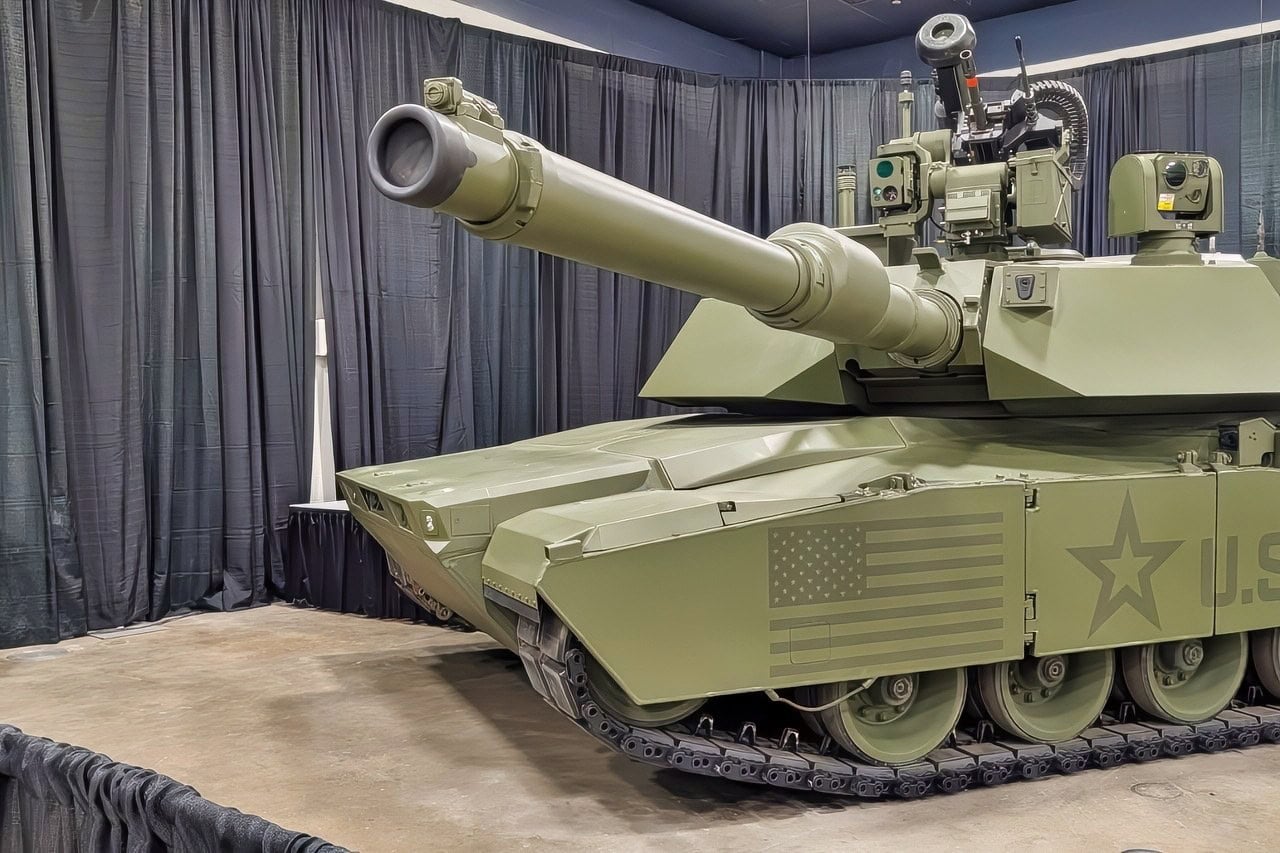
M1E3 Tank at the Detroit Auto Show. Image Credit: 19FortyFive.com
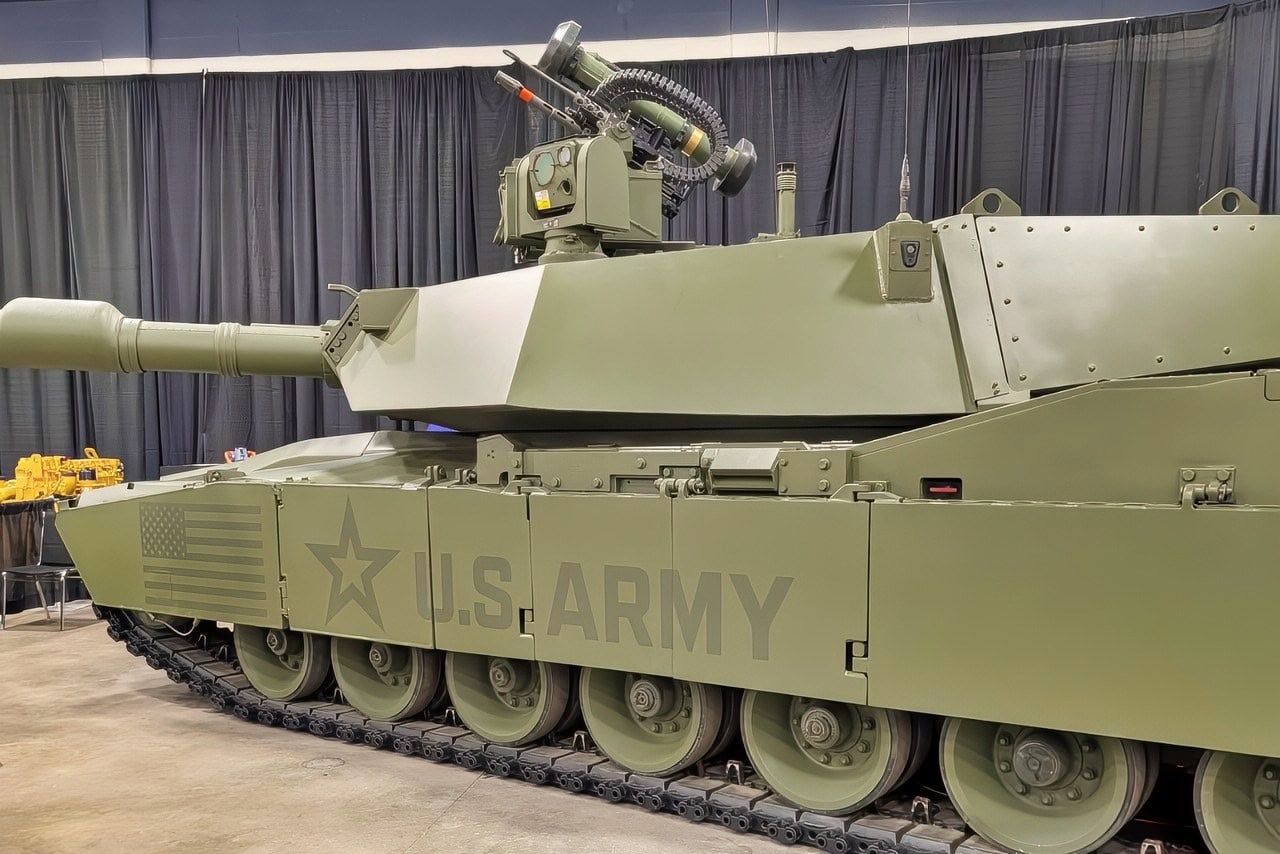
M1E3 Tank at the Detroit Auto Show. Image Credit: 19FortyFive.
Trophy has not been explicitly confirmed on the M1E3, but it is a system that the Army knows well and trusts. The explicit objective of the M1E3 program is to integrate APS into the vehicle natively, thereby improving coverage, reliability, and diagnostics while reducing the weight penalties associated with add-on kits.
APS integration also matters because overhead coverage against top-attack and diving drones requires different sensor placement, engagement windows, and kill mechanisms than defeating horizontal ATGMs at the 10 o’clock.
Blending Hard-Kill and Soft-Kill APS
It is also important to note that protection in the drone age is not just a turret-level problem. The Army has built and deployed a layered C-UAS ecosystem comprising sensors, command-and-control, and interceptors that M1E3 is intended to integrate with.
The Forward Area Air Defense (FAAD) command and control, mobile and fixed Low, Slow, Small UAS Integrated Defeat System (LIDS), Ku-band Radio Frequency Sensor (KuRFS) radar, and the Coyote family of kinetic and non-kinetic interceptors collectively form the lattice within which maneuver units should operate.
The Coyote Block 2 series has chalked up more than 170 operational drone kills across multiple theaters, while the Block 3 provides non-kinetic options for cost-effective takedowns or swarm mitigation.
With all this in mind, the M1E3’s own defenses will almost certainly blend hard-kill APS, soft-kill electronic attack, and short-range kinetic adjuncts. The MOSA backbone enables rapid insertion of radio-frequency jammers or high-power RF emitters to sever control links or damage circuit boards, while a remote weapon station configured with proximity-fuzed 12.7 mm or 30×113 mm airburst ammunition is becoming a practical last-ditch tool for disabling quadcopters within a few hundred meters.
The exact effector mix for M1E3 will be proven in soldier testing, but the demonstrator’s redesigned RWS mount and expanded power budget were not incidental; they were there to support sensors and effectors sized for drone defeat as well as traditional coax roles.
M1E3 Tank: Is It Enough?
Are these measures enough to keep the M1E3 relevant in the drone age? The harsh truth is that there is no such thing as “enough”.
Nowadays, a $400 FPV quadcopter can be built faster than any tank can be rebuilt, and no single platform can intercept every drone every time. What M1E3 does is attack the problem on each layer it controls.
It reduces the probability of detection and classification by trimming weight and by exploring hybrid-electric propulsion, which, in turn, lowers acoustic and thermal signatures and enables silent watch.
It increases the probability of defeat for threat classes that reach it by integrating APS into the architecture rather than mounting it on the sides, thereby extending protection upward against top-attack profiles and loiterers.
And it maximizes the probability of timely cueing and engagement by existing within a network that can pair “any sensor” to the “best effector,” whether that effector is on the tank, on a nearby M-LIDS truck, or at a battalion node.
All-in-all, the M1E3 is not “drone-proof,” and no single vehicle will be. What it promises is a more effective balance of mass, protection, and power that is designed for the counter-drone fight rather than retrofitted into it.
By reducing weight, integrating APS and soft-kill effects through an open digital backbone, and ensuring the tank can operate within the Army’s layered C-UAS architecture, the M1E3 provides the Abrams lineage a path to remain relevant and survivable in the drone age.
The condition is that the Army sustains the surrounding ecosystem through sensors, interceptors, EW, a new doctrine, and rapid upgrade cycles. If that ecosystem is maintained and iterated through MOSA, the M1E3 can perform its role at acceptable loss rates and with the agility to keep pace with a threat that evolves every quarter, not every decade.
About the Author: Isaac Seitz
Isaac Seitz, a Defense Columnist, graduated from Patrick Henry College’s Strategic Intelligence and National Security program. He has also studied Russian at Middlebury Language Schools and has worked as an intelligence Analyst in the private sector.