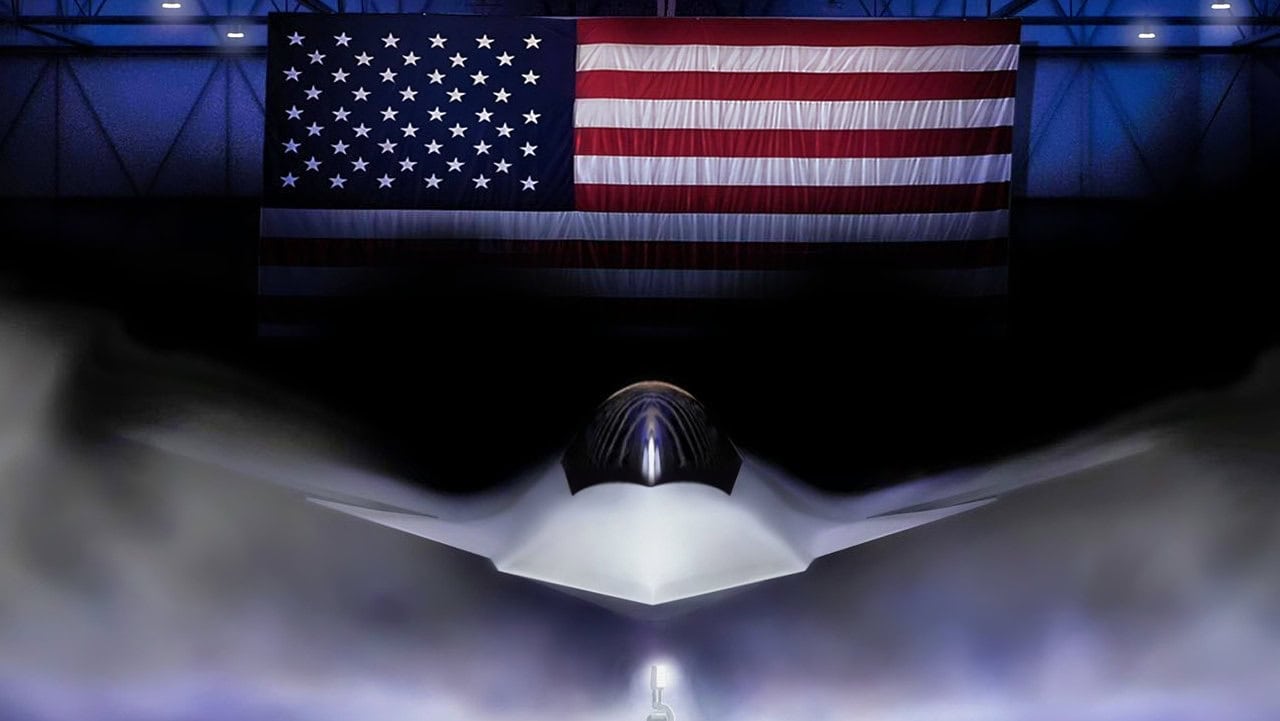
Summary and Key Points: President Trump made headlines at the World Economic Forum in Davos by suggesting he might remove the “47” designation from the U.S. Air Force’s future sixth-generation fighter if he is displeased with the program.
-The “F-47” name, assigned to the Boeing-developed NGAD fighter, references the P-47 Thunderbolt, the Air Force’s 1947 founding, and Trump’s status as the 47th president.
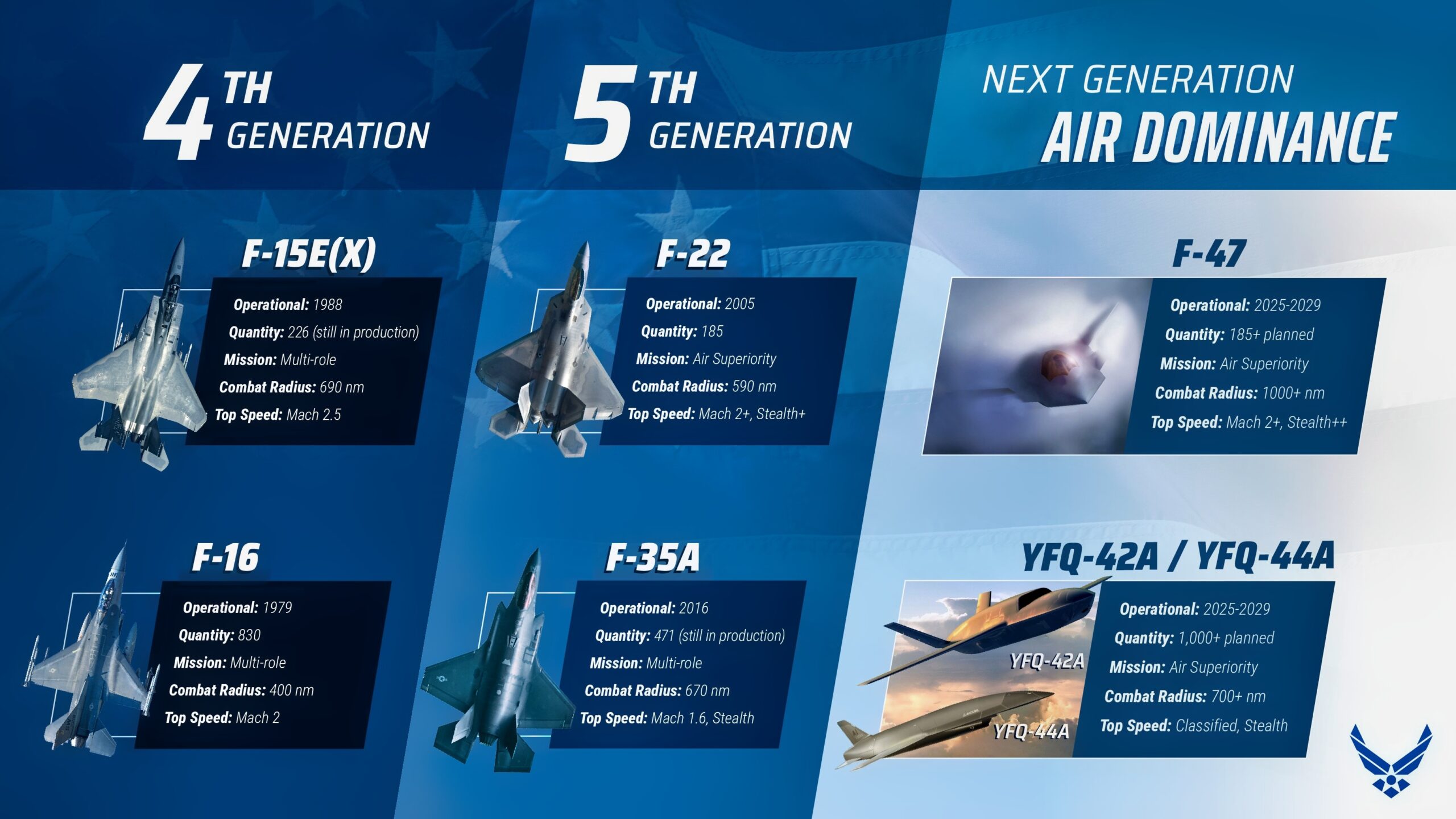
F-47 Infographic. Image Credit: U.S. Air Force
-While no official rebranding is underway, the comments highlight the unusual link between a major defense program and presidential branding.
-The aircraft is currently targeting a first flight in 2028 as the successor to the F-22 Raptor.
Trump Threatens to Rename the Air Force’s F-47 Fighter
This week has once again been a big one for U.S. President Donald Trump. But aside from his divisive comments over Greenland and NATO, he also used the Davos summit in Switzerland to suggest that the Air Force’s future sixth-generation fighter might lose its “47” if he finds the new program waiting.
Speaking at the World Economic Forum on Wednesday, he said the F-47 aircraft program was proof Washington has “the best equipment.” “If I don’t like it, I’m going to take the 47 off it,” he continued, without explaining what he would rename the vehicle, or what exactly would trigger such a dramatic change.
Trump’s remarks made headlines, not simply down to his characteristic brashness, but because there are specific reasons for the plane’s number.
Reporting by The War Zone online magazine notes the Air Force has laid out multiple reasons for “47.” On the one hand, it is a deliberate nod to the WWII-era P-47 Thunderbolt and its later redesignation, the service’s 1947 founding year. Its name also alludes to Trump’s status as the 45th and 47th president, making the label a marker of the White House’s explicit support.
The F-47 sits at the center of the Air Force’s Next Generation Air Dominance (NGAD) push, with Boeing selected in March 2025 to develop the crewed stealth fighter meant to succeed the F-22 Raptor for high-end scenarios, including a potential conflict in the Indo-Pacific. Reuters previously reported the initial development award at more than $20 billion, with far higher long-term costs possible once production scales.
For now, there is zero sign that the Air Force is preparing to rebrand anything. Both the service and Boeing continue to publicly project confidence in the model. A prototype is already in the works, and a first flight is targeted for 2028.
The F-47 NGAD Challenge
Still, Trump’s ideas could collide with some inconvenient realities. Military designations do change, but generally for purposes of standardization, not Presidential whims.
The Air Force’s recent switch from EC-37B to EA-37B for its Compass Call replacement is a neat example of a practical nomenclature tweak.
As with any pricey defense project, the F-47 program could encounter execution risks, including acknowledged delays in the separate Next Generation Adaptive Propulsion (NGAP) effort that could impact early aircraft configurations and delivery timelines.
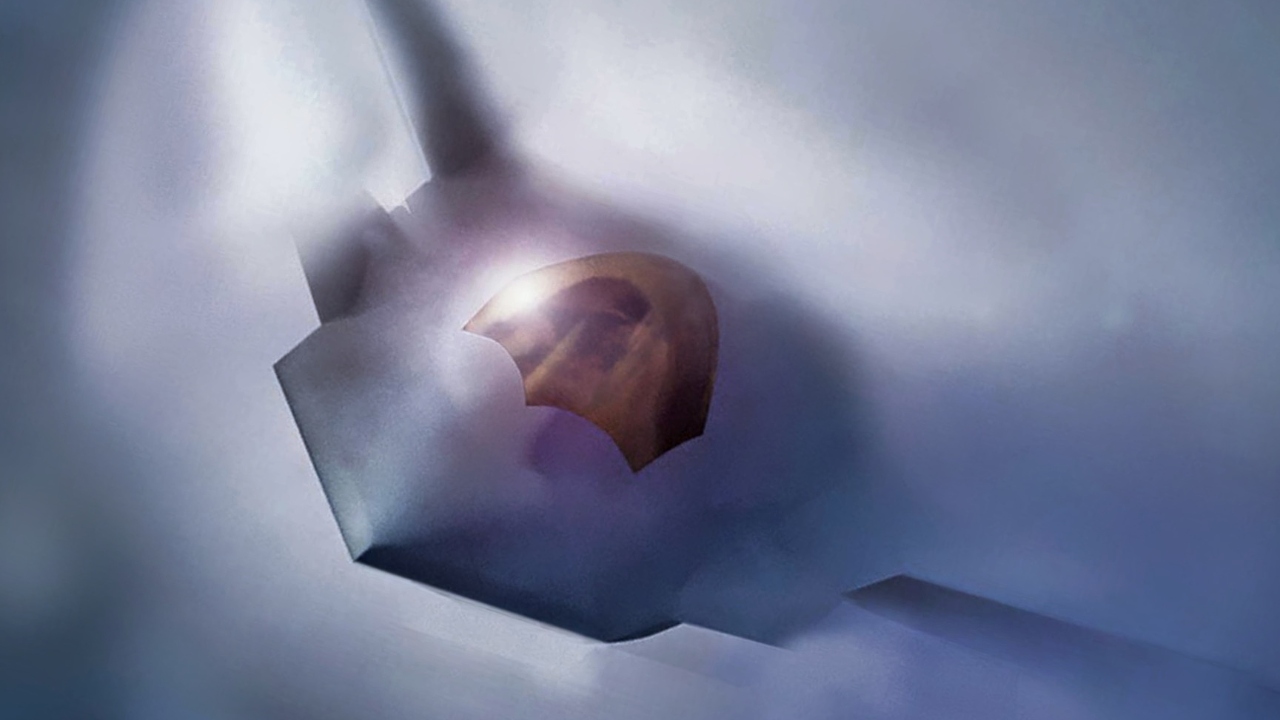
Shown is a graphical artist rendering of the Next Generation Air Dominance (NGAD) Platform. The rendering highlights the Air Force’s sixth generation fighter, the F-47. The NGAD Platform will bring lethal, next-generation technologies to ensure air superiority for the Joint Force in any conflict. (U.S. Air Force graphic)
The deeper question is whether tying a flagship weapons program so directly to a president’s personal numerology is a good long-term strategy.
If NGAD is supposed to signal steadiness to allies and threaten rivals to American hegemony, surely its powerful name ought to be fixed, rather than at the whim of the commander-in-chief?
Or is this yet another subtle move by Trump, with the intention of keeping the defense sector on its toes, and thus more likely to perform well?
About the Author: Georgia Gilholy
Georgia Gilholy is a journalist based in the United Kingdom who has been published in Newsweek, The Times of Israel, and the Spectator. Gilholy writes about international politics, culture, and education. You can follow her on X:@llggeorgia.