
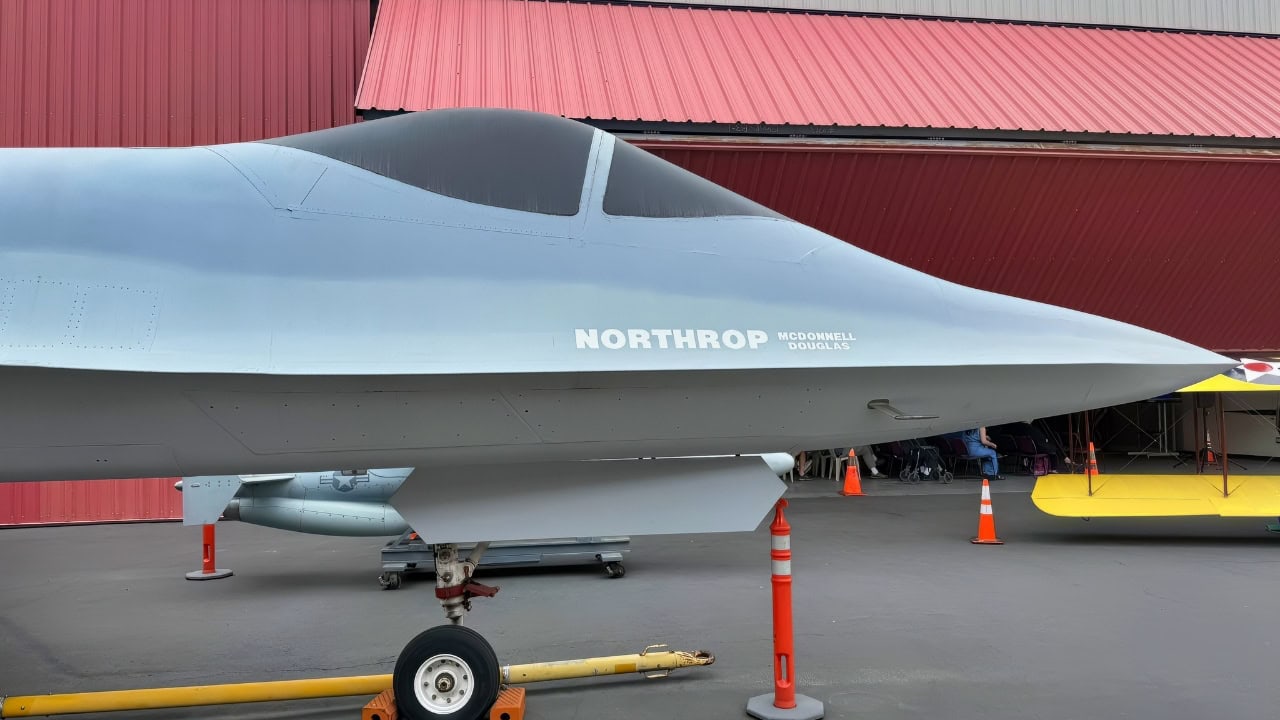
YF-23 Black Widow II: The Stealth Fighter Built For Mach 2.2 Speed And Long Range
The YF-23, known as the Black Widow II, was a prototype stealth fighter developed by Northrop and McDonnell Douglas for the U.S. Air Force’s Advanced Tactical Fighter (ATF) program in the late 1980s and early 1990s.
Although it lost the competition to the YF-22 (which became the F-22 Raptor), the YF-23 was an outstanding aircraft.
The YF-23’s best features were its superior stealth, achieved through unique shaping and engine design, its outstanding supercruise (sustained supersonic flight without afterburners) for unmatched speed and range, and its innovative V-tail rudders (butterfly tails) that offered control and stealth, making it a true “first-look, first-kill” long-range interceptor.
It prioritized stealth and kinematic performance, with a sleek blended wing-body, diamond-shaped wings, and shielded exhaust nozzles to reduce radar and infrared signatures, making it harder to detect than its YF-22 competitor. However, it sacrificed some agility for these advantages.
Northrop and McDonnell Douglas’ YF-23 was probably a better aircraft than the outstanding Raptor, but suffered from a lack of presentation to the program’s decision-makers. Otherwise, history may have turned out quite differently.
Here are some of the Black Widow’s best features.
The YF-23 Stealth Fighter’s Stealth
The YF-23 had a sleek, stealthy design and innovative features; the Black Widow incorporated technologies like advanced radar-absorbing materials, a revolutionary diamond-shaped wing, and an emphasis on reduced infrared signatures.
Its stealth design was incredible. Its diamond-shaped wings, blended fuselage, and unique S-duct engine intakes created a very low radar cross-section, arguably even better than the YF-22.
The YF-23 truly stood out with its extraordinary appearance. It featured diamond-shaped wings that reduced radar visibility, and its slim side profile reminded one of the SR-71 Blackbird spy plane.
Supercruise And Powerplant
The aircraft was powered by two Pratt & Whitney YF119 or General Electric YF120 engines, enabling supercruise. Having the supercruise capability meant it could maintain supersonic speeds (Mach 1.6+) without fuel-guzzling afterburners, giving it significant range and endurance advantages.
The YF-23 could reach speeds of up to Mach 2.2 at high altitudes, flying over distances of 2,424 nautical miles (2,789 miles / 4,489 km), according to Aerotime Hub. Its combination of speed, agility, and stealth made it a fierce competitor.
Infrared Signature Reduction
Flattened, shielded engine exhausts minimized heat, making it difficult for heat-seeking missiles to track.
From We.Love.Jets: “The YF-23 featured a distinctive set of tiles surrounding its engine exhausts, which were part of its advanced infrared signature suppression system. These tiles, often mistaken for ceramic or heat shielding like those on the Space Shuttle, were actually part of a complex composite structure designed to diffuse and cool the engine’s heat signature.
“By channeling hot exhaust gases into a wide, flattened trough that blended with cooler boundary layer air, the YF-23 was able to drastically reduce its infrared visibility from below and behind—critical angles in a combat environment.
“The tiles helped manage the extreme thermal loads from the exhaust and preserved the aircraft’s stealth by reducing the chance of detection by heat-seeking missiles and IR sensors. This exhaust design, sometimes called a “platypus tail,” was a key feature that differentiated the YF-23 from the YF-22 and represented an innovative approach to stealth that favored passive survivability over thrust vectoring or extreme maneuverability.”
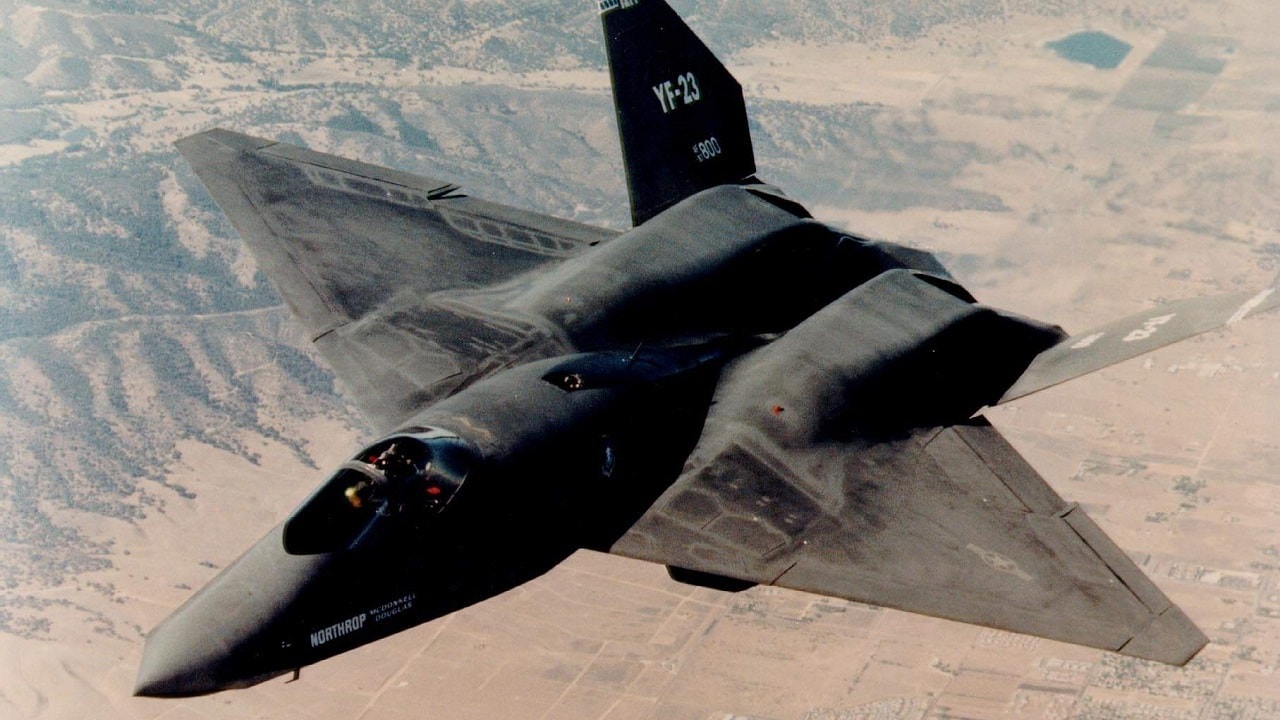
YF-23 stealth fighter, which could inspire the design of the NGAD.
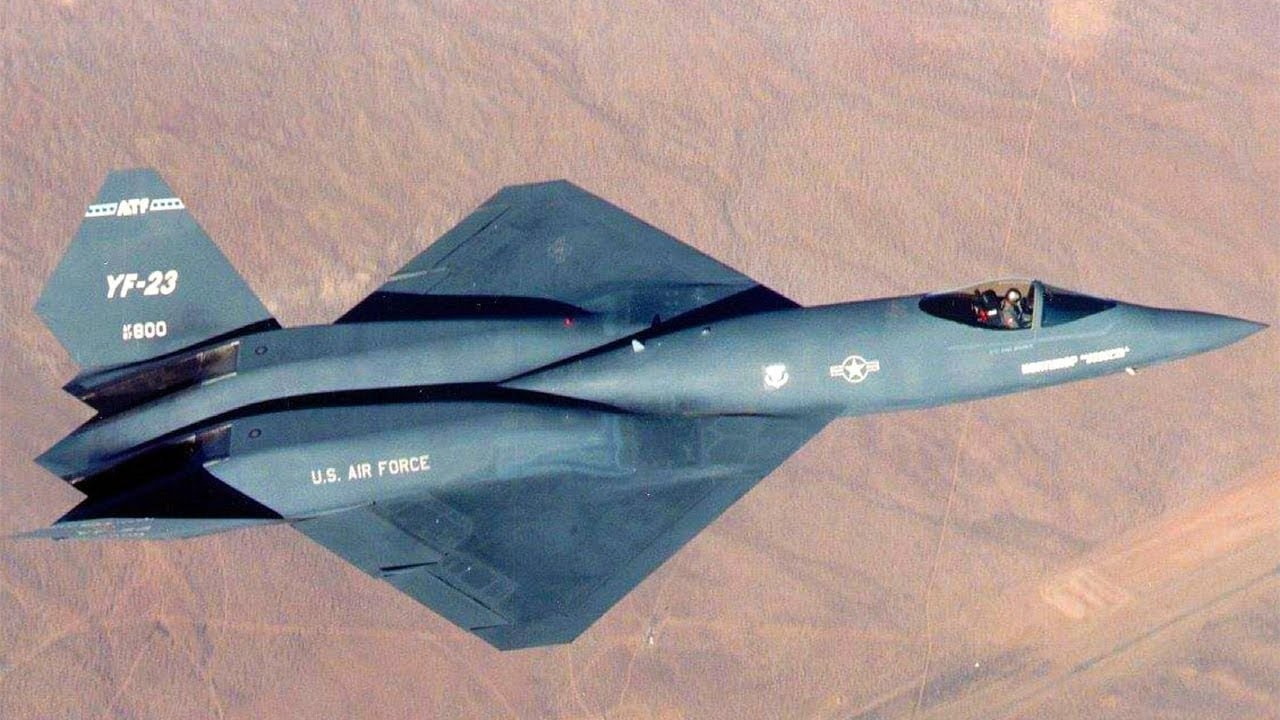
Image of YF-23 in fight. Image Credit: Creative Commons.

Northrop-McDonnell Douglas YF-23. (U.S. Air Force photo)
V-Tail Rudders
Replaced traditional vertical stabilizers with V-shaped rudders, contributing to stealth and providing control.
The YF-23’s V-tail, or “butterfly tail,” used two angled surfaces that functioned as both rudders and elevators (ruddervators) for pitch and yaw control, significantly improving its stealth by hiding engine exhaust and reducing radar cross-section. Although it traded some traditional stability for advanced control, the YF-23 relied on its powerful flight computer and advanced systems for stability, ultimately losing the ATF competition to the more conventional F-22 but showcasing unique stealth and speed capabilities.
Advanced Avionics & Internal Weapons
The YF-23’s avionics were central to its advanced capabilities, featuring sophisticated sensor fusion for a simplified pilot view, a digital fly-by-wire system for carefree handling, and advanced radar and sensors for stealthy target detection.
This was aimed at reducing pilot workload and enhancing situational awareness to support the ATF program’s “see but not be seen” mandate, with integrated systems designed to consolidate data into a single, clear tactical picture.
The YF-23’s avionics were considered as cutting-edge as its airframe, representing a significant leap in integrating complex systems for high-performance stealth combat.
TWZ wrote that the Internal Weapons Bay of the YF-23 was arguably both its best and worst feature.
“Instead of shallow, largely conformal bays, the YF-23 had a single, coffin-like, cavernous weapons carrying cavity that ran from behind the cockpit, back into the area between the aircraft’s widely spaced and very unique air intakes. Two huge outwardly swinging doors covered the bay, and the interior of the bay was far deeper than the one found on the YF-22, but also a bit narrower overall.”
But because the weapons were stacked, a malfunction would have rendered the rest unusable.
Why Did The YF-23 Lose to YF-22?
The YF-23 Black Widow was an aircraft ahead of its time, designed for incredible stealth. Its unique shape, angular surfaces, and blended edges were carefully crafted to minimize radar cross-section, ensuring reduced detectability by enemy radar systems.
The aircraft’s dark, radar-absorbent material coating further enhanced its stealth capabilities, absorbing and diffusing radar waves to prevent them from being reflected to the source.
The YF-23 had better speed and stealth characteristics. The YF-23 also “showcased better range, higher ceiling,” one report stated after the competition. However, the aircraft lost the ATF competition to the YF-22, primarily due to the YF-22’s superior agility and maneuverability, which were considered more desirable for air combat. The thrust vector nozzles on the YF-22 made it a much more desirable dogfighter, and that ultimately won over the Air Force.
“What no one wants to admit is the ‘white-scarf, inside the furball’ fighter mafia still reigned supreme at that time,” according to test pilot Paul Metz, one of the few ever to fly both aircraft.
“Northrop’s YF-23 team was comprised of brilliant engineers,” he said. Metz added that the engineers were beyond compare, but he also recognized that they “thought and spoke almost exclusively in engineering terms.”
However, “Lockheed infused far more marketing, salesmanship, and pizazz—’ lasting impressions’ as he describes”—into their YF-22 flight demonstration program.
“They fundamentally understood how to sell their aircraft and how ‘showmanship’ heavily impacts the acquisition decision-making process. Northrop didn’t, and that fact may have proven fatal for the YF-23.”
Was politics involved in the decision? Possibly. Lockheed Martin’s track record with stealth aircraft, having developed the F-117 Nighthawk, was obviously an advantage. Its industrial team was larger and more experienced, and the company had strong relationships with key decision-makers in the Department of Defense.
At the time, Lockheed Martin lacked new fighter programs. The F-22 decision kept them in the fighter business. Northrop had the B-2 project. The Air Force decided that it was essential to the country’s national security to keep Lockheed as an aircraft manufacturer and sided with the YF-22.
The other reason was that while the YF-23 may have represented a larger evolutionary leap in fighter design and had even more potential to evolve than its counterpart, the YF-22 was a safer bet based on the information available when the ATF decision was made.
The Bottomline: YF-23 Better?
The YF-22 was a more mature, lower-risk, and fully realized example of what Lockheed wanted to bring to life as the F-22A than the YF-23. It was also a more traditional option, a factor that weighed heavily in the USAF’s final decision.
After the competition was completed, one of the two YF-23 prototypes was donated and is on display at the National Museum of the U.S. Air Force in Dayton, Ohio.
Considering the F-22’s status as a fighter widely regarded as the most dominant air-superiority platform ever, and its continuous upgrades throughout its service life, it is fair to wonder how successful the YF-23 would have been, given its superior range and speed.
It may have been even more dominant, given how aircraft have evolved in modern air warfare.
About the Author: Steve Balestrieri
Steve Balestrieri is a National Security Columnist. He served as a US Army Special Forces NCO and Warrant Officer. In addition to writing on defense, he covers the NFL for PatsFans.com and is a member of the Pro Football Writers of America (PFWA). His work was regularly featured in many military publications.