
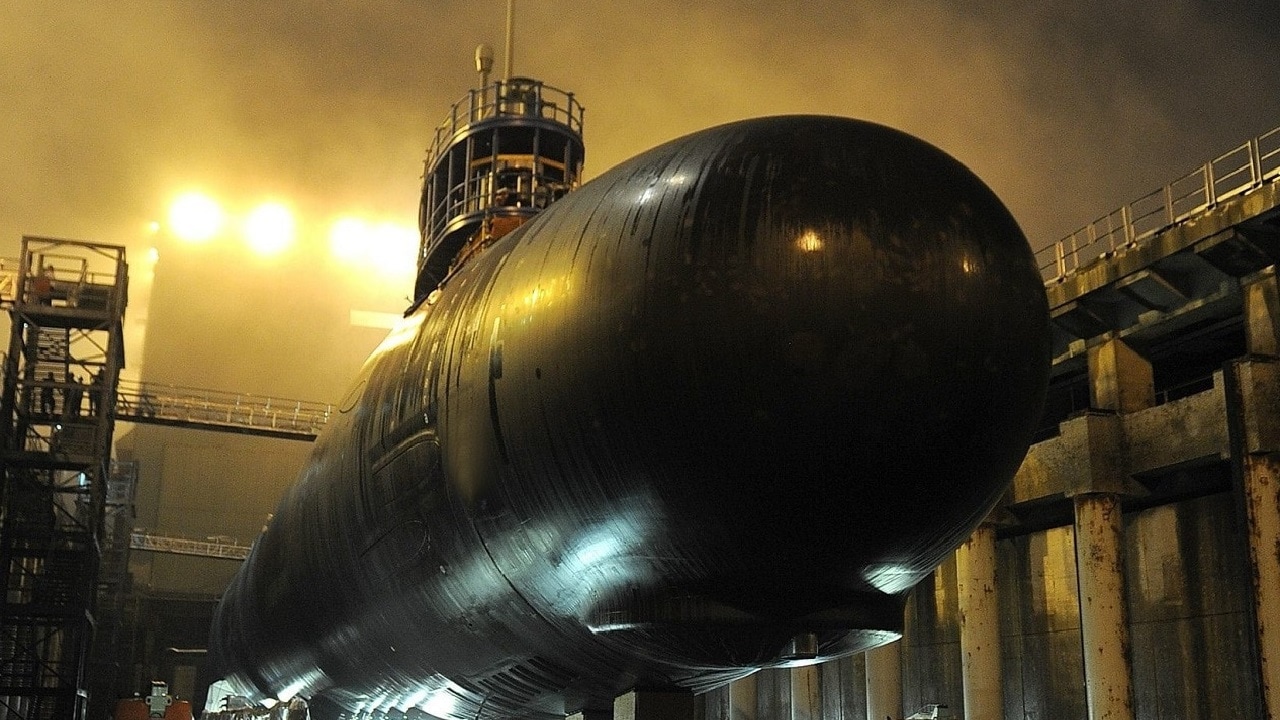
Summary and Key Points: China is now claiming two new ways to help detect stealth submarines: a drone-mounted quantum magnetic sensor and a system that tracks faint magnetic signatures tied to Kelvin wakes.
-Together, these ideas point to a broader anti-submarine strategy built around layered detection, data fusion, and AI-supported tracking.
-If the claims hold up, they could complicate operations for U.S. Navy submarines, including Virginia-class and ballistic missile boats, especially in contested waters.
-Still, the technologies appear to be emerging tools rather than proven game-changers, and they do not make nuclear attack or ballistic missile submarines obsolete in 2026.
China’s Quantum and Kelvin Wake Sensors Could Change Submarine Warfare for the U.S. Navy
Great Power competition is a game defined by technological one-upmanship. Stealth warplanes are one area of gamesmanship, whether they be bombers such as the B-21 Raider, B-2 Spirit, or China’s H-20; or fighters such as the F-22 Raptor, F-35 Lightning II, Russia’s Sukhoi Su-57, or China’s Chengdu J-20.
Of course, submarines are the original stealth technology—the U.S. Navy calls its sub force “The Silent Service” for a reason.
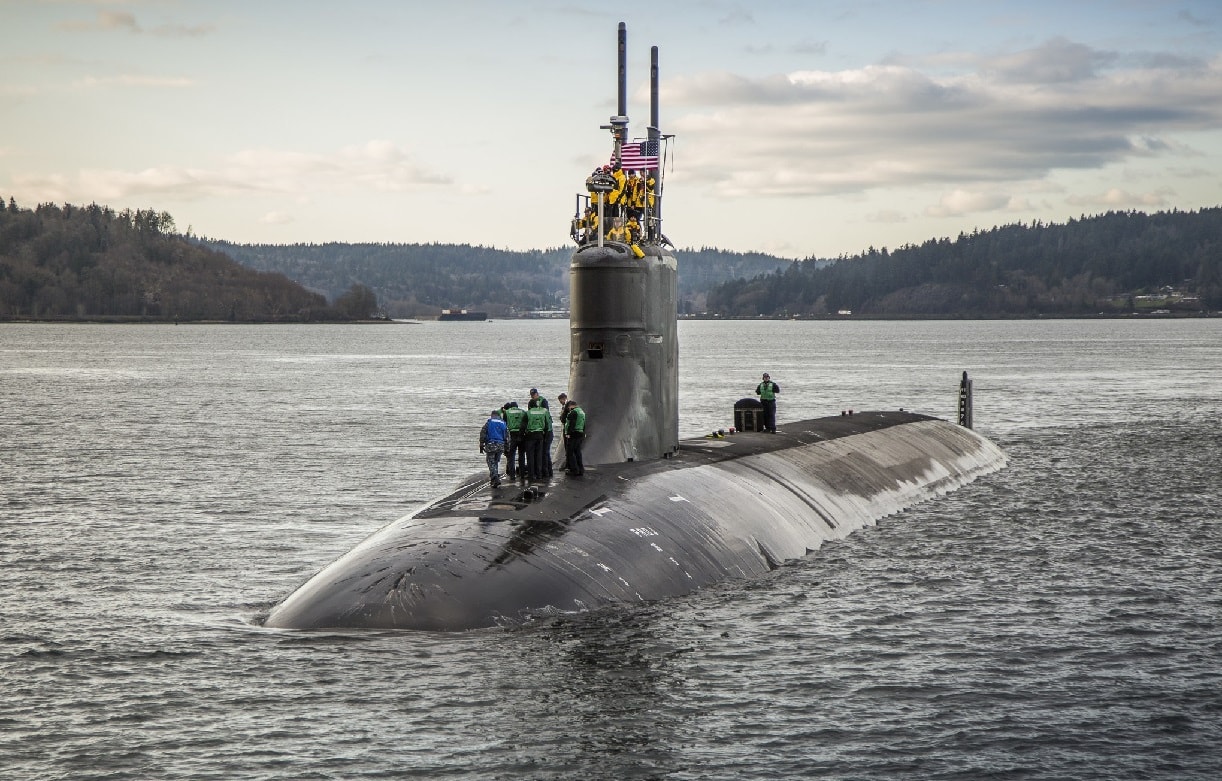
BREMERTON, Wash. (Dec. 15, 2016) – The Seawolf-class fast-attack submarine USS Connecticut (SSN 22) departs Puget Sound Naval Shipyard for sea trials following a maintenance availability. (U.S. Navy photo by Thiep Van Nguyen II/released)
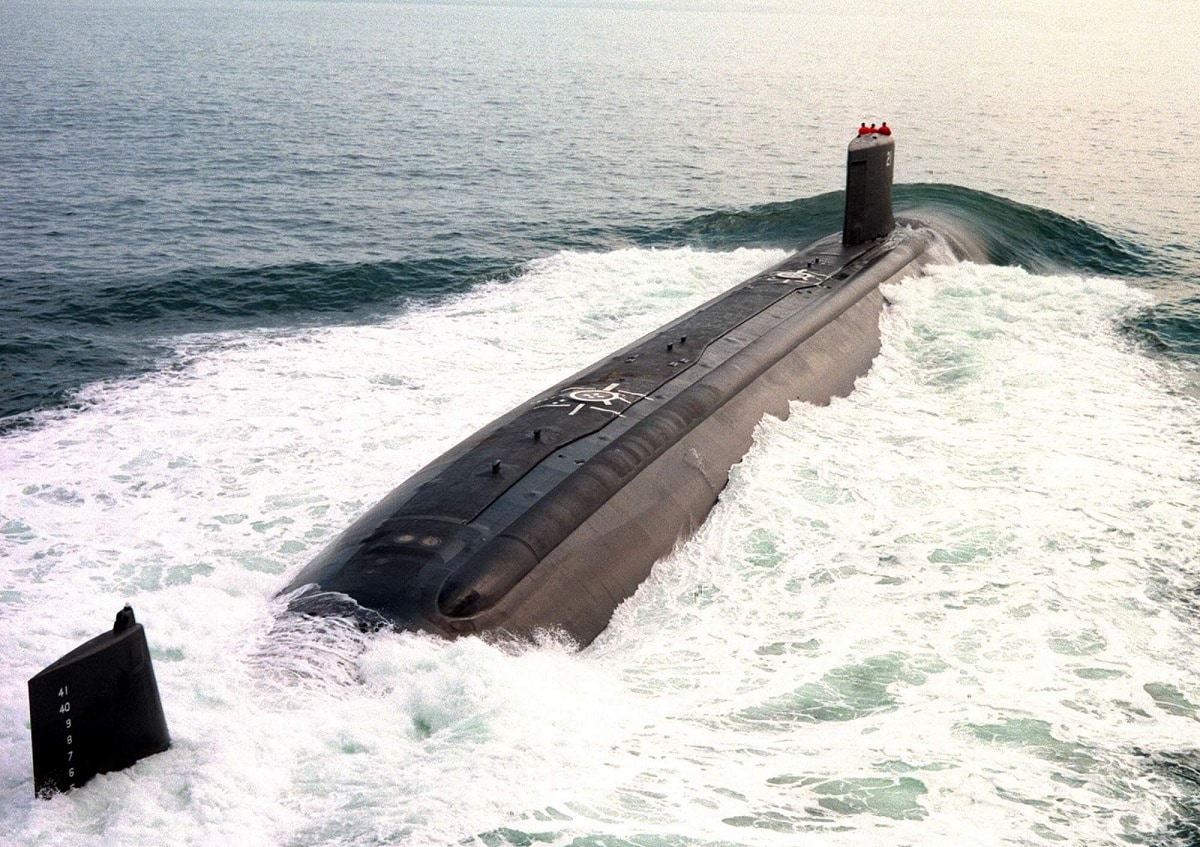
Seawolf-class. Image: U.S. Navy.
Accordingly, Russia, China, and the United States also try to outdo each other in the ability to detect and negate one another’s stealth advantages. For example, in October we reported that China claimed to have developed a “photon catcher” quantum radar that could detect the F-22. Now Beijing claims that it can track the U.S. Navy’s nuclear-powered fast-attack submarines (SSNs) and nuclear-powered ballistic missile submarines (SSBNs).
So, how much veracity is there to this Chinese claim, and does it render SSNs and SSBNs obsolete?
Detector Claim #1: Quantum Sensor
Separate from its claimed quantum radar for detecting stealth planes, China now reports a quantum leap in submarine sensors.
As explained by Matt Swayne of The Quantum Insider:
“Chinese researchers have developed and tested a drone-mounted quantum sensor that could allow faster and more accurate detection of submarines and underwater features, according to a study published April 16 in the Chinese Journal of Scientific Instrument.
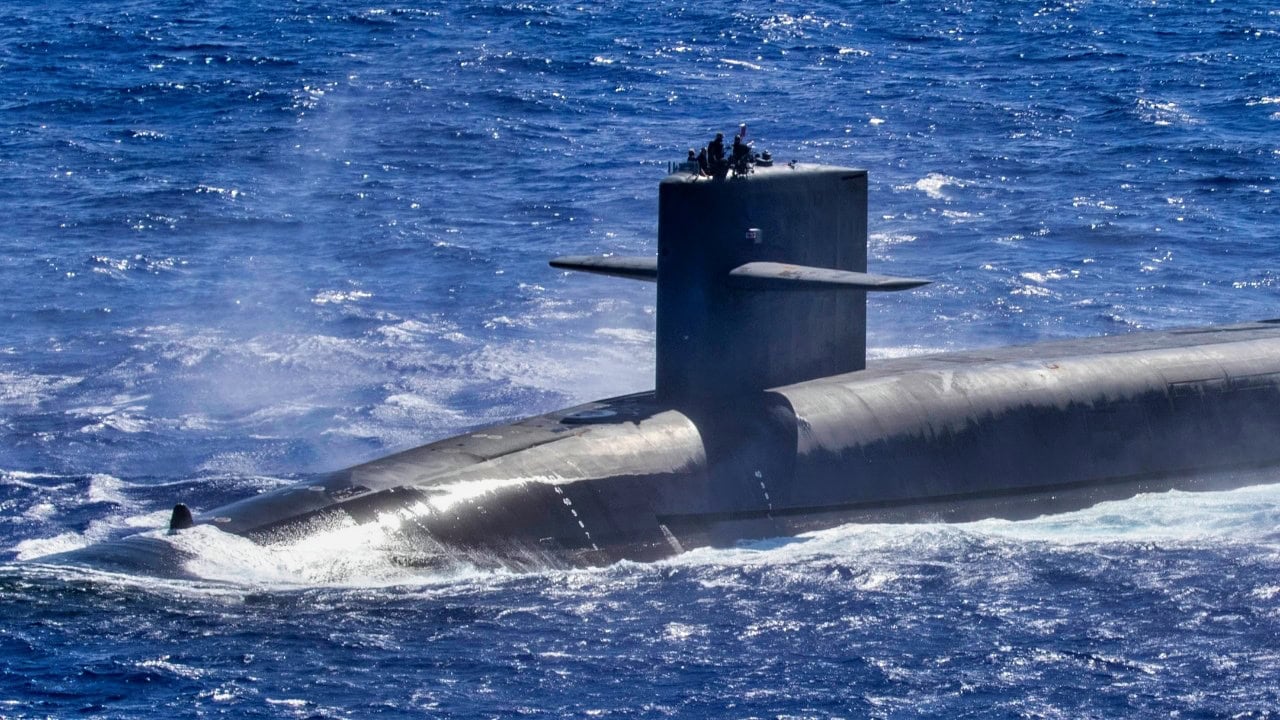
PACIFIC OCEAN (June 28, 2024) – An AS-332 Super Puma assigned to the Lewis and Clark-class dry cargo ship USNS Cesar Chavez (T-AKE 14) delivers supplies to the Ohio-class ballistic missile submarine USS Louisiana (SSBN 743) during a vertical replenishment at sea, June 28, 2024. The presence of the SSBN in the Pacific demonstrates the flexibility, survivability, readiness, and capability of the U.S. Navy submarine forces and complements the many exercises, training, operations, and other military cooperation activities conducted by Strategic Forces to ensure they are available and ready to operate around the globe at any time. Homeported in Bangor, Washington and currently assigned to Submarine Squadron 17, Louisiana is an undetectable launch platform for submarine-launched ballistic missiles, providing the United States with its most survivable leg of the nuclear triad. (U.S. Navy Photo by Mass Communication Specialist Seaman Andrew McPeek)
“Led by Wang Xuefeng at the Quantum Engineering Research Centre of China Aerospace Science and Technology Corporation (CASC), the team designed a system to overcome a major flaw in traditional magnetic anomaly detectors, as reported by the South China Morning Post. In low-latitude regions like the South China Sea, Earth’s magnetic field runs nearly parallel to the surface, causing blind zones where conventional sensors lose effectiveness.”
A salient feature of this sensor is a coherent population trapping (CPT) atomic magnetometer, which leverages quantum interference effects in rubidium atoms. This CPT would match the sensitivity of the sophisticated Magnetic Anomaly Detection-Extended Role system used by NATO allies but operates at significantly lower cost and complexity.
Scientific Sidebar Note: Rubidium is described by Stanford Advanced Materials as “a soft, silvery-white alkali metal with distinctive chemical and physical traits, crucial for advanced research and diverse industrial applications. Discovered in the mid-19th century and bearing the atomic number 37, one of rubidium’s most notable common uses is in the production of atomic clocks which are known for their exceptional precision, which is vital for GPS and telecom networks.”

Los Angeles-Class Submarine. Image Credit: Creative Commons.
Detector Claim #2: Kelvin Sensor
If these claims were not concerning enough, Prabhat Rajan Mishra adds a disturbing report for Interesting Engineering:
“The team [of Northwestern Polytechnical University in Xian) focused on studying the impact of Kelvin wake, a V-shaped wave pattern created by submarines or other ships while sailing.
“Chinese researchers revealed that Kelvin wake creates a faint but detectable magnetic field. It’s generated as seawater ions interact with the Earth’s geomagnetic field after being disturbed by the submarine’s motion. Kelvin wakes cannot be silenced, which the team uses to identify stealth vessels in waters.”
Mishra points out that there are no guarantees when it comes to submarine detection. However, this Kelvin detector would serve as an additional tool in the Chinese antisubmarine warfare toolbox—part of a broader kill web that includes acoustic arrays, satellites, drones, and AI algorithms to fuse data streams.
Mishra singles out the U.S. Navy’s Seawolf-class submarines as a key potential target for this Kelvin detection system. However, Virginia-class, Los Angeles-class, and Columbia-class submarines would presumably be every bit as vulnerable to exposure.
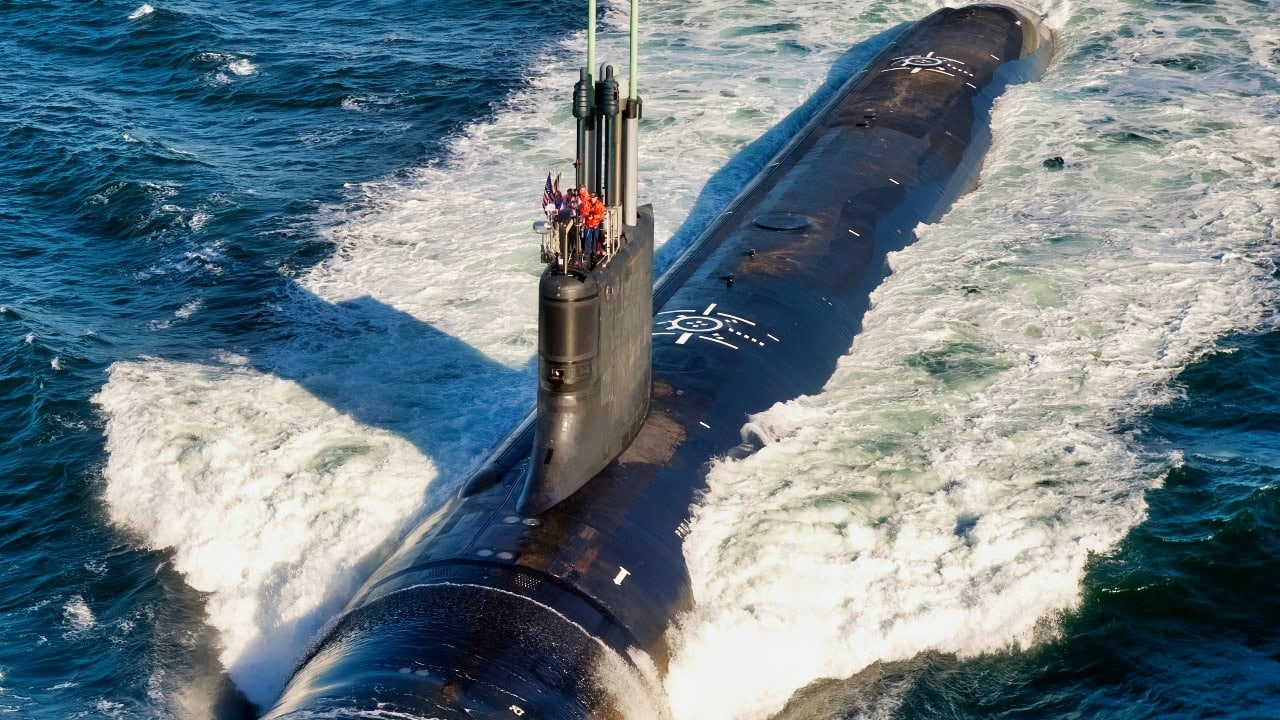
Virginia-Class Submarine.

HMS Talent Royal Navy Submarine
The Way Forward
Though both of these technologies would seem to be cause for concern, thus far, U.S. Navy leaders don’t seem to be nearly as worried about them as they are about, say, the threat of hypersonic ship-killing missiles to supercarriers. Certainly, neither the U.S. Navy nor its counterparts in Russia or China appear to be in any sort of hurry to cashier their submarine fleets. In short, SSNs and SSBNs are not obsolete just yet.
About the Author: Christian D. Orr, Defense Expert
Christian D. Orr is a Senior Defense Editor. He is a former Air Force Security Forces officer, Federal law enforcement officer, and private military contractor (with assignments worked in Iraq, the United Arab Emirates, Kosovo, Japan, Germany, and the Pentagon). Chris holds a B.A. in International Relations from the University of Southern California (USC) and an M.A. in Intelligence Studies (concentration in Terrorism Studies) from American Military University (AMU). He is also the author of the newly published book “Five Decades of a Fabulous Firearm: Celebrating the 50th Anniversary of the Beretta 92 Pistol Series.”