
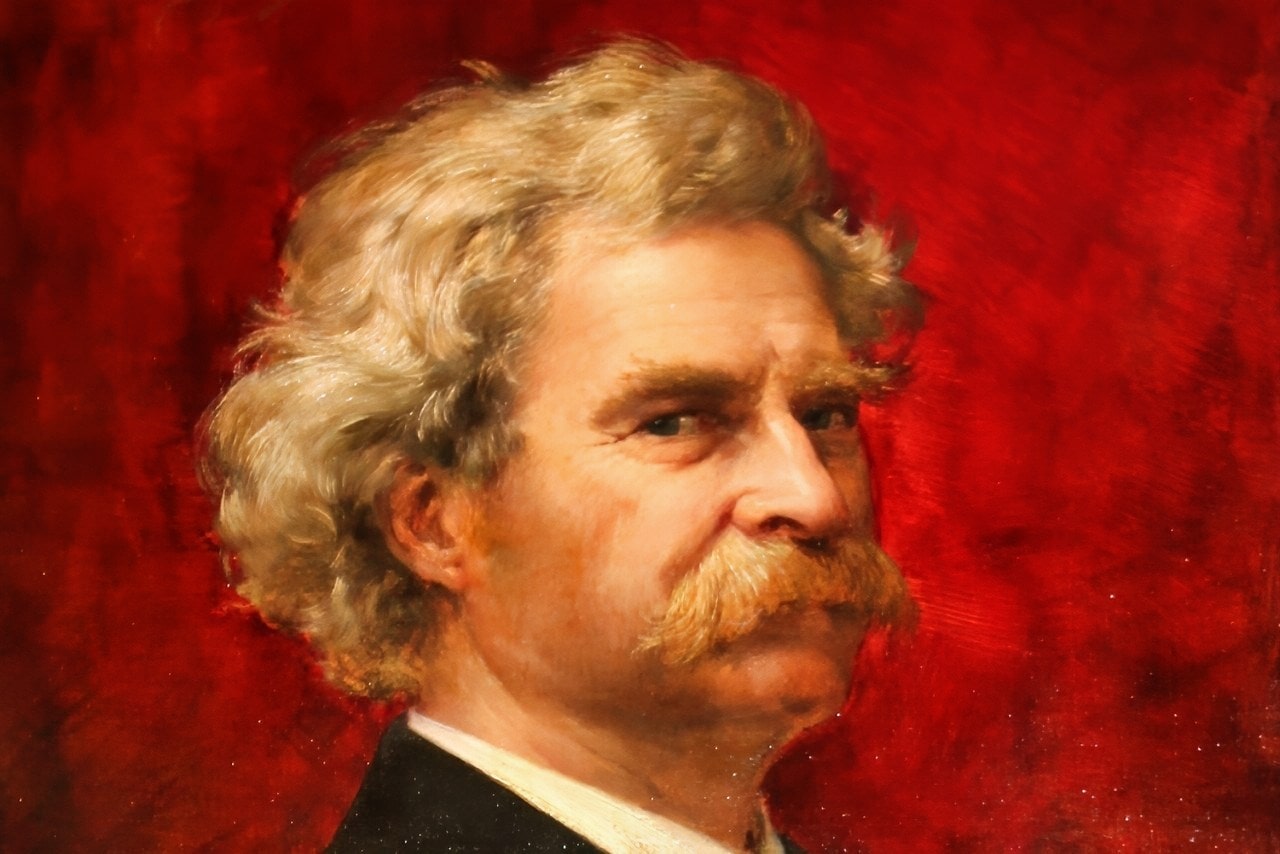
Synopsis: Mark Twain, born Samuel Langhorne Clemens, remains America’s most iconic voice on the human condition.
-From his humble beginnings in Hannibal, Missouri, to his global fame as a master of satire, Twain’s life was a masterclass in living fully despite crushing debt and personal tragedy.
-His legendary quote—”A man who lives fully is prepared to die at any time”—perfectly captures the philosophy that carried him through bankruptcy and the loss of his family.
-Discover how the Mississippi River pilot became a literary giant whose work, including Huckleberry Finn, continues to define American literature today.
Quote of the Day Inspiration: Why Mark Twain Believed the Fear of Death Was Actually a Fear of Life
“The fear of death follows from the fear of life. A man who lives fully is prepared to die at any time.” – Mark Twain
Samuel Langhorne Clemons was one of the most famous American authors of the 19th century and was renowned for his witty and humorous style of writing.
Writing under the pen name “Mark Twain,” he is most fondly remembered for The Adventures of Tom Sawyer and the Adventures of Huckleberry Finn, though he wrote a number of other fictional and satirical works as well.
Everyone has probably read or at least heard of one of Mark Twain’s works, though few know the broader life story of the renowned author.
Early Life and Upbringing
Samuel Clemens entered the world in the rural village of Florida, Missouri, as the sixth of seven children.

Mark Twain Black and White. Image Credit: Creative Commons.
The Clemens family struggled financially, and only three of the siblings survived into adulthood—reflecting a heartbreaking but common reality of 19th-century life. When Samuel was four years old, the family moved to Hannibal, Missouri, a bustling Mississippi River town that would ignite his imagination.
Hannibal later became the blueprint for St. Petersburg, the setting of Tom Sawyer’s and Huckleberry Finn’s adventures.
Growing up in a slaveholding state deeply shaped his understanding of race, injustice, and the contradictions of American society, which he would later write about in his most powerful works.
Samuel’s father, John Marshall Clemens, was a severe man whose business ventures rarely succeeded.
His death in 1847 forced young Samuel to leave school and work as a printer’s apprentice to help support the family.
These early years in printing exposed him to newspapers, storytelling, and satire, and he soon began contributing humorous sketches to his brother Orion’s newspaper, The Hannibal Journal. Even as a teenager, he displayed a sharp wit and a flair for narrative that hinted at the writer he would become.
The Emergence of Mark Twain
In 1853, Samuel left Hannibal and spent several years traveling from city to city while working as a journeyman printer.
His life changed dramatically in 1857 when he became an apprentice steamboat pilot on the Mississippi River. Piloting was glamorous, respected, and well-paid, and the river itself awakened something in him: freedom, possibility, and a sense of identity. He earned his pilot’s license two years later.
The vocabulary and rhythms of the river captivated him. One of the riverboat leadsman’s depth calls, “mark twain,” meaning two fathoms of safe water, lodged itself in Samuel’s memory. Years later, when he reinvented himself as a writer, he adopted the phrase as his pen name, anchoring his literary identity to the river he loved.
The outbreak of the Civil War in 1861 ended steamboat travel and forced Samuel to leave the river.
He briefly joined a militia unit but abandoned it within a couple of weeks. He followed his brother to the Nevada Territory, hoping to strike it rich as a silver miner. The mining life proved a failure, but journalism did not. In 1863, while working for the Virginia City Territorial Enterprise, he first signed a newspaper piece with the name “Mark Twain.” His bold humor, sarcasm, and storytelling quickly made him one of the most recognizable voices in the Western press.
Literary Career
In 1870, Twain married Olivia Langdon, known as Livy. His marriage was something of a stabilizer for him, and the two would share a warm relationship. Thanks to Livy and her prominent family, Twain entered a world of artists, reformers, and thinkers.
The couple settled in Hartford, Connecticut, where they built an elaborate and now iconic Victorian home. During their Hartford years, Twain produced many of his most cherished works, including The Adventures of Tom Sawyer, The Prince and the Pauper, Life on the Mississippi, and A Connecticut Yankee in King Arthur’s Court.
Twain’s masterpiece, Adventures of Huckleberry Finn, completed in 1884 and published in the United States in 1885, forever changed American literature. The novel’s daring use of regional dialect, its exploration of friendship and moral awakening, and its bold condemnation of racism made it a landmark in world literature.
Ernest Hemingway famously declared that all modern American literature came from Twain’s work on that book, though academics respectfully disagreed.
Later Years
Despite his literary success, Twain’s finances were often in disarray.
He was an ambitious, sometimes reckless investor, pouring enormous sums into new inventions and business ventures. His most disastrous investment was the Paige typesetting machine, an ingenious but overly complex device that ultimately failed. Combined with setbacks at his personal publishing company, Twain went bankrupt in the 1890s.
Determined to repay his debts, Twain undertook a strenuous around-the-world lecture tour.
His performances were wildly successful, and, through a combination of global speaking engagements and Livy’s careful management, he repaid every creditor in full, even though bankruptcy law technically freed him from the obligation. Yet this period also brought great sorrow.
His daughter Susy died of meningitis in 1896, a loss that devastated the family. Livy’s health declined for years before her death in 1904, and another daughter, Jean, died in 1909. These losses pushed Twain toward a more somber, philosophical tone in his later writings.
A Man Who Lives is Prepared to Die
In the last decade of his life, Twain became an elder statesman of American letters.
His public persona, complete with his trademark white suits, made him an icon recognized around the world. He published essays critical of imperialism, organized religion, and human cruelty, and although his humor never deserted him entirely, it was increasingly tempered by grief and disillusionment.
Even so, he remained beloved, often hailed as America’s greatest living writer.
Twain died on April 21, 1910, in Redding, Connecticut, just one day after Halley’s Comet passed close to Earth.
He had been born shortly after its appearance in 1835 and had predicted he would depart with it as well. This prediction turned out to be eerily accurate. His death was a cause of national mourning, with President William Howard Taft expressing the magnitude of Twain’s contributions to American literature.
About the Author: Isaac Seitz
Isaac Seitz, a Defense Columnist, graduated from Patrick Henry College’s Strategic Intelligence and National Security program. He has also studied Russian at Middlebury Language Schools and has worked as an intelligence Analyst in the private sector.