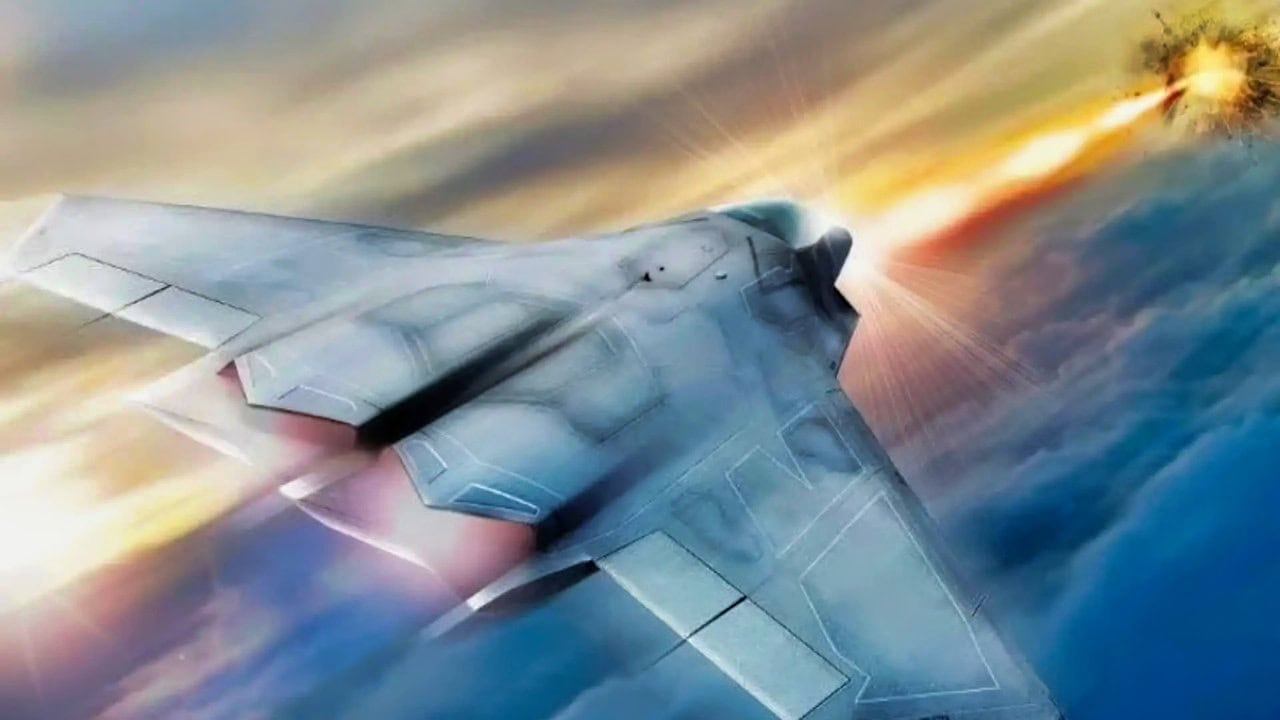
Summary and Key Points: The dream of a “loyal wingman” is no longer science fiction; it is the operational reality of the U.S. Air Force’s emerging F-47.
-Former Air Force Chief Scientist Dr. Gregory Zacharias predicted a future where manned stealth fighters would operate drone swarms directly from the cockpit—a vision that has now come to fruition.
-Through Collaborative Combat Aircraft (CCA), the F-47 functions as a high-speed command-and-control node, managing flight paths, sensor payloads, and mission scopes for multiple drones simultaneously.
-This manned-unmanned teaming (MUM-T) allows the F-47 to “quarterback” air attacks, using drones to test enemy defenses and conduct ISR while reducing latency by bypassing ground control centers.
F-47 Stealth “Quarterback”: The 6th-Gen Fighter Controlling Drone Swarms from the Cockpit
As early as 15 years ago, it was envisioned that drones would be operated from the cockpits of in-flight F-22s and F-35s.
That scenario was told to me by former US Air Force Chief Scientist Dr. Gregory Zacharias, who offered insight into the service’s vision.
This “vision,” outlined by top service scientists, autonomy specialists, and weapons developers such as Zacharias, is now completely “here.”
The day is upon us, as the technological breakthroughs anticipated by Zacharias arrived about the time he predicted they would, and all Air Force weapons developers have been acutely aware that the service’s emerging Next-Generation-Air-Dominance 6th-gen stealth fighter is a “family” of systems.
Drone On
Since then, when early conceptual work and subsystem technologies were informing the effort, the Air Force has made rapid progress with its “loyal wingman” initiatives, which have now come to fruition.
Several years ago, the US Air Force Research Laboratory demonstrated that its Valkyrie drone could exchange information “in flight” with an F-35 and F-22. This breakthrough has accelerated the pace of change and fostered a technological environment in which NGAD’s family of systems and Collaborative Combat Aircraft (CCA) have now come to life.
The CCAs are intended to function as attritable, lower-cost loyal-wingman drones capable of supporting 6th-gen aircraft in flight; much has been discussed regarding the US Air Force’s application of CCAs designed to operate as part of a “family of systems” aligned with the now-arriving F-47.
There is no hesitation that the F-47’s speed, stealth, sensing and armaments are designed to position it as a pre-eminent air combat superiority platform and strike or rapid attack platform.
Yet, the 6th-gen F-47 is equally equipped to operate as a flying “command and control” node. Just as was envisioned more than a decade ago, pilots in the F-47 6th-gen stealth fighter can operate the flight path, mission scope, and sensor payload, from the cockpit of an F-47.
This is the very essence of manned-unmanned teaming, the “loyal wingman” technique and a new generation of Concepts of Operation supporting new kinds of air-combat maneuver formations.
The advantages are considerable, as an ability to operate multiple drones and drone teams from the cockpit can enable an F-47 to use drones to test enemy air defenses, locate targets, blanket areas with ISR or even conduct strikes if directed by a human.
The other critical element of this is that high-speed “loyal wingman” technologies massively reduce latency because datalinks, RF signals, GPS, or other transport-layer technologies can operate without routing through a ground command and control center.
Of course, this greatly improves survivability for manned platforms, given that they can operate at stand-off ranges, and also helps manned F-47s conduct successful attacks through advanced mission planning, target specifics, and intelligence on the size, shape, scope, and effectiveness of an enemy force.
Therefore, the F-47 is capable of operating multiple drones performing a range of otherwise incompatible or disaggregated missions simultaneously, such as ISR and reconnaissance of enemy air capacity, multi-domain information sharing at the combat edge, or attacking a verified target as directed by a human decision-maker.
The concept of the F-47 “quarterbacking” an integrated air attack mission makes great tactical sense, particularly if fortified by AI-enabled sensing and computing at the tactical edge. This allows for much faster and more optimal sensor-to-shooter pairing, threat identification and airwar engagement success.
About the Author: Kris Osborn
Kris Osborn is the President of Warrior Maven – Center for Military Modernization. Osborn previously served at the Pentagon as a highly qualified expert in the Office of the Assistant Secretary of the Army—Acquisition, Logistics & Technology. Osborn has also worked as an anchor and on-air military specialist at national TV networks. He has appeared as a guest military expert on Fox News, MSNBC, The Military Channel, and The HistoryChannel. He also has a Master’s Degree in Comparative Literature from Columbia.