

Summary and Key Points: Lockheed’s F-117 Nighthawk emerged from DARPA’s mid-1970s “Have Blue” effort, pairing faceted shaping with radar-absorbent materials to shrink radar returns to near noise.
-Skunk Works moved from contract to operational capability in about seven years, fielding the first jets in 1983 while keeping the program officially unacknowledged until 1988.
-Built for precision strike, it carried weapons internally and relied on passive sensors instead of radar.
-In Desert Storm, it flew a small share of sorties yet hit a disproportionate share of high-value targets. Officially retired in 2008, select airframes still fly from Tonopah for testing and “red air” training through at least 2034.
Origins Of The F-117 Nighthawk: The World’s First Stealth Aircraft
The Lockheed F-117 Nighthawk was the world’s first operational stealth aircraft.
The F-117 Nighthawk originated in the mid-1970s from Lockheed’s Skunk Works as a DARPA-funded project to create an undetectable strike aircraft. Following heavy bomber losses to Soviet SAMs in Vietnam and the Yom Kippur War, the “Have Blue” program utilized 1960s Soviet radar research on faceting to develop a design and radar absorbent material with a radar cross-section smaller than a marble.
It was developed in response to a need for an aircraft capable of attacking high-value targets without being detected by radar. It utilized a faceted design and radar-absorbent materials to minimize its radar cross-section.
The F-117 Nighthawk is still flying, even though it was officially retired from combat service in 2008. A portion of the fleet remains airworthy and is used by the U.S. Air Force for testing new technologies and training, including acting as an adversary to simulate enemy stealth aircraft.
The Air Force plans to continue these operations through at least 2034.
The Air Force maintains all F-117s at the Tonopah Test Range Airport, located within the boundaries of the larger Nevada Test and Training Range (NTTR), which lies adjacent to Nellis Air Force Base.
The F-117 Nighthawk Is Another Skunk Works Marvel
The F-117A’s story dates back to the 1970s, when the U.S. Air Force began to realize that increasingly sophisticated Soviet Air defense systems and radar, particularly surface-to-air missiles, were jeopardizing American air supremacy.
During the 1970s, when Lockheed’s “Skunk Works” produced the A-12 (Oxcart)/SR-71 (Blackbird) reconnaissance aircraft, the strategic and tactical power of reducing an aircraft’s radar cross-section (RCS) was first realized.
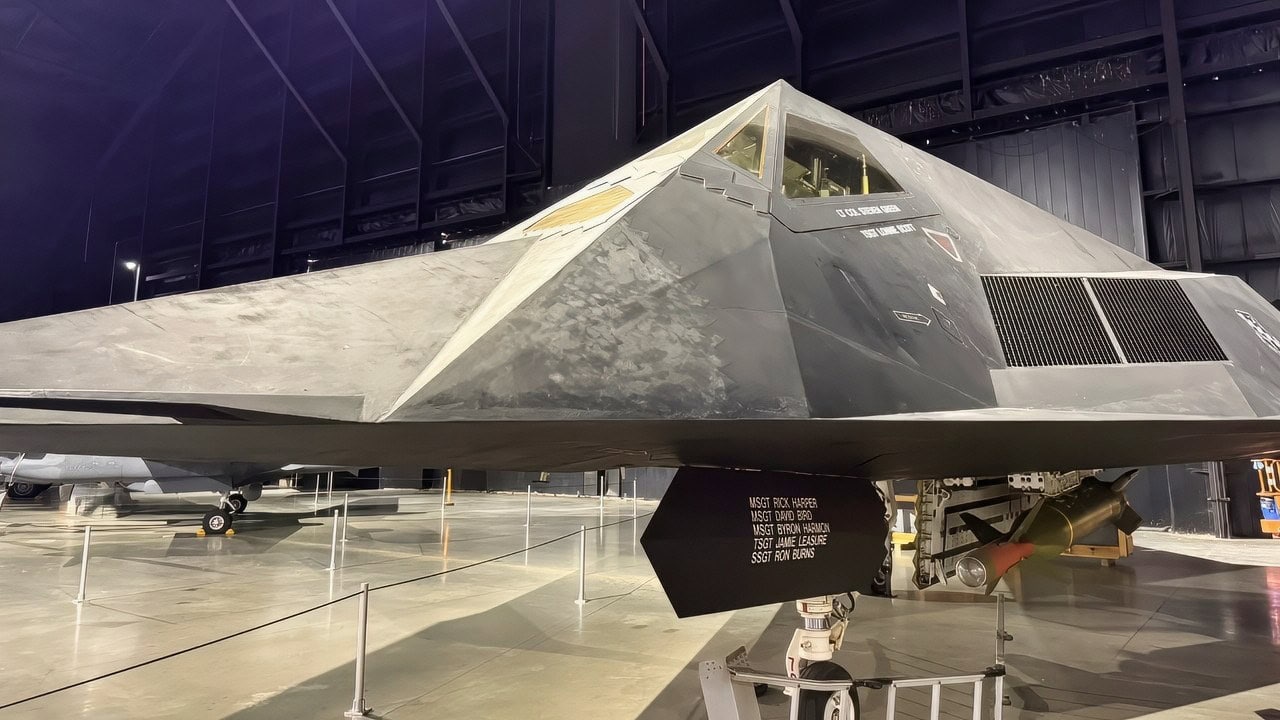
F-117A Nighthawk at USAF Museum. Image taken by 19FortyFive Owner, Harry J. Kazianis.
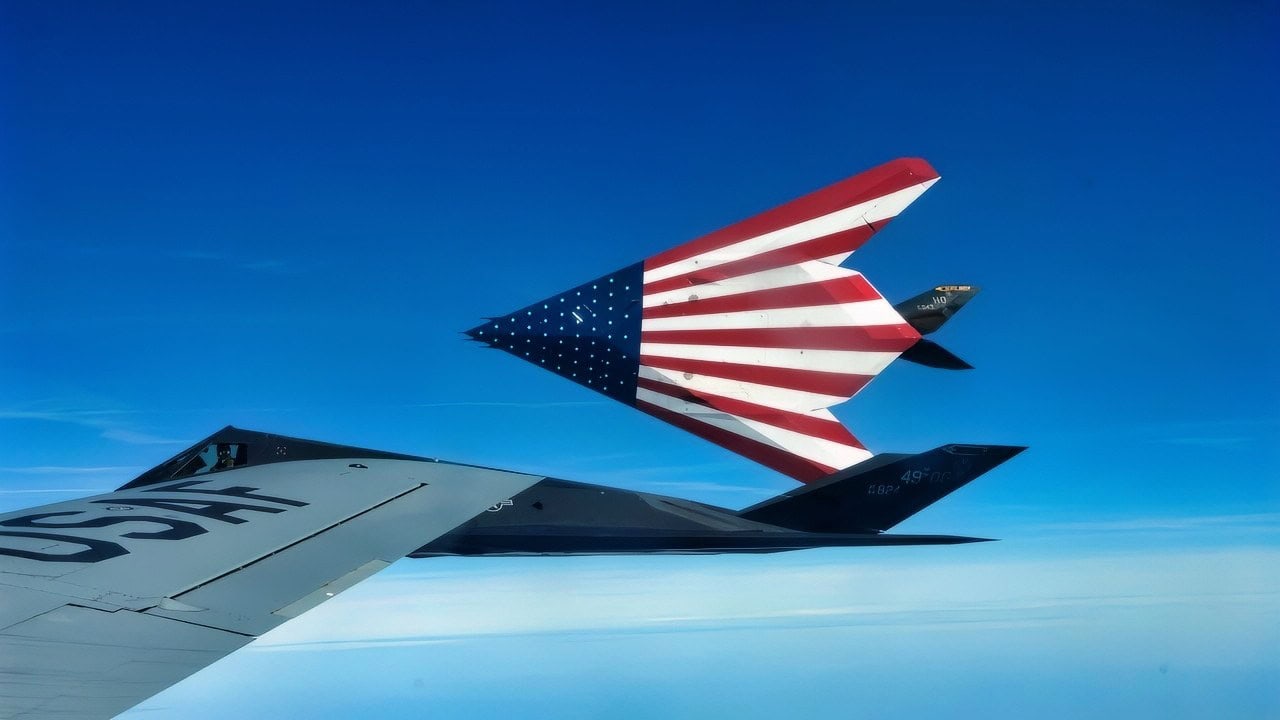
Pilots from the 121st Air Refueling Wing of the Ohio Air National Guard based at Rickenbacker IAP, refuel a pair of F-117 Stealth Fighters from the 49th Fighter Wing based at Holloman AFB in New Mexico. The aircraft is being retired and this was the last refueling operation of The Pilots on this mission were Major Paul Hughes, Captain Danny Slater and the Boom Operator was MSgt Bob Derryberry. The photographs are by SMSgt Kim Frey of the 121st ARW. The aircraft were at Wright Patterson AFB where the F-117 program is managed for an informal retirement ceremony. The F-117 is being replaced by the F-22 Raptor which also uses stealth technologies to avoid detection.
Both aircraft employed radar-absorbing materials in their coatings and RCS-reduction measures at the airframe’s structural edges, but these were only the beginning.
DARPA challenged five U.S. aircraft companies to answer two questions.
-What were the radar signature thresholds that aircraft would have to achieve to be essentially undetectable at an operationally useful range?
-What were the capabilities of each company to design and build an aircraft with the necessary signatures?
By January 1975, DARPA had narrowed the five contenders to McDonnell Douglas and Northrop to design a stealthy aircraft. Unaware at the time of Lockheed’s work on the A-12 and SR-71, DARPA had not invited the company to join the competition.
After the CIA approved Lockheed’s discussion of the A-12 with DARPA director George Heilmeier, Heilmeier allowed Lockheed to participate in the study under a $1 contract.
It was then that DARPA, contracted with Lockheed’s fabled Skunk Works division to design and build the Have Blue stealth technology demonstrator, the similar-looking predecessor to the F-117A Nighthawk.

An F-117 Nighthawk taxies down the runway after landing Jan. 11 at Kunsan Air Base, Republic of Korea. A squadron of F-117s, together with 300 Airmen, have deployed here in support of a continuing force posture adjustment throughout the Pacific. The aircraft, assigned to the 9th Expeditionary Fighter Squadron, is part of the third squadron of Kunsan AB’s host unit, the 8th Fighter Wing, during the deployment’s duration. (U.S. Air Force photo/Senior Airman Darnell Cannady)
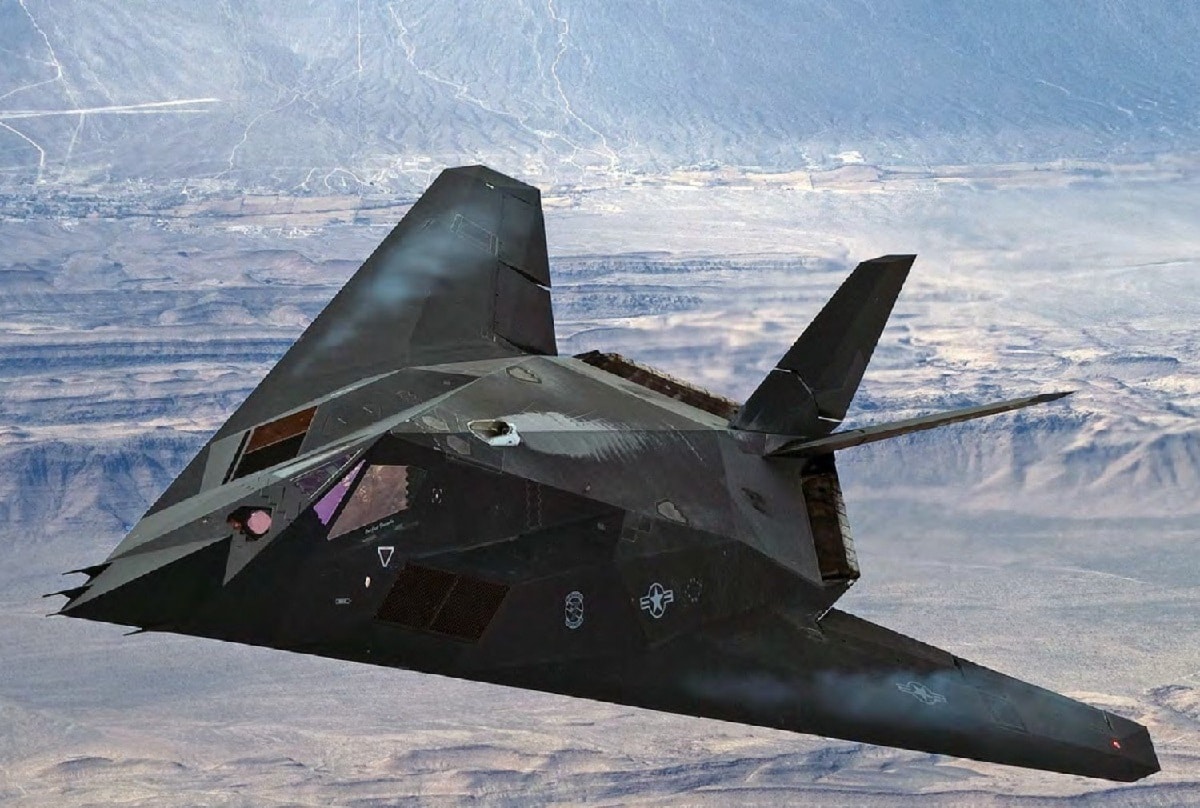
F-117. Image Credit: Creative Commons.
The technologies that were addressed were RCS reduction, radiation-absorbent material development, infrared shielding, reduced visual signatures, low-probability-of-intercept radar, inlet shielding, and exhaust cooling and shaping.
The turnaround time, from contract award to initial operating capability, was incredibly short, just seven years, which was a testament to the talented team at Lockheed’s Skunk Works. The first F-117As became operational in 1983. But the Air Force didn’t acknowledge its existence until 1988.
The technology used to develop the F-117 laid the foundation for the B-2 Spirit stealth bomber, which first flew in 1989.

B-2 Spirit Stealth Bomber 19FortyFive Image. Taken By Harry J. Kazianis at U.S. Air Force Museum in 2025.
During Operation Desert Storm in 1991, the F-117 flew only 2 percent of combat sorties but accounted for 40 percent of the targets.
The Oldest Stealth Aircraft Are Still Useful
The F-117 first saw combat action during Operation Just Cause in 1989. It was retired by the U.S. Air Force in 2008, but remains an iconic example of stealth technology and a subject of public fascination.
Its small radar signature, Low Observable (LO, Stealth) technologies, and advanced targeting system allowed the aircraft to penetrate dense threat environments and deliver precision weapons against heavily defended, high-value targets with pinpoint accuracy. Primary missions included precision attack, air interdiction, Suppression of Enemy Air Defenses (SEAD), and special operations.
The Nighthawk’s Stealth Technology
The Skunk Works designed and developed the first aircraft based on stealth technology. Using faceted, flat panels to deflect and scatter radar waves, it achieved a minimal radar cross-section, often described as similar to a small bird. The aircraft relied on radar-absorbent materials (RAM), internal weapon bays, and non-afterburning engines to remain undetected.
Key stealth technologies included a faceted design (The “Hopeless Diamond”). To enable computer modeling with 1970s technology, Skunk Works designers (spec Denys Overholser, building on Soviet mathematician Petr Ufimtsev’s research) created a shape consisting of flat, angled surfaces that scattered radar signals away from the source.
Radar-Absorbent Material (RAM), the exterior was covered in nearly a ton of radar-absorbing sheets held by adhesive, with gaps filled with a “putty” material called “butter”.
The engines were buried deep in the fuselage with inlets covered by radar-reflecting grids. The exhaust was designed to dissipate heat to minimize the infrared signature, using flat, rectangular nozzles.
Passive targeting also aided in the aircraft’s stealth. The F-117 did not use onboard radar, which would expose its location. Instead, it used infrared sensors, laser designators, and inertial guidance to find and destroy targets.
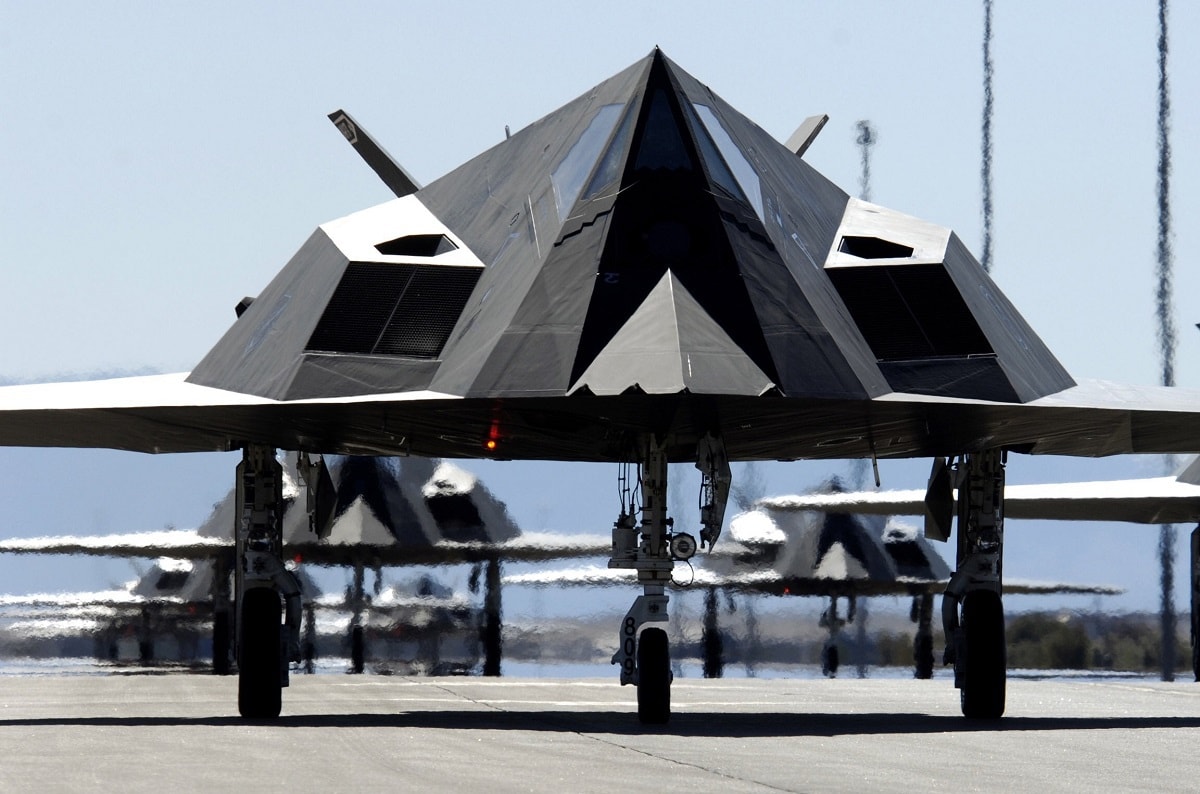
F-117 Image: Creative Commons.
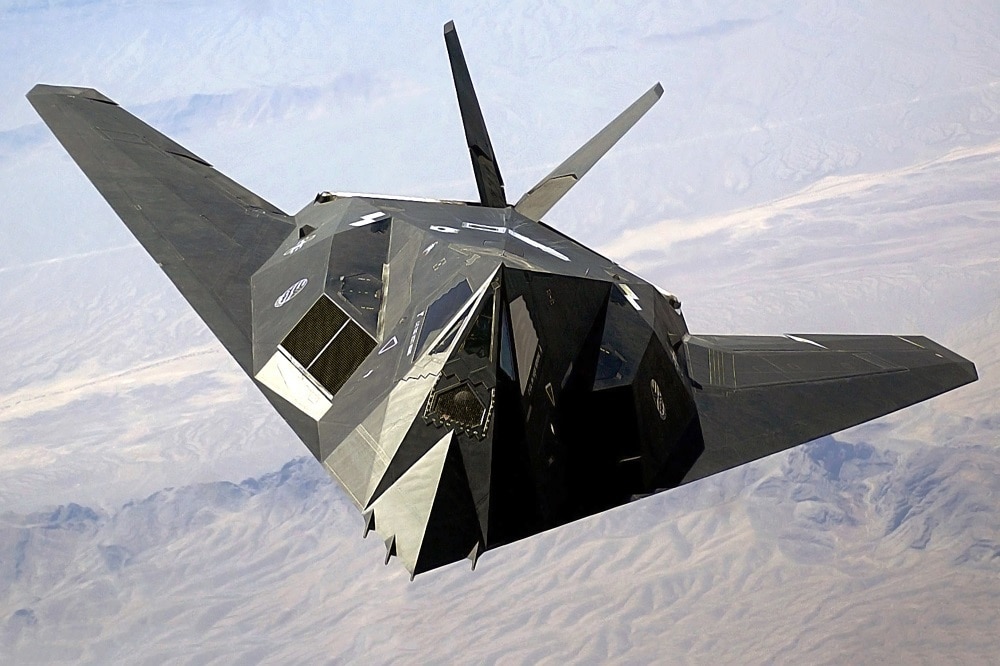
The USAF F-117 Nighthawk, one of the key aircraft used in Operation Desert Storm.
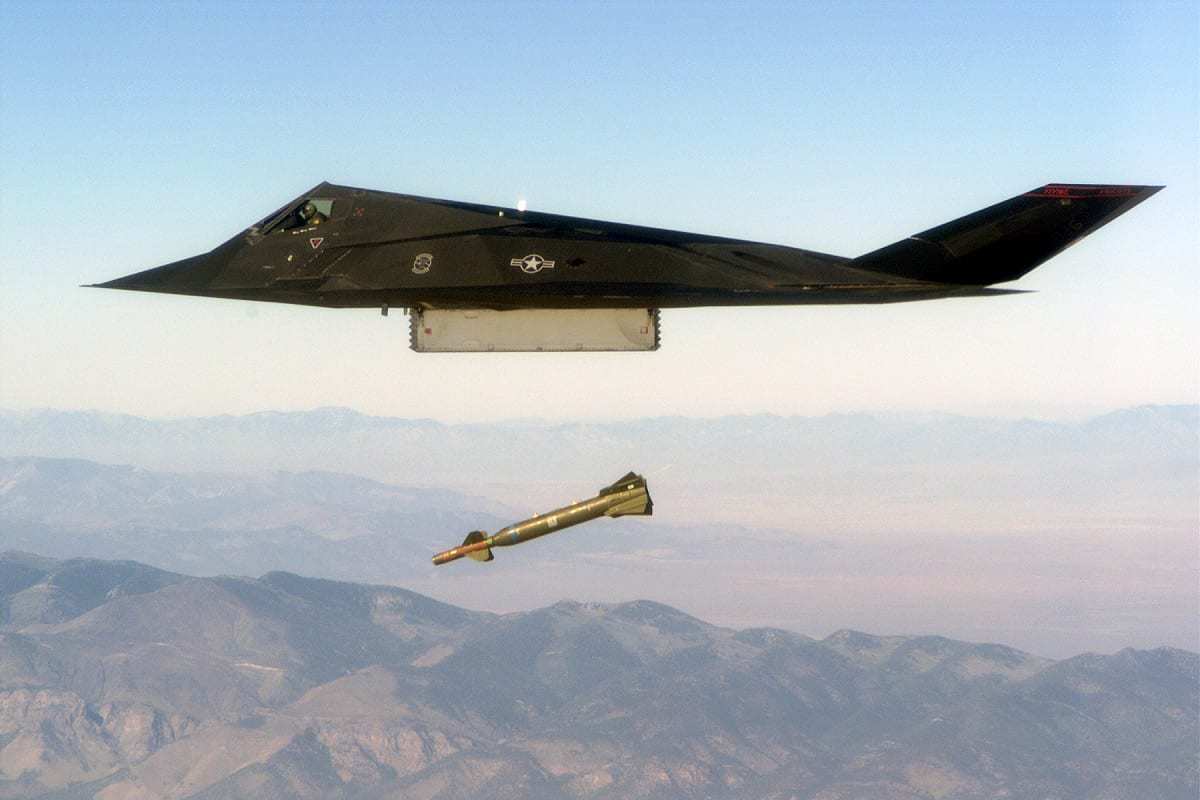
An F-117 Nighthawk engages it’s target and drops a GBU-28 guided bomb unit during the ‘live-fire’ weapons testing mission COMBAT HAMMER, at Hill Air Force Base, Utah.
The aircraft could not fly supersonic to reduce heat and noise signatures, focusing entirely on low-observable operations.
Development and Impact
Have Blue Program: The technology was tested using the “Have Blue” demonstrators, which demonstrated that a highly angled design could effectively evade radar detection.
The “F” Designation: Although technically a bomber/attacker (due to its lack of air-to-air weapons), it was designated an “F”
The F-117’s internal weapons bays further reduced its radar profile.
The Air Force only built 59 of the F-117s, but they punched above their weight, especially in Operation Desert Storm.
Technical Specifications :
Engines: Two General Electric F404-F1D2 engines, 9,040 lbf thrust each
Maximum speed: 684 mph (0.84 Mach)
Range: 1,070 miles (unlimited with aerial refueling)
Crew: 1
Length: 65 ft 11 in (20.09 m)
Wingspan: 43 ft 4 in (13.21 m)
Height: 12 ft 5 in (3.78 m)
Wing area: 780 sq ft (72 m2)
Empty weight: 29,500 lb (13,381 kg)
Max takeoff weight: 52,500 lb (23,814 kg)
The F-117 Nighthawk was designed as a stealth attack aircraft, primarily focused on delivering precision-guided munitions. It carried its weapons internally in two bomb bays, and its arsenal mainly consisted of laser-guided bombs (LGBS) and GPS-guided bombs (JDAMs). The GBU-27 Paveway III was a key munition, designed to penetrate hardened targets.
The F-117’s stealth design required that all weapons be carried internally, limiting its payload capacity to two bombs.
The F-117 was equipped to deploy laser-guided bombs (LGBs) such as the GBU-12, GBU-16, GBU-10, and GBU-27, which were guided by the aircraft’s laser designator.
Later in its service, the F-117 also utilized GPS-guided bombs like the GBU-31 and GBU-38, providing an alternative to laser guidance.
The F-117s Are Still Flying, Teaching
The Nighthawks continue to fly for the Air Force despite being officially retired from the USAF in 2008, and they are still providing the service with several valuable tools.
The Air Force is using the Nighthawk as a testbed for new technologies, such as radar systems, infrared tracking, and stealth-enhancing materials.
The Nighthawk serves as a valuable “red air” asset for training pilots to counter and defeat other nations’ modern stealth aircraft.
Using the F-117 for these purposes is less risky and expensive than testing these systems on more modern, active-duty aircraft like the F-22 Raptor or F-35.
The F-117 can be used to simulate stealthy cruise missiles during large-scale exercises.
The Skunk Works Paved The Way For Stealth Aircraft Of Today
The F-117’s development and operational use paved the way for other stealth aircraft, such as the B-2, F-22, and F-35. The Air Force still uses the F-117, and an official said, “On occasion, we fly certain [F-117A] aircraft to support limited research and training activities.”
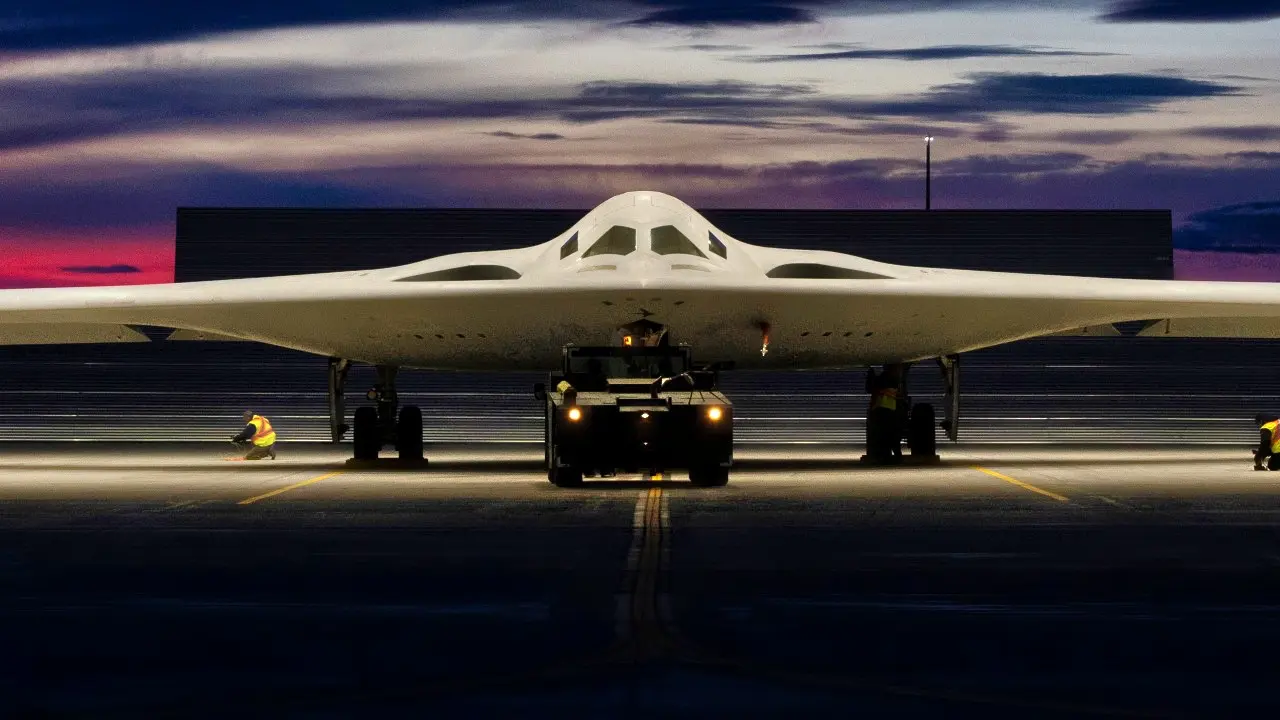
B-21 Raider Stealth Bomber.
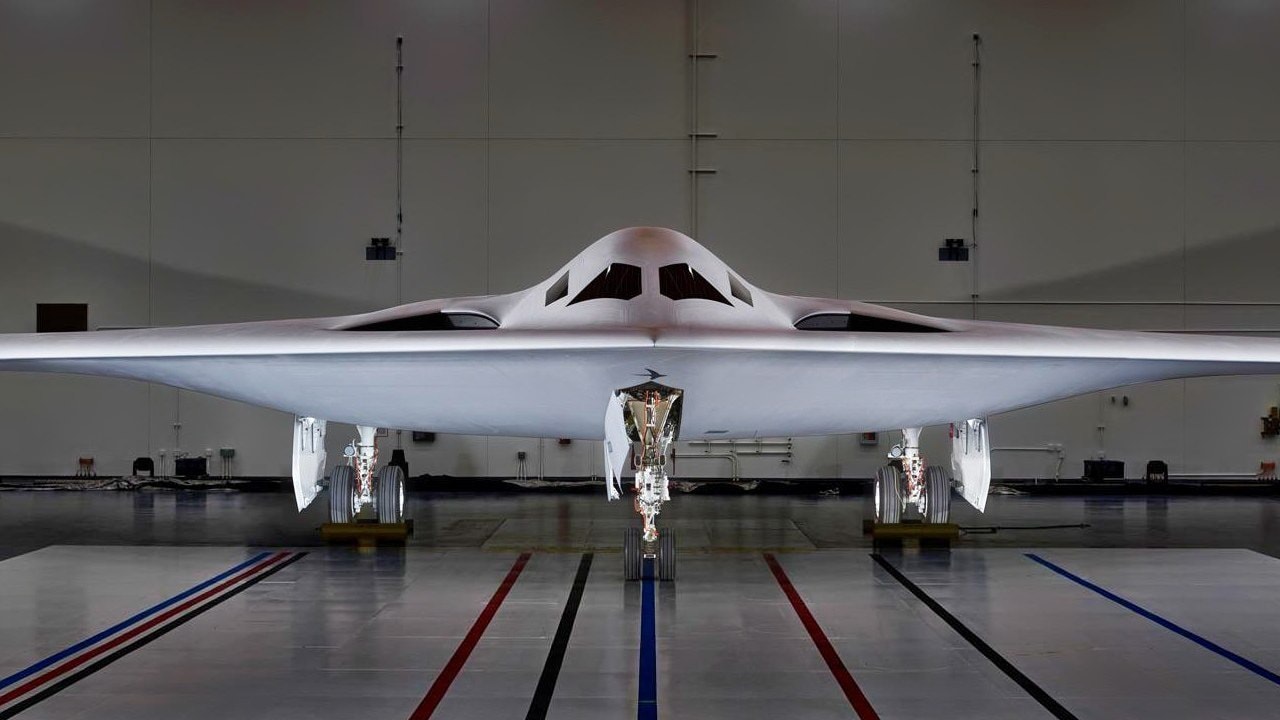
B-21 Raider Bomber U.S. Air Force.
F-117s have recently been involved with and supported several exercises in 2020, operating more frequently and openly alongside Aggressor aircraft at Nellis and MCAS Miramar.
In 2023, a USAF spokesperson said: “We have approximately 45 F-117s currently. As we demilitarize the aircraft, they will be made available to museums, if requested, or be disposed of.”
Eventually, all of the 45 remaining aircraft will be retired. Then they’ll be scrapped or donated to museums. Currently, 10 are slated for museum duty.
About the Author: Steve Balestrieri
Steve Balestrieri is a National Security Columnist. He served as a US Army Special Forces NCO and Warrant Officer. In addition to writing on defense, he covers the NFL for PatsFans.com and is a member of the Pro Football Writers of America (PFWA). His work was regularly featured in many military publications.