

Summary and Key Points: Boeing’s X-32 was built around a clear idea: keep the JSF affordable, simple, and highly common across Air Force, Navy, and Marine variants.
-The design used a large one-piece delta wing, internal bays, and a huge chin intake meant to avoid complex inlet systems—good for cost, less good for signature risk.
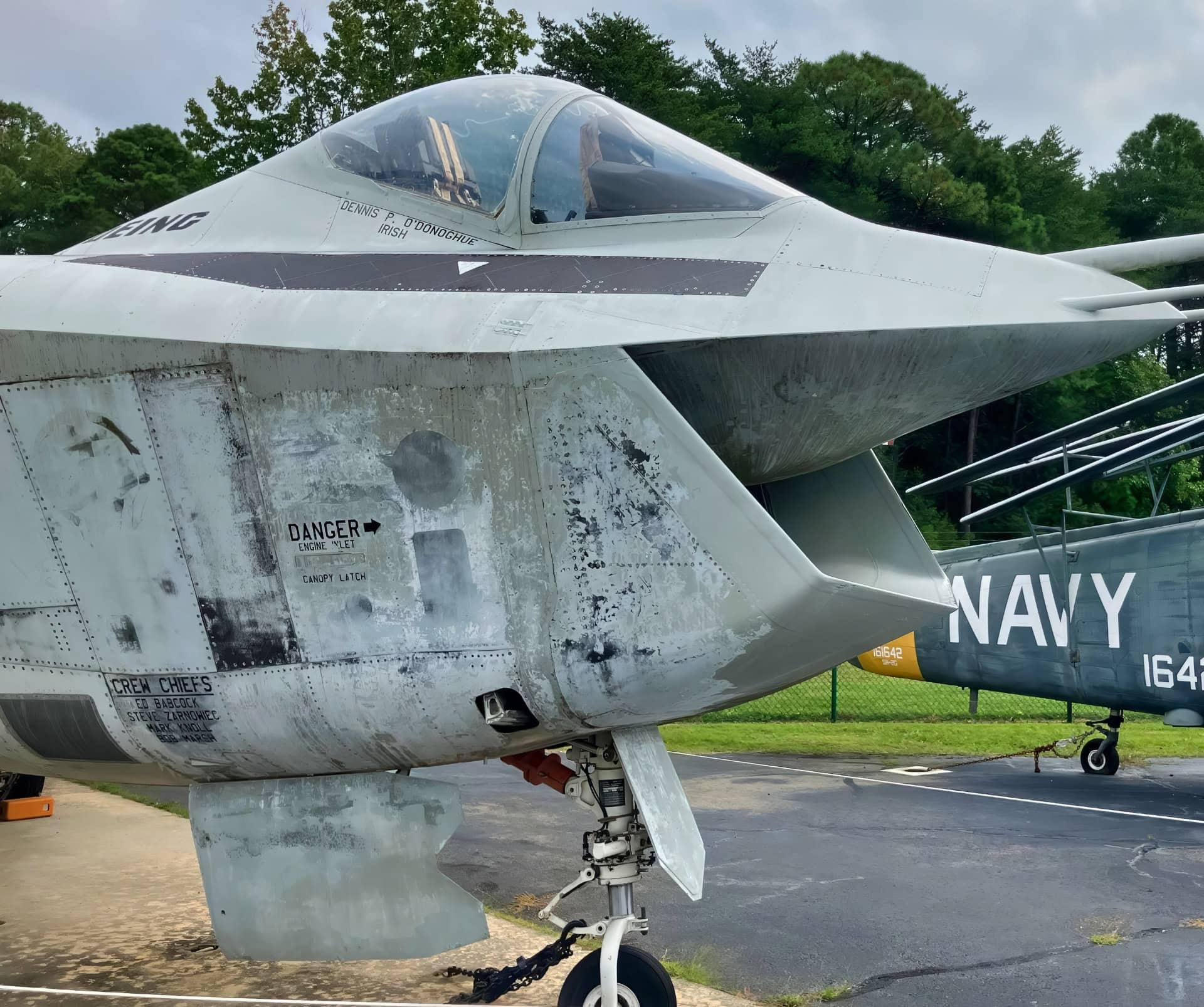
Sideview of Boeing X-32B In Maryland. Image Credit: 19FortyFive.com
-The decisive weakness was STOVL.
-Boeing’s direct-lift, vectored-thrust approach suffered from hot exhaust recirculation during hover and vertical landings, shrinking safety margins and stressing the airframe. Lockheed’s X-35 lift-fan setup delivered steadier, cooler vertical lift and inspired more confidence, so it won.
We Got Close to the Boeing X-32: What We Learned
From 2000 to 2001, the Air Force held its Joint Strike Fighter (JSF) competition to determine the next fifth-generation stealth fighter.
The X-35 won the competition and became the F-35, one of the most successful stealth fighters in the world.
Its competitor, the Boeing X-32, was remembered for its appearance. Well, that’s not exactly fair to say. The Boeing X-32 had several advantages in its design, but aesthetics was not one of them (though some people do like the X-32’s design).

Boeing X-32 Stealth Fighter in Maryland. Image taken by 19FortyFive.com staff back in 2025.
And, in fact, the 19FortyFive.com team has spent countless hours studying the X-32 fighters, one at the National Museum of the Air Force and the other in Maryland. We have included numerous original images for our readers to enjoy in this article.
So why did the X-32 get canned?
Was it really too ugly for service, or did X-35 simply offer more bang for its buck?
That’s where our pictures might come in handy.
The JSF Program: Boeing’s Contribution
The JSF program itself emerged from the merger of DARPA’s Common Affordable Lightweight Fighter initiative and the Joint Advanced Strike Technology program during the early 1990s. From the outset, the intent was to create a single family of stealthy, multirole aircraft capable of serving the U.S. Air Force, Navy, and Marine Corps, as well as multiple allied nations.

Boeing X-32 Fighter image taken by 19FortyFive back in July 2025.
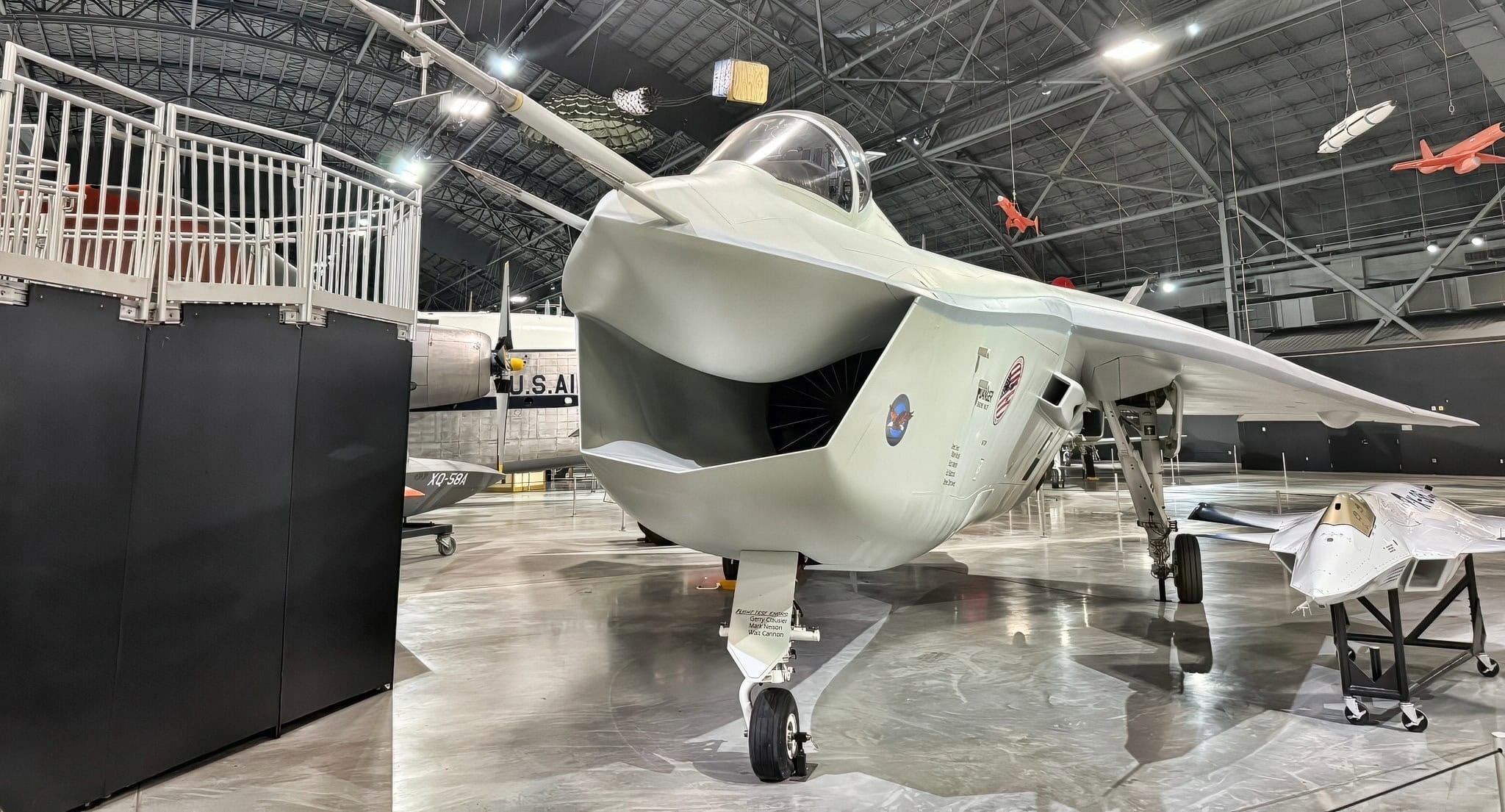
Boeing X-32 Fighter image taken by 19FortyFive back in July 2025.

Boeing X-32 Fighter image taken by 19FortyFive back in July 2025.
This meant that competing designs would be judged not only on tactical performance, but also on cost, manufacturability, maintenance burden, and adaptability over decades of service.
Boeing interpreted this mandate more literally than its rival. Where Lockheed Martin focused on maximizing stealth and aerodynamic performance, Boeing emphasized affordability, simplicity, and commonality above all else. These priorities shaped every major aspect of the X-32’s design.
The aircraft featured a large, thick delta wing built as a single-piece carbon-fiber structure. This wing provided significant internal fuel capacity, structural efficiency, and reduced part count, all of which supported Boeing’s vision of lower production and life-cycle costs. Internal weapons bays preserved low observability, and the airframe was sized to accommodate the needs of all three JSF variants with minimal modification.
Nothing symbolized the X-32’s design philosophy more clearly than its massive chin-mounted air intake. The intake’s size and placement allowed sufficient airflow for both supersonic flight and vertical lift while avoiding complex ducting or moving inlet mechanisms. Mechanically, it was an elegant solution as it provided enough air for the system. Aesthetically, however, it was suboptimal.
Additionally, radar energy could more easily penetrate the intake and reflect off the engine face, increasing the aircraft’s radar cross-section relative to competing designs.
Although Boeing argued that production versions would mitigate this weakness through inlet treatments and internal shaping, the aircraft would never see that stage.
The Downsides of the X-32
At the heart of the X-32’s downfall was its approach to STOVL operations, a critical requirement for the U.S. Marine Corps. Boeing chose a direct-lift, vectored-thrust system inspired by the AV-8B Harrier rather than adopting a separate lift fan.
In the X-32, engine exhaust was diverted downward through vectoring nozzles to provide vertical lift. The advantage of this system was simplicity: fewer moving parts, lower weight growth risk, and less mechanical complexity than a shaft-driven lift fan. In practice, however, the system proved inferior under JSF evaluation standards.
During hover and vertical landing, hot exhaust gases from the X-32 tended to recirculate back into the intake.
This reduced thrust, increased engine temperatures, and placed severe thermal stress on both the propulsion system and the airframe.
These effects narrowed safety margins and constrained operational envelopes. By contrast, the X-35’s lift fan system delivered large volumes of cool air for vertical lift, avoided recirculation, and demonstrated more stable and repeatable STOVL performance.
Evaluators viewed this difference as decisive, especially considering the Marine Corps’ reliance on austere forward basing and shipboard operations.
Boeing’s decision to significantly revise the planned production configuration during the competition further eroded confidence.
Although such changes were technically rational responses to evolving requirements, they introduced uncertainty about weight growth, schedule risk, and whether the promised cost advantages would actually materialize. In a program of enormous political and financial importance, risk perception mattered almost as much as raw performance.
Why the Air Force Chose X-35
When the Department of Defense announced its decision in October 2001, the verdict was clear. The X-35 offered superior STOVL capability, better demonstrated stealth characteristics, and greater confidence in long-term adaptability.

X-35 19FortyFive.com Image. Image Credit: 19FortyFive.com taken on February 4, 2026.
In fact, we were just visiting an X-35 at the Smithsonian outside of Washington, DC. It is quite impressive, to say the least. We have several photos here for your review. We also have included some older video of the X-35B we shot back in 2022 at the Smithsonian.

X-35 Fighter 19FortyFive Image. Image Credit: 19FortyFive.com take on 2/4/2026 at the Smithsonian.
The X-32 was not rejected as unsafe, unworkable, or poorly engineered. It was rejected because its central design compromises ran counter to the strategic priorities the JSF program ultimately embraced.
Today, the Boeing X-32 stands as one of the most instructive aircraft in modern aviation history. It represents a coherent, internally consistent vision of what a fifth-generation fighter could be if affordability and simplicity were treated as primary objectives.
Its failure underscores a hard lesson of modern air combat: in an environment characterized by integrated air defenses, advanced sensors, and networked warfare, compromises in stealth and vertical-lift performance are rarely forgiven.
The X-32 was a capable aircraft, but it was built for a future the Pentagon ultimately chose not to pursue.
About the Author: Isaac Seitz, Defense Expert
Isaac Seitz, a Defense Columnist, graduated from Patrick Henry College’s Strategic Intelligence and National Security program. He has also studied Russian at Middlebury Language Schools and has worked as an intelligence Analyst in the private sector.

