
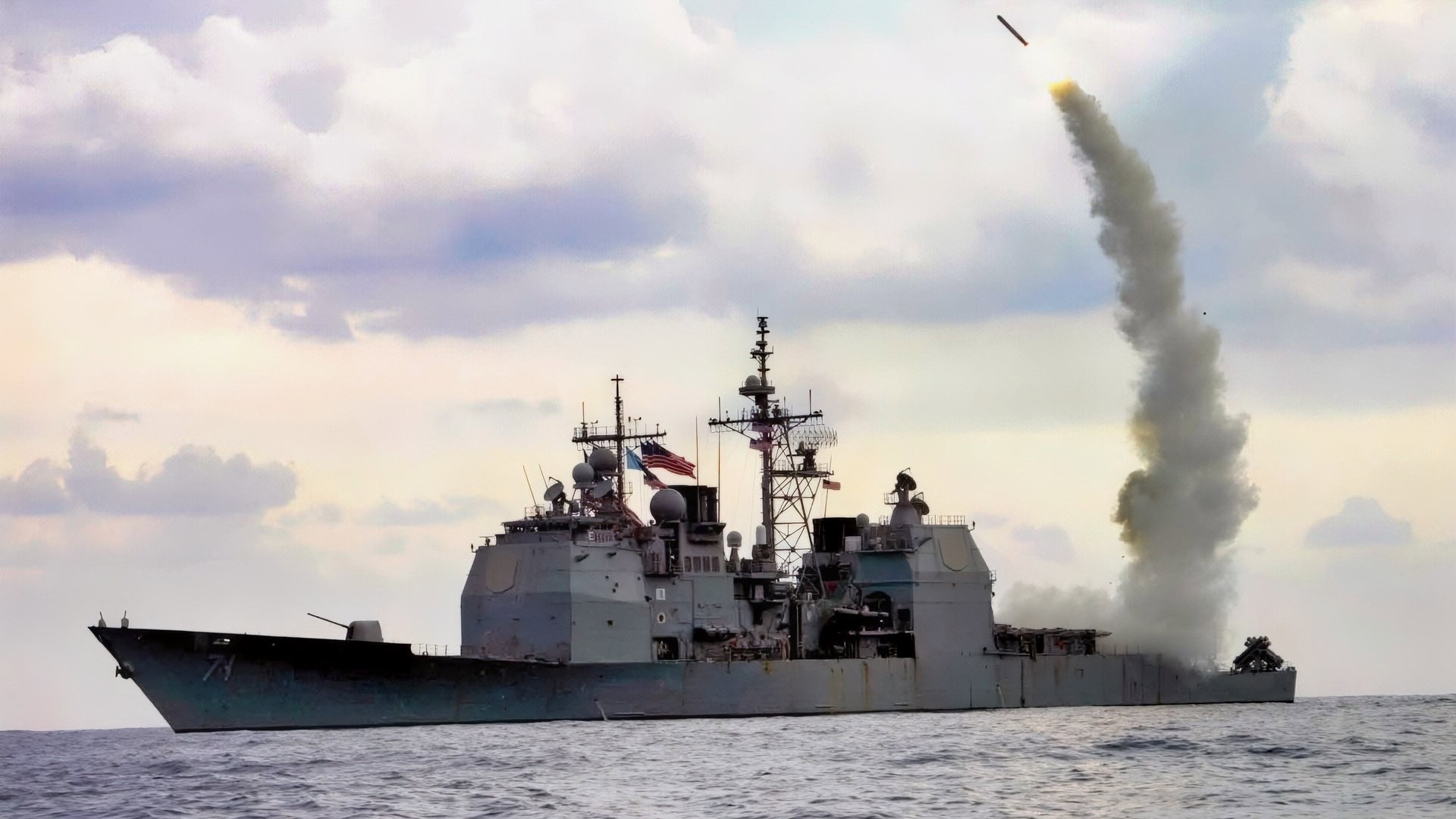
Summary and Key Points: Defense analyst Jack Buckby evaluates the strategic “firepower gap” as the U.S. Navy retires its remaining Ticonderoga-class cruisers amidst the 2026 Iran conflict.
-Each cruiser’s 122-cell Mk 41 VLS magazine is a critical “missile truck” for Tomahawk strikes.
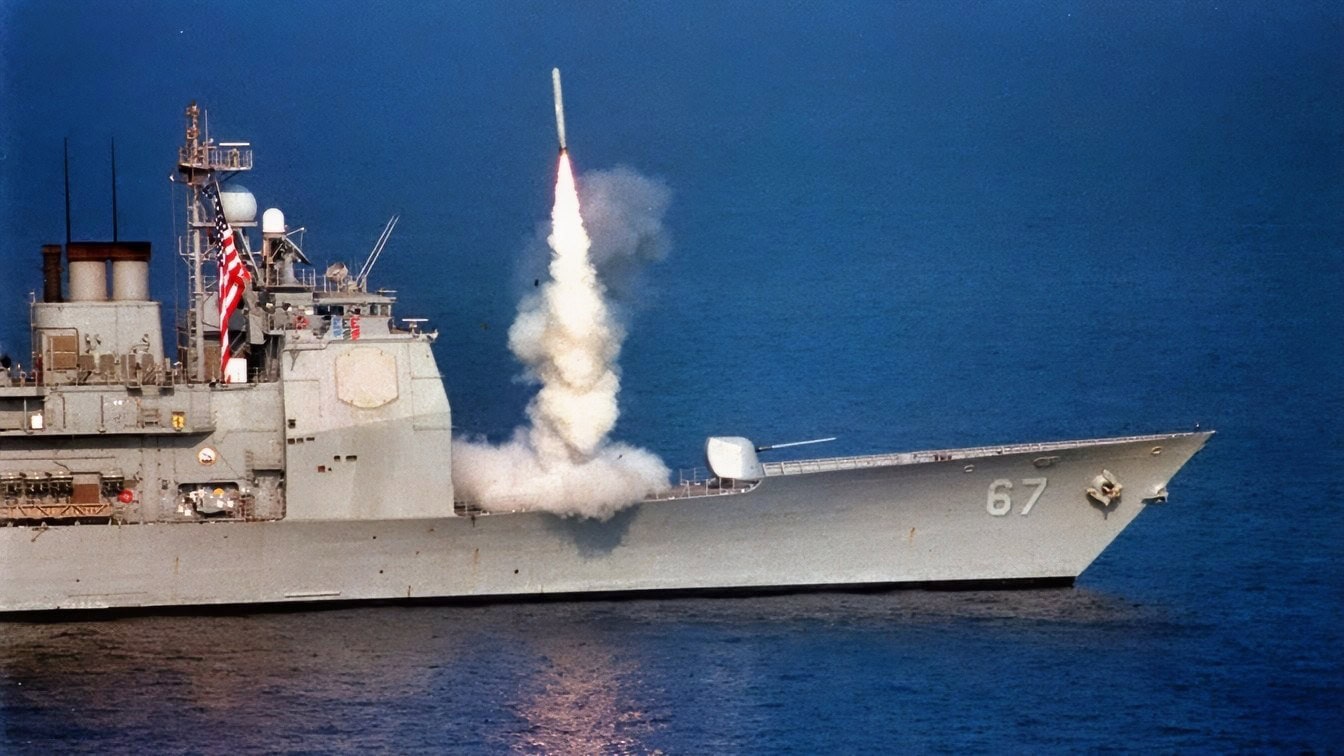
A Tomahawk cruise missile launches from the forward vertical launch system of the USS Shiloh (CG 67) to attack selected air defense targets south of the 33rd parallel in Iraq on Sept. 3, 1996, as part of Operation Desert Strike. The attacks are designed to reduce risks to the pilots who will enforce the expanded no-fly zone. President Clinton announced an expanded no-fly zone in response to an Iraqi attack against a Kurdish faction. The larger no-fly zone in Southern Iraq will make it easier for U.S. and coalition partners to contain Saddam Hussein’s aggression. The U.S. Navy Ticonderoga Class cruiser launched the missiles as it operated in the Persian Gulf.
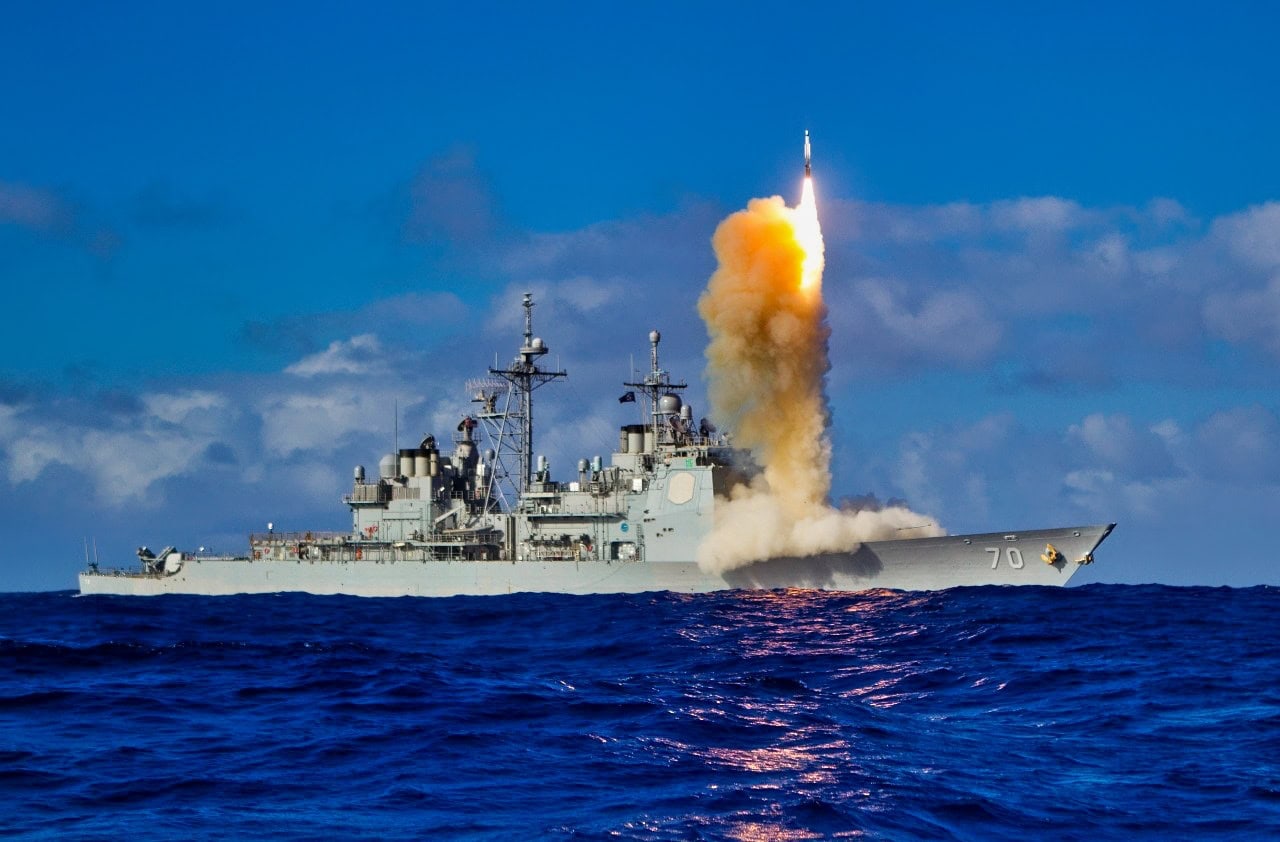
Ticonderoga-Class US Navy. Image Credit: Creative Commons.
-With Operation Epic Fury consuming over 400 Tomahawks in its first 72 hours—roughly 10% of the total inventory—the retirement of ships like USS Shiloh (CG 67) and USS Lake Erie (CG 70) leaves a 1,220-cell deficit.
-This transition to smaller Arleigh Burke Flight III destroyers threatens Indo-Pacific deterrence by reducing massed strike capacity during the “tyranny of distance.”
Retiring the Ticonderoga Means A Big Loss for Tomahawk Power
The U.S.-Israeli operation against Iran has depended heavily on the Tomahawk cruise missile, particularly in the opening phase of the war, using them to dismantle air defenses and strike missile infrastructure. These long-range weapons have allowed U.S. forces to hit targets without exposing aircraft to enemy air defenses.
But while demand for Tomahawks is rising, the Navy is preparing to retire the ships that carry them in the largest numbers.
The Ticonderoga-class cruisers, long the backbone of the Navy’s surface-based strike capacity, are being phased out by the end of the decade. Each carries 122 vertical launch system (VLS) cells, the highest of any surface combatant in the U.S. fleet.
As these ships retire, the Navy is not just losing hulls – it is losing hundreds of missile launch cells, many of which can carry Tomahawk cruise missiles. At a time of sustained combat operations and growing global risk, that reduction in launch capacity is becoming a serious strategic concern.
The Ticonderoga Class
The Ticonderoga-class cruisers were developed during the Cold War as the U.S. Navy’s first Aegis-equipped surface combatants, designed to provide advanced air defense for carrier strike groups. The lead ship, USS Ticonderoga, entered service in 1983, and a total of 27 ships were eventually built.
The most important feature of the later ships in the class is their 122-cell Mk 41 vertical launch system, split between forward and aft launch arrays (missile launch cells located at both the front and rear of the ship).
This system allows cruisers to carry a mix of missiles, including Standard surface-to-air missiles, anti-submarine rockets, and Tomahawk land-attack cruise missiles. No other surface combatant in the U.S. Navy matches this level of missile density.
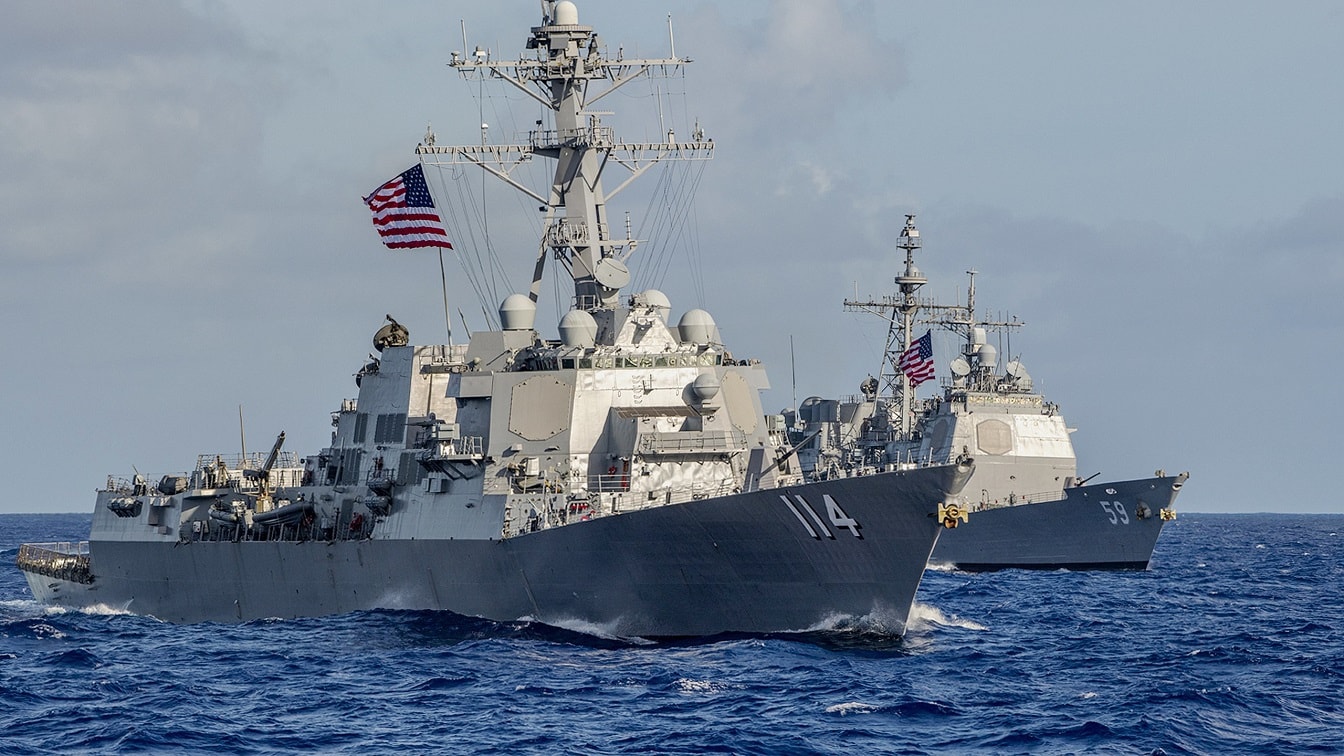
The Arleigh Burke-class guided-missile destroyer USS Ralph Johnson (DDG 114) and the Ticonderoga-class guided-missile cruiser USS Princeton (CG 59) steam in formation during dual carrier operations with the Nimitz and Theodore Roosevelt Carrier Strike Groups (CSG). Dual carrier operations unify the tactical power of two individual CSG, providing fleet commanders with an unmatched, unified credible combat force capable of operating indefinitely. The CSGs are on a scheduled deployments to the Indo-Pacific.
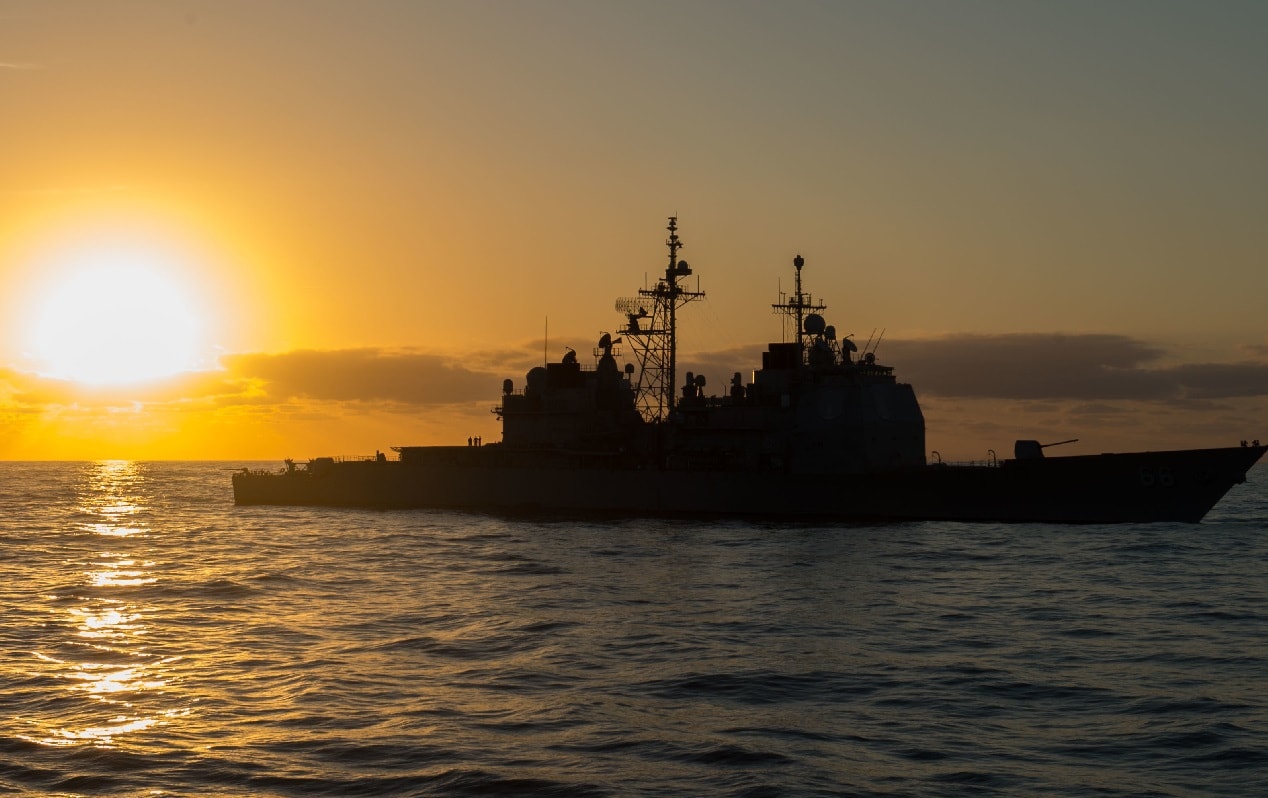
The sun rises over the Ticonderoga-class guided-missile cruiser USS Hue City (CG 66) in the Atlantic Ocean March 28, 2018. Hue City is underway supporting Carrier Strike Group Four Task Force Exercise 18-2. (U.S. Navy photo by Mass Communication Specialist 3rd Class Danny Ray Nuñez Jr.)
By comparison, Arleigh Burke-class destroyers typically carry between 90 and 96 VLS cells depending on the variant. That gap matters operationally because it directly determines how much firepower a ship can bring to a fight.
From Air Defense to Strike Platform
Although originally designed for air defense, Ticonderoga-class cruisers evolved into some of the Navy’s most important strike platforms in the post-Cold War era.
Their large VLS capacity made them ideal for launching Tomahawk cruise missiles in the opening stages of conflicts.
Tomahawks have been used extensively in U.S. operations, including in Iraq, Libya, and Syria, where they were employed to strike fixed targets such as command centers, radar installations, and missile sites from long range. The same model is now being used in the Iran conflict, where standoff strikes are critical to degrading air defenses before manned aircraft enter contested airspace.
Cruisers are particularly valuable in this role because they can carry a large number of Tomahawks at once, enabling massed strike salvos early in a campaign. That ability to deliver concentrated firepower is not easily replicated by smaller ships or dispersed platforms.
In effect, Ticonderoga-class cruisers have functioned as floating missile magazines, capable of delivering both defensive and offensive firepower at scale. Their retirement, therefore, removes not just a ship type, but a specific operational capability.
Retirement – and What Replaces Them
A combination of age and rising maintenance costs means the Navy is looking to retire all remaining Ticonderoga-class cruisers by the late 2020s.
Many of these ships are already more than 30 years old, and sustaining them has become too expensive – but the ships’ replacements do not offer a direct equivalent in terms of missile capacity.
Arleigh Burke-class destroyers will continue to form the backbone of the surface fleet, but they carry fewer VLS cells.
At the same time, the ships are also tasked with a wide range of missions, including ballistic missile defense and carrier escort duties, thereby limiting the number of cells that can be allocated to strike weapons like Tomahawks.
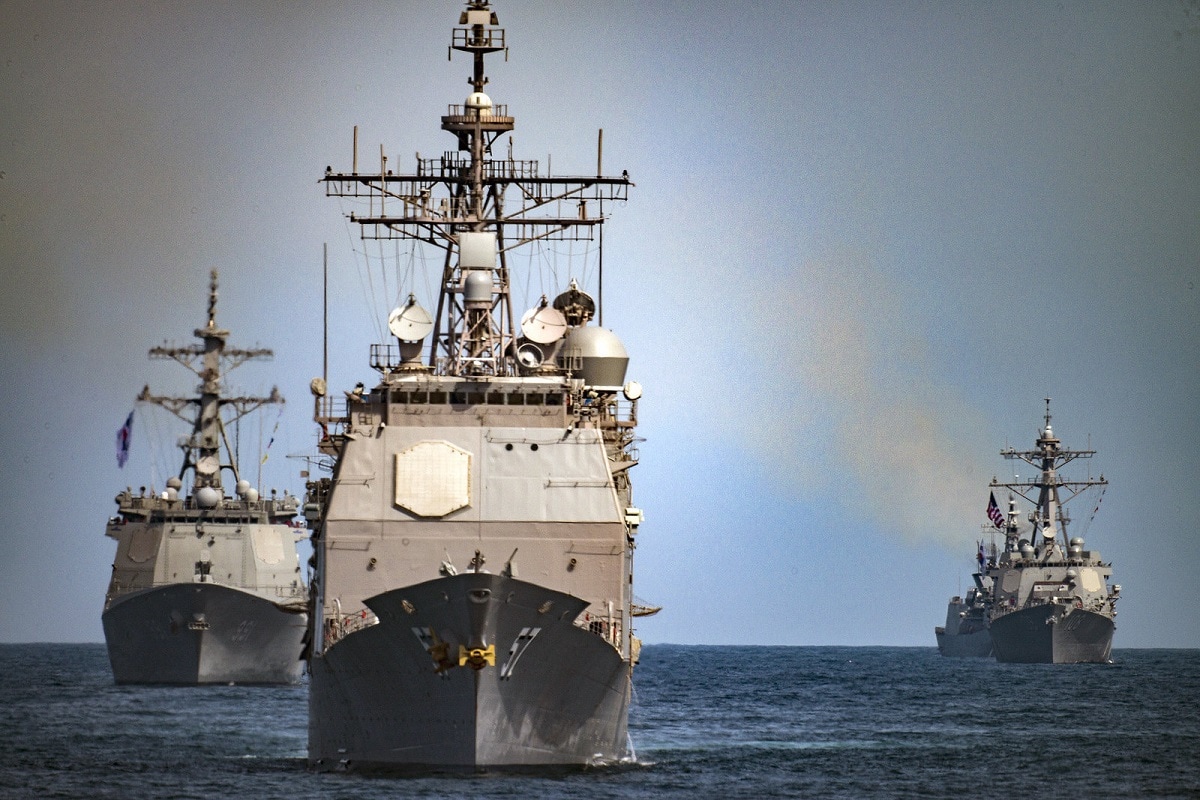
PACIFIC OCEAN (May 3, 2017) The Ticonderoga-class guided-missile cruiser USS Lake Champlain (CG 57), center, leads the Republic of Korea destroyers Sejong the Great (DDG 991), left, and Yang Manchun (DDH 973) while transiting the Western Pacific. The U.S. Navy has patrolled the Indo-Asia-Pacific routinely for more than 70 years promoting regional peace and security. (U.S. Navy photo by Mass Communication Specialist 2nd Class Z.A. Landers/Released) 170503-N-GD109-160
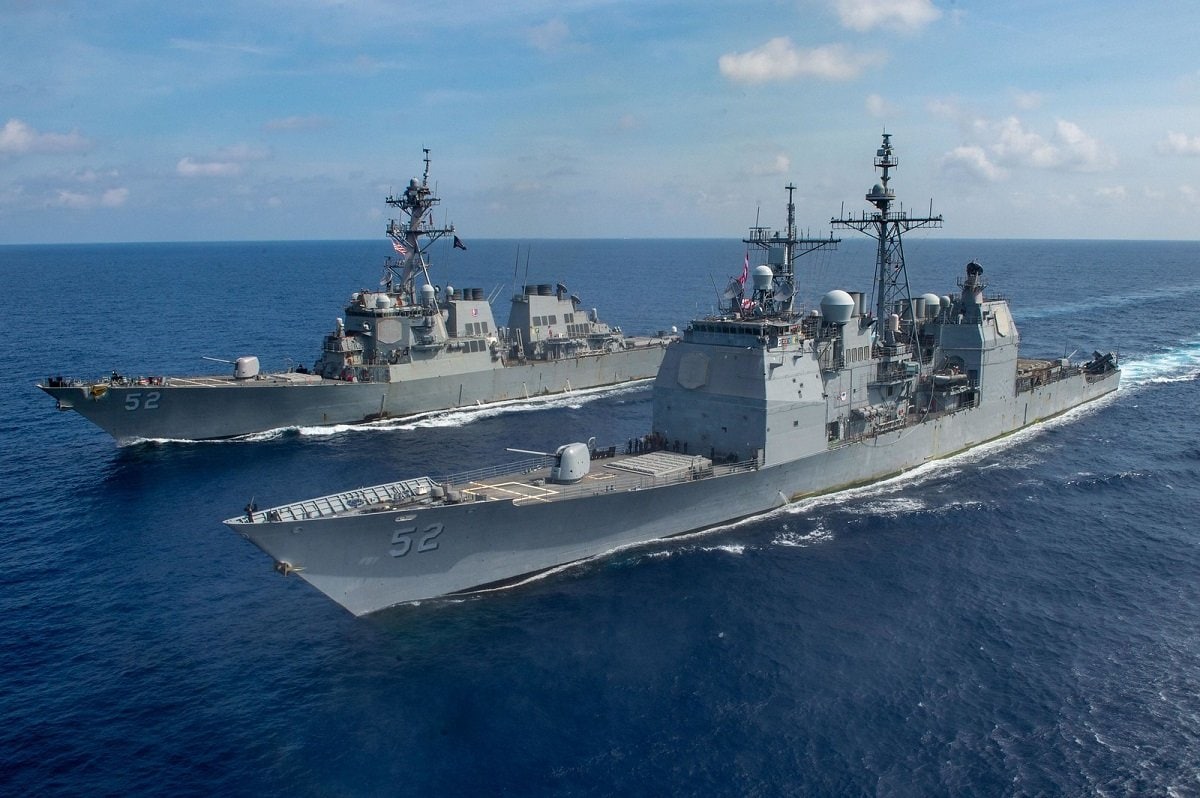
SOUTH CHINA SEA (April 18, 2020) The Ticonderoga-class guided missile cruiser USS Bunker Hill (CG 52), front, and the Arleigh Burke-class guided-missile destroyer USS Barry (DDG 52) transit the South China Sea. Bunker Hill is deployed to the U.S. 7th Fleet area of operations and is operating with the America Expeditionary Strike Group in support of security and stability in the Indo-Pacific region. (U.S. Navy photo by Mass Communication Specialist 3rd Class Nicholas V. Huynh/Released)200418-N-IW125-2047.
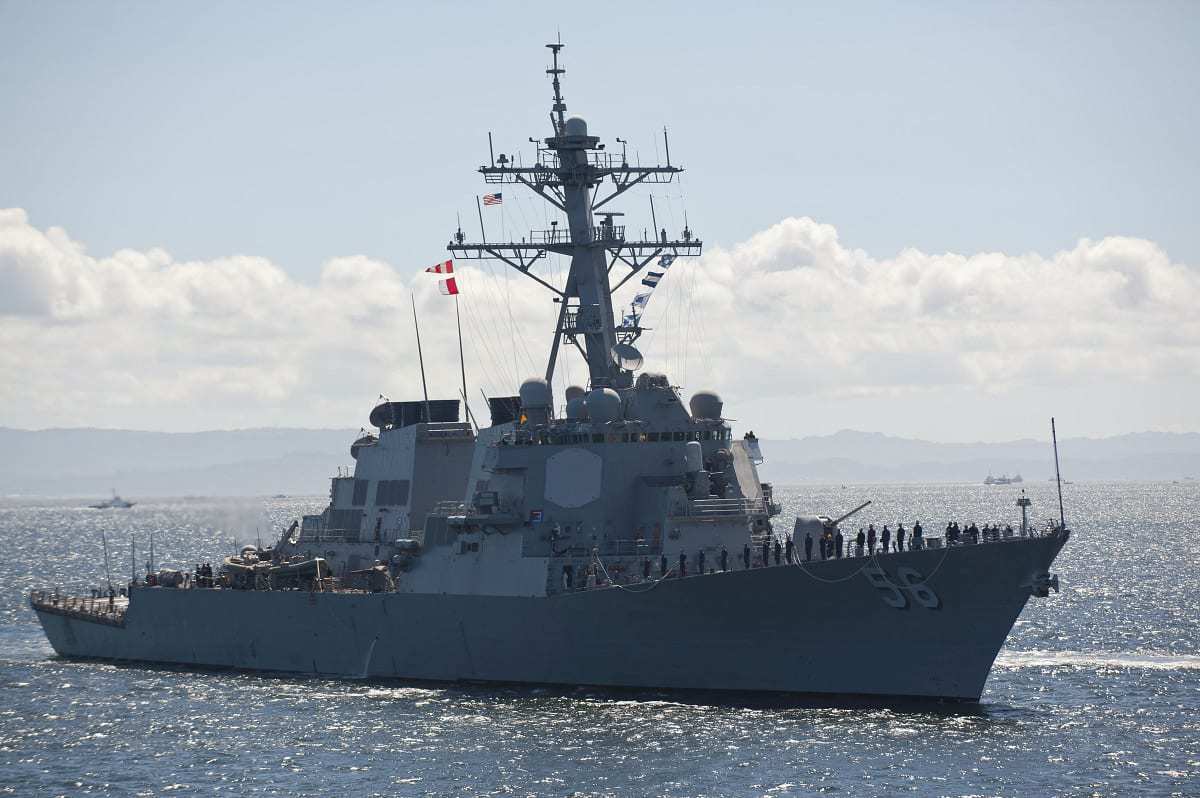
YOKOSUKA, Japan (Aug. 22, 2012) Sailors aboard the Arleigh Burke-class guided-missile destroyer USS John S. McCain (DDG 56) render side honors as they pass by the Ticonderoga-class guided-missile cruiser USS Cowpens (CG 63). Cowpens is part of the George Washington Carrier Strike Group, the US Navy’s only forward deployed carrier strike group, based out of Yokosuka, Japan, and is conducting a routine western Pacific Ocean patrol. (U.S. Navy photo by Mass Communication Specialist 3rd Class Paul Kelly/Released)
The upcoming Constellation-class frigates aren’t much better, either, carrying even fewer missiles – around 32 VLS cells – making them unsuitable as replacements for cruiser-level strike capacity.
Then there are the Virginia-class submarines – particularly the Block V variant with the Virginia Payload Module, which will add additional missile capacity.
Each Block V submarine can carry up to 40 Tomahawk missiles – but submarines operate differently from surface ships, are fewer in number, and cannot fully replace the role of cruisers in providing scalable and rapidly deployable strike power. These are all problems, but there’s also another one to contend with: the U.S. is losing Tomahawks at a rapid pace.
The Scale of the Tomahawk Losses
Each Ticonderoga-class cruiser carries 122 VLS cells. If approximately 10 remaining cruisers are retired over the next several years, that represents a loss of around 1,220 launch cells across the fleet that could have carried a Tomahawk – not accounting, of course, for the smaller number of launch cells that will replace them.
And while it’s true that not every VLS cell is loaded with a Tomahawk, because ships carry a mix of weapons depending on mission requirements, a significant portion of those cells can be allocated to Tomahawks in strike-heavy configurations.
That means the retirement of the cruiser fleet could remove hundreds of Tomahawk launch positions per ship, and more than 1,000 potential long-range strike slots in total.
These VLS cells are a finite resource for the Navy, and they determine how many missiles can be launched at any point in a conflict – particularly during the opening phase, when Tomahawks are particularly valuable. They also determine how much sustained firepower the fleet can generate over time.
The current war with Iran demonstrates that problem. U.S. forces are already firing large numbers of Tomhawk missiles in quick bursts, and these weapons are not being produced at a rapid pace. Replenishing stockpiles takes time, and it could take several years to replace those lost in Iran so far. And at the same time, the Navy is reducing the number of platforms capable of launching them in large volumes.
If the Iran conflict remains limited, the impact may be manageable. But if another contingency arises – particularly in the Indo-Pacific – the United States could face a situation in which both missile inventories and launch capacity are put under simultaneous strain.
As the ships retire, the capability lost is replaced by a more fragmented one across smaller platforms with competing priorities, potentially reducing the speed and scale at which the U.S. can generate strike power.
The Navy, of course, understands this risk – but little can be done about it. At a certain point, the Navy must address the fact that operating these aging ships costs both time and money – and ultimately, availability rates matter more than theoretical capacity. A ship in drydock, after all, contributes zero VLS cells.
About the Author: Jack Buckby
Jack Buckby is a British researcher and analyst specialising in defence and national security, based in New York. His work focuses on military capability, procurement, and strategic competition, producing and editing analysis for policy and defence audiences. He brings extensive editorial experience, with a career output spanning over 1,000 articles at 19FortyFive and National Security Journal, and has previously authored books and papers on extremism and deradicalisation.