
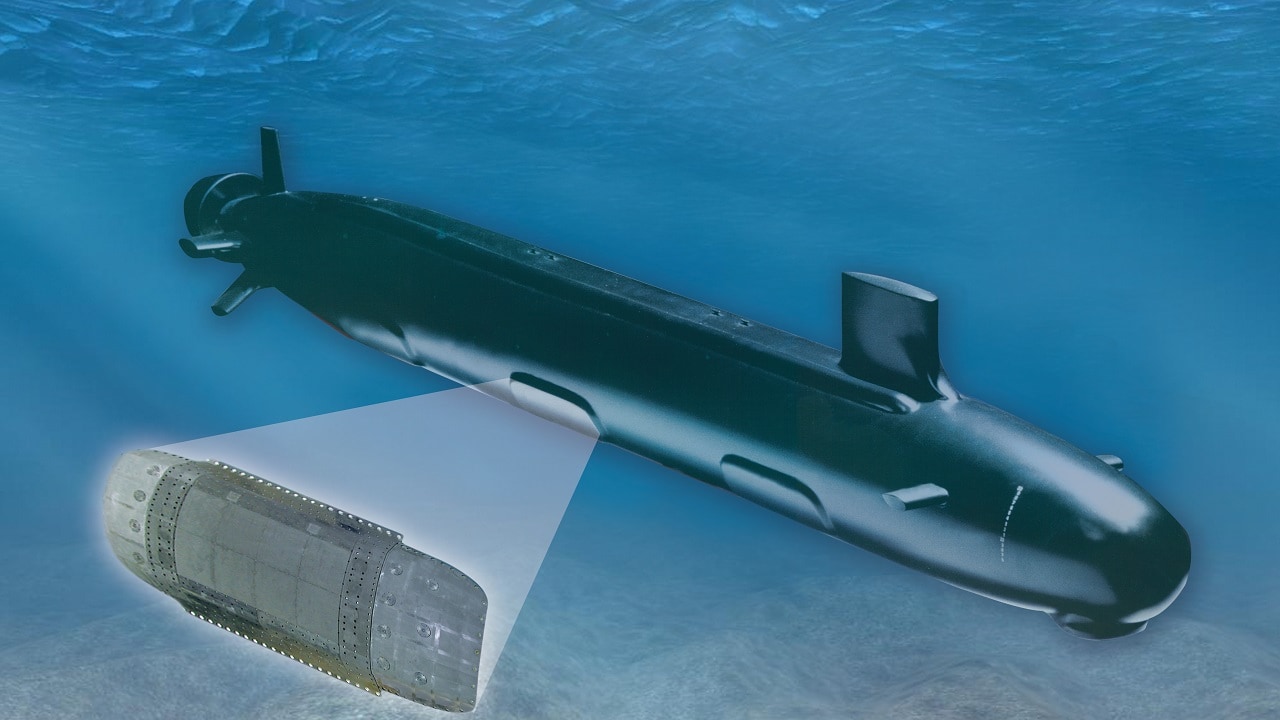
Summary and Key Points: Christian D. Orr — former Air Force Security Forces officer, federal law enforcement officer, private military contractor with assignments in Iraq, the UAE, Kosovo, and the Pentagon, USC International Relations graduate, and American Military University intelligence studies master’s — examines the critical question facing U.S. submarine strategy: could the Virginia Payload Module be enlarged to transform Virginia-class SSNs into true SSGN guided-missile submarines capable of matching the Ohio-class’s 154-Tomahawk capacity?
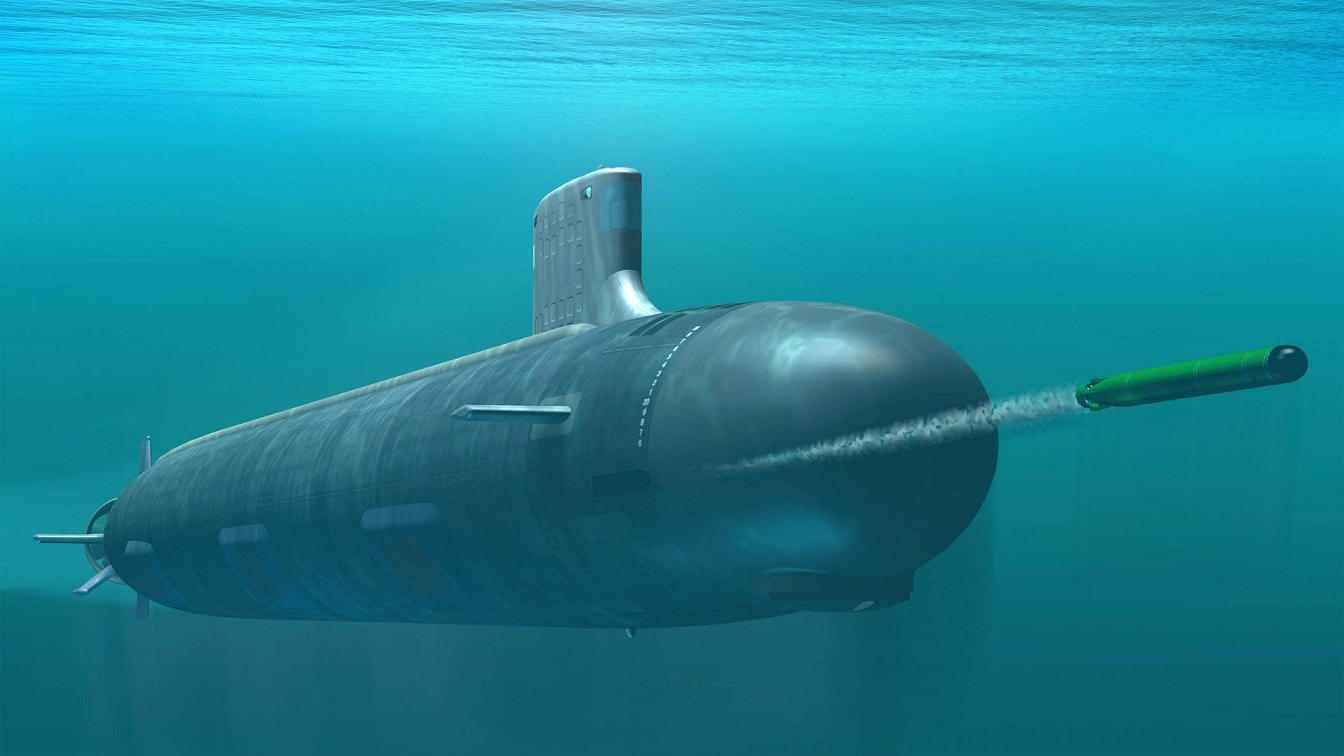
(May 21, 2003) — This conceptual drawing shows the new Virginia-class attack submarine now under construction at General Dynamics Electric Boat in Groton, Conn., and Northrop Grumman Newport News Shipbuilding in Newport News, Va. The first ship of this class, USS Virginia (SSN 774) is scheduled to be delivered to the U.S. Navy in 2004. U.S. D.O.D. graphic by Ron Stern. (RELEASED)
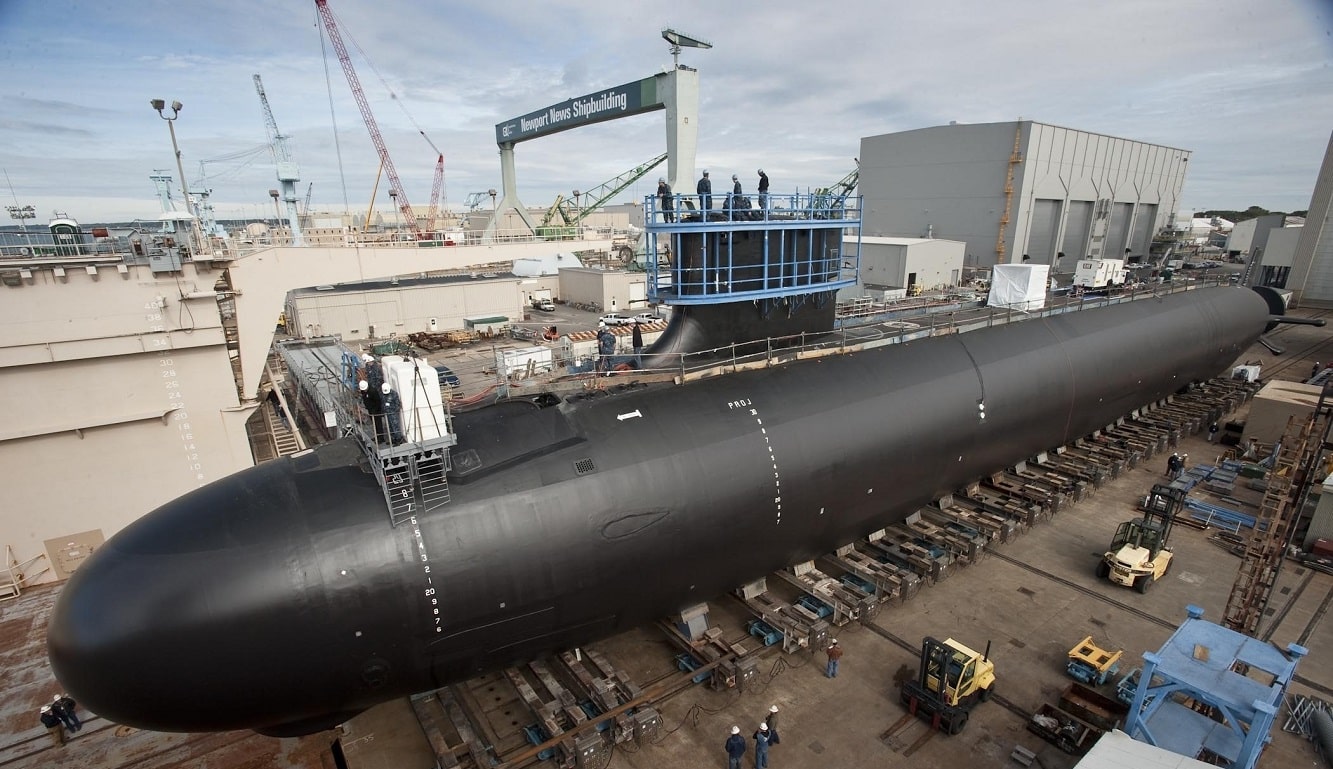
The Virginia-class attack submarine Minnesota (SSN 783) is under construction at Huntington Ingalls Newport News Shipbuilding. (U.S. Navy photo courtesy of Newport News Shipbuilding/Released)
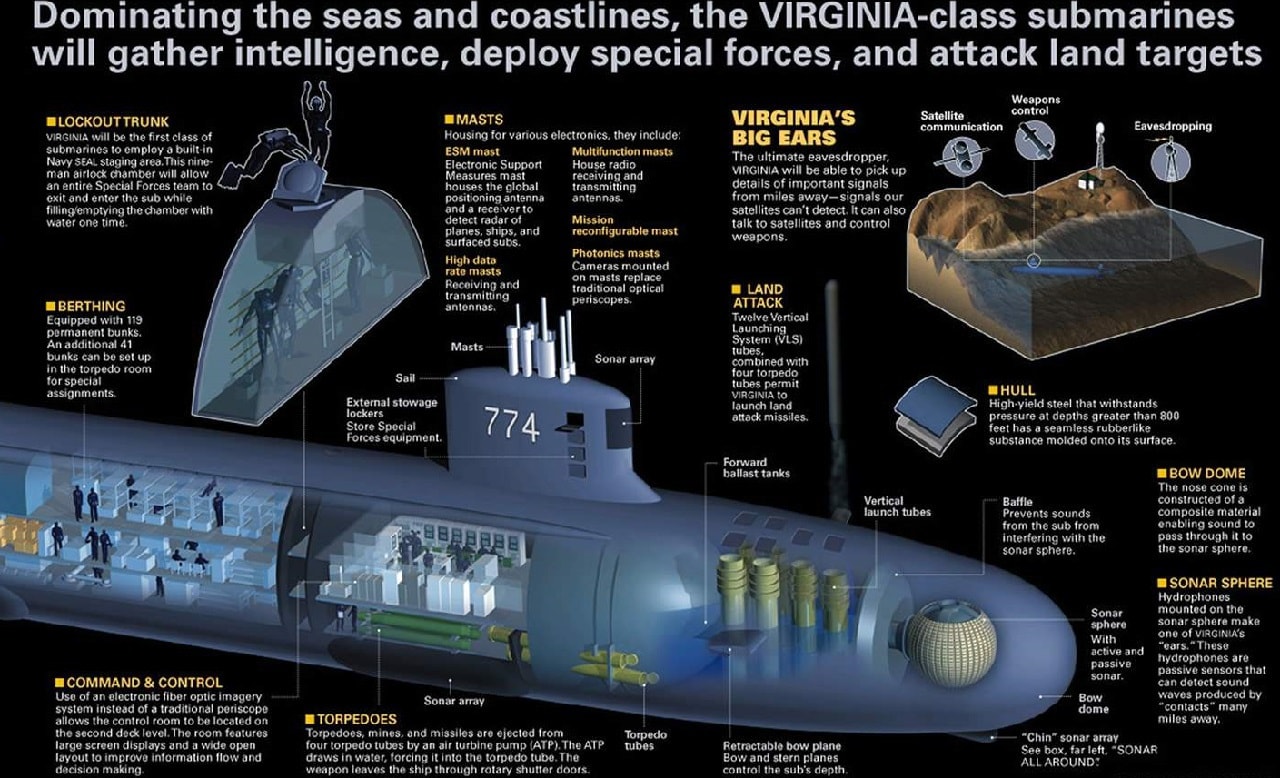
Image of Virginia-class Submarine features. Image Credit: Creative Commons.
-The current VPM adds an 84-foot hull section housing four payload tubes carrying 28 additional Tomahawks per boat.
-Hudson Institute senior fellow and former submarine officer Bryan Clark argues Virginia Block V boats will likely shift toward Ohio-style special operations and strike missions — but workforce shortages at General Dynamics Electric Boat and Newport News Shipbuilding, compounded by a dysfunctional Pentagon acquisition process, make a true capacity expansion effectively impossible for now.
The U.S. Navy Needs a New Missile Submarine — and Making the Virginia-Class Bigger Is Harder Than It Sounds
In the civilian world, the acronym VPN stands for “virtual private network,” a service that protects a user’s internet connection and privacy by creating an encrypted tunnel for the user’s data, hiding the user’s IP address, and allowing a person to use public Wi-Fi hotspots safely.
With cybersecurity threats and identity theft running rampant, this is a pretty valuable protective service.
In the military, the acronym “VPM” stands for “go on offense rather than defense.”
It stands for Virginia Payload Module, and it’s for enhancing the strike capabilities of the Virginia-class nuclear-powered attack submarines (SSNs; not to be confused with Social Security Numbers), AKA “fast-attacks” that are slowly but surely augmenting and replacing the battle-proven but aging Los Angeles-class SSNs.
An intriguing question is whether the VPM can be enlarged to turn these SSNs into SSGNs (guided-missile submarines) and thus help augment and replace another aging class of undersea boats, the Ohio-class SSGNs.
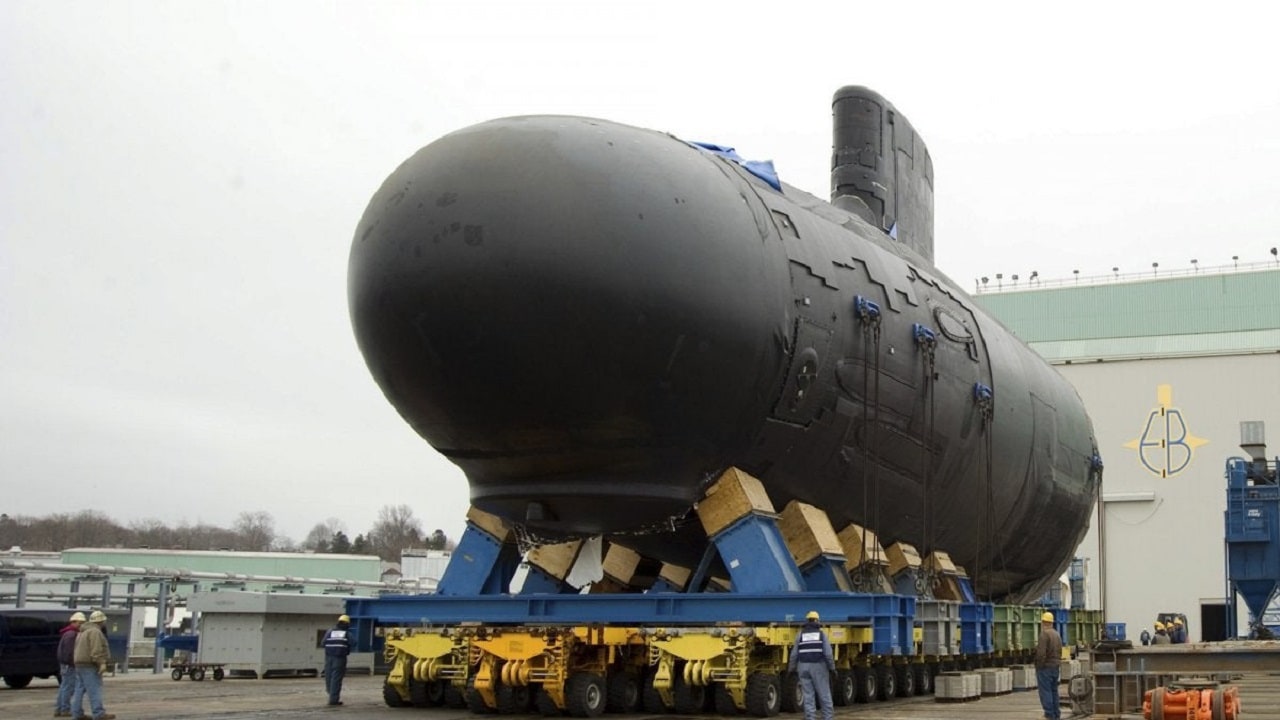
Image of Block III US Navy Virginia-class Submarine.
VPM Explained
But before we dig deeper into that question, we should first provide a detailed description of the VPM. For that, we turn to the official U.S. Navy info page.
Accordingly, “The next major change is the incorporation of the Virginia Payload Module (VPM), starting with the second Block V ship, SSN 803, currently under construction. VPM incorporates four additional large-diameter payload tubes in a new amidships hull section.
Each VPM payload tube can carry 7 Tomahawk cruise missiles, adding 28 missiles per VPM. VPM restores the ability to host dry-deck shelters, further enhancing SOF capability, and enables the Navy to host additional advanced payloads via multiple ocean interfaces. Block V hulls include the 10 ships procured from 2019 through 2025 (SSNs 802-811).”
The VPM is 84 feet (25.6 meters) long, thus increasing the Virginias.
total length from 377 feet (114.9 meters) to 461 feet (140.5 meters).
About SSN-803
That’s the USS Arizona, which will be the first USN warship to bear that moniker since the ill-fated Pennsylvania-class battleship BB-39 that was sunk during the infamous Pearl Harbor raid of December 7, 1941—killing 1,177 of her commissioned officers and enlisted seamen—and is now solemnly memorialized via the USS Arizona Memorial.
Her keel was laid on December 7, 2022, at the Quonset Point Facility of General Dynamics Electric Boat (GDEB) in North Kingston, Rhode Island.
To add an appropriate degree of poignancy, SSN-803’s sponsor was Nikki Stratton, the granddaughter of Donald Stratton, a Seaman First Class aboard the battleship USS Arizona during the attack, who passed away in February 2020 at the age of 97.
SSN To SSGN Via VPM?
Bryan Clark(himself a former enlisted submarinerand submarine officer), a senior fellow and director of the Center for Defense Concepts and Technology at the Hudson Institute, opines that the Virginia-class boats with the VPM will likely be used more for patrolling or special operations support missions, similar to those carried out by the Ohio-class SSGNs, as opposed to “traditional submarine missions” such as gathering intelligence in contested waters.
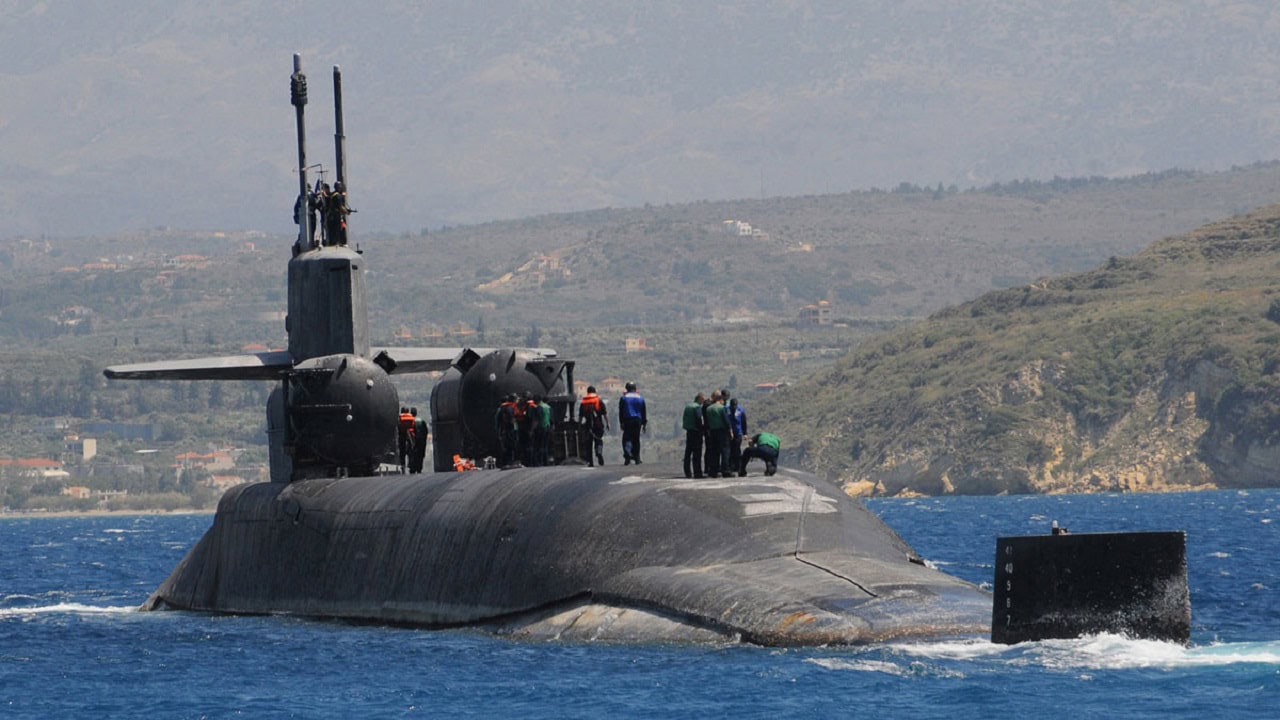
Ohio-Class SSGN. Image Credit: U.S. Navy.
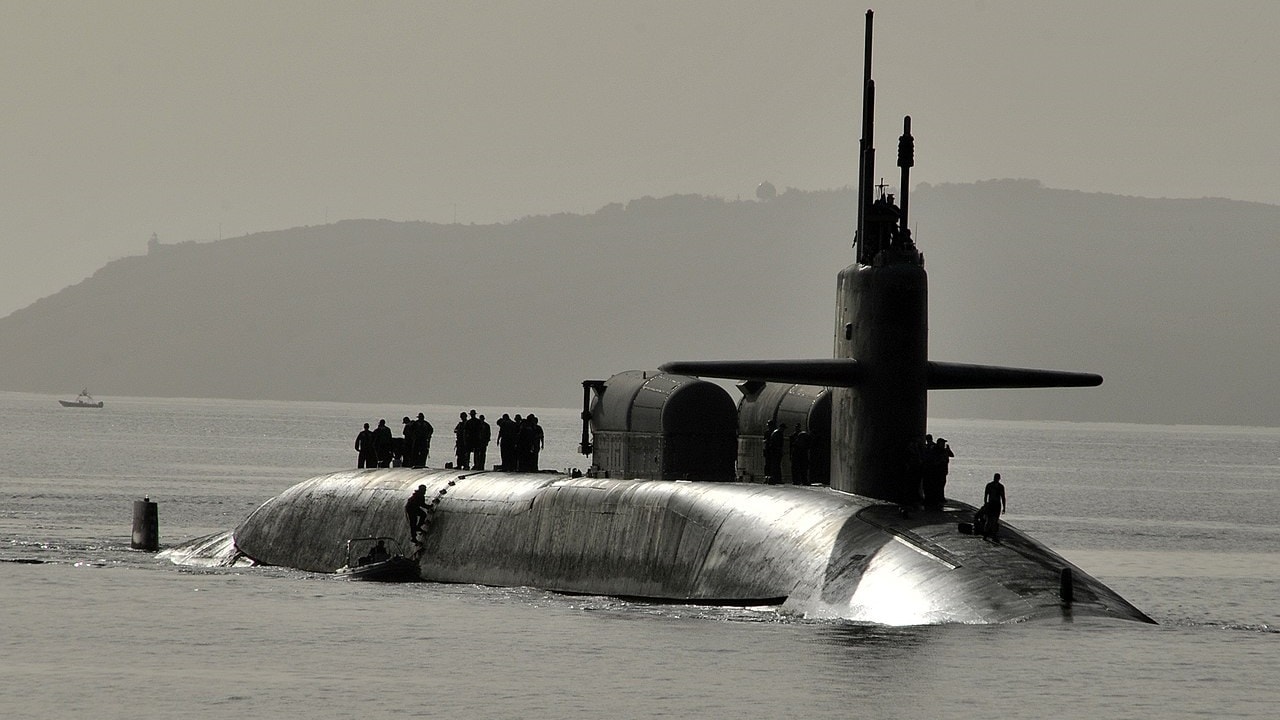
SOUDA BAY, Greece (May 21, 2013) The Ohio-class guided-missile submarine USS Florida (SSGN 728), gold crew, arrives in Souda harbor. Florida is homeported in Kings Bay, Ga., and is deployed conducting maritime security operations and theater security cooperation efforts in the U.S. 6th Fleet area of responsibility. (U.S. Navy photo by Paul Farley/Released) 130521-N-MO201-047
So then, wouldn’t it be a logical extension—both literally and figuratively—to make the VPMs even bigger and thus accommodate a true Ohio-style guided missile arsenal capacity, i.e., a whopping 154 Tomahawk land-attack cruise missiles?
Sounds great in theory, but in practice, there doesn’t seem to be any serious discussion of it. Any attempt to quintuple the planned carrying capacity of the Virginia Payload Module would run afoul of two major hurdles:
-The incredibly convoluted, inefficient, and time-consuming weapons acquisition process, a process that U.S. Secretary of War Pete Hegseth is attempting to reform and improve, and
-A current shortage of skilled workers for the submarine program necessitates the BuildSubmarines.com recruitment push; a physical extension of the VPM would almost certainly require even more such skilled workers to make it happen.
About the Author: Christian D. Orr, Defense Expert
Christian D. Orr is a Senior Defense Editor. He is a former Air Force Security Forces officer, Federal law enforcement officer, and private military contractor (with assignments worked in Iraq, the United Arab Emirates, Kosovo, Japan, Germany, and the Pentagon). Chris holds a B.A. in International Relations from the University of Southern California (USC) and an M.A. in Intelligence Studies (with a concentration in Terrorism Studies) from American Military University (AMU). He is also the author of the newly published book “Five Decades of a Fabulous Firearm: Celebrating the 50th Anniversary of the Beretta 92 Pistol Series.”