
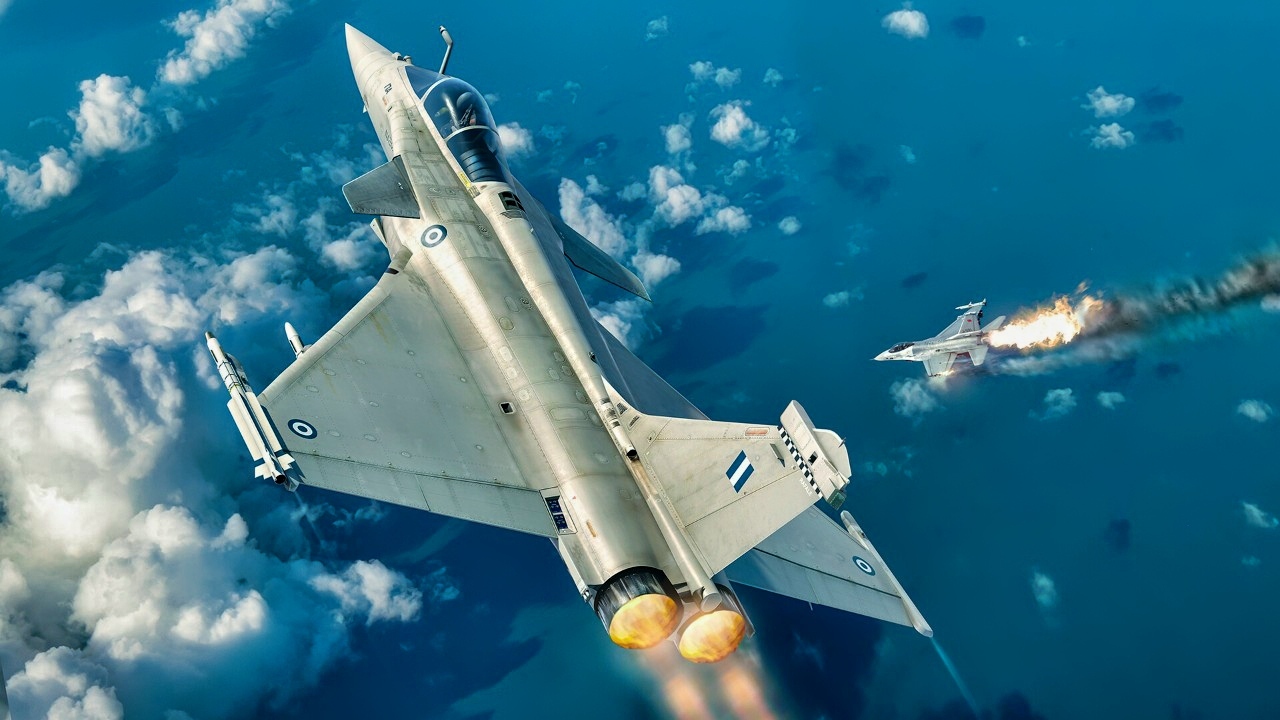
Summary and Key Points: Christian D. Orr, a senior defense editor and former Air Force Security Forces officer, evaluates the Dassault Rafale’s evolution through the F4 and F5 Standards.
-Currently, the F4 upgrade integrates the Thales RBE2 XG AESA radar and the 1000 kg AASM Hammer guided bomb, significantly boosting connectivity and precision.

Dassault Rafale Fighter. Image Credit: Creative Commons.
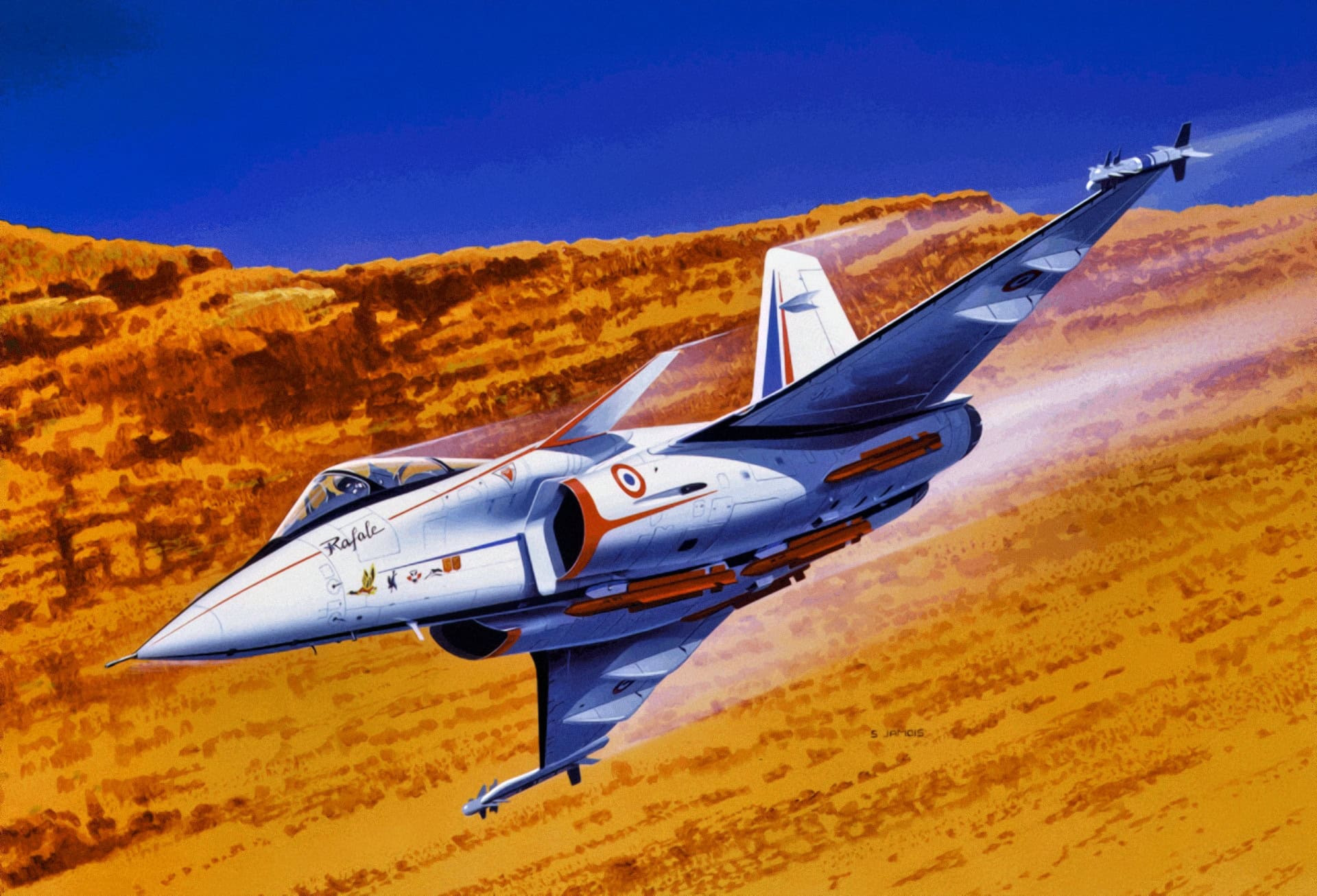
Dassault Rafale Artist Image. Image Credit: Creative Commons.
-This 19FortyFive report analyzes the future F5 Standard, which will feature a “Loyal Wingman” UCAV based on the nEUROn and the ASN4G hypersonic nuclear missile, while weighing the industrial challenges of GaN technology transitions and Dassault’s 200-jet backlog against emerging threats like the Chinese J-20.
The F5 Revolution: Why the Future Dassault Rafale Will Lead Stealth “Loyal Wingman” Drone Swarms
The French-made Dassault Aviation Rafale is a 4.5-generation jet fighter; it will never be a stealth fighter.
Its reputation took a bit of a hit during Operation Sindoor when Indian Air Force (IAF) Rafale pilots were absolutely embarrassed by their Pakistani Air Force (PAF) adversaries, who reportedly shot down at least one and as many as three Rafales without suffering any losses.
Those shortcomings notwithstanding, the Rafale remains an extremely deadly and capable warbird in real-world combat. It is an outstanding flying and fighting platform, as demonstrated by its air-to-ground strikes in places such as Afghanistan, Libya, and Syria.
Any adversary who underestimates this warbird does so at his or her own peril. The same thing can be said about several other non-stealth 4.5-generation multirole fighters, such as the F-15EX Eagle II, F-16V “Viper,” and Eurofighter Typhoon.
And just like that terrific triumvirate, the Rafale has not remained frozen in time. It has undergone continual upgrades and improvements.
Current and Future Upgrades: The Rafale Marine F4 Standard and F5 Standard
The F4 standard is the Rafale’s most current, operational upgrade, and the F5 is the wave of the future. Grosswald, an independent European defense intelligence publication, elaborates in a November 12, 2024 report:
“The F4 standard, set for full operational status by 2024, significantly enhances the Rafale’s connectivity and targeting precision. Major additions include the Thales RBE2 XG [AESA] radar and improved helmet-mounted displays, designed to increase pilot situational awareness and streamline target acquisition. These upgrades also include improved data fusion capabilities, enabling more seamless interoperability with French and allied forces. Armament options expand with the integration of the 1000 kg AASM guided bomb, designed for precision strikes on high-value targets. These capabilities allow the Rafale F4 to excel in multi-role missions, from air-to-air engagements to precision ground strikes, with the versatility required for both naval and air force deployment.”
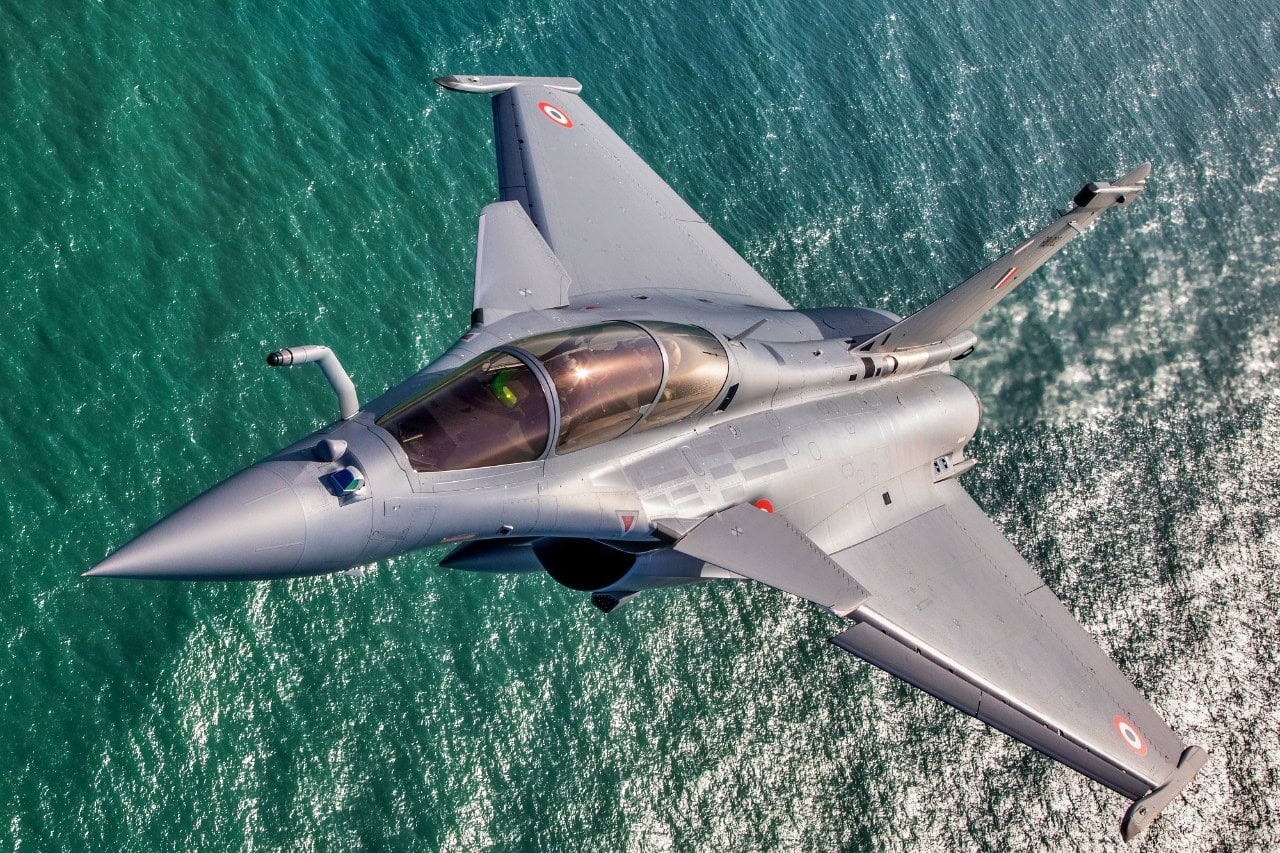
Dassault Rafale. Image Credit: Creative Commons.
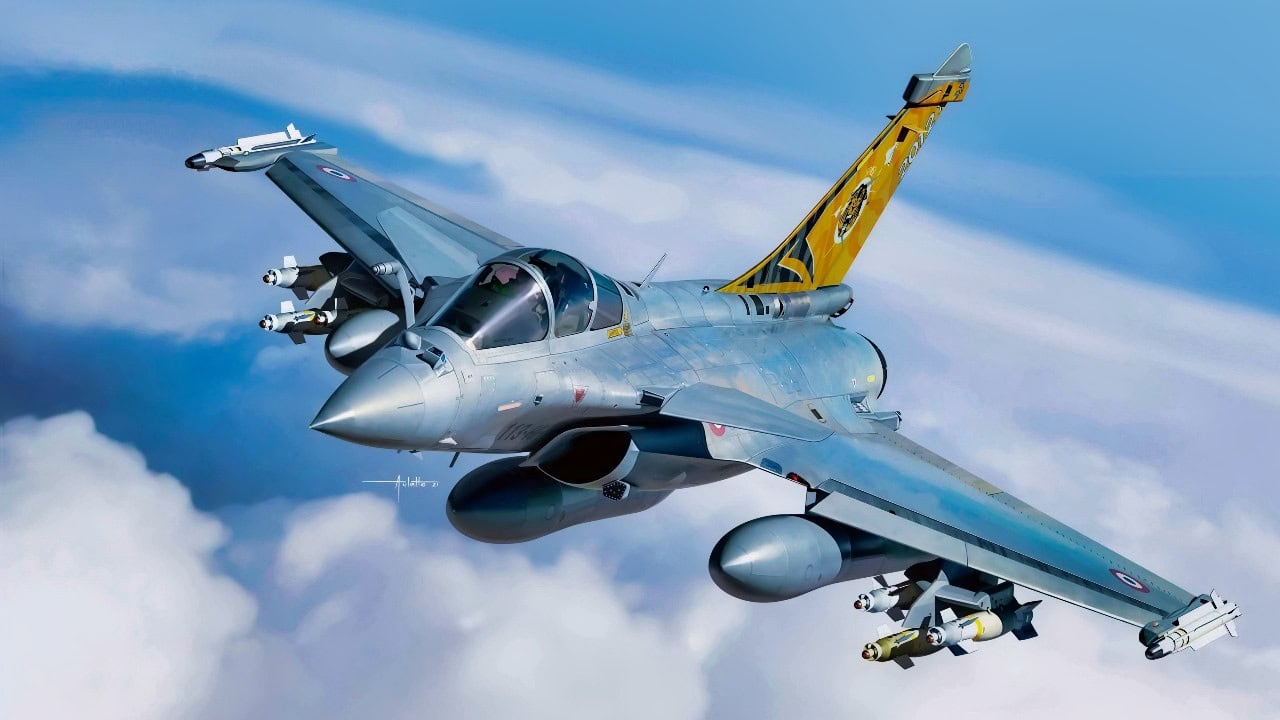
Dassault Rafale. Image Credit: Creative Commons.
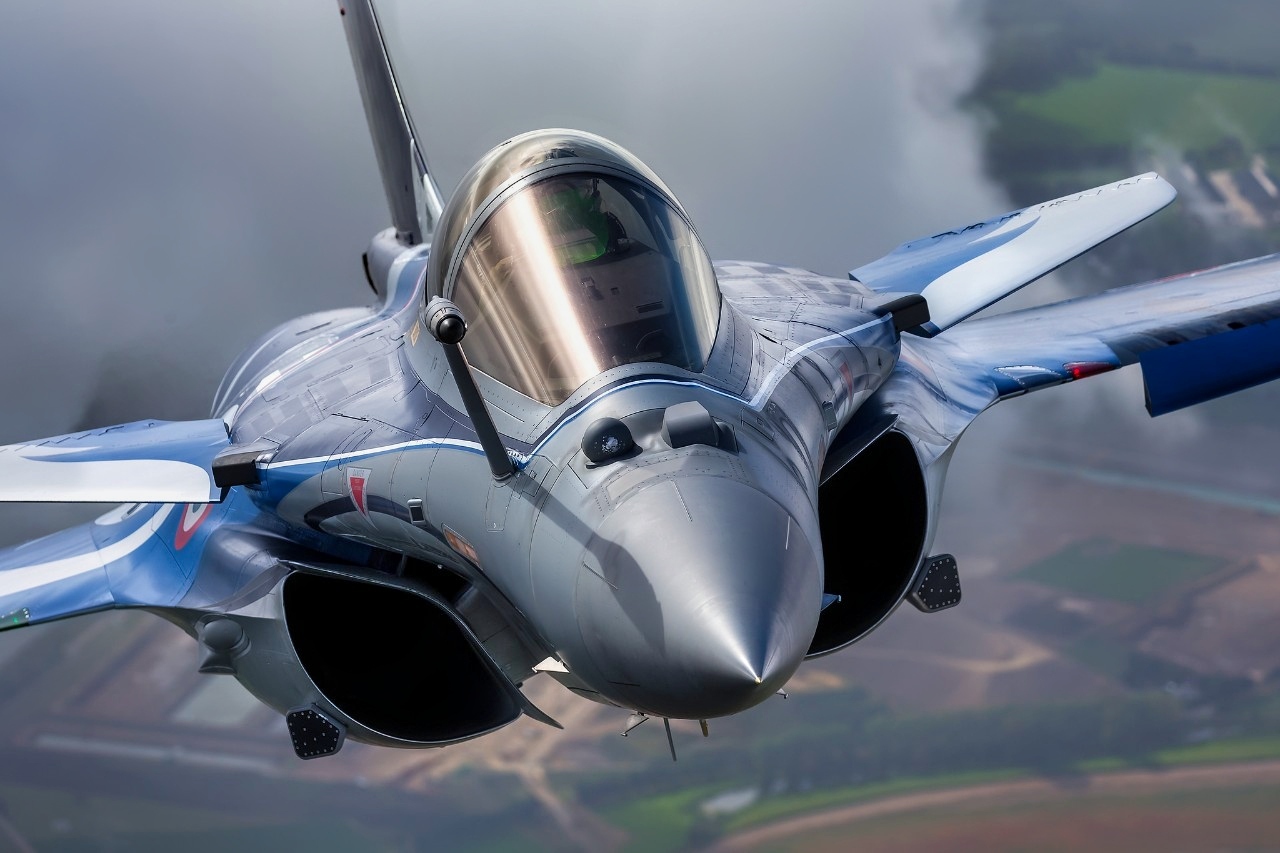
Dassault Rafale Fighter. Image Credit: Creative Commons.
Note that “AASM” stands for “Armement Air-Sol Modulaire (Modular Air-to-Ground Armament).” Also known as the “Hammer” (yet another acronym, believe it or not: “Highly Agile Modular Munition Extended Range”), the weapon has been in service since 2007 and is built by Safran Electronics & Defense.
For good measure, a subvariant F4.1 model is soon to come. It will provide a range of upgrades and additional capabilities, including a new helmet sight, improved fire control for use with the Meteor missile, expanded passive threat detections, and boosted datalink exchange. This is slated for deliveries beginning in 2027.
Grosswald analyzes the F5:
“Scheduled for introduction post-2033, the F5 standard will redefine the Rafale’s combat role with a focus on collaborative drone operations. This involves the addition of an Unmanned Combat Aerial Vehicle (UCAV), likely based on the stealth nEUROn demonstrator program…This ‘loyal wingman’ UCAV will act as an advanced sensor and combat adjunct, capable of performing reconnaissance and penetrating heavily defended areas ahead of the manned aircraft. It will also support electronic warfare tasks, allowing the Rafale to avoid direct engagement with high-threat air defenses, enhancing survivability and strike precision under intense operational conditions. This innovation aligns with the French Military Programming Law’s mandate to build network-centric air combat capabilities as a prelude to the Future Combat Air System (FCAS)…The F5 standard also aims to accommodate the ASN4G [Air-Sol Nucléaire de 4ème Génération] hypersonic missile, the next-generation nuclear deterrent to replace the current ASMPA [Air-Sol Moyenne Portée Amélioré]. This addition underscores France’s commitment to maintaining a credible, advanced nuclear deterrent that can respond flexibly to evolving threats. Advanced data processing and fiber-optic cabling upgrades are part of this new configuration, ensuring that the Rafale F5 can handle large volumes of data essential for integrated UCAV support and real-time mission adjustments.”
Presumably, sixth-generation fighters such as the F-47 will be operational by 2033, but Dassault execs and engineers appear to be undeterred.
Reaping the Rewards
The F4 upgrades in particular have indeed reaped a foreign military sales (FMS) windfall for Dassault Aviation (and, by logical extension, the French government’s tax coffers).
As noted by Richard Thomas for Airforce Technology, the aerospace firm delivered 21 Rafale airframes in 2024, compared to 13 aircraft in 2023.
Breaking that down further, 14 specimens were for home use in 2024, while 7 were earmarked for export.
Contrast this with 11 Rafales delivered to the French armed forces in 2023, and a measly two provided to foreign buyers. In other words, Dassault saw a 350 percent increase in FMS transactions from one year to the next.
The international customers of the Rafale include Croatia, Egypt, Greece, India, Indonesia, Qatar, and the United Arab Emirates.
Some Trouble in Paradise, However
Alas, Rafale improvements have not always worked out to satisfaction.
On June 25, 2025, the Indian Defence Research Wing (IDRW) published an article with the self-explanatory title of “Dassault’s Rafale Upgrade Delays: A Growing Concern for Operators like India.” The article noted that Dassault had a backlog of more than 200 jets and an estimated eight-year timeline for the critical upgrades.
The most concerning shortfall from the IDRW standpoint was the transition from gallium arsenide to gallium nitride, which will offer superior performance in radar, electronic warfare, and sensor systems, with enhanced power efficiency, range, and resistance to jamming.
These factors will be badly needed against adversary weapon systems such as the Chinese J-20 Weilong stealth fighter and the Russian S-400 air-defense system.
About the Author: Christian D. Orr, Defense Expert
Christian D. Orr is a Senior Defense Editor. He is a former Air Force Security Forces officer, Federal law enforcement officer, and private military contractor (with assignments worked in Iraq, the United Arab Emirates, Kosovo, Japan, Germany, and the Pentagon). Chris holds a B.A. in International Relations from the University of Southern California (USC) and an M.A. in Intelligence Studies (concentration in Terrorism Studies) from American Military University (AMU). He is also the author of the newly published book “Five Decades of a Fabulous Firearm: Celebrating the 50th Anniversary of the Beretta 92 Pistol Series.”