
Forget Iran: China’s DF-21D and DF-26 Carrier-Killer Missiles Can Hold U.S. Surface Ships at Risk Beyond the First Island Chain
More than a month after the start of Operation Epic Fury or the Iran war, the Strait of Hormuz remains firmly closed despite the number of U.S. Navy assets that are still located near and around the Middle East.
To add insult to injury, the Iranian Navy is now actively conducting military drills in its territorial waters, with ships from the Russian and Chinese navies joining in as well.
While the U.S. is still unquestionably one of the most powerful navies on the planet, its ability to “shock and awe” its adversaries into submission is no longer guaranteed.
The recent experience in Iran calls the U.S.’ plans against China into serious question. If the U.S. Navy can’t contain the Iranians, how in the world can it be expected to fare any better against China?
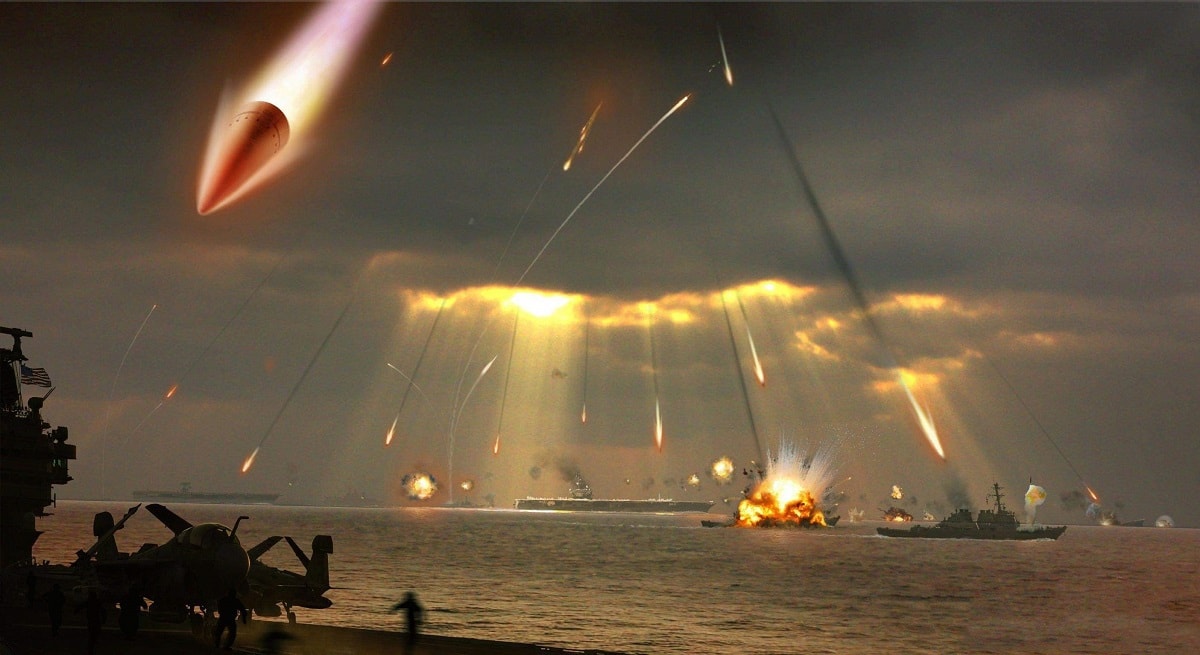
Depiction of Chinese missiles attacking the U.S. Navy. Image: Chinese Internet.
Operation Epic Fury and the Limits of Naval Deterrence
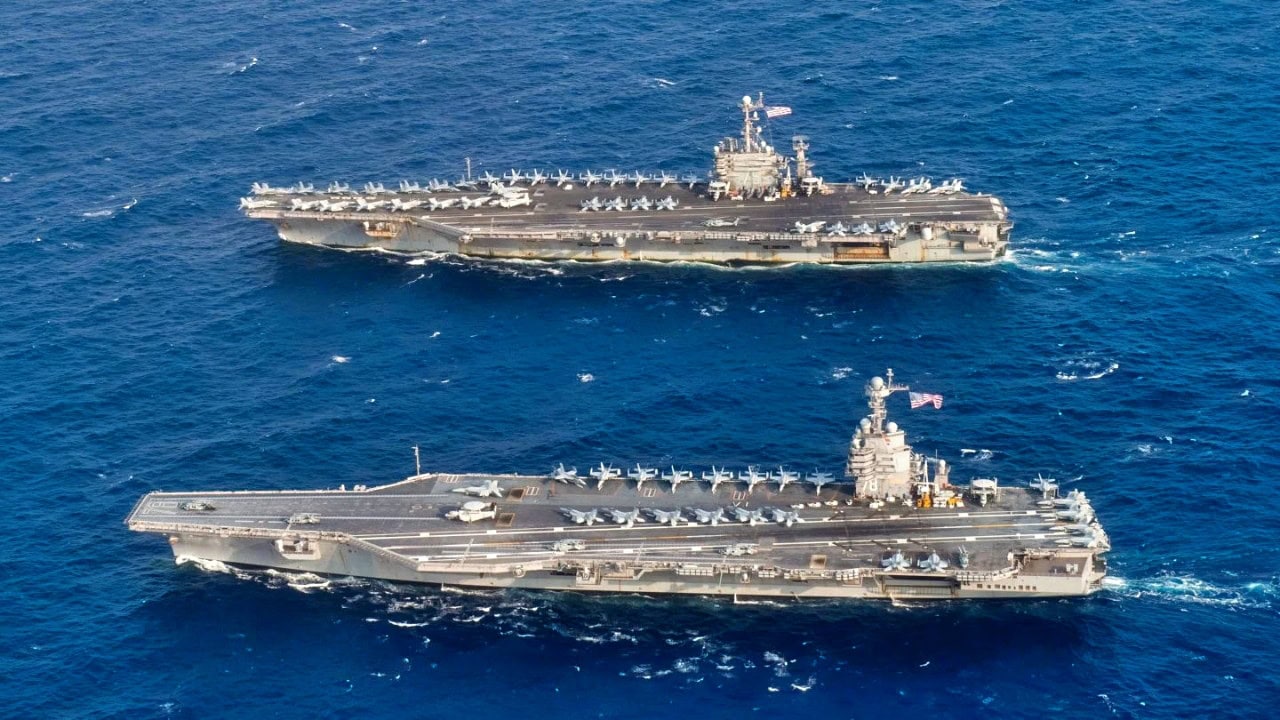
Prior to the start of Operation Epic Fury, the U.S. had moved significant resources near the Middle East for deterrence and in anticipation of upcoming operations. On February 20th, about a week before the operation, the USS Abraham Lincoln (CVN-72) and her carrier strike group were spotted in the Arabian Sea while a contingent of destroyers and other combat ships remained at port in Bahrain.
The destroyers USS Roosevelt and Bulkeley were spotted in the Eastern Mediterranean, the destroyer USS Delbert D. Black was spotted in the Red Sea, and the USS Gerald R. Ford and her CSG were spotted near Gibraltar, en route to the Middle East. With such a massive force in the region, it was clear that the U.S. intended to either send a strong message or really bring the hurt down on Iran.
When combat operations began, both CSGs, along with other naval vessels, conducted offensive operations against Iran. When Iran responded, however, the U.S. forces in the region were quickly forced to withdraw to safe distances to avoid the threat posed by Iranian naval drones and anti-ship missiles.
Official sources in Iran claimed that it had scored hits against Ford and Lincoln; however, there is no evidence to corroborate these claims (a disgruntled sailor would have posted proof if that were the case).
On the other hand, it is true that naval forces in the region continue to face a significant threat from Iranian attacks, which prevents them from reopening the Strait of Hormuz. In the past, it was assumed that the mere presence of U.S. naval assets was enough to deter most adversaries from submission.
Iran, even after multiple strikes against senior leadership, shattered those assumptions.
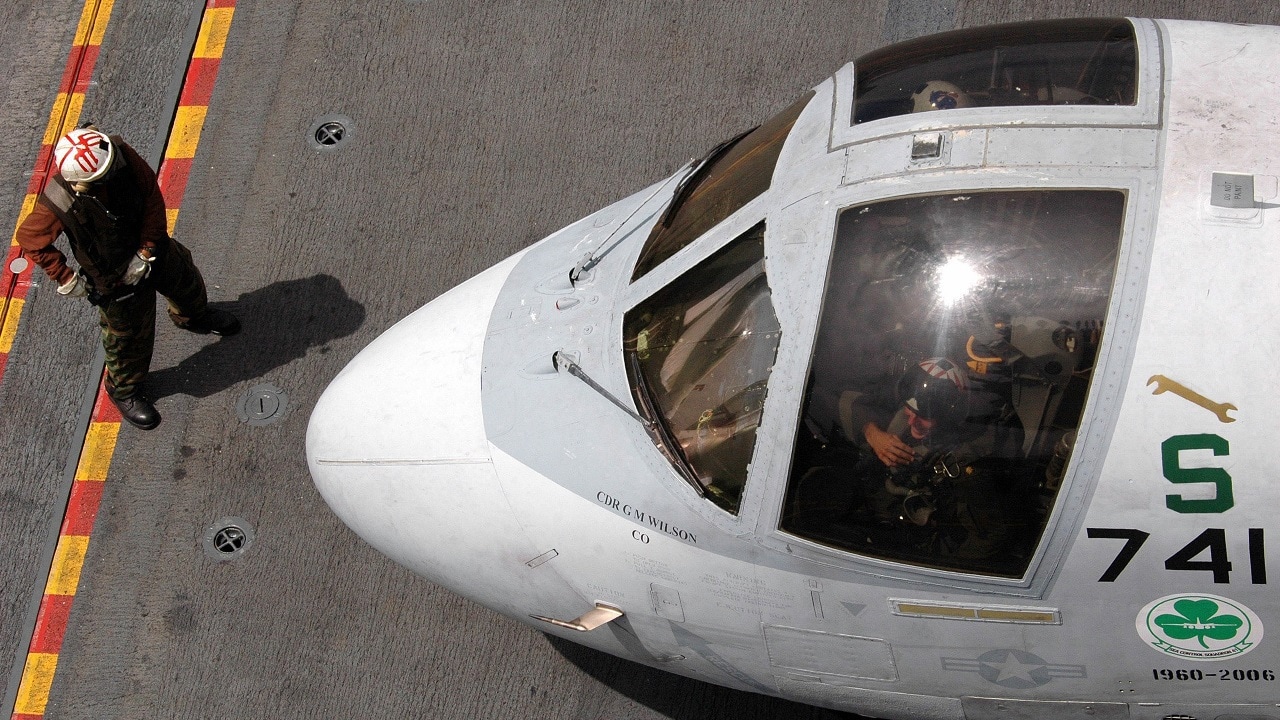
A U.S. Navy S-3B Viking aircraft assigned to the”Shamrocks”of Sea Control Squadron 41 prepares for launch from the U.S. Navy Aircraft Carrier USS NIMITZ (CVN 68).
Can the U.S. Beat China’s A2/AD Strategy?
The events of Operation Epic Fury call the U.S.’ containment plans against China into question.
China fields the world’s largest inventory of conventional ballistic missiles, many of which are integral to its A2/AD strategy. At the forefront of its weapon stocks are China’s “carrier killers” like the DF-21D and the DF-26.
These systems are designed to hold large surface combatants at risk at ranges extending beyond the First Island Chain, theoretically forcing adversary navies to operate farther from contested areas.
In addition to anti-ship missions, China’s missile arsenal includes land-attack ballistic and cruise missiles capable of striking airbases, ports, logistics hubs, and command facilities throughout the Western Pacific.
Forward bases in Japan, Taiwan, and Guam fall within the range of various missile systems, creating persistent challenges for force protection and sustainment. The ability to conduct rapid, large-scale missile strikes against fixed infrastructure is a core element of China’s effort to contest access at the operational level.
China’s A2/AD architecture is further reinforced by an increasingly sophisticated and well-integrated network of air defense systems. Long-range surface-to-air missile systems such as the HQ-9 and its variants, complemented by Russian-made S-400 units, provide layered defenses against aircraft, cruise missiles, and some ballistic threats.
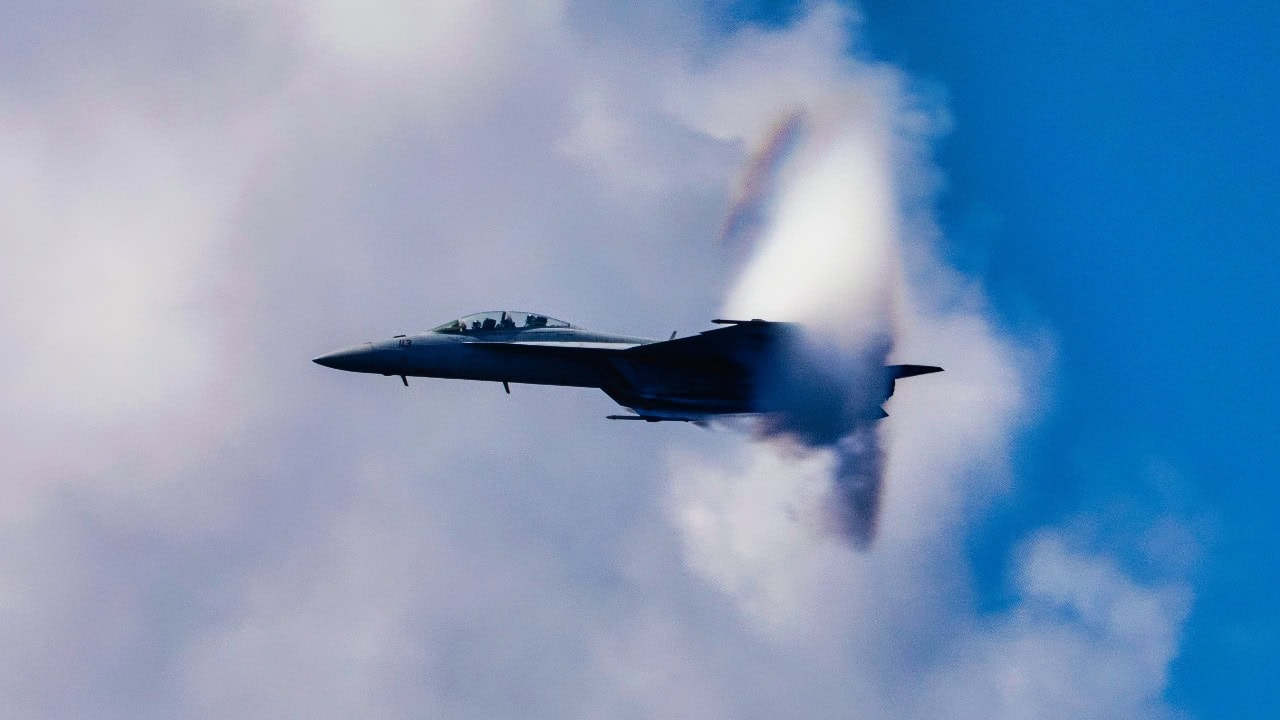
(June 18, 2023) An F/A-18F Super Hornet from the “Fighting Redcocks” of Strike Fighter Squadron (VFA) 22 breaks the sound barrier during flight operations near the aircraft carrier USS Nimitz (CVN 68). Nimitz is underway, conducting routine operations. (U.S. Navy photo by Mass Communication Specialist 3rd Class Kevin Tang)
These systems protect key coastal regions, military bases, and missile forces, complicating adversary efforts to achieve air superiority or suppress Chinese defenses early in a conflict. In the South China Sea, air defense systems deployed on artificial islands extend China’s defensive coverage and support its broader area-denial objectives.
China is a Whole Different Beast
Contingency plans against China are further constrained by the naval air wing present on most carriers. The F-35 and the F/A-18 are great aircraft; their combat range is not their strongest suit.
The F-35C has a combat radius of around 670 nautical miles, while the F/A-18E/F has a range of only 558 nautical miles. This means that even with stand-off munitions, aircraft carriers have to get closer to mainland China to launch combat sorties, putting them squarely in range of China’s many anti-ship missiles.
Taken together, China is in a much better position to resist an attack from the U.S. than Iran. It has spent decades building an A2/AD network and improving its intelligence-gathering capabilities.

Nimitz-class aircraft carrier USS Carl Vinson (CVN 70) transits the Bay of Bengal as part of Maritime Partnership Exercise (MPX), Oct. 16, 2021. MPX 2021 is a multilateral maritime exercise between the Royal Australian Navy, Japan Maritime Self-Defense Force, U.K. Royal Navy, and U.S. maritime forces, focused on naval cooperation, interoperability and regional security and stability in the Indo-Pacific and is an example of the enduring partnership between Australian, Japanese, U.K. and U.S. maritime forces, who routinely operate together in the Indo-Pacific, fostering a cooperative approach toward regional security and stability. (U.S. Navy photo by Mass Communication Specialist 2nd Class Russell Lindsey)
With its wide arsenal of anti-ship missiles, any move from the U.S. Navy carries the risk of getting hit. Due to its proximity to the U.S., sustaining operations against China would be difficult to say the least, especially since Guam and other valuable U.S. bases are in range of China’s long-range ballistic missiles. As of writing this, Iran remains an active fighting force, and the U.S. has already lost several high-value assets during this conflict.
China is Iran on steroids.
Its airspace is better protected, its industry produces more weapons, and its missiles are (on paper) more advanced.
About the Author: Isaac Seitz
Isaac Seitz, a Defense Columnist, graduated from Patrick Henry College’s Strategic Intelligence and National Security program. He has also studied Russian at Middlebury Language Schools and has worked as an intelligence Analyst in the private sector.