
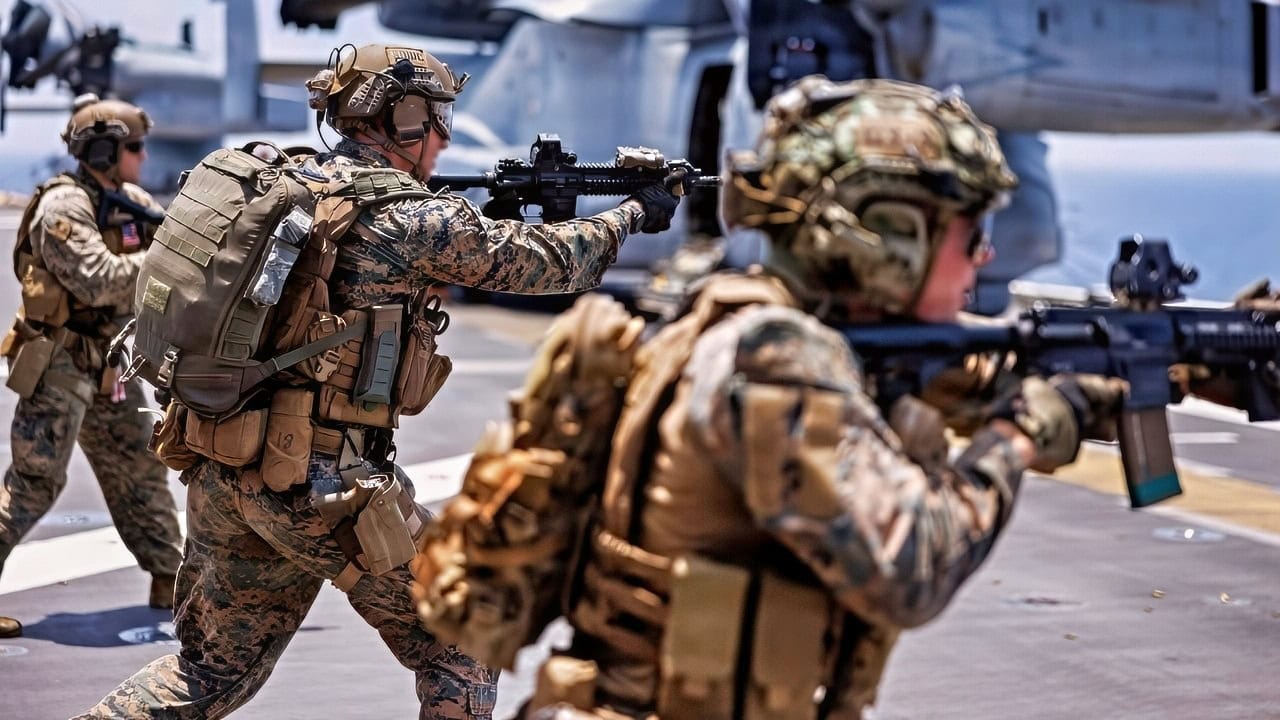
Sending U.S. ground troops into Iran would be militarily risky and politically fraught. There is simply not enough civilian political support to send boots onto Iranian soil. A ground operation could be conducted by U.S. special operations forces, paratroopers, and Marines, but that could create an unacceptable level of casualties and prolong the war, creating a situation in which the American people would grow frustrated with President Donald Trump.
The U.S. Marines Are Ready for an Attack
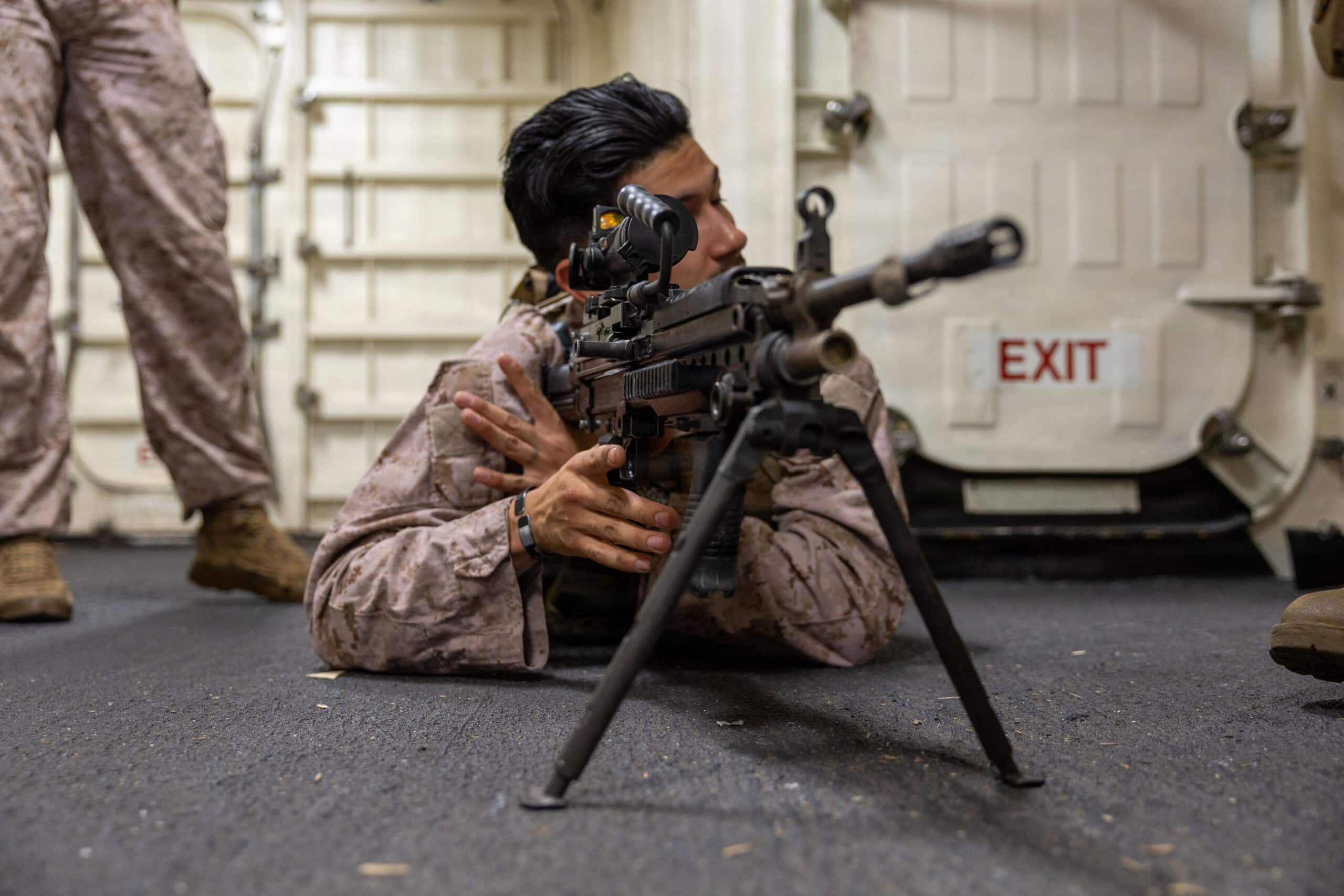
PACIFIC OCEAN (March 23, 2026) U.S. Marine Corps Sgt. Osvaldo Ochoagomez, an infantry squad leader with Lima Company, Battalion Landing Team 3/5, 11th Marine Expeditionary Unit, demonstrates how to use an M27 infantry automatic rifle aboard San Antonio-class amphibious transport dock ship USS Portland (LPD 27), March 23, 2026. Portland, part of the Boxer Amphibious Ready Group, is underway with the 11th Marine Expeditionary Unit in the U.S. 3rd Fleet area of operations demonstrating the U.S. Navy’s long-term commitment to a free and open Indo-Pacific. (U.S. Navy photo by Mass Communication Specialist 2nd Class Sheryssa Dodard)
Nevertheless, the U.S. military has contingency plans for an Iranian attack. There are about 2,500 to 3,500 Marines near Iran. This force comprises at least one Marine Expeditionary Unit, which provides the means for an amphibious landing. These leathernecks are well prepared for kinetic shoreline operations. U.S. Navy SEALs would prepare the landing zone for a large Marine maneuver, which could be carried out with little difficulty. U.S. paratroopers from the 82nd Airborne Division and Army Rangers could also be infiltrated.
Strategic Variables Are Difficult to Solve
But to what end would these forces operate? An overarching strategy is needed, with a clearly defined end state for the war. Let’s say the United States sorted out such a strategy, and planners gave the green light for a ground attack. What would be Iran’s response?
Iran Can Strike Back Handily
Iranian forces could allow the Americans to establish a beachhead and permit U.S. Marines and Army personnel to enter the country. Then, the Iranians could launch a massive counterattack with ballistic missiles and drones.
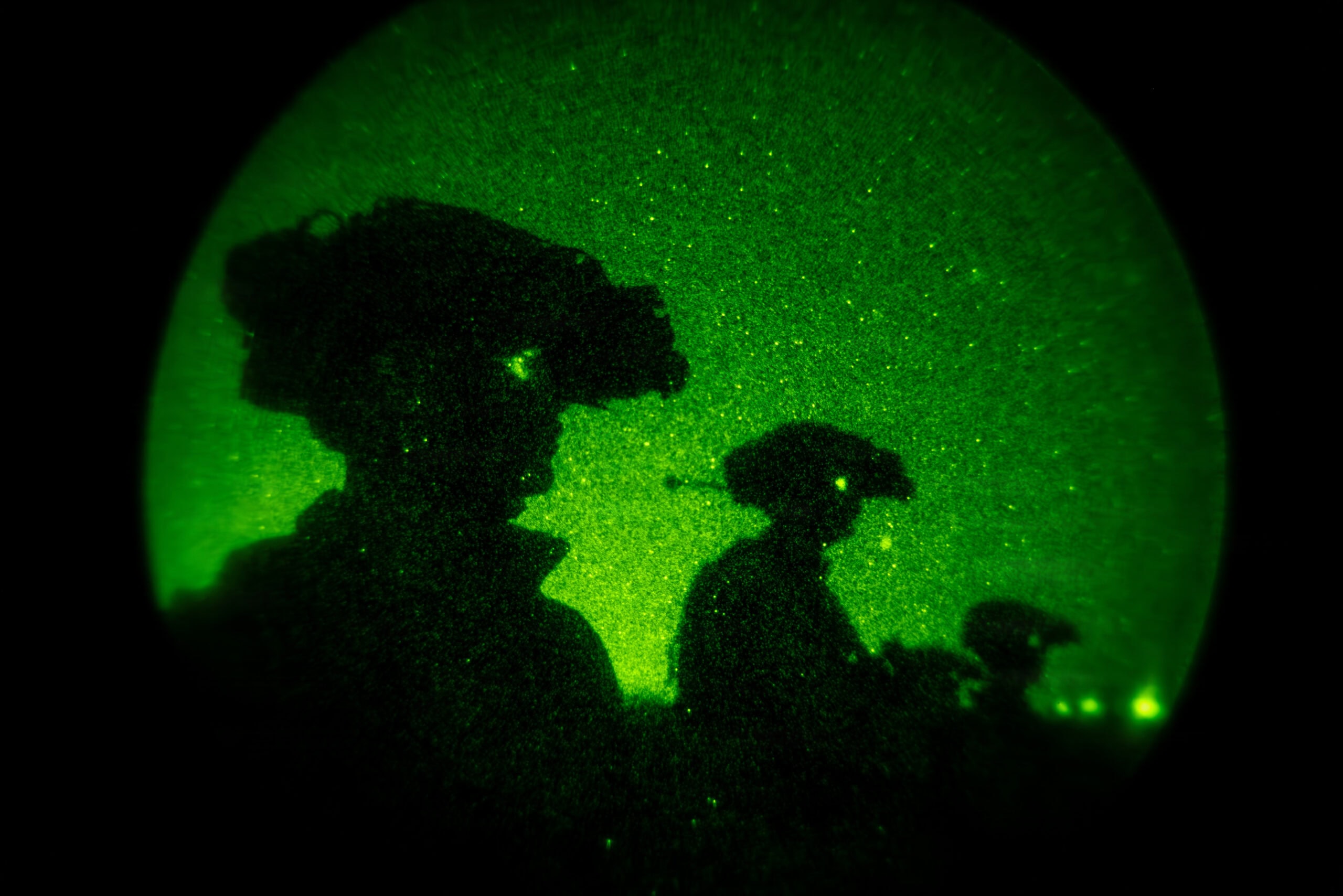
U.S. Marines with 1st Battalion, 1st Marine Regiment, 1st Marine Division, conduct a night patrol during the annual 1st MARDIV squad competition at Marine Corps Base Camp Pendleton, California, March 19, 2026. The 1st MARDIV squad competition is a four-day event that evaluates a Marine rifle squad’s infantry skills, fitness, toughness, and small unit tactics. (U.S. Marine Corps photo by Sgt. Vincent Needham)
Long-range Strikes Against Parked Airplanes
Iran has used drones effectively in the past. On March 27, Iranian forces launched missiles and one-way unmanned aircraft to destroy a U.S. Air Force E-3 Sentry at Prince Sultan Air Base in Saudi Arabia.
The attack also damaged several KC-135 Stratotankers. Iran had already struck other KC-135s. These operations showed Tehran knows how to use a flight of kamikaze drones to threaten U.S. ground forces. Such forces would have to worry about a drone counterattack as one key part of an Iranian asymmetric tactical response against an attacking force on its shores.
The Iranians understand the Americans’ basic aerial strategy. The United States needs total air dominance before it launches a land attack.
“The goal is control of the air, from air denial at the contested end of the spectrum to air superiority or supremacy at the other. Whereas defensive counterair protects friendly forces and assets from attack, offensive counterair seeks to prevent the enemy from ever getting airborne,” according to War on the Rocks.
U.S. Marines with 1st Battalion, 1st Marine Regiment, 1st Marine Division, conduct a night patrol during the annual 1st MARDIV squad competition at Marine Corps Base Camp Pendleton, California, March 19, 2026. The 1st MARDIV squad competition is a four-day event that evaluates a Marine rifle squad’s infantry skills, fitness, toughness, and small unit tactics. (U.S. Marine Corps photo by Sgt. Vincent Needham)
The U.S. Has Learned It Must Improve Its Air Bases
Iran wants to destroy U.S. air power on the ground, not necessarily in the air. The United States has learned that its bases need hardened infrastructure, such as reinforced bunkers and underground facilities, to house its airplanes. Iranian long-range one-way drones have shown that such basing has disadvantages.
Defending Against the Counter-Attack
U.S. Marines would need a strategy to counter the effects of Iranian drone attacks. Marine Expeditionary Units and the 82nd Airborne have limited counter-drone and anti-aircraft defenses. They rely on the Navy and the Air Force for those capabilities. A missile and drone counterattack by Iran could therefore be effective against Marines and paratroopers on Iranian land.
Punish the Marines’ Command and Control Centers
An Iranian counterattack might seek to eliminate the Marines’ command-and-control nodes, which allow land forces to communicate with the Navy. Iran would likely try to hit these operations centers first, meaning that Marines would need to focus their air defenses on these nodes. A successful Iranian attack could blind the Marines and hinder the overall invasion effort.
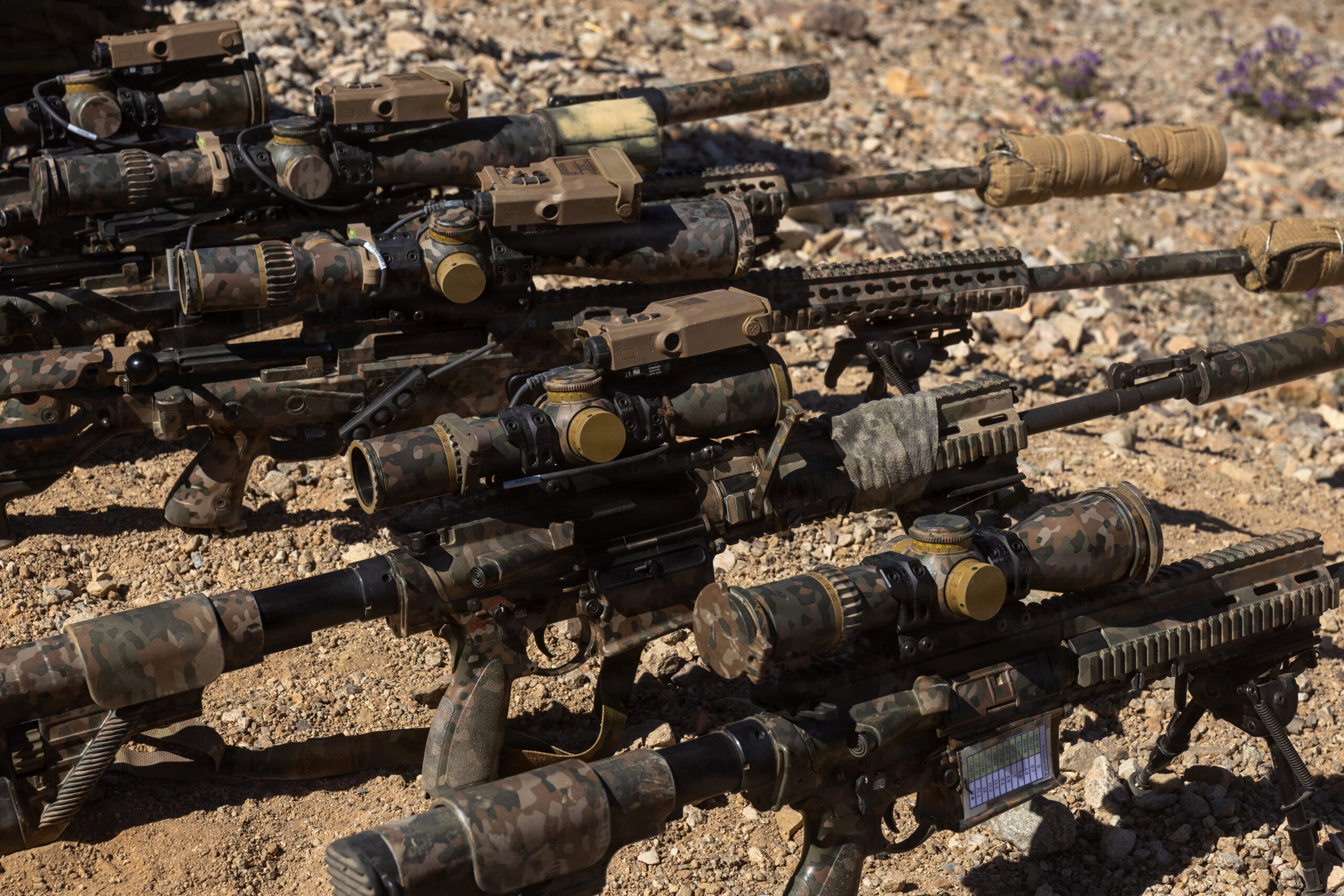
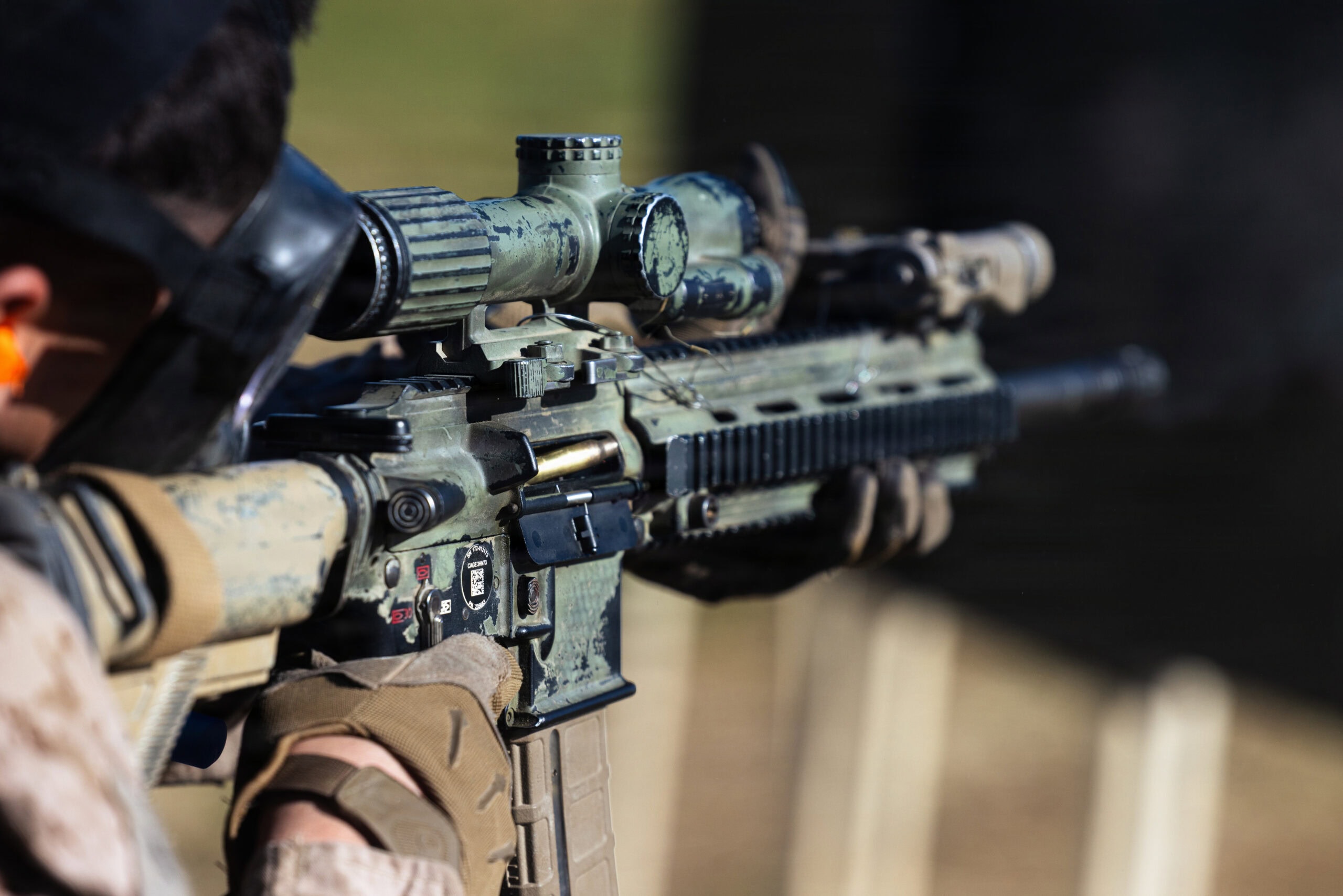
Rifles staged during a foreign training exercise as part of a live-fire exercise at Range 400, Marine Corps Air Ground Combat Center, Twentynine Palms, California, Feb. 13, 2026. The Netherlands Marine Corps visited MCAGCC to promote interoperability, strengthen partnerships and enhance strategic and tactical cooperation between U.S. and Dutch Marines. (U.S. Marine Corps photo by Lance Cpl. Jozef P. Majewski)
Hitting Satellite and Communications Nodes
Iran could also target other types of installations throughout the Middle East. For example, its missiles and drones have destroyed satellite communications terminals in Bahrain, as well as early warning radars in the region. Such attacks during a U.S. invasion could blind the Americans by targeting communication systems and intelligence-gathering capabilities. The Marines and Navy would have to coordinate across the Middle East to ensure that missile and drone attacks would not hit satellite and radar centers deep behind the front.
Iranian drones could also attack Terminal High Altitude and Patriot air defense systems—or continue targeting their radars.
Placing the Marines At Risk
A ground attack by the United States would be both easy and hard. The initial Marine invasion would be successful; the Devil Dogs excel at amphibious operations. But Iran would strike back—not only at the Marines, but also at U.S. assets across the Middle East.
The United States would have to protect itself vigorously against drones and missiles. This would strain air defenses and undermine the United States’ overall dominance in information warfare, which it holds so dear.
A ground invasion would be risky unless U.S. air power could completely eliminate ballistic missile and drone launchers. Iran has shown it can conduct long-range strikes and punish ancillary assets necessary for a ground invasion.
This could continue as long as Iran keeps a supply of drones and missiles. The U.S. military is likely communicating to President Donald Trump and others in the White House that a ground invasion could succeed initially, but would be costly in the long run.
About the Author: Brent M. Eastwood, PhD
Author of now over 3,500 articles on defense issues, Brent M. Eastwood, PhD, is the author of Don’t Turn Your Back On the World: A Conservative Foreign Policy and Humans, Machines, and Data: Future Trends in Warfare, plus two other books. Brent was the founder and CEO of a tech firm that predicted world events using artificial intelligence. He served as a legislative fellow for US Senator Tim Scott and advised the senator on defense and foreign policy issues. He has taught at American University, George Washington University, and George Mason University. Brent is a former US Army Infantry officer. He can be followed on X @BMEastwood.