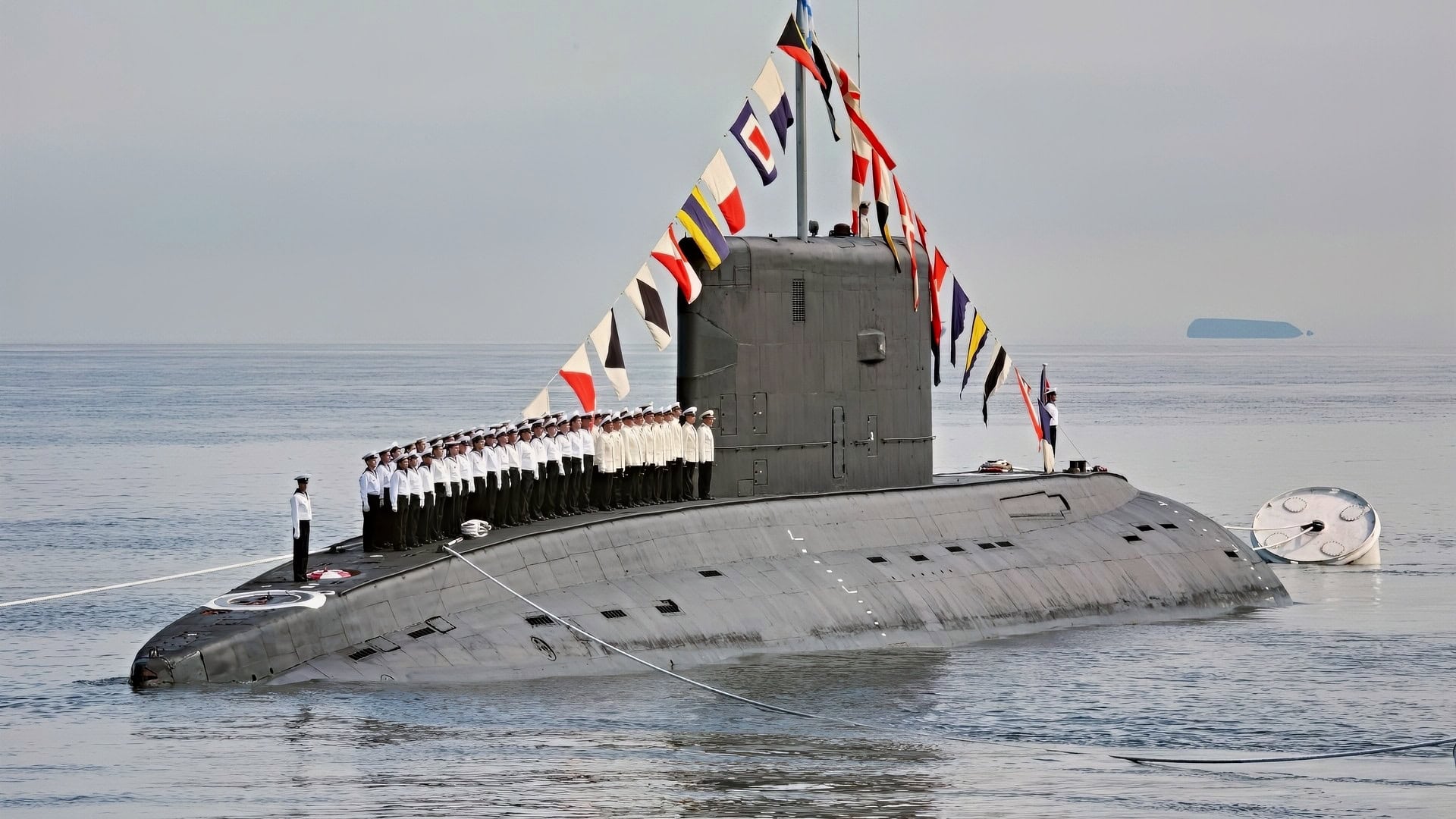
Russia is a world leader in submarine technology. The Russian Navy possesses many advanced nuclear-powered designs that are more than a match for the larger United States Navy (and, now, the larger Chinese People’s Liberation Army Navy submarine force). Despite this, the Russian Navy is also a world leader in diesel-electric submarines. One of Russia’s most iconic systems is the Kilo-class diesel-electric attack submarine.
A Cold War Relic That Refuses to Die

Kilo-Class Submarine Fleet. Image Credit: Creative Commons.
Designed in the late Soviet era and first introduced in 1980, this submarine was assigned anti-ship warfare (ASW), anti-submarine warfare, coastal defense, and intelligence-gathering roles. Even though the Kilo-class dates back to a bygone era, the Russians have managed to keep these legendary submarines relevant in today’s era of advanced submarines.
The Kilo-class remains the backbone of Russia’s conventional submarine force. The boat is so popular that Russia exports it widely.
Why the US Navy Calls It the “Black Hole”
The Kilo-class is nicknamed the “Black Hole” for good reason. While not as advanced as a nuclear-powered submarine, there are certain advantages that diesel-electric subs bring to the table. One of their strengths, especially for the Kilo-class, is their quiet operation. In submarine warfare, the quieter a boat is, the more lethal it is. Stealth is the name of the game.
By being quiet underwater, enemy submarines can’t hear this decades-old prowler coming up on them. In fact, the submarine’s nickname–Black Hole–was given to it not by the Russians, but by the United States Navy, which has gone up against this class of submarine since the halcyon days of the Cold War.
One analysis of the Kilo-class submarine’s silence says that the sound around a Kilo-class submarine tends to “disappear,” almost as if the Kilo-class were a black hole for underwater sound. During NATO exercises, the Western navies have struggled to track this class of submarine. That’s a problem, of course, because the Kilo-class is still widely used and is, therefore, one of the most likely Russian underwater systems that NATO’s navies will encounter if a war ever erupts between them and Russia.
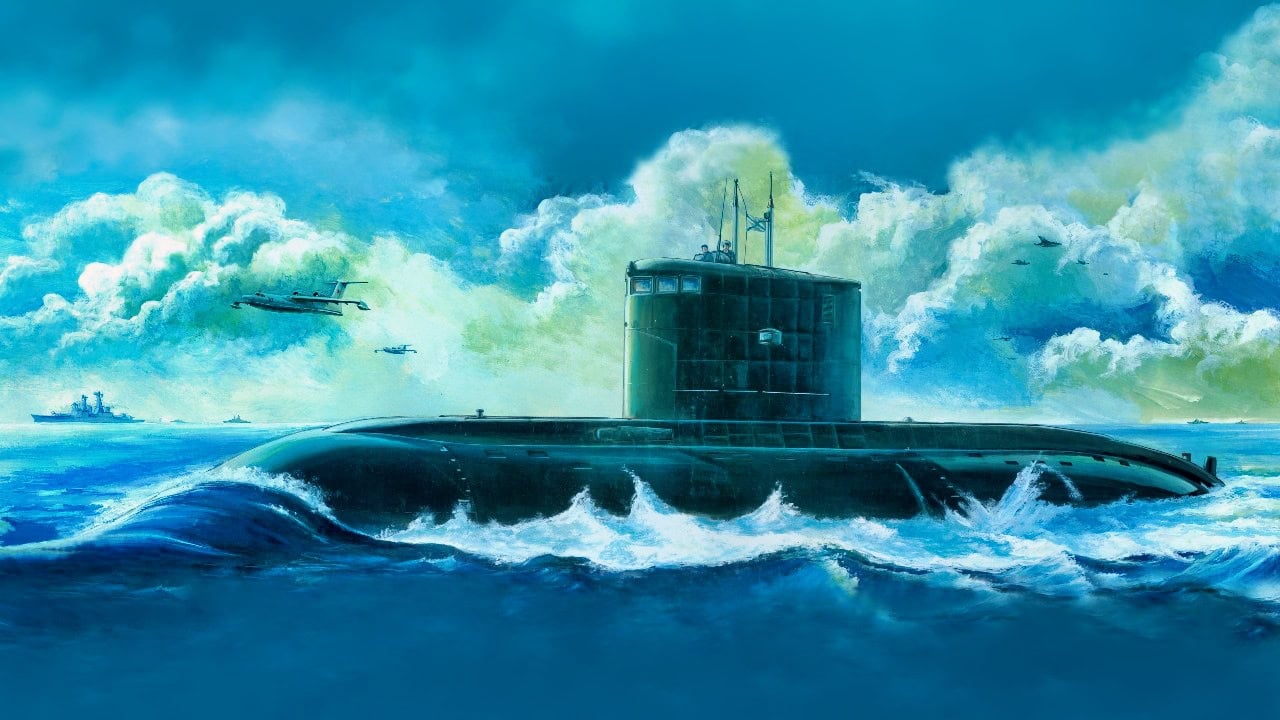
Kilo-Class Submarine
Stealth Engineering: Built to Disappear
But the battery mode that makes the diesel-electric submarine work is nearly silent underwater. Plus, the Russians installed anechoic tiles on the hulls of these submarines to absorb sonar waves. Overall, there is lower mechanical noise on the Kilo-class than there is on nuclear submarines. That makes the Kilo-class submarine a nightmare to locate, especially in littoral waters.
Nevertheless, the Kilo-class diesel-electric submarine is old. So, Moscow spent years upgrading these submarines. The Improved Kilo (Project 636.3) carries Kalibr cruise missiles for long-range attack, better sonar and combat systems than its predecessor, even greater levels of noise reduction technology, and more strike flexibility than the original variant of the Kilo-class.
Thanks to Russia’s modernization of the Kilo-class, these subs can hit targets from hundreds of miles away (as has been demonstrated throughout the Ukraine War, where Kilos have fired Kalibr cruise missiles at targets deep inside Ukraine). The upgraded Kilo-class submarines can also simultaneously threaten ships and submarines.
Thus, the new Russian modifications have transformed the Kilo-class from coastal killers to long-range strategic strike platforms. They may not be as fancy as American nuclear-powered submarines. But the Russians don’t need that. They need a system that is “good enough” to provide their forces with capabilities similar to those of the more complex US nuclear-powered submarines.

The Virginia-class attack submarine Pre-commissioning Unit (PCU) John Warner (SSN 785) is moved to Newport News Shipbuilding’s floating dry dock in preparation for the Sept. 6 christening. A team of shipbuilders spent about eight hours to move the submarine from the facility where it was assembled to the dock. (U.S. Navy photo courtesy of Huntington Ingalls Industries by John Whalen/Released)
Where the Kilo-Class Thrives: Chokepoint Warfare
Still, the Kilo-class shines in shallower, more congested waterways. These systems are perfect for critical chokepoints, such as the Black Sea, Baltic, or even the Persian Gulf. Thanks to their stealth capabilities, the Kilo-class subs can operate undetected in these tight waterways and potentially inflict grave damage on their enemies’ ships.
Basically, the Kilo-class is most useful as a “sea-denial” weapon, much more than being used as a blue-water system. That would be a waste of capabilities if a navy relied on the Kilo-class as a power-projection platform in the open ocean rather than keeping the submarine closer to the enemy’s coastal regions, especially given its limited endurance compared to nuclear submarines. Because it is a diesel-electric system, the submarine must periodically snorkel and recharge its batteries. At that point, the Kilo-class becomes vulnerable to detection and attack.
Limitations: The Cost of Simplicity
And since they are diesel-electric rather than nuclear-powered, these submarines are much cheaper to purchase, export, and maintain for foreign militaries than nuclear-powered submarines. That’s why these boats are so popular, and why the Russians have invested so much time and resources in ensuring these submarines remain relevant. These submarines are not ideal for long-range pursuit missions.
Kilo-class submarines possess a modest speed and are not ideal for long-range pursuit missions. What’s more, Kilo-class submarines, even the upgraded ones, are from the Cold War. Russia built the Kilo-class submarines to meet the needs and doctrines of the Cold War era.
They were modified to operate more effectively in today’s battlespace. Fundamentally, however, these submarines have inherent limitations thanks to their original design concepts.
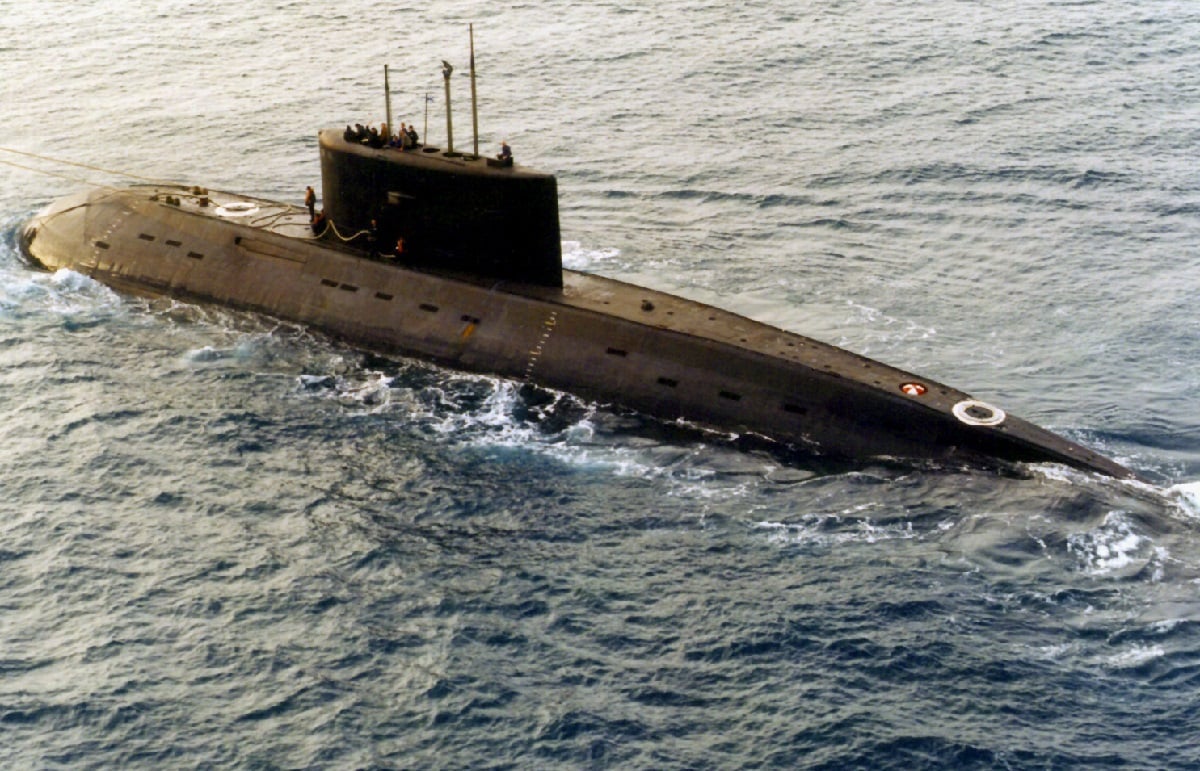
A Russian-built, Kilo-class diesel submarine recently purchased by Iran, is towed by a support vessel in this photograph taken in the central Mediterranean Sea during the week of December 23. The submarine and the support ship arrived at Port Said, Egypt, on Tuesday and were expected to begin transiting the Suez Canal today, Jan. 2, 1996. Ships and aircraft from the U.S. Navys Sixth Fleet are tracking the submarine, which has been making the transit on the surface. This is the third Kilo-class submarine the Iranians have purchased from Moscow. DoD photo
Old, Silent–and Still Deadly
What the Kilo-class submarine does is expose a core vulnerability in Western navies. Those navies, notably the United States Navy, are optimized for big, expensive nuclear platforms.
Instead, Russia fields cheap, quiet coastal ambushers. In confined waters, a single Kilo-class submarine can threaten US aircraft carrier battle groups, vulnerable tankers, and overall supply lines in contested regions. Therefore, these submarines vastly complicate US naval operations everywhere–especially in places like the Strait of Hormuz.
Finally, the Kilo-class isn’t flashy. These subs are merely old, silent, patient killers built for chokepoint warfare. This submarine thrives where US global naval power is most constrained. And in the right fight, the Kilo-class can punch well above its weight. That’s why, decades later, the US Navy still calls the Kilo-class the “Black Hole.”
MORE – Iran Has One Goal in the Strait of Hormuz
MORE – Russia Almost Built a Nimitz-Class Aircraft Carrier Similar to the USA
About the Author: Brandon J. Weichert
Brandon J. Weichert is the Senior National Security Editor at 19FortyFive.com. Recently, Weichert became the editor of the “NatSec Guy” section at Emerald.TV. He was previously the senior national security editor at The National Interest. Weichert is the host of The National Security Hour on iHeartRadio, where he discusses national security policy every Wednesday at 8 pm Eastern. He hosts a companion show on Rumble entitled “National Security Talk.” Weichert consults regularly with various government institutions and private organizations on geopolitical issues. His writings have appeared in numerous publications, among them Popular Mechanics, National Review, MSN, and The American Spectator. And his books include Winning Space: How America Remains a Superpower, Biohacked: China’s Race to Control Life, and The Shadow War: Iran’s Quest for Supremacy. Weichert’s newest book, A Disaster of Our Own Making: How the West Lost Ukraine, is available for purchase wherever books are sold. He can be followed via Twitter/X @WeTheBrandon.