
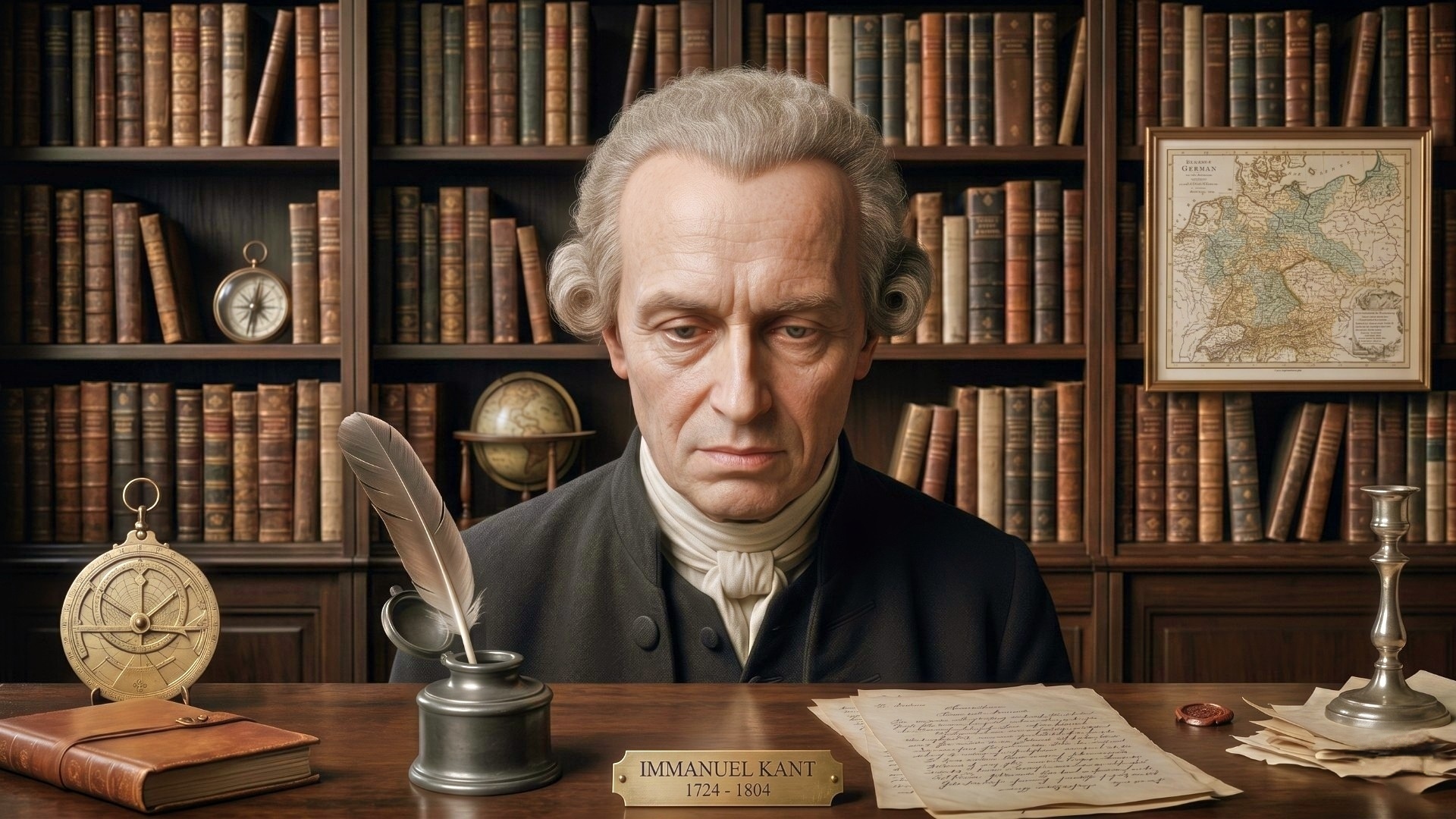
Immanuel Kant was a German philosopher and one of the leading thinkers of the Enlightenment Era whose comprehensive work in epistemology (the theory of knowledge), ethics, and aesthetics had a significant influence on Western philosophy.
Born and raised in Königsberg, Prussia (now Kaliningrad, Russia), he was the son of a saddler, and the family lived in a remote, bucolic setting.
Both of his parents were members of the Piety branch of Lutheranism, which taught that life and religion are expressed by simplicity and adherence to moral law.
Kant’s “Critique of Pure Reason” Changed The Course Of Metaphysics:
His idea is that while all knowledge begins with experience, the mind actively structures perception through inherent, a priori frameworks—specifically, space, time, and causality —which he details in his famous Critique of Pure Reason.
The quote by Kant, “We are not rich by what we possess, but by what we can do without,” reminds us that our true wealth isn’t measured by material possessions but by our ability to live a happy life without them.
This is especially true today, when people place their worth in material possessions, money, and an exorbitant lifestyle.
Immanuel Kant’s Early Life:
Kant was born on April 22, 1724, in Königsberg, Kingdom of Prussia. Kant believed his family was of Scottish descent, though no records of his family history support this claim.
Kant was baptized as Emanuel, but changed his name to Immanuel after learning Hebrew. The Kant family belonged to a strict branch of the Lutheran Church that stressed religious devotion, humility, and a literal interpretation of the Bible.
His early education focused on Latin and religion rather than on mathematics or science.
Kant Was An Early And Accomplished Young Scholar:
He graduated from the Collegium Fridericianum in the summer of 1740. There, at the age of 16, he enrolled at the University of Königsberg, where he would later remain for the rest of his professional life.
Studying the works and the philosophy of Gottfried Leibniz and Christian Wolff, Kant was introduced to, and followed the works of mathematical physics by Sir Isaac Newton.
He and his circle of friends, fellow students, and some professors were frequent visitors to the local Masonic Lodge.
His Father’s Death Forces Him To Earn His Way Tutoring:
Kant’s father died in 1746 from a stroke, which forced him to leave the university in early 1748. He then worked as a private tutor in and around Königsberg until he went back to the university in 1754.
It was during this time that Kant published his first book. In 1749, he published his first philosophical work, Thoughts on the True Estimation of Living Forces.
The book shows Kant’s early commitment to independent reasoning rather than to reverence for scientific authority.
Return To the University and Further Works:
In 1755, Kant returned to teaching and received a license to lecture at the University of Königsberg, and began lecturing on a variety of topics, including mathematics, physics, logic, and metaphysics.
In his 1756 essay on the theory of winds (“New Remarks toward an Elucidation of the Theory of Winds“), Kant laid out his qualitative theory of what is now called Coriolis force.
By the early 1760s, Kant became a well-published and popular author. It wasn’t until he turned 46, however, that he wrote the Critique of Pure Reason, and he became famous for his philosophy. However, it wasn’t initially received well.
The book was overly long and written in a convoluted and difficult-to-decipher style. Many of his devoted followers considered it a disappointment.
This contrasted sharply with his teaching style at the university, where he constantly injected humor and personal stories into his subjects, making his classes very popular.
Kant’s Later Life And Death:
Kant had suffered from ill health for much of his life, but he always adhered to a very strict regimen (some characterizing it as obsessive); his neighbors reportedly would set their watches by his daily walks.
Kant died in Königsberg on February 12, 1804, uttering the words “Es ist gut” (“It is good”) before his death. His final unfinished work was published as Opus Postumum.
He was buried in a mausoleum that adjoins the northeast corner of Königsberg Cathedral in Kaliningrad, Russia.
What Kant’s Quote Means For People Today:
Kant’s philosophy argues that even though you may have a large bank account, you may feel poor emotionally or mentally because you depend heavily on possessions for happiness.
According to Kant, true richness comes when you learn to let go of your desires, live simply and freely, and find joy without constantly needing more.
About the Author: Steve Balestrieri
Steve Balestrieri is a National Security Columnist. He served as a US Army Special Forces NCO and Warrant Officer. In addition to writing on defense, he covers the NFL for PatsFans.com and is a member of the Pro Football Writers of America (PFWA). His work was regularly featured in many military publications.