
When all its member states are combined, NATO possesses one of the most capable and diverse tank forces in the world. It comprises heavy hitters such as the M1 Abrams from America, the Leopard 2 from Germany, the Challenger 2 from the UK, and the Leclerc from France.
These tanks are among the most capable and well-armored in the world and are a critical staple of NATO’s armored forces.

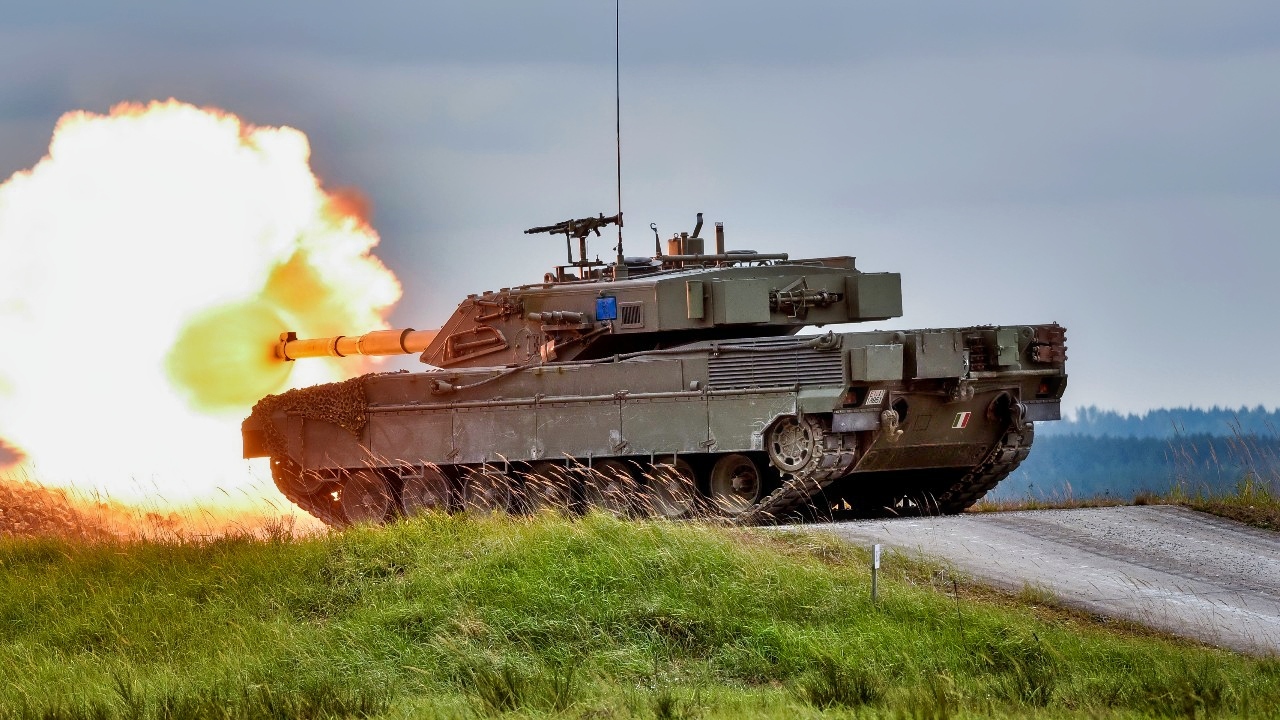
The Ariete is often described by many as the worst tank in NATO. Image Credit: Creative Commons.
And then there’s Italy… Italy fields the C1/C2 Ariete, a tank which is famous for being somewhat unremarkable.
The Ariete is often treated as the black sheep of NATO armor. It is usually forgotten, and in the rare instances when the tank is actually brought up, it’s often as the butt of a joke.
But does the tank deserve this harsh reputation? Is it really as bad as many people say it is, or is there more to this tank than meets the eye?
Design and Development
Throughout the late Cold War, the Italian Army fielded the M60 as its primary MBT, supported by various Leopard 1 models.
In the 1980s, however, it became apparent that the M60, as reliable as it was, would no longer be sufficient against modern tanks and anti-tank weapons.
The task of developing a new MBT fell to a consortium comprised of Iveco and OTO Melara (CIO). CIO possessed prior knowledge of tank manufacturing, thanks to its experience producing Leopard 1s under license.
The Italian Army requested a tank that could fire accurately while on the move, with the most sophisticated fire control systems (FCS) available, and operate in both day and night conditions.
The tank underwent trials from 1988 to 1994, when the Ariete officially entered service.
The hull of the Ariete bears a striking resemblance to the Leopard 2 with a sloped frontal glacis, flat sides, and a raised rear engine deck.
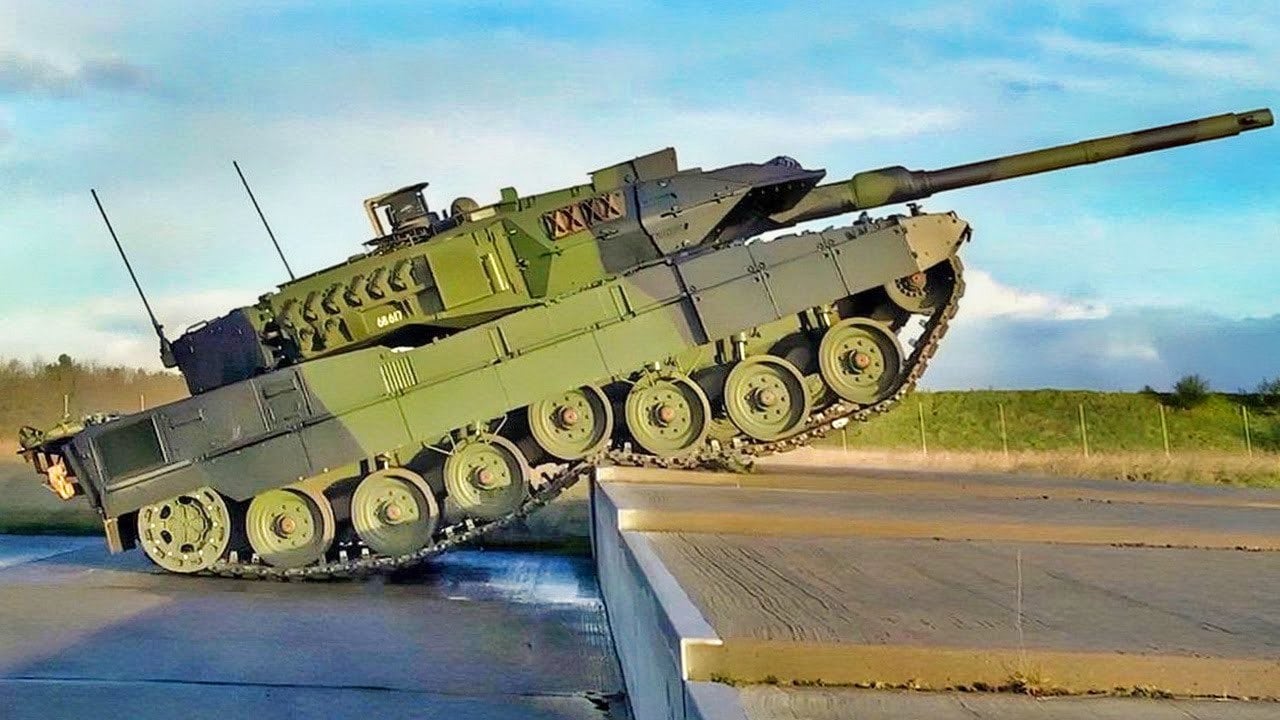
NATO Leopard 2 Tank. Image Credit: Creative Commons.
The tank is protected by a composite armor placed at the front of the turret and on the upper frontal plate of the hull, inspired by the Challenger 2 and M1 Abrams.
The tank is smaller than most of its Western peers due to its more compact engine, which also helps reduce weight.
For enhanced side protection, the C2 Ariete can be fitted with add-on side armor kits and additional mine protection add-ons. Overall, the protection on the Ariete is alright, but pales in comparison to the protection and survivability features of tanks like the M1 Abrams and later variants of the Leopard 2.
Armament and Mobility
In terms of armament, the Ariete is equipped with a 120 mm OTO Breda L/44 smoothbore cannon, which is similar to Rheinmetall’s L/44.
The gun is interoperable with most NATO-standard ammunition and provides the tank with excellent offensive capabilities. Like most NATO MBTs, the tank is manually loaded by a dedicated loader.
Unlike the Leopard 2, the ammo is not stored in a separate compartment but is instead located on the left side of the gun breach.
Secondary armaments include a 7.62 coaxial machine gun and an additional 7.62 machine gun mounted on the roof, which can be operated by the main loader if necessary.
The tank’s FCS is provided by the OG14L3 TURMS, which allows day/night capabilities for the commander’s primary sight.
The gunner is equipped with thermal sights that can be shared with the commander (the C2 variant finally gives the commander access to independent thermal sights).
The gunner’s sight is also equipped with a laser rangefinder, and the tank’s internal computers automatically calculate external factors like wind speed and the vehicle’s angle of attack to provide maximum accuracy.
Like most other modern tanks, this tank’s computers enable the seamless exchange of information on the battlefield to ensure maximum situational awareness for the crew.
For mobility, the Ariete is fitted with a Fiat-Iveco MTCA turbo-diesel V12, which generates around 1,257 hp, propels the tank to around 64 km/h, and gives it a power-to-weight ratio of around 23.5 hp/t.
It has an automatic transmission with four forward gears and two reverse gears, along with torsion-bar suspension.
The Ariete is not the fastest tank in NATO, but, honestly, when it comes to tanks, speed is never really a concern.
The tank is lighter than most other Western MBTs, however, weighing at 54 tons. This enables it to cross most bridges across Europe and makes it ideal for Italy’s rugged Northern terrain.
Unfortunately, the lighter weight comes at the expense of overall armor thickness.
Why the Ariete is Considered a “Bad” Tank
One of the main factors holding back the Ariete is the lack of continual upgrades.
Whereas the Leopard 2, M1 Abrams, and even the T-72 have received a steady stream of upgrades, the Ariete stagnated after final deliveries were completed.
The most comprehensive upgrade the tank has received is the C2 standard, which improves the tank’s sights, protection, mobility, and more.
Had this upgrade arrived in the 2000s (as originally intended) and been followed by more continuous upgrades, the tank would be a much more capable platform.
The Ariete is in a place similar to that of the Challenger 2. It is a decent platform, but the lack of ongoing upgrades has left the tank behind in the face of contemporary threats.
Overall, the Ariete is a decent tank that has good firepower and situational awareness.
The tank, however, lacks overall armor protection. Furthermore, because of the Italian Army’s lack of available funds, the tank is limited in numbers, and modernization efforts have been slow.
The tank is made to look even worse by the presence of other NATO tanks, namely later versions of the Leopard 2, which can do pretty much everything the Ariete can do, but better.
The main advantage it has over its NATO peers is its lighter weight and comparatively smaller price tag.
The Ariete is not a bad tank; it simply isn’t as good as its NATO brethren and is operated by an army that lacks the funds to make it even better.
About the Author: Isaac Seitz
Isaac Seitz, a Defense Columnist, graduated from Patrick Henry College’s Strategic Intelligence and National Security program. He has also studied Russian at Middlebury Language Schools and has worked as an intelligence Analyst in the private sector.