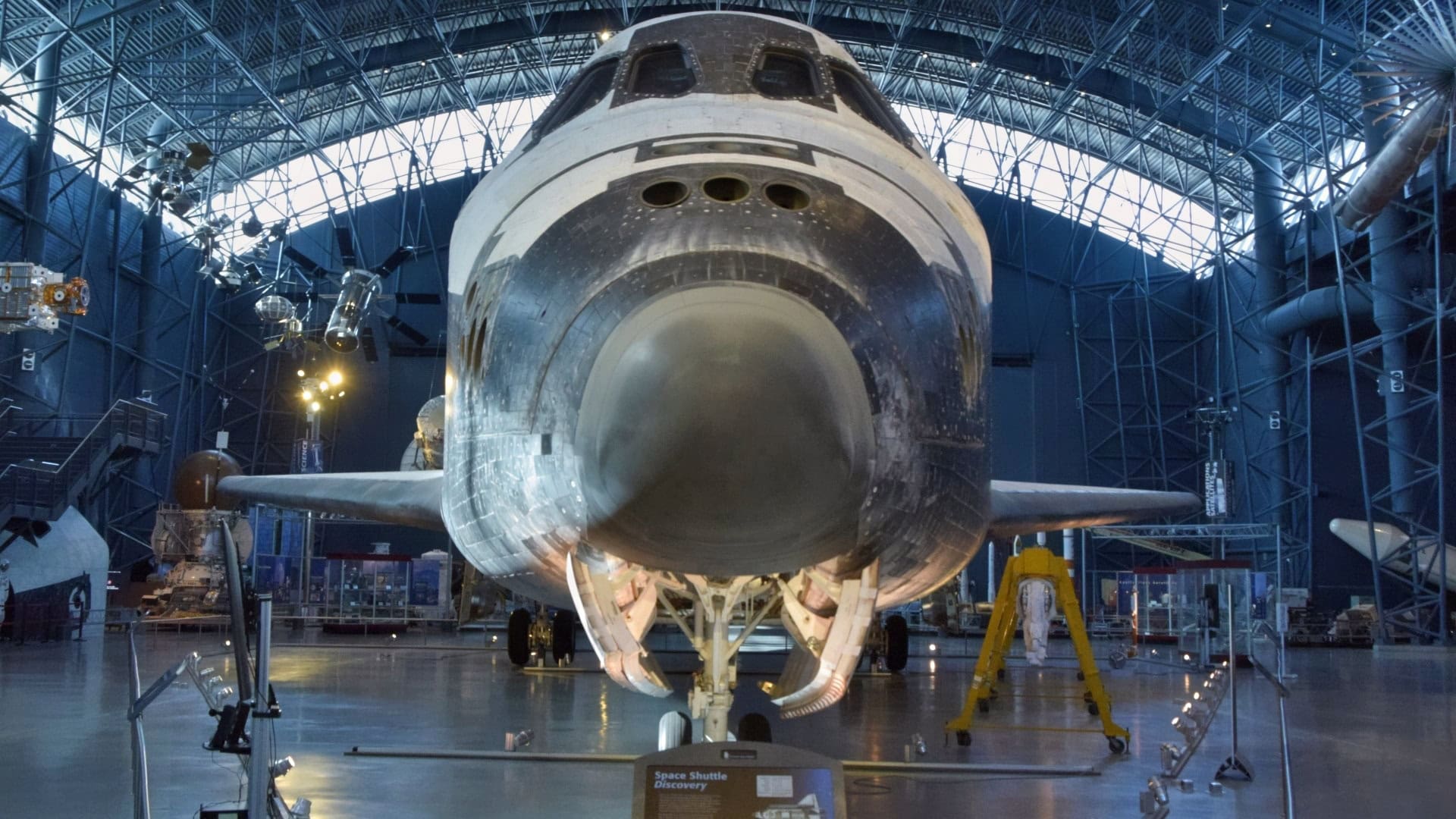
The Space Shuttle is a marvel of engineering. We know this from personal experience, as the photos in this article are from our visit to see the Space Shuttle up close at the Smithsonian in 2025. Moving at Mach 25, or about 25 times the speed of sound, it slices through the air with blisteringly high speed.
At that velocity, reentry is a dangerous game of friction, heat, and protecting the aircraft from mid-air breakup.
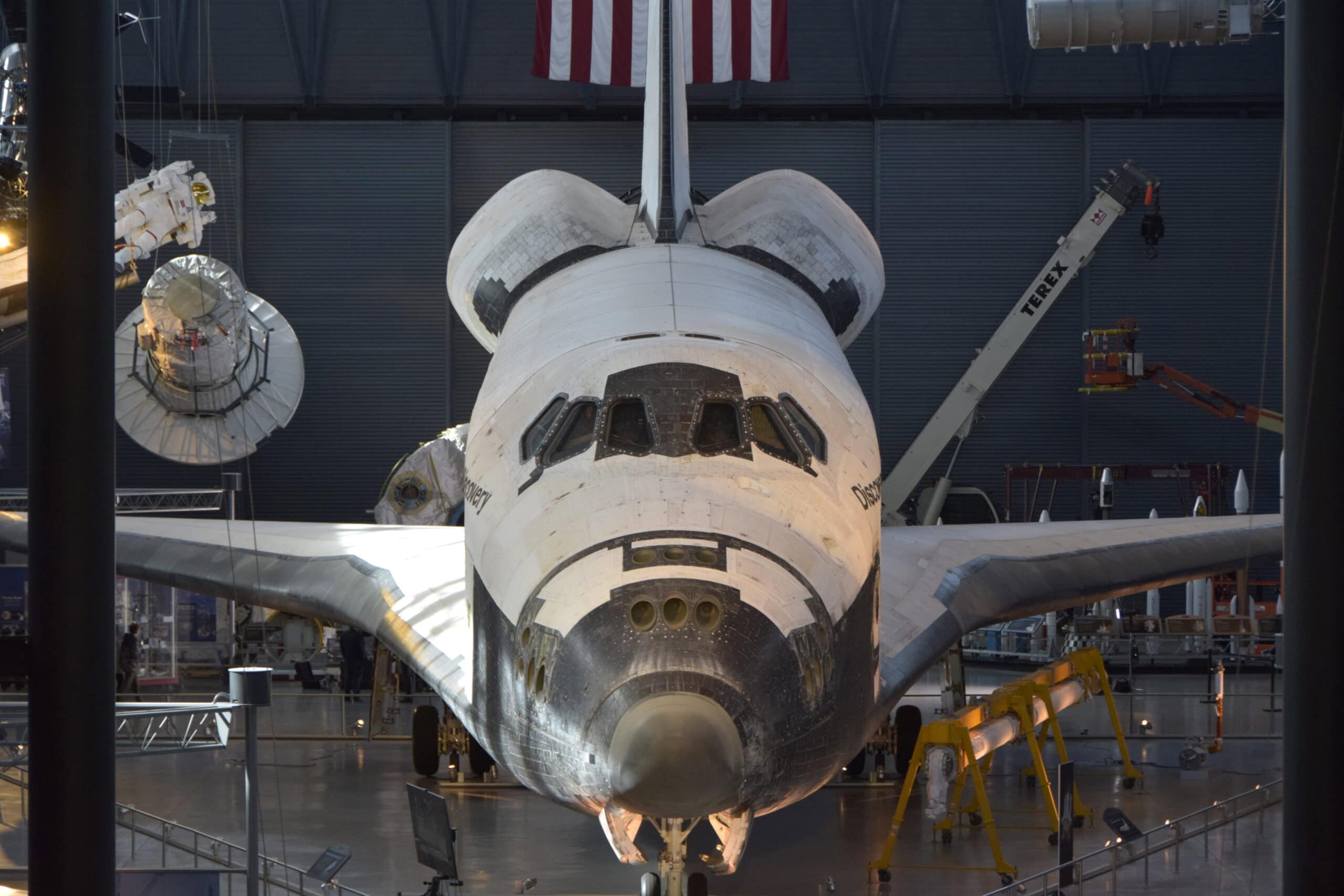
Space Shuttle Discover at the Smithsonian 19FortyFive Original Photo from 2025 Visit.
When the Space Shuttle dips into Earth’s upper atmosphere, it compresses the air ahead of it so quickly that the air rapidly heats up to unbelievably extreme temperatures.
A shock wave forms in front of the Space Shuttle, and the atmosphere trapped in the front of this shock layer can reach temperatures of several thousand degrees Celsius — more than hot enough to melt steel.
At these incredible temperatures, molecules break apart, atoms lose electrons, and the air becomes superheated plasma.
Heat Mitigation Posture
The Space Shuttle’s solution to this intense engineering challenge was to prevent most of that heat from reaching the Space Shuttle itself.
It reenters at a high angle of attack, flying nose-up at about forty degrees.
This creates a fusion of shock-heated air beneath the orbit and keeps the hottest part of the flow somewhat separated from the Space Shuttle’s structure.
In essence, the Space Shuttle rides its own shock wave down through the atmosphere.
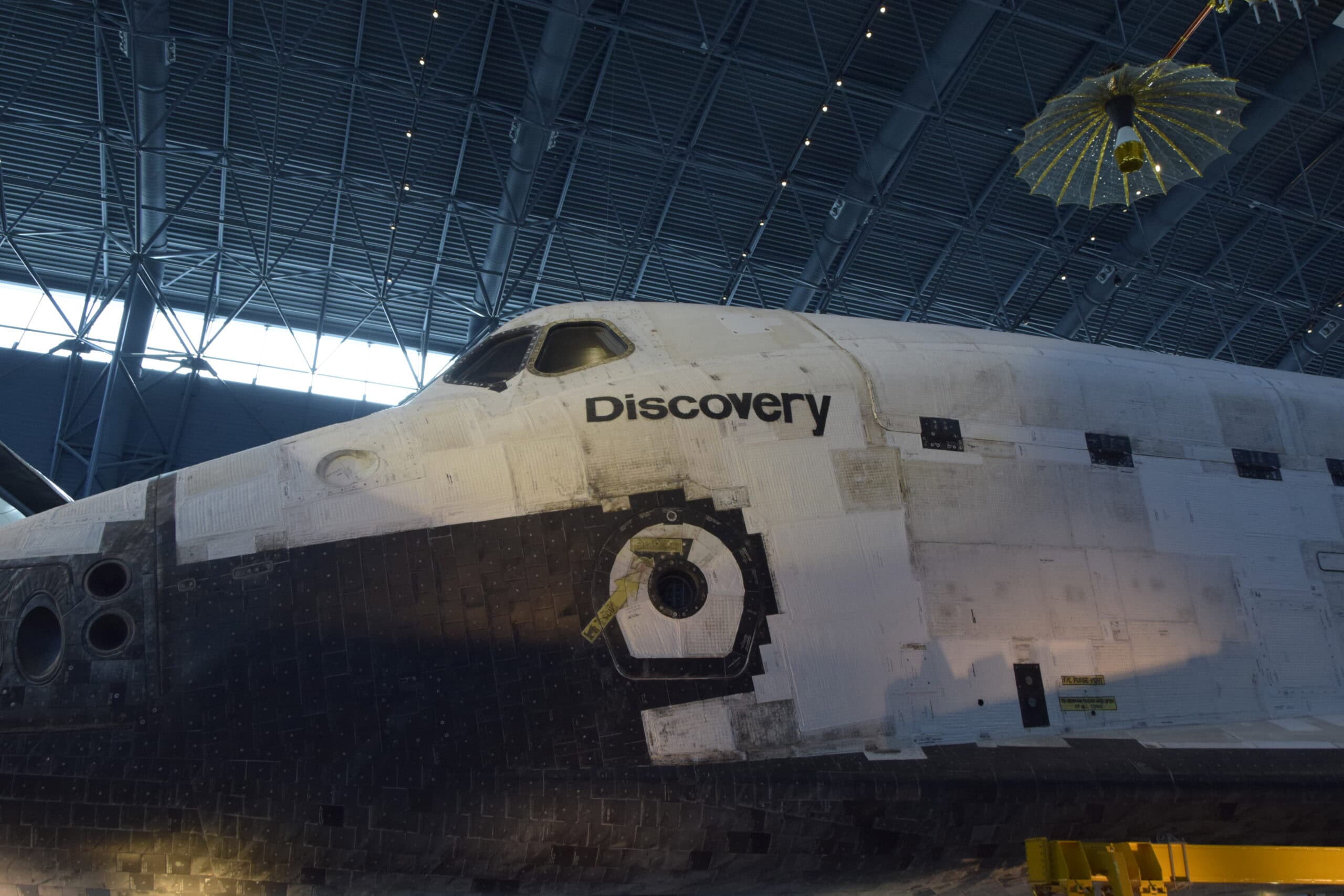
Space Shuttle Discover at the Smithsonian 19FortyFive Original Photo from 2025 tour.
Thermal Protection
The Space Shuttle’s thermal protection system was one of the Shuttle’s most distinctive features. Different parts of the orbit used different materials depending on the temperatures they were expected to encounter.
The Space Shuttle’s nose cap and leading edges of the wings undergo the highest heating. These areas are protected by reinforced carbon-carbon panels, a carbon composite material that withstands repeated exposure to extreme temperatures.
On the underside of the Space Shuttle, a different material is used: lightweight silica tiles.
These black tiles can withstand temperatures of 1,200 degrees Celsius or more and conduct very little heat to the Shuttle’s aluminum structure below.
One incredible NASA demonstration illustrates their remarkable properties: tiles are heated until they glow orange-hot — but remarkably, they can be picked up and handled with bare hands.
Other parts of the orbiter experienced lower temperatures and used insulating tiles or thermal blankets rather than the more fragile silica tiles.
The Space Shuttle’s aluminum airframe would have begun losing strength at temperatures far below those experienced by the aircraft’s outer surface.
The Shuttle’s thermal protection system acts first as insulation. But the goal is not to keep the surface cool. Rather, it is to prevent dangerous amounts of heat from reaching the structure beneath.
Communications Blackout
Communication with Mission Control during reentry presented other challenges, though.
During the hottest parts of the Shuttle’s reentry, the plasma surrounding the orbiter vehicle interfered with radio transmissions.
The ionized gas could absorb, reflect, or scatter radio waves, preventing signals from reaching ground stations.
This phenomenon was not unique to the Space Shuttle, but had been known since the early days of human spaceflight, and crews aboard the Mercury, Gemini, and Apollo missions experienced communication blackouts during reentry into Earth’s atmosphere.
These blackouts could last for several minutes at a time.
At first, the Space Shuttle had to deal with the same issue.
As the plasma sheath formed around the orbiter, communications became intermittently choppy or were lost completely.
Although the duration of the communications blackout depended on flight conditions, atmosphere properties, and other factors, blackouts were a normal part of reentry planning.
Tracking and Data Relay Satellite System
NASA’s solution to the communications blackout problem was the creation of the Tracking and Data Relay Satellite System, commonly known as TDRSS.,
Rather than relying exclusively on ground-based stations, the Space Shuttle can communicate through relay satellites positioned in orbit.
By the late Space Shuttle era, communication gaps were significantly shorter than they had been in the program’s early days.
A Persistent Challenge
Today’s crop of modern aircraft, however, faces challenges similar to those of the Space Shuttle.
The reentry capsules of the Orion and SpaceX Dragon have to account for plasma effects during reentry, but advances in communications systems, computer modeling, and thermal protection technologies have made the problem much more manageable and therefore safer.
The Space Shuttle’s challenge was, for the time, highly unique and posed a difficult question.
How to protect astronauts who would be subjected to the heating environment of a spacecraft with the flight characteristics of an aircraft.
It was one of the major Space Shuttle engineering hurdles — but one that was ultimately surmounted.
About the Author: Caleb Larson
Caleb Larson is an American multiformat journalist based in Berlin, Germany. His work covers the intersection of conflict and society, focusing on American foreign policy and European security. He has reported from Germany, Russia, and the United States. Most recently, he covered the war in Ukraine, reporting extensively on the war’s shifting battle lines from Donbas and writing on the war’s civilian and humanitarian toll. Previously, he worked as a Defense Reporter for POLITICO Europe. You can follow his latest work on X.