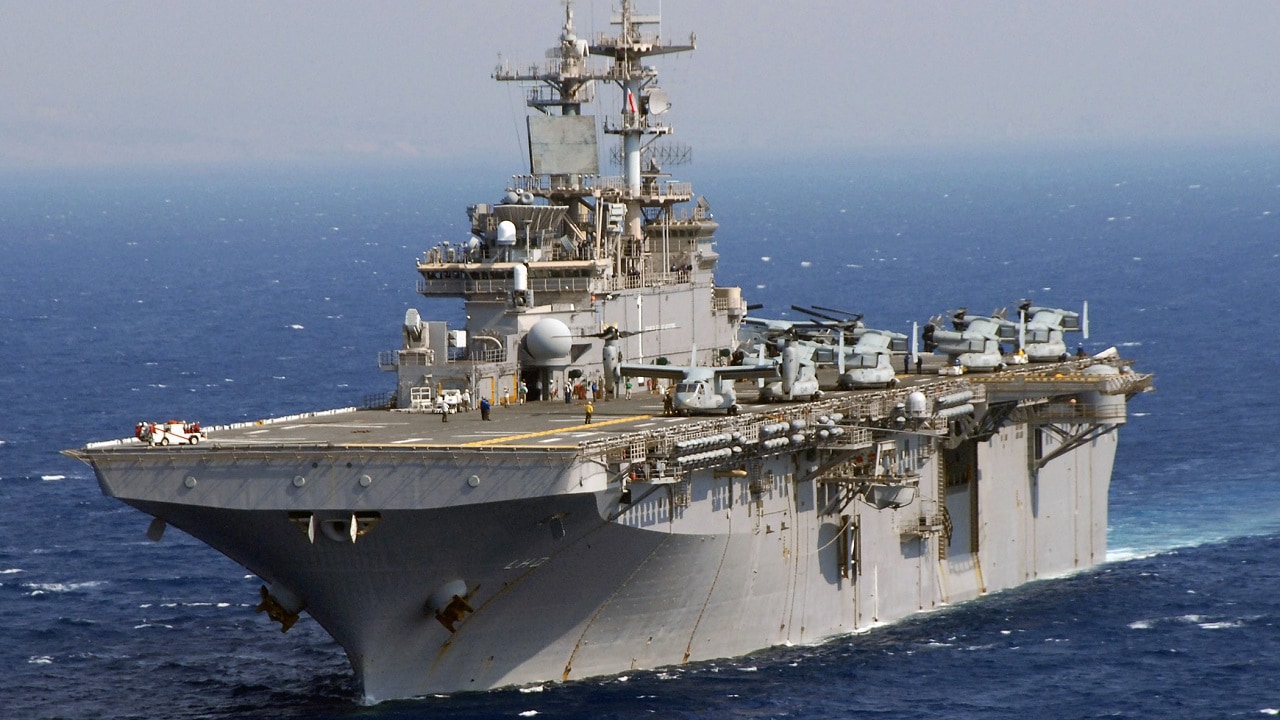
The United States military is fundamentally an expeditionary force. It must travel long distances to engage perceived enemies in combat and to deter those rivals.
To achieve these mission sets, the US Navy, Air Force, and Marine Corps are often the most important components of the expeditionary force.
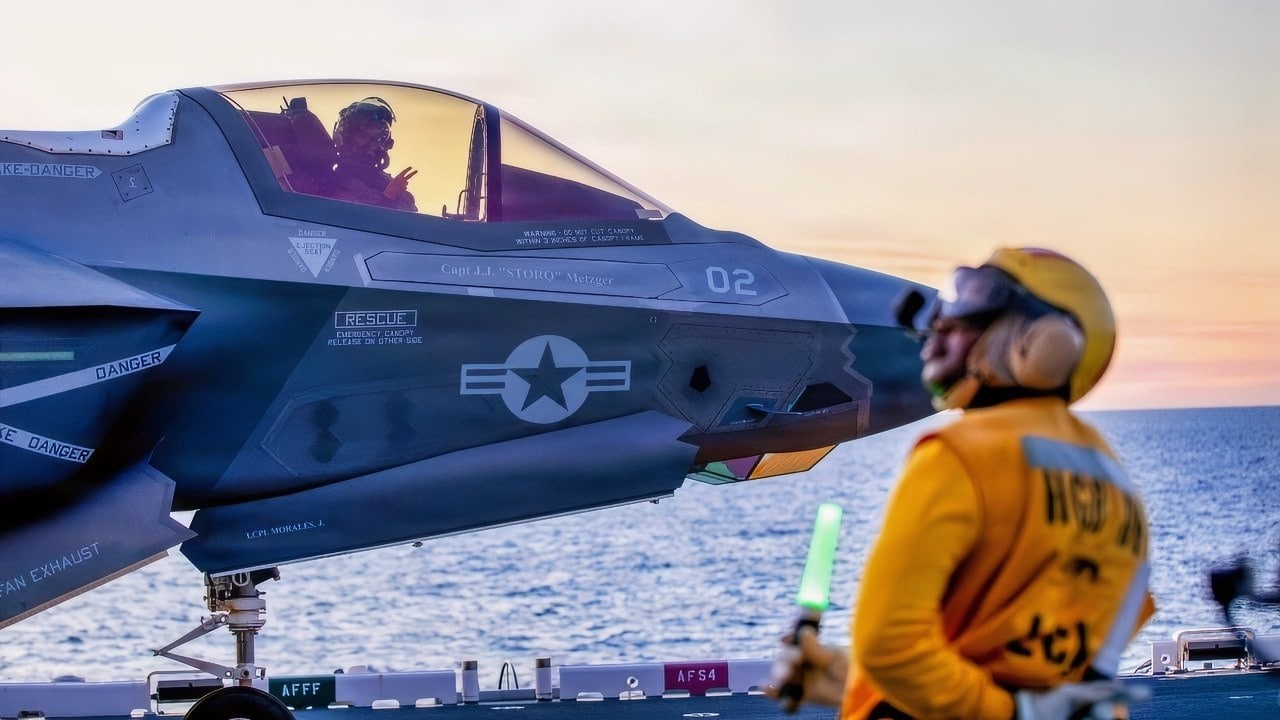
Chief Aviation Boatswain’s Mate (Handling) Stephane Togue, assigned to Wasp-class amphibious assault ship USS Makin Island (LHD 8), prepares to signal an F-35B Lightning II, attached to Marine Fighter Attack Squadron 211, for takeoff, Dec. 4, 2025. Makin Island is currently underway conducting routine operations in the U.S. 3rd Fleet. (Photo by Mass Communication Specialist Seaman Abraham Ramirez)

GULF OF ADEN – U.S. Navy Petty Officer 1st Class Rey White, an aviation boatswains mate handler with the Essex Amphibious Ready Group (ARG), launches an F-35B Lightning II from the Wasp-class amphibious assault ship USS Essex (LHD 2), Sept. 22, 2018. The Essex is the flagship for the Essex ARG and, with the embarked 13th Marine Expeditionary Unit, is deployed to the U.S. 5th Fleet area of operations in support of naval operations to ensure maritime stability and security in the Central Region, connecting the Mediterranean and the Pacific through the western Indian Ocean and three strategic choke points. (U.S. Marine Corps photo by Cpl. Francisco J. Diaz Jr./Released)
The US Marine Corps relies on Wasp-class amphibious assault ships to land thousands of Marines, along with their helicopters, vehicles, artillery pieces, and supplies, on a hostile shoreline without relying on local ports.
These ships became the centerpiece of the Navy-Marine Corps Amphibious Ready Group (ARG) and Marine Expeditionary Unit (MEU) concept that emerged after the Vietnam War.
It remains central to the US expeditionary way of war today.
The Tarawa-Class: The Original “Mini Carrier”
The Tarawa-class entered service in the 1970s and was revolutionary for its time. It consolidated the roles of several earlier amphibious ship types into one hull. Instead of requiring separate helicopter carriers, cargo ships, troop transports, and dock ships, a single Tarawa could perform all those functions.
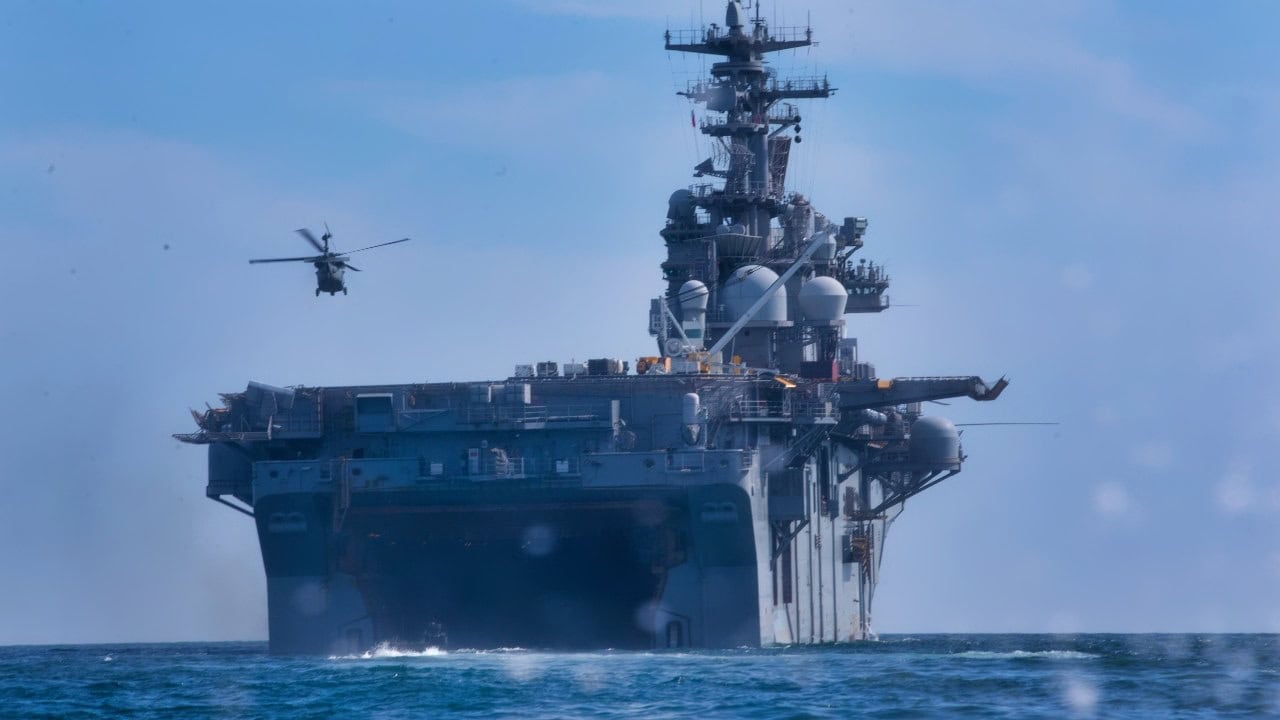
U.S. Marines with Bravo Company, 2d Assault Amphibious Battalion, 2d Marine Division approach the USS Wasp (LHD 1) in assault amphibious vehicles off of Onslow Beach during a three-day ship-to-shore exercise on Camp Lejeune, N.C., June 27, 2020. During the exercise, the Marines conducted amphibious maneuvers and dynamic ship-to-shore operations with the USS Wasp (LHD 1). (U.S. Marine Corps photo by Lance Cpl. Jacqueline Parsons)
Key characteristics included:
-Roughly 40,000 tons of displacement,
-Capacity for more than 1,700 Marines,
-Large flight deck for helicopters and Harrier jumpjets,
-Well deck for landing craft and amphibious vehicles,
-Ability to support battalion-sized amphibious assaults
The Tarawas were essentially the first modern American “assault carriers.” They looked like aircraft carriers but were optimized for Marine Corps operations rather than fleet air defense.
The Wasp-Class: A Better Tarawa
The Wasp-class was the direct successor to Tarawa. The hull was broadly similar, but the Navy redesigned the ship around two emerging technologies of the time: the AV-8B Harrier jump jet and the Landing Craft Air Cushion (LCAC) hovercraft.
These changes significantly increased the ship’s operational flexibility. The Wasp-class became the first amphibious assault ship specifically designed to support both technologies from the outset.
Major improvements included:
-Larger well deck for LCACs,
-Improved aviation facilities,
-Better command-and-control spaces,
-Enhanced ability to operate fixed-wing aircraft,
-Increased Marine Corps combat power ashore
A Wasp-class ship can carry 1,900 Marines, helicopters, Ospreys, armored vehicles, artillery, and an air wing tailored to the mission.
Why They Are Called “Mini Aircraft Carriers”
Modern Wasp-class ships can operate substantial numbers of F-35B Lightning II fifth-generation multirole fighters.
In a “Lightning Carrier” configuration, a Wasp can embark around 20 F-35Bs and function as a light aircraft carrier.
This functionality allows the Navy to generate additional airpower without deploying one of its nuclear-powered supercarriers.
Such a configuration has become particularly attractive to US Navy planners because:
-Supercarriers are scarce (and expensive),
-The Indo-Pacific is enormous,
-The Marine Corps increasingly focuses on island warfare,
-F-35Bs can operate from smaller flight decks.
In many scenarios, a Wasp-class operating 16-20 F-35Bs can provide meaningful combat airpower while simultaneously carrying Marines and landing aircraft.
How the Marines Would Use Them In War
A Wasp-class ship approaches offshore with a Marine Expeditionary Unit (MEU) embarked.
It then launches MV-22 Ospreys carrying infantry, CH-53 heavy-lift helicopters, AH-1 attack helicopters, F-35B or Harrier aircraft, LCAC hovercraft loaded with vehicles, and amphibious assault vehicles from the well deck.
The ship functions as a floating headquarters directing the entire operation.
Historically, the concept was designed for places such as the Pacific Islands, Middle Eastern coastlines, humanitarian disasters, evacuation operations, and expeditionary raids.
Today, the Marine Corps increasingly envisions using these ships in the First Island Chain (the region running from the Kamchatka Peninsula down through Japan and Taiwan into the Philippines and the South China Sea) against China.
Rather than storming massive beaches like the Marines did in the Pacific Theater of the Second World War, such as Iwo Jima, the Marines would instead rapidly occupy islands, establish missile bases, and help control key sea lanes.
The Strategic Debate
An interesting question is whether these ships can remain viable in a missile-heavy environment. The Wasp and its predecessor, the Tarawa, were concepts developed during an era in which the United States controlled the air and sea.
China today fields large numbers of anti-ship ballistic missiles (ASBMs), cruise missiles, long-range bombers, and maritime strike aircraft.
Critics argue that the 40,000-ton amphibious ship concept is vulnerable to these saturation attacks that China will undoubtedly subject them to in any war.
Supporters rebut those arguments by claiming these mini-carriers remain indispensable in crisis response.
According to these supporters, no other platform combines aviation, command facilities, hospital services, troop transport, and amphibious capability quite like the Wasp-class does.
Plus, F-35Bs have transformed these amphibious assault ships into more capable combat platforms than originally envisioned.
Why This Matters
The Wasp-class clearly represents a bridge between two eras. It was built for Cold War-era amphibious assaults.
Instead, it has evolved into a light aircraft carrier capable of deploying F-35Bs, supporting distributed maritime operations, and serving as a mobile base for Marine littoral forces.
The Navy’s recent decision to extend the service life of the USS Wasp suggests military planners still see significant value in the platform despite growing concerns about missile threats.
About the Author: Brandon J. Weichert
Brandon J. Weichert is the Senior National Security Editor at 19FortyFive.com. He also manages The Weichert Brief on Substack. Weichert also hosts “National Security Talk” on Rumble. He is the author of four bestselling national security books, the most recent of which is A Disaster of Our Own Making: How the West Lost Ukraine (Encounter Books). Follow him via Twitter/X @WeTheBrandon.