
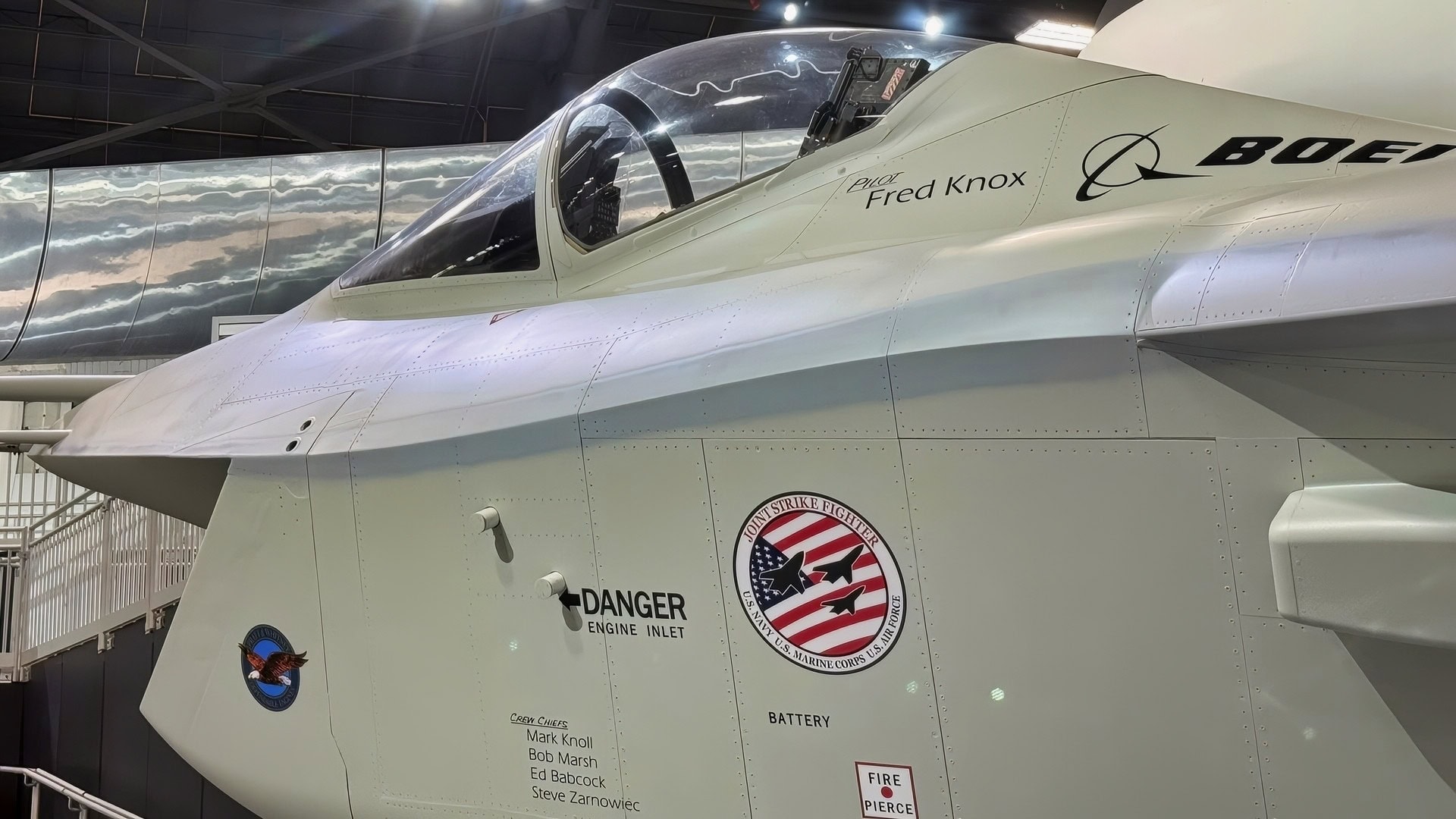
Boeing rolled out two X-32 concept demonstrators at its Palmdale, California, plant on December 14, 1999, in front of 5,500 people, and the second aircraft was a surprise even to the crowd. The company built the X-32A first, followed by the X-32B three months later, finishing the second airframe just six weeks after the first. They looked like siblings, sharing a one-piece delta wing, a Pratt & Whitney F119-derived engine, and the enormous chin-mounted air intake that earned the jet comparisons to a catfish and, later, to Tow Mater from the Pixar film Cars. Underneath that shared skin, the two aircraft were built to answer two different questions, and the answers Boeing gave are why Lockheed Martin builds the F-35 today.
And the X-32 bonus: 19FortyFive went out last year to visit both fighters in their present state and presented original photos of both for you to check out.
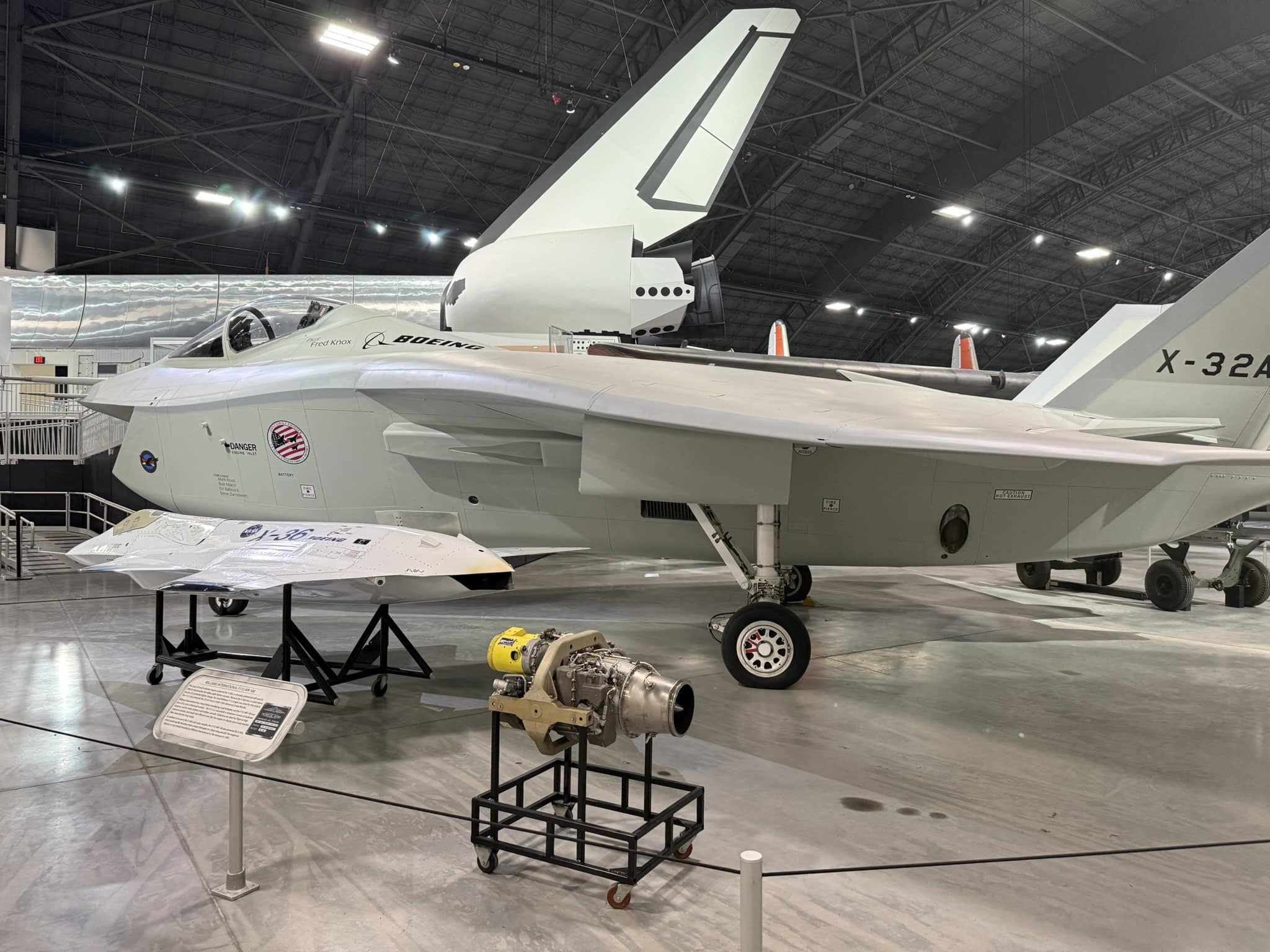
X-32A. Photo Taken by Harry J. Kazianis for 19FortyFive.com at the National Museum of the U.S. Air Force.
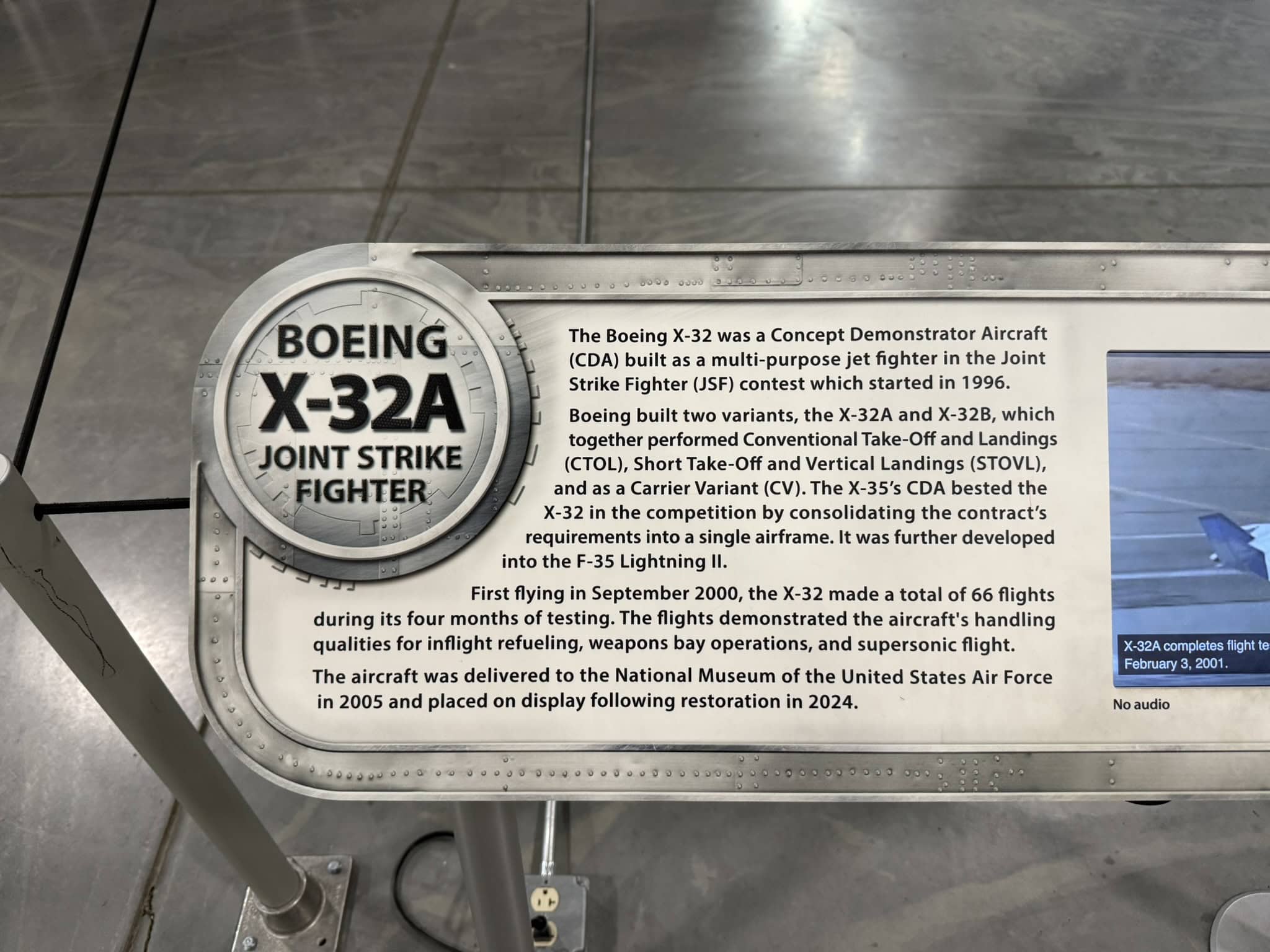
X-32A. Photo Taken by Harry J. Kazianis for 19FortyFive.com at the National Museum of the U.S. Air Force.
The X-32A: Boeing’s Conventional Fighter That Flew Clean
The X-32A was the straightforward one. Designed to demonstrate conventional takeoff and landing for the Air Force and carrier approaches for the Navy, it flew first, lifting off from Palmdale for Edwards Air Force Base on September 18, 2000, with Boeing chief test pilot Fred Knox at the controls.
The debut was not quite flawless.
A minor hydraulic leak turned up shortly after takeoff, and the crew cut the flight from a planned 40 minutes to 20, but the aircraft still hit about 80 percent of its planned test points, and Knox reported that the F/A-18 chase plane needed heavy afterburner to stay with the X-32 during the climb. For a jet that the press would spend two decades calling ugly, it was quick.
The X-32A went on to fly 66 times over roughly four months and about 50 flight hours, doing the unglamorous work a demonstrator exists to do. It broke the sound barrier on December 21, 2000, completed its first aerial refueling that same month at 20,000 feet, ran weapons-bay-door tests in January 2001, and flew field carrier landing practice to prove it could handle Navy approach profiles.
Six Boeing and government pilots flew it. Across the entire program, the X-32A validated the delta-wing configuration’s handling, stability, and supersonic performance without drama.
If the Joint Strike Fighter had been decided on conventional flying alone, the competition would have been close, because in that regime, Boeing’s airplane worked.

X-32 Outside in the Elements. 19FortyFive.com Image.
The X-32B: Where the STOVL Problem Lived
The X-32B was the hard one, and it carried the requirement that has broken more fighter designs than any other.
The Marine Corps and the United Kingdom’s Royal Navy needed a short-takeoff and vertical-landing aircraft to replace the AV-8 Harrier, and balancing a stealth fighter on a column of its own thrust is among the most punishing problems in aerospace engineering.
Boeing chose a direct-lift solution, the same basic philosophy as the Harrier: divert the engine’s exhaust straight down through vectoring nozzles to hold the aircraft up. The X-32B’s first flight came on March 29, 2001, a 50-minute hop from Palmdale to Edwards with Boeing lead STOVL test pilot Dennis O’Donoghue flying, after which the aircraft made a transcontinental ferry flight to Naval Air Station Patuxent River in Maryland for the bulk of its vertical-landing work.
The engine is where the two X-32s truly diverged. The X-32A flew with a conventional direct-thrust F119. The X-32B used a modified variant, the F119-PW-614S, that behaved like a normal afterburning turbofan in forward flight but, in STOVL mode, closed a butterfly valve to divert the core exhaust to a pair of thrust-vectoring nozzles mounted near the aircraft’s center of gravity, with a jet-screen nozzle ahead of them laying down a curtain of cooler bypass air and roll nozzles out near the wingtips for control. It was clever, lighter, and simpler than the alternative.

Boeing X-32 Fighter image taken by 19FortyFive back in July 2025.
It also had a flaw that showed up exactly where it could not be tolerated, in the hover.
Hot-Gas Reingestion: The Flaw That Decided the Competition
When the X-32B hovered, its own hot exhaust tended to recirculate off the ground and back up into that big chin intake. Feeding an engine its own heated exhaust reduces the density of the air it is trying to breathe, which costs thrust at the precise moment the aircraft is balanced on thrust alone, while also driving up engine temperatures and thermal stress on the airframe.
The jet-screen curtain of cool air was Boeing’s attempt to hold the hot gas at bay, but it added weight and bled power from the engine, and the margins stayed tight. The aircraft could hover, but it did so with less thrust reserve and more heat than the competition, and by accounts from the test community, it never performed a vertical landing at full weight.
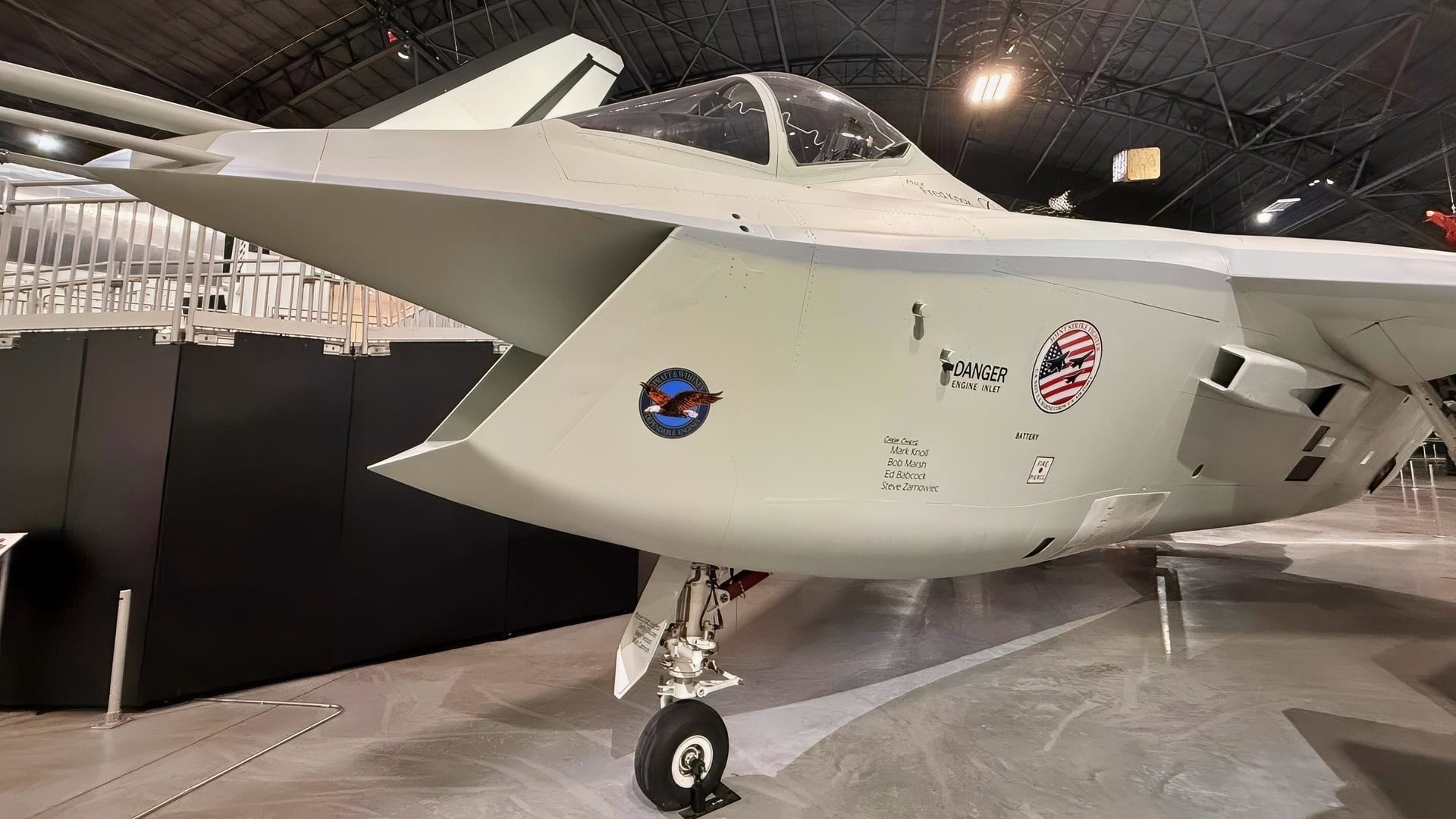
Boeing X-32 19FortyFive.com Photo
Boeing’s STOVL demonstrator leaned on the denser, cooler sea-level air at Patuxent River to give it enough margin to hover safely, which is part of why so much of the B’s flying happened in Maryland rather than the high desert.
Lockheed Martin had answered the same requirement in a completely different way.
The X-35 used a shaft-driven lift fan, a large fan mounted vertically behind the cockpit, which the main engine spun via a clutch and driveshaft when the pilot wanted to hover. That fan blasted a column of cool air downward at the front of the aircraft, balancing the hot exhaust at the rear, and because it moved a large mass of unheated air, it produced more lifting force than direct exhaust could, with a far lower temperature and a smaller infrared signature.
Lockheed’s system was mechanically more complex and, on paper, riskier.
In practice, it worked beautifully and promised greater payload and range for the eventual fighter. The contrast between a lift fan throwing cool air and a direct-lift system choking on its own heat was visible to every engineer watching.
The Delta Wing Boeing Had Already Abandoned
There was a deeper problem that both X-32s shared, and it is the part of the story that rarely gets told. Boeing had chosen the one-piece delta wing to hold down manufacturing cost, and it was heavy.
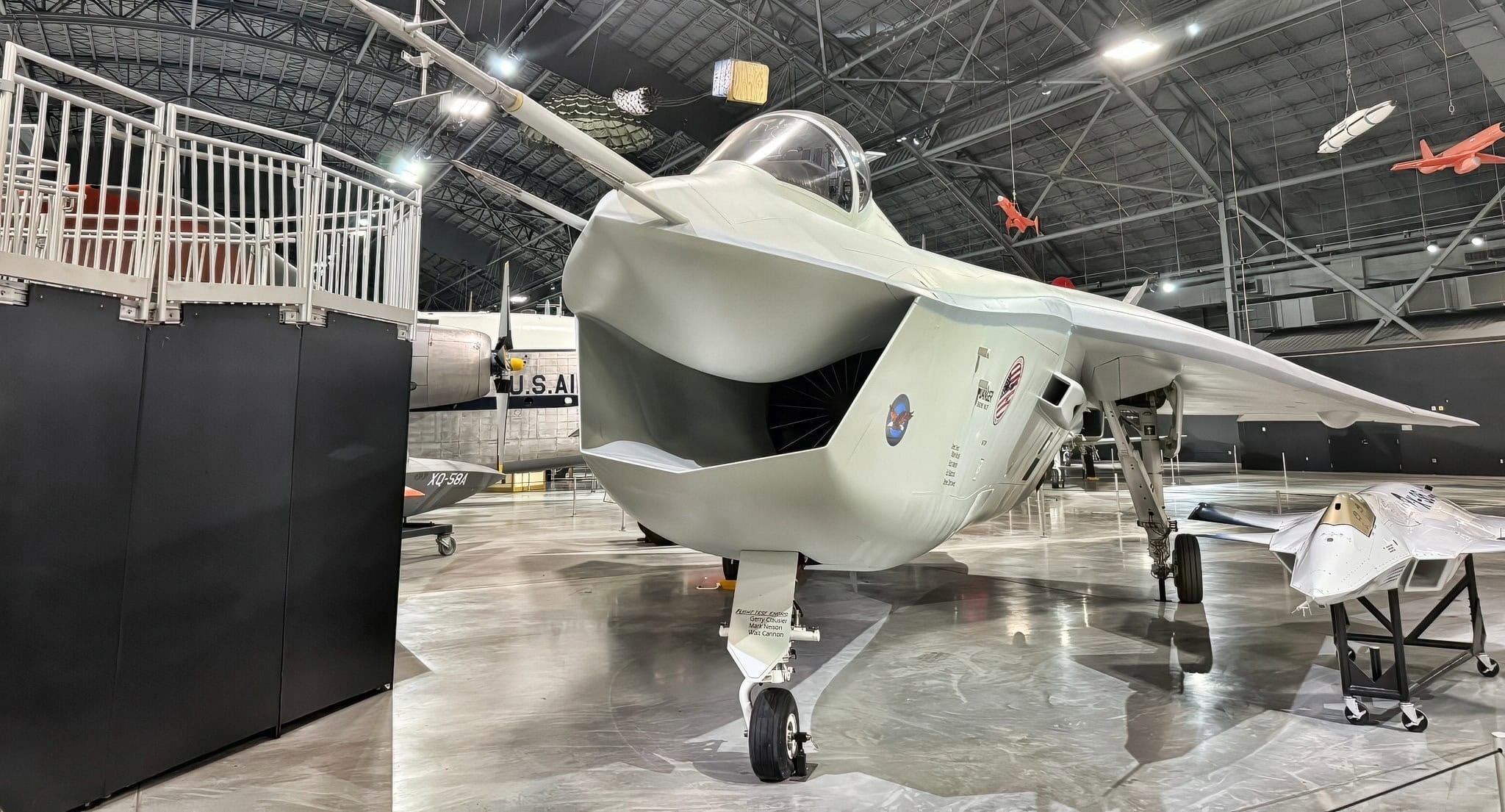
Boeing X-32 Fighter image taken by 19FortyFive back in July 2025.
It was heavy enough that Boeing could not demonstrate STOVL and supersonic flight in the same physical configuration. To perform a vertical takeoff, ground crews had to remove parts from the aircraft, and to fly supersonic, it had to be configured differently again.
The company told the Pentagon that production models would fix this with a new tail arrangement that eliminated the need for reconfiguration, but the demonstrators could not do so. Lockheed’s X-35, by contrast, transitioned between its STOVL and supersonic configurations in mid-flight, without a maintenance crew touching it.
Test pilot Phil “Rowdy” Yates, who flew the X-32 with a maintenance detachment supporting him, described the core limitation directly: the airplane handled well in general flying, but it could not demonstrate STOVL and supersonic flight in a single configuration, and the crew had to modify the aircraft to move from one to the other.
The wing carried a second, quieter irony. About eight months into building the two prototypes, the Navy refined its maneuverability and payload requirements, and Boeing’s delta wing no longer met the targets.
Engineers went back and designed a replacement with a conventional tail, narrowly choosing it over an exotic “Pelican” tail arrangement, which was lighter and more agile.
It came too late. The two demonstrators were already too far along to rebuild, so both the X-32A and the X-32B flew, and lost, on a wing their own maker had already decided to abandon for the production aircraft.
Every visitor who looks at either surviving X-32 today is looking at a design Boeing had superseded on the drawing board before the airplanes ever left the ground.
October 26, 2001: One Flight Sealed It
Lockheed ended the argument with a single demonstration. In one sortie, the X-35 took off in a short roll, accelerated to supersonic speed, and then landed vertically, without reconfiguring between any of it.
It was precisely the sequence the X-32 could not perform in one configuration, executed with a confidence that left little room for debate. On October 26, 2001, the Department of Defense announced that Lockheed Martin’s X-35 had won the Joint Strike Fighter competition, a program then estimated at 3,000 to 5,000 aircraft and the most valuable fighter contract in history.
Boeing’s simpler, cheaper approach had produced an airplane that flew well in conventional flight and struggled in the one regime the Marines cared about most, and the winner-take-all structure of the competition meant there was no consolation prize.
Boeing has always framed the X-32 as a strategic investment rather than a failure, and the claim has merit. The stealth work, the digital design and assembly methods that let the company build the second airframe in six weeks, and the manufacturing lessons fed into the F/A-18E/F Super Hornet and the X-45 unmanned combat air vehicle.
The X-32 was fast, it handled like a much prettier airplane, and the test pilots who flew it defended it for years afterward. None of that changed the verdict, because the competition turned on vertical landing and mid-flight transition, and on those two points the two X-32s told the story themselves.
Two Airframes, Two Fates
The aircraft that flew cleanly got the better ending.
The X-32A, the conventional demonstrator that broke the sound barrier and never had to fight its own exhaust, went to the National Museum of the United States Air Force near Dayton in 2005, sat outdoors and deteriorated for years, and was then brought inside and restored over about three months in late 2023.
On May 31, 2024, the museum moved it into the research and development gallery and parked it near the Northrop YF-23, another advanced prototype that lost its own competition, two beautifully preserved might-have-beens sharing a room. She looks amazing, as I spent so much time staring at her and taking photos of this X-32 last July that the museum staff came over to ask what I was doing.
The X-32B, the STOVL demonstrator that carried the hot-gas problem and the reconfiguration burden, went to the Patuxent River Naval Air Museum in Maryland the same year, near the base where it spent most of its hovering.
It was restored once, around 2009, but it sits outdoors on the flight line, and the humidity, rain, snow, and salt air of the Chesapeake have worn it down again. The aircraft that struggled in the hover is the one now struggling against the weather, its paint fading while its clean-flying sibling stands under a roof in Ohio. She is in rough shape, as these photos taken by my staff last summer show.
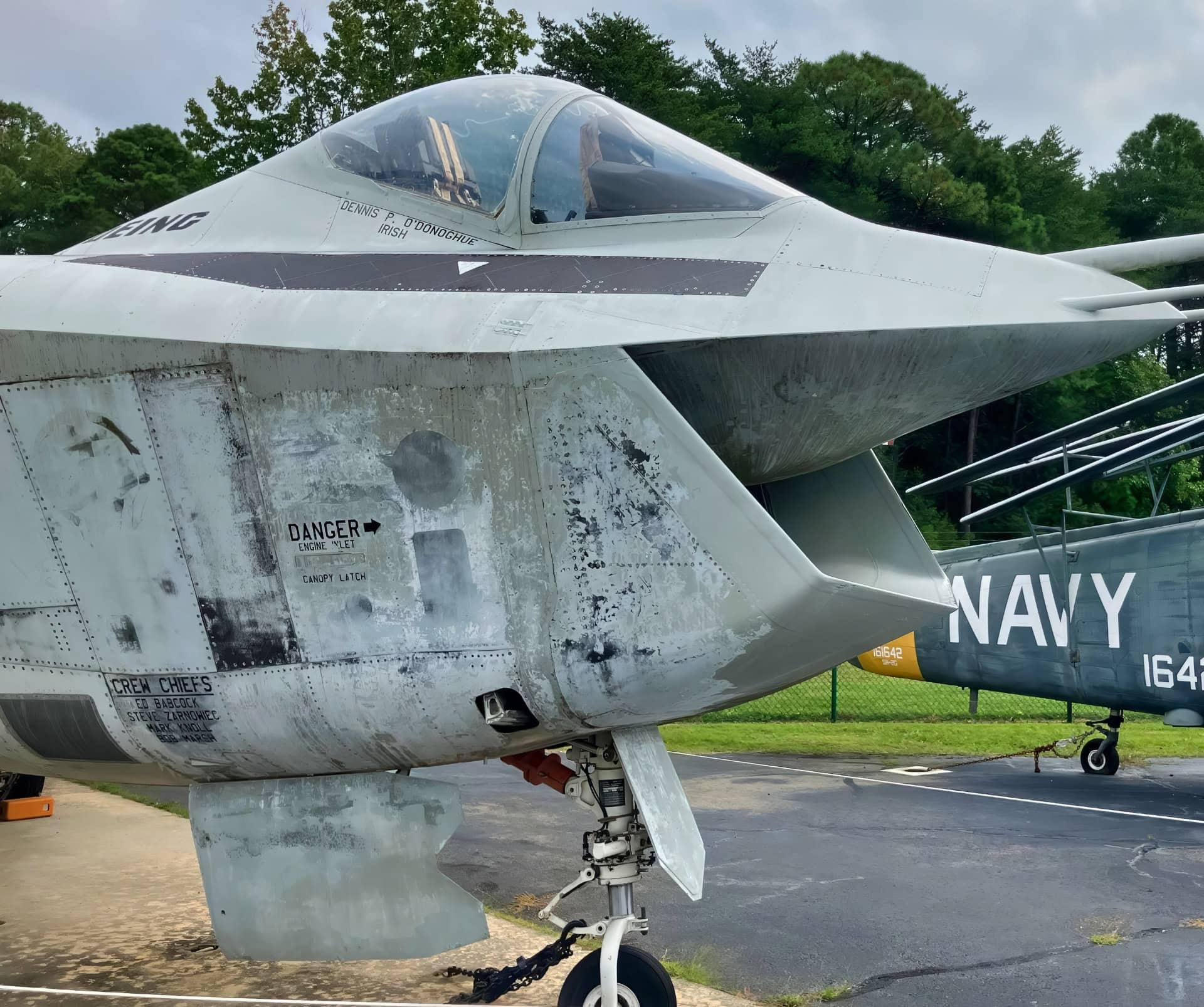
Sideview of Boeing X-32B In Maryland. Image Credit: 19FortyFive.com
The airplane was never assigned a Navy Bureau Number, and it never will be. It remains what it was always built to be, a demonstrator of an idea that did not win, weathering in the open a few miles from where it once worked to stay aloft on a pillar of its own overheated thrust.

Boeing X-32B. 19FortyFive.com Image.
About the Author: Harry J. Kazianis
Harry J. Kazianis (@Grecianformula) was the former Senior Director of National Security Affairs at the Center for the National Interest (CFTNI), a foreign policy think tank founded by Richard Nixon based in Washington, DC. Harry has over a decade of experience in think tanks and national security publishing. His ideas have been published in the NY Times, The Washington Post, The Wall Street Journal, CNN, and many other outlets worldwide. He has held positions at CSIS, the Heritage Foundation, the University of Nottingham, and several other institutions related to national security research and studies. He is the former Executive Editor of the National Interest and the Diplomat. He holds a Master’s degree focusing on international affairs from Harvard University.