
Taiwan has not become indefensible because drones, missiles, and sensors have changed modern war. It has become harder to defend cheaply.
Washington is drifting into bad habits. One camp talks as if Taiwan is already lost, because China is close and too far along in the military balance. Another talks as if cheap drones and unmanned boats can solve the problem that carriers, air bases, and manned aircraft increasingly struggle to solve.
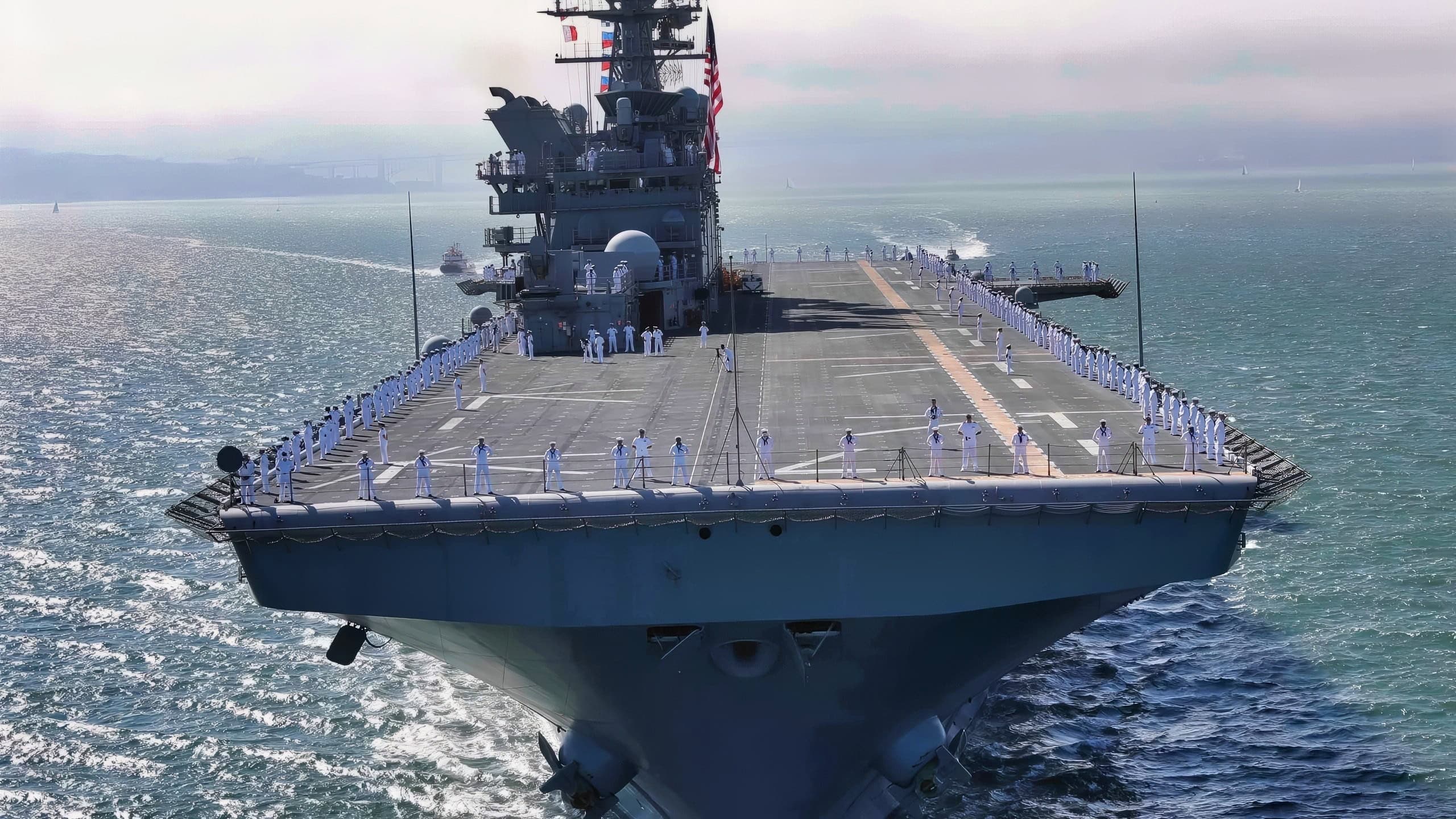
210911-N-OP825-1213 PACIFIC OCEAN (Sept. 11, 2021) Sailors aboard amphibious assault ship USS Tripoli (LHA 7) man the rails on the ship’s flight deck as the ship prepares to pull into San Francisco in support of San Francisco Fleet Week (SFFW), Sept. 11, 2021. SFFW is an opportunity for the American public to meet their Navy, Marine Corps and Coast Guard teams and experience America’s sea services. During fleet week, service members participate in various community service events, showcase capabilities and equipment to the community, and enjoy the hospitality of San Francisco and its surrounding areas. (U.S. Navy photo by Mass Communication Specialist 3rd Class Erica Higa /Released)
Both views dodge the harder point. Taiwan can be made a terrible target.
China can be denied a quick victory. But a serious defense of Taiwan still carries a price that American politics has barely begun to discuss.
Taiwan War: The Drone Age Cuts Both Ways
Admiral Samuel Paparo’s “hellscape” idea captured something real about the way war is changing. If China attempts an amphibious assault, it must move men, armor, fuel, and follow-on forces across the Taiwan Strait. That means ships in predictable waters, landing craft moving toward narrow beaches, ports that must function, and communications that cannot go dark.
Drones make all of that more dangerous. Small unmanned aircraft can find targets. Unmanned surface vessels can threaten ships. Loitering munitions can turn logistics into exposure. Mines, mobile missiles, decoys, and cheap sensors make the problem worse. None of this guarantees Taiwan’s survival, but it does make a Chinese assault less like a parade and more like a bet Beijing cannot fully price in advance.
China has watched the same wars. It has drones too, missiles in quantity, cyber tools, space assets, electronic warfare, and the industrial base to replace losses. So the drone age does not simply rescue Taiwan. It makes the whole fight more lethal and less forgiving.
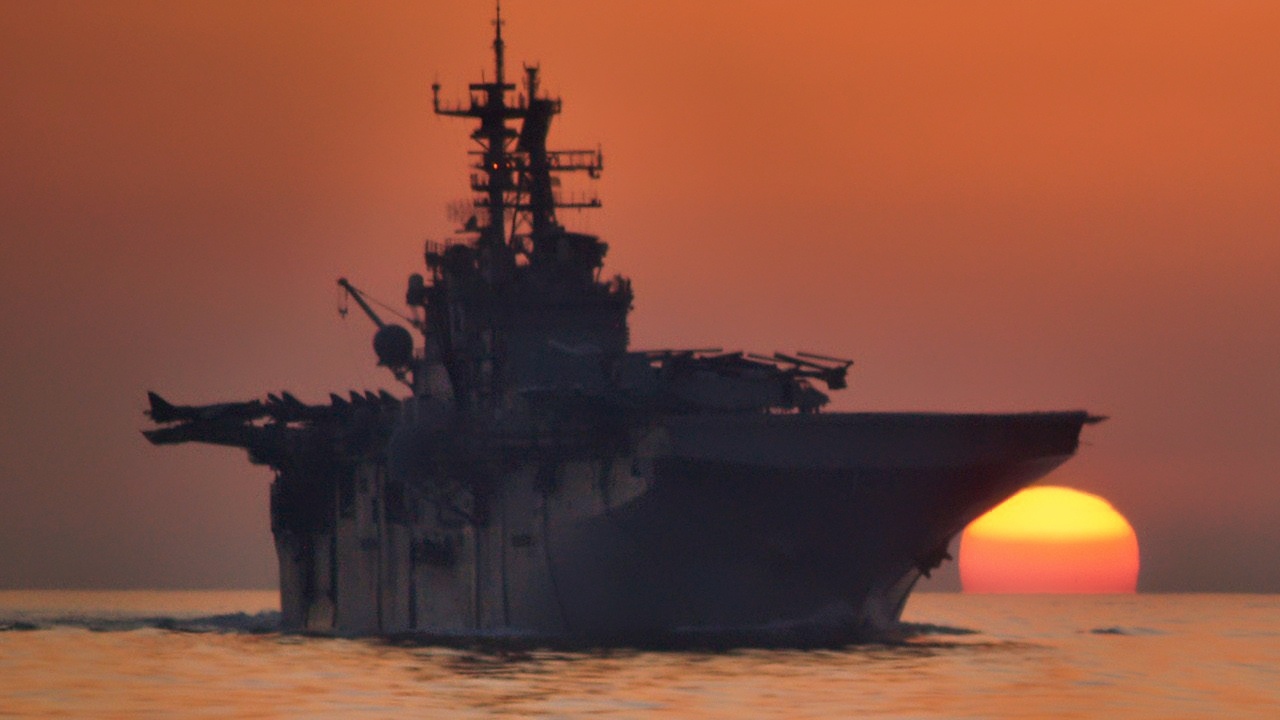
The amphibious assault ship USS Bataan (LHD 5) transits the Strait of Hormuz.
The Fight Would Not Stay On Taiwan
The part Washington prefers not to dwell on is geography. Taiwan is close to China and far from the United States. This cannot be wished away by invoking innovation.
A U.S. defense of Taiwan would have to operate inside a region China has spent decades trying to make hostile to American military power. Ships would be exposed. Air bases in Japan and Guam would matter immediately. Fuel depots, ports, maintenance hubs, and command networks would all become part of the war even if nobody in Washington wanted to say so.
Japan would not be spared in this crisis. U.S. bases there are central to any serious Taiwan contingency. That means Tokyo would face a political and military decision almost as soon as the shooting started. The alliance system would be the operating platform for American strategy, not a diplomatic footnote attached to it.
Loose talk about resolve becomes dangerous here. Resolve is cheap before a war begins. It becomes more expensive when runways are cratered, ships are hit, pilots are lost, and allies begin calculating what the next Chinese missile salvo might mean for their own cities.
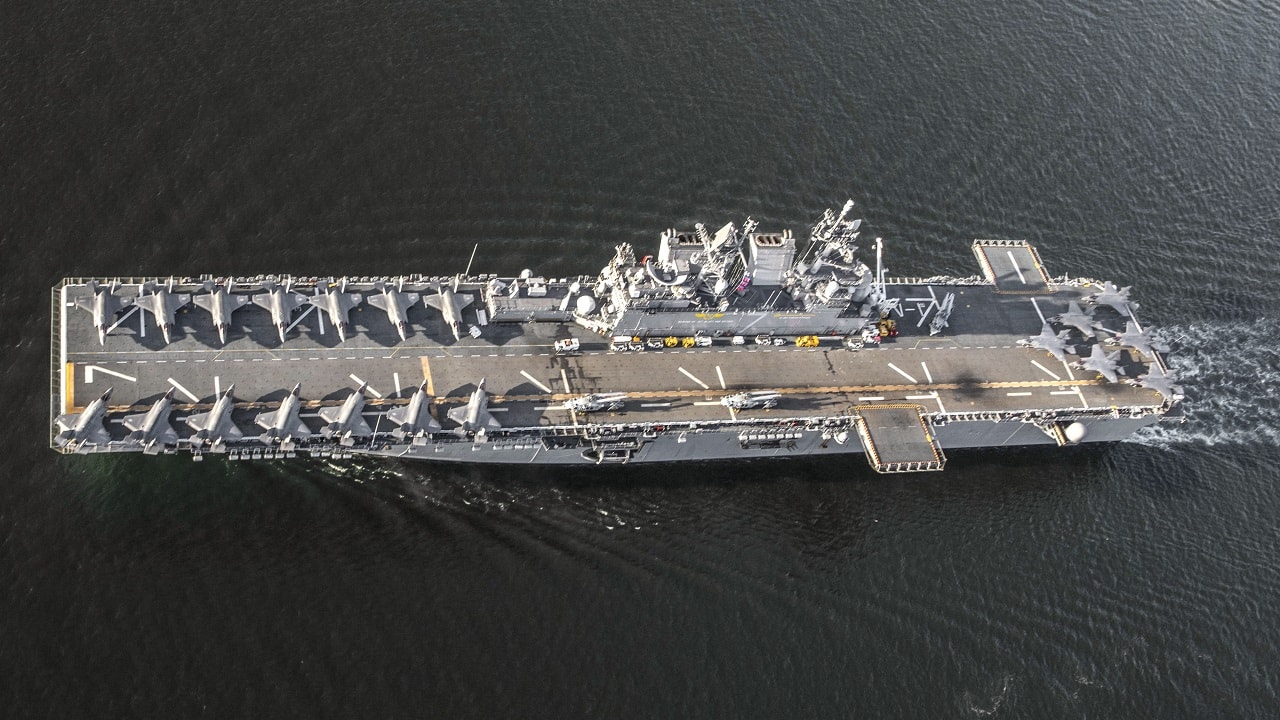
Amphibious assault ship USS Tripoli (LHA- 7) , departs Naval Air Station North Island, Calif., April 7, 2022. Tripoli completed flight deck operations with 20 F-35B Lightning II jets from Marine Fighter Attack Squadrons 211 and 225, Marine Aircraft Group 13, and 3rd Marine Aircraft Wing, as well as Marine Operational Test and Evaluation Squadron 1, as part of the U.S. Marine Corps’ Lightning carrier concept demonstration. The Lightning carrier concept demonstration shows Tripoli and other amphibious assault ships are capable of operating as dedicated fixed-wing strike platforms when needed, capable of bringing fifth generation Short Takeoff/Vertical Landing aircraft wherever they are required. (U.S. Marine Corps photo by Sgt. Samuel Ruiz)
Taiwan Can Survive, and America Can Still Bleed
Recent public wargaming on Taiwan has not concluded that defense is futile. The CSIS Taiwan invasion wargames concluded that U.S., Taiwanese and Japanese forces could frequently defeat a conventional Chinese invasion attempt and maintain Taiwan’s independence — albeit with heavy losses.
The rest of it is less comforting. In those scenarios, the United States and its allies lost dozens of ships, hundreds of aircraft, and thousands upon thousands of service members. Taiwan’s economy was devastated. America’s global position was damaged for years.
That is not an argument for surrender. It is an argument for sobriety. A campaign can succeed by the narrow military standard and still leave the United States strategically weaker. Great-power war has a way of taking neat plans and grinding them into uglier choices.
If the United States is killing Chinese forces at scale, Beijing gets a vote on escalation. China may strike bases beyond the immediate theater. It may use cyber and economic pressure to split American allies. It may accept damage that Washington assumes no rational state would accept.
The Blockade Problem
An invasion is the cleanest scenario analytically and the least likely to be clean. China may prefer something murkier: a quarantine, a partial blockade, pressure against ports and shipping, or a campaign that moves in pulses rather than one dramatic opening blow.
An invasion gives Washington a clearer trigger. A blockade asks the United States when it is willing to start shooting. China would try to make that question uncomfortable, using coast guard vessels, maritime militia, legal claims, and selective pressure on commercial traffic. The point would be to make Taiwan suffer while making American escalation look optional.
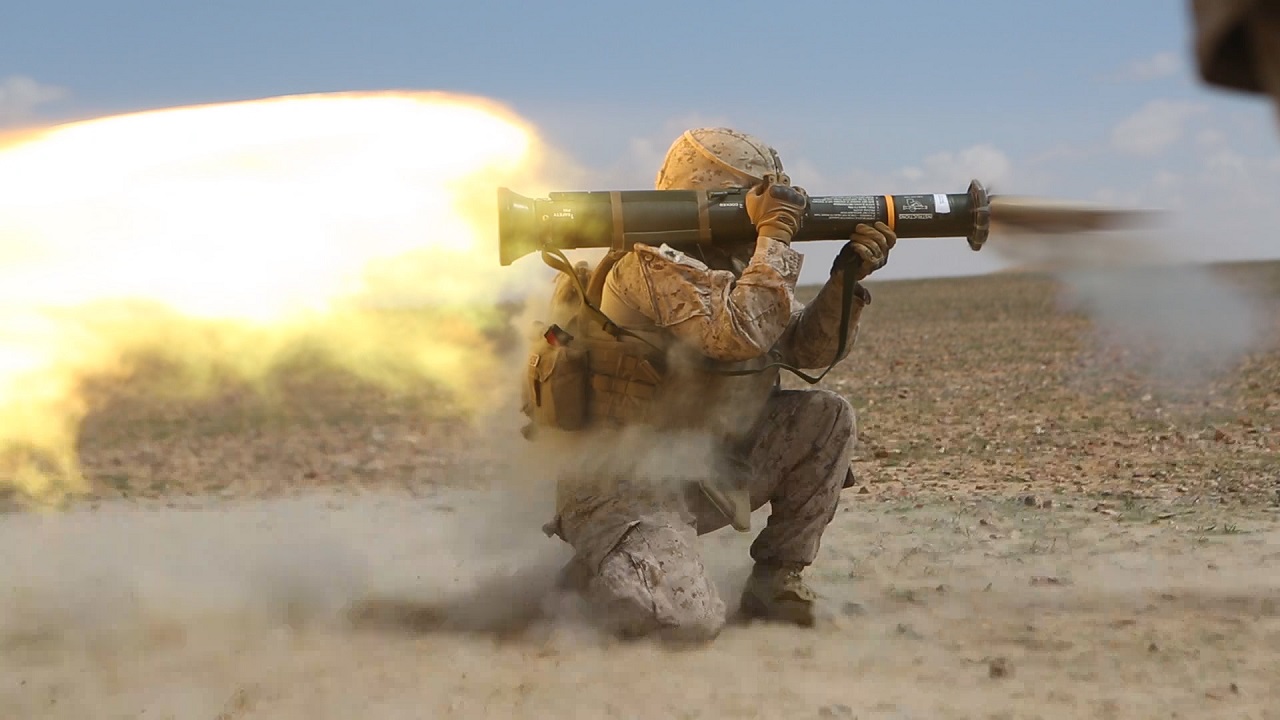
A Marine with Company G, 2nd Battalion, 7th Marine Regiment, Special Purpose Marine Air Ground Task Force – Crisis Response – Central Command, fires an AT4 antitank rocket launcher in the Central Command area of operations, March 23, 2015. The 2/7 Marines participated in a range that tests their ability to conduct an integrated combined arms assault against a simulated enemy position. (U.S. Marine Corps photo by Cpl. Will Perkins/Released)
A Serious Strategy Starts With the Bill
Taiwan has become much harder to coerce or conquer on its own soil and in its own waters. The priority should be survivable denial: replaceable drones, hidden anti-ship missiles, mines that complicate movement, air defenses that protect what has to keep operating, and stockpiles that last longer than the opening exchange.
Washington also has to be more honest about the objective. The aim should be to deny Beijing a quick victory, not to promise an open-ended war for dominance in China’s near seas. Those are different missions. They require different force posture, different alliance diplomacy, and a different tolerance for risk.
Restraint does not mean indifference to Taiwan. It means refusing to confuse an important interest with an unlimited one. Taiwan matters to the people who live there. It matters to Japan. It matters to the balance of power in Asia. It matters to the credibility of American commitments, though that phrase has been stretched thin.
Drones may help Taiwan ruin China’s first week. They may make a landing bloodier, a blockade riskier, and a fait accompli less likely. But they do not repeal geography. They do not remove escalation. They do not make Japan invulnerable, Guam distant enough, or American losses politically painless.
Taiwan is not hopeless. The fantasy is that defending it can be made cheap enough to avoid the tragic part of the choice.
About the Author: Dr. Andrew Latham
Andrew Latham is a professor of international relations and political theory at Macalester College in Saint Paul, MN. You can follow him on X: @aakatham.