
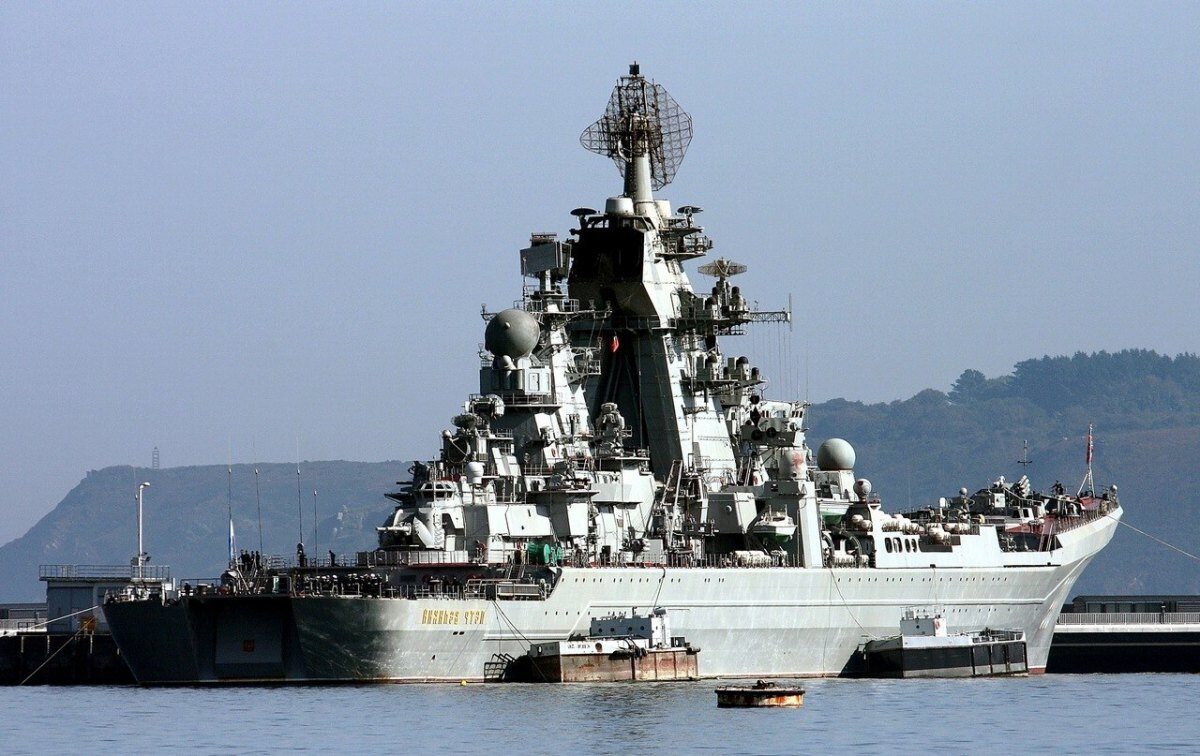
Summary and Key Points: The Soviet Navy conceived Project 1144 in the 1960s as a nuclear-powered anti-submarine ship of roughly 8,000 tons, designed to track American ballistic-missile submarines. Under Admiral Sergey Gorshkov, who rejected the original design as too small, the ship absorbed an anti-ship mission and, after a 1971 merger with the separate Project 1165 missile ship design, an area air defense role as well. The result was the Kirov class, a 28,000-ton, 252-meter nuclear battlecruiser, the largest surface combatant built by any nation since 1945, so far outside modern categories that Western analysts revived a retired term to describe it, from a navy whose doctrine had formally abandoned capital ships.
The Kirov-Class Is Born: An Introduction
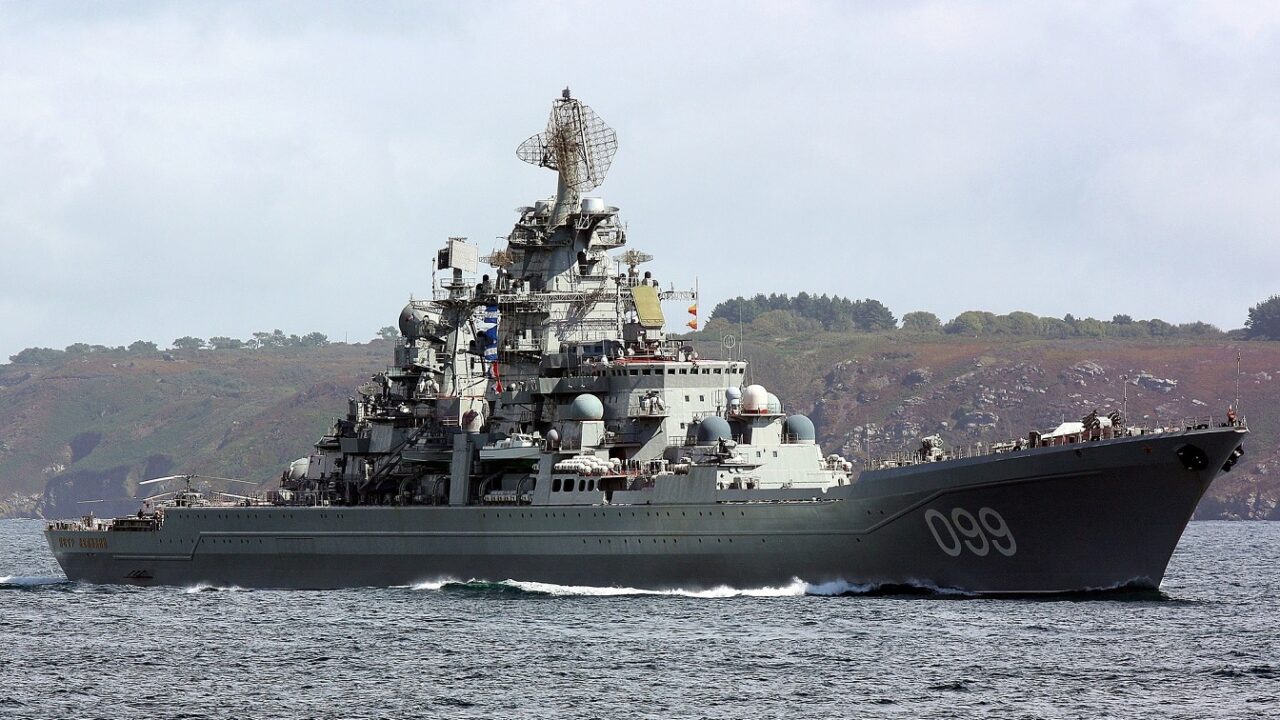
Russian Battlecruiser Kirov-class. Image Credit: Creative Commons.
The Kirov class is the biggest surface combatant any navy has put to sea since 1945, a 28,000-ton nuclear-powered giant the size of a World War I battleship. The Soviet Union never meant to build anything like it. The program that produced the Kirov began in the 1960s as a modest nuclear submarine hunter of around 8,000 tons, and it grew into a battlecruiser, with requirements added one at a time, driven by a single admiral, the sinking of an Israeli warship in 1967, and a merger of two separate ship designs. The name “battlecruiser” is an accident of that growth, not a plan.
The Severnoye Design Bureau in Leningrad set out in the 1960s to build a nuclear-powered ship to hunt American ballistic missile submarines, and the vessel it had in mind was roughly the size of a large destroyer. What eventually slid down the slipway at the Baltic Shipyard was the heaviest surface warfare vessel constructed by any nation since the Second World War, a ship Western analysts could describe only by reaching back to a category the world had abandoned decades earlier. The story of how a submarine hunter became a battlecruiser is a case study in requirements growth, in the influence of one determined naval commander, and in a Soviet Navy that officially wanted nothing to do with capital ships yet built the largest one of the modern era anyway.
The Ship the Soviet Union Did Not Intend to Build
To understand how unlikely the Kirov was, start with where Soviet naval thinking stood when the project began. After Stalin’s death in 1953, Premier Nikita Khrushchev scrapped the old Soviet naval program that had called for battleships, battlecruisers, and long-range gun cruisers, canceling that entire vision of a big-gun surface fleet. In its place, the Soviet Navy turned to missiles and submarines as the asymmetric answer to American naval superiority, a doctrine that shaped Soviet shipbuilding for decades and produced a fleet of missile-armed cruisers and submarines rather than traditional capital ships. The Soviet Union, in other words, had deliberately gotten out of the business of building large surface warships. The plan was to counter the U.S. Navy with cheaper, more specialized platforms, not to match it hull for hull.
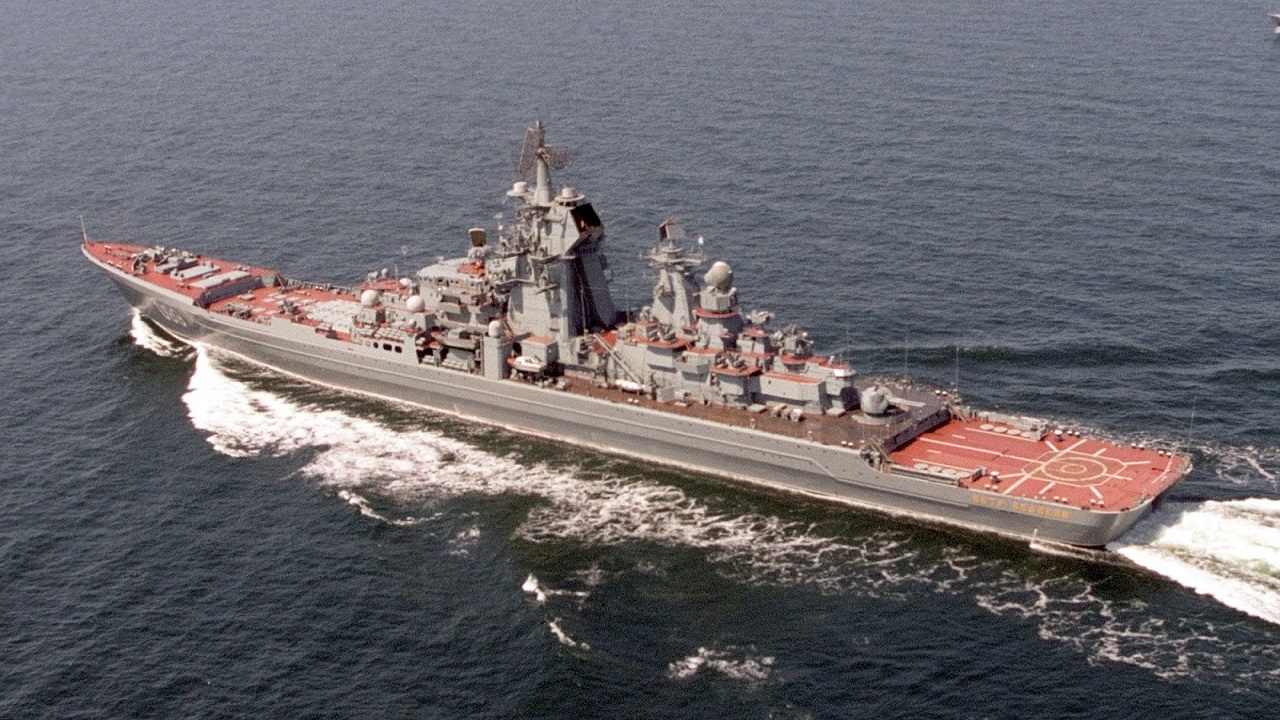
Kirov-Class battlecruiser. Image Credit: Creative Commons.
Against that backdrop, the Soviet Navy began studying a nuclear-powered surface warship in the mid-1960s, resuming work it had interrupted in the 1950s. The American nuclear-powered cruiser USS Long Beach, commissioned in 1961, and the broader U.S. experiment with an all-nuclear surface task force built around the carrier Enterprise, gave the project its impetus. If the Americans were putting reactors in surface combatants, the argument ran, the Soviet Navy should have the capability too. Nuclear propulsion offered effectively unlimited range and the ability to operate independently in distant oceans, exactly what a navy trying to project power far from home would want. The question was what kind of ship to wrap around the reactor, and the initial answer was modest.
An 8,000-Ton Submarine Hunter
The project received the designation 1144 and the codename Orlan, meaning sea eagle, and its original purpose was narrow and specific. The Northern Design Bureau was given terms of reference for a large anti-submarine ship with a nuclear power plant and a displacement of about 8,000 tons, according to Russian state reporting, and its intended job was to hunt enemy ballistic-missile submarines, track American boomers continuously, and sink them the moment war broke out.
This was a raider, a nuclear-powered submarine killer built for long-endurance oceanic patrols, and nothing about the initial concept suggested a battleship-sized vessel. The chief designer assigned to the project, Boris Kupensky, had previously designed the Soviet Union’s first gas-turbine-powered warships, the Project 61 destroyers, and the natural expectation was a large destroyer or destroyer escort with a reactor.
The anti-submarine focus reflected where Soviet doctrine had placed its surface ships. After the last of the Project 58 missile cruisers was delivered in 1965, the Soviet Navy went nearly a decade without building surface ships intended to fight enemy surface vessels, because nuclear submarines were considered the primary attack force and surface ships were assigned mainly to the anti-submarine role.
The early Project 1144 was a product of that thinking, a specialized platform for one demanding mission. Had it been built as first conceived, it would have been a large but unremarkable nuclear escort, forgotten alongside dozens of other Cold War designs. Two forces pushed it in a completely different direction.
The Eilat and the Case for Attack
The first force was a single event in the Mediterranean. On October 21, 1967, an Egyptian missile boat of Soviet manufacture sank the Israeli destroyer Eilat using Soviet-built Styx anti-ship missiles, the first time a surface-launched guided missile had sunk a warship in combat. The sinking was a highly visible demonstration of what cheap anti-ship missiles could do, and it reverberated through the Soviet Navy’s leadership.
It gave the naval command the argument it needed to convince the Soviet political and military leadership that surface ships should carry serious anti-ship attack capability rather than being confined to the anti-submarine role. The lesson of Eilat was that the surface combatant, written off in Soviet doctrine as a submarine’s junior partner, could once again be a potent striking platform if armed with modern missiles.
That shift in thinking landed directly on Project 1144. A ship conceived to hunt submarines now took on a second mission: to attack enemy surface ships, specifically to threaten the American aircraft carrier battle groups that represented the core of U.S. naval power. The Soviet Navy had settled on a layered anti-carrier strategy built around long-range bombers, submarines, and heavily armed surface ships, all firing missiles to overwhelm a carrier’s defenses through saturation. A large nuclear-powered ship with long endurance was an appealing platform for that anti-ship role, and so the anti-submarine cruiser began acquiring the weapons and the mission of a carrier killer. Each added capability demanded more space, more power, and more displacement.
Gorshkov’s Ship
The second and more decisive force was a person. Admiral of the Fleet of the Soviet Union Sergey Gorshkov commanded the Soviet Navy from 1956 to 1985, and he was the architect of its transformation from a coastal defense force into a blue-water fleet capable of global operations.
Gorshkov wanted capital ships that could form surface action groups and project Soviet power and prestige around the world, and Project 1144 became a vehicle for that ambition. When the Northern Design Bureau planned the ship at a modest 8,000 to 9,000 tons, Gorshkov rejected the design as too small. He wanted more, and his insistence drove the displacement upward.
The pivotal decision came in August 1971, when Soviet planners merged Project 1144, the anti-submarine cruiser, with Project 1165, a separate design that would have carried P-700 Granit anti-ship missiles. Combining the two put anti-submarine, anti-ship, and area air-defense missiles into a single hull, and after this merger, displacement began climbing in earnest. A ship that was supposed to displace 8,000 tons was now required to carry three distinct missile systems and their associated sensors, and the size grew to accommodate them.
The technical design was approved in 1972 at a standard displacement that would eventually exceed 20,000 tons, and by the time the ships were complete, they displaced around 24,000 tons standard and up to 28,000 tons fully loaded. The requirements had roughly tripled the vessel’s size since its original conception, and each expansion had its own logic, even as the cumulative result was a ship no one had originally set out to build.
Why a Battleship Needs a Backup Engine
Gorshkov left another fingerprint on the design that speaks to how new and how risky the whole enterprise was. He demanded that the ship carry a conventional oil-fired steam plant as a backup to its nuclear reactors, an arrangement the Soviets called combined nuclear and steam propulsion.
The reason was reliability. Soviet experience with naval reactors was still limited, and the November-class submarines had suffered reactor accidents that made a deep impression on the naval command. Gorshkov feared what would happen if a Kirov’s reactor failed at sea, leaving the ship dead in the water far from home, and he insisted on a backup that could burn ordinary fuel to get the vessel moving again.
The resulting design allows a Kirov to make around 20 knots on nuclear power alone or exceed 30 knots with both plants together.
The concern proved prescient. The lead ship suffered a reactor accident in 1990 during a Mediterranean deployment, and the damage was never repaired given the collapsing Soviet economy and the political upheaval of the period. Gorshkov’s insistence on a backup propulsion system, which added weight and complexity to an already enormous ship, looks, in hindsight, like sound engineering judgment regarding an immature technology.
It also illustrates the pattern that defines the whole program. Every reasonable requirement, the anti-ship missiles, the layered air defense, the redundant propulsion, added mass, and the mass accumulated into a vessel of unprecedented size.
The Class That Grew Too Large for Its Own Navy
The Soviet Navy recognized, even during construction, that the ship had become unwieldy. While the lead vessel was already on the slipway, designers attempted to separate the anti-air, anti-submarine, and anti-ship functions back into distinct ships, starting work on a nuclear escort design and a nuclear strike cruiser design. Those efforts went nowhere. More tellingly, the Soviets developed the conventionally powered Slava class, Project 1164, as a cheaper and less demanding fallback to the Kirov, a smaller gas-turbine cruiser carrying a comparable anti-ship punch at a fraction of the cost and complexity.
The existence of the Slava class was an admission that the Kirov had become too large and too expensive to build in the numbers the navy needed.
Of the five Kirov-class ships originally planned, only four were completed, spread over a construction period that ran from 1974 into the late 1990s as the program stretched into the entire final act of the Soviet Union.
The finished ships were formally classified by the Soviets as heavy nuclear-powered missile cruisers, and that terminology matters because the “battlecruiser” label so common in the West was never an official designation. NATO and Western defense commentators reached for the term because the ships were simply too big to fit any modern category. At around 252 meters long and up to 28,000 tons, the Kirovs were close in size to the battleships of the First World War, and no other navy had built a surface combatant of that scale since 1945.
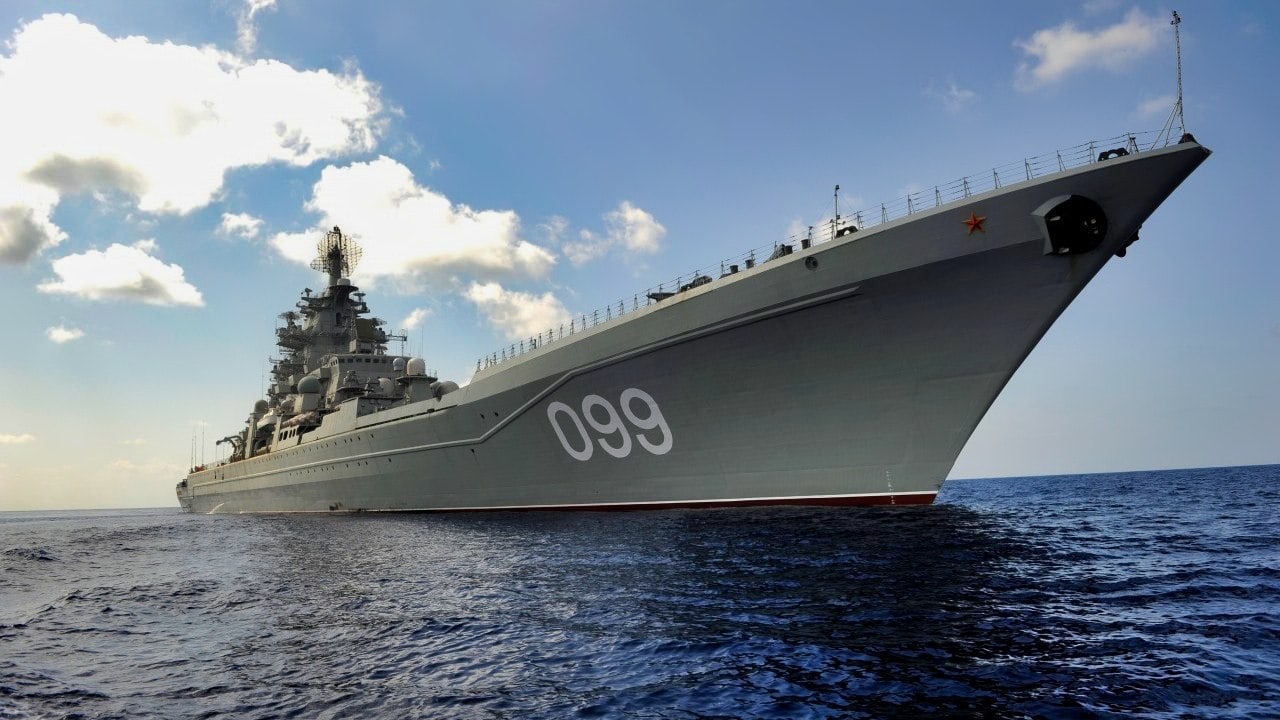
Kirov-Class Battlecruiser Russian Navy
The lead ship so unsettled Western observers that its appearance contributed directly to the U.S. Navy’s decision to recommission its Iowa-class battleships in the 1980s, a response to a Soviet ship that looked, to American eyes, like a return of the capital ship. The irony is that the Soviet Union had abandoned the capital ship decades earlier and never intended to revive it.
An Accidental Battlecruiser
The Kirov class endures as one of the more revealing artifacts of Soviet naval ambition, precisely because it was never designed to be what it became. The program began as a focused effort to build an 8,000-ton nuclear submarine hunter, a specialized tool for a single Cold War mission. It ended as a 28,000-ton behemoth carrying twenty long-range anti-ship missiles, ninety-six air-defense missiles, and a full anti-submarine suite, a ship that tried to do everything and grew to battleship size in the attempt.
The transformation was not the product of a grand decision to build the largest warship of the modern era. It was the sum of individually sensible choices, the lesson of the Eilat, Gorshkov’s rejection of the small design, the 1971 merger of two programs, the demand for redundant propulsion, each one adding capability and displacement until the original concept was unrecognizable.
The Soviet Navy set out to avoid building capital ships, yet built the biggest surface combatant the world had seen since the battleship era, without ever quite deciding to.
The Kirov class is what happens when requirements accumulate faster than anyone steps back to ask whether the result still makes sense, and the ships that resulted were so large that the only word the West could find for them was one the world thought it had retired.
The name was never the plan. It was what the ship became when a submarine hunter kept absorbing missions until it ran out of room to grow.
About the Author: Harry J. Kazianis
Harry J. Kazianis (@Grecianformula) was the former Senior Director of National Security Affairs at the Center for the National Interest (CFTNI), a foreign policy think tank founded by Richard Nixon based in Washington, DC. Harry has over a decade of experience in think tanks and national security publishing. His ideas have been published in the NY Times, The Washington Post, The Wall Street Journal, CNN, and many other outlets worldwide. He has held positions at CSIS, the Heritage Foundation, the University of Nottingham, and several other institutions related to national security research and studies. He is the former Executive Editor of the National Interest and the Diplomat. He holds a Master’s degree focusing on international affairs from Harvard University.

