
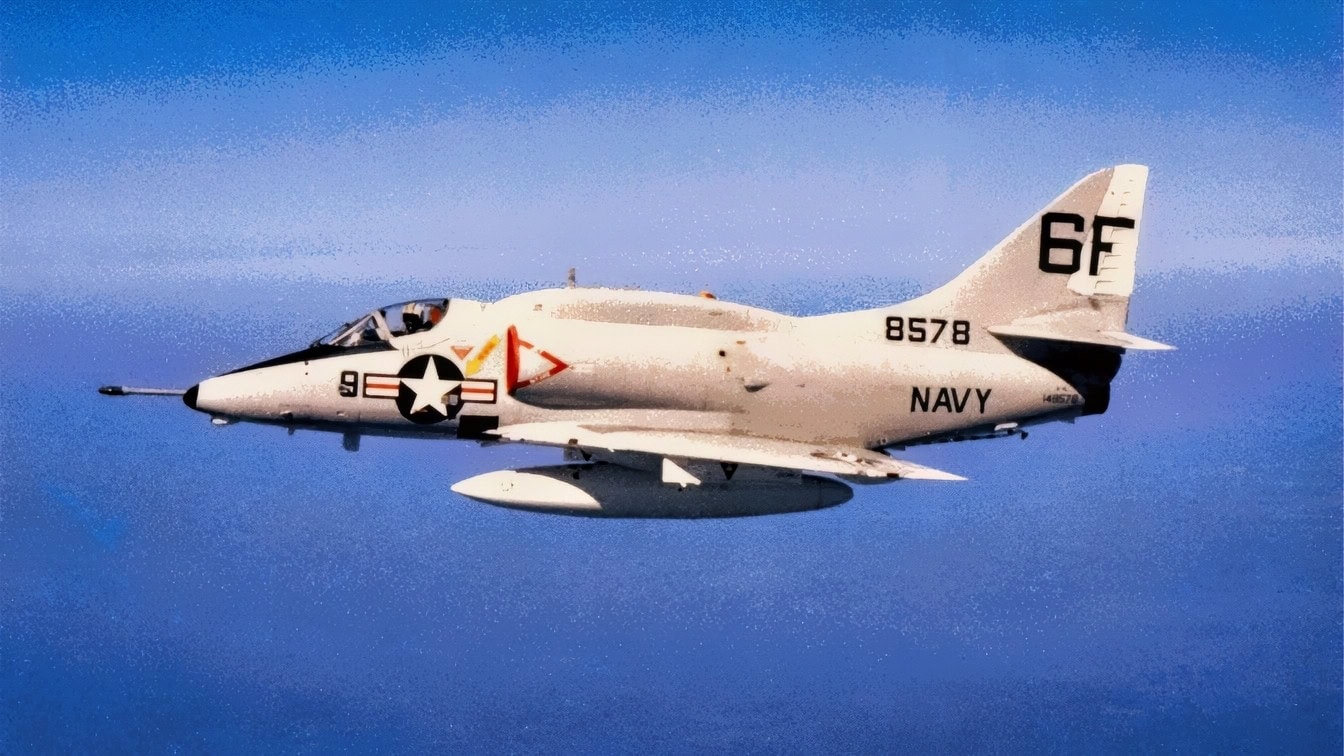
One of the most underappreciated aspects of modern aviation design is the ejection seat. Typically, ground crews perform regular aircraft maintenance to ensure that nothing goes wrong in the air. However, no one can fully prevent accidents.
Sometimes, maintenance is performed incorrectly, or sometimes an aircraft simply malfunctions with no plausible explanation.
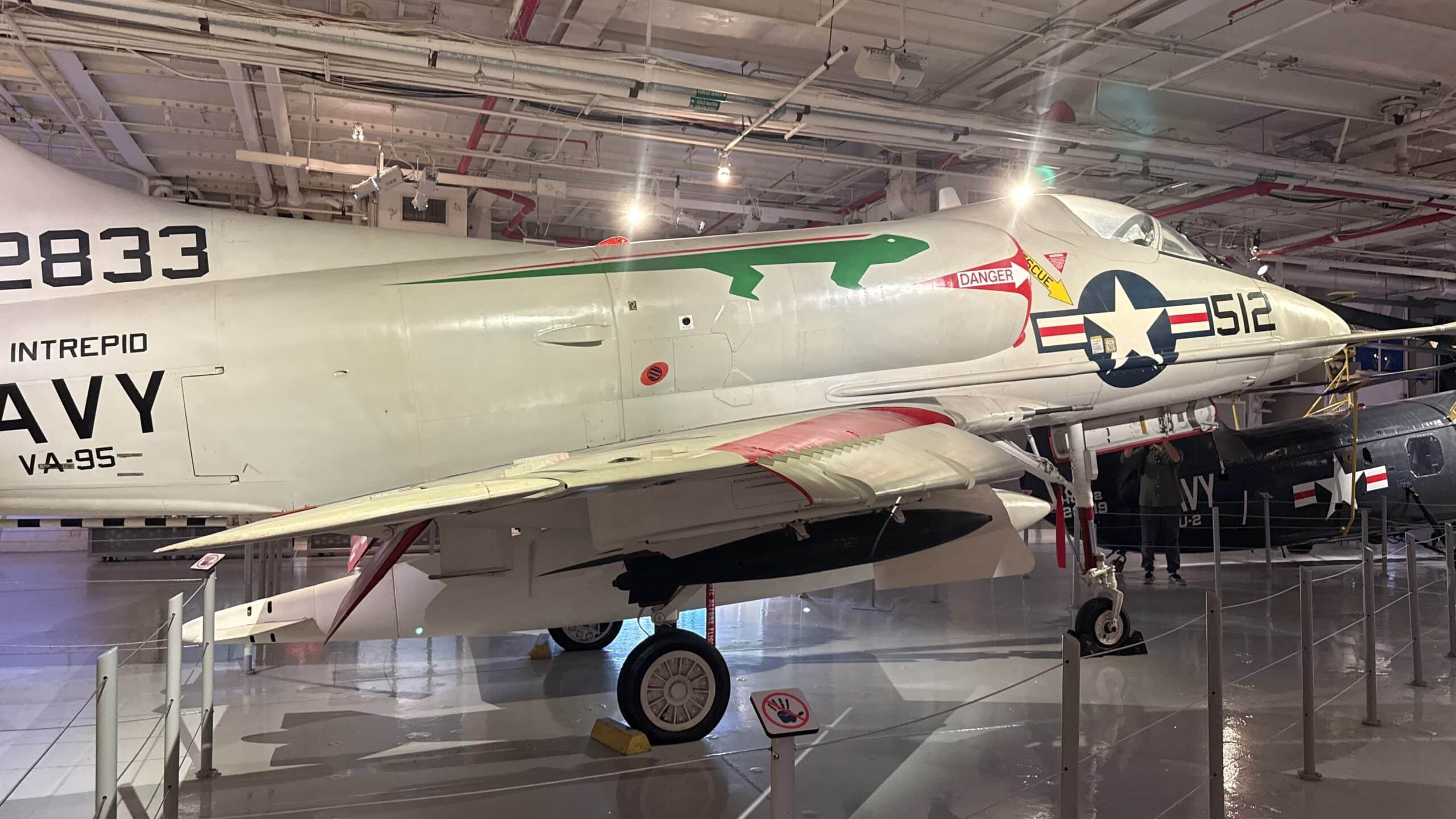
A-4 Skyhawk 19FortyFive Photo from USS Intrepid.
In these frightening scenarios, a good ejection seat can be the difference between life and death. Designing a proper ejection system is an art in and of itself.
The angle of ascent, the rocket motor, and the parachute must all be perfect to keep the pilot safe in most conditions.
Ejecting From the A-4: Ken VanderHorst’s Story
Take Ken VanderHorst, for example. Ken VanderHorst was a naval fighter pilot who flew the A-4 Skyhawk.
During a sand blower (low-flying) mission somewhere in California, VanderHorst’s A-4 experienced a catastrophic turbine failure, which caused his aircraft to burst into flames.
“I had a catastrophic turbine failure that essentially buzz sawed the back end of my plane and turned the plane into a fireball,” he recalled later. At the time, he was flying at around 500 knots (575 miles per hour) while flying low to the ground. With no other option, VanderHorst ejected from his plane. “So yes, you can eject while on fire. Indeed, that is almost certainly your best option for a serious fire,” he continued.
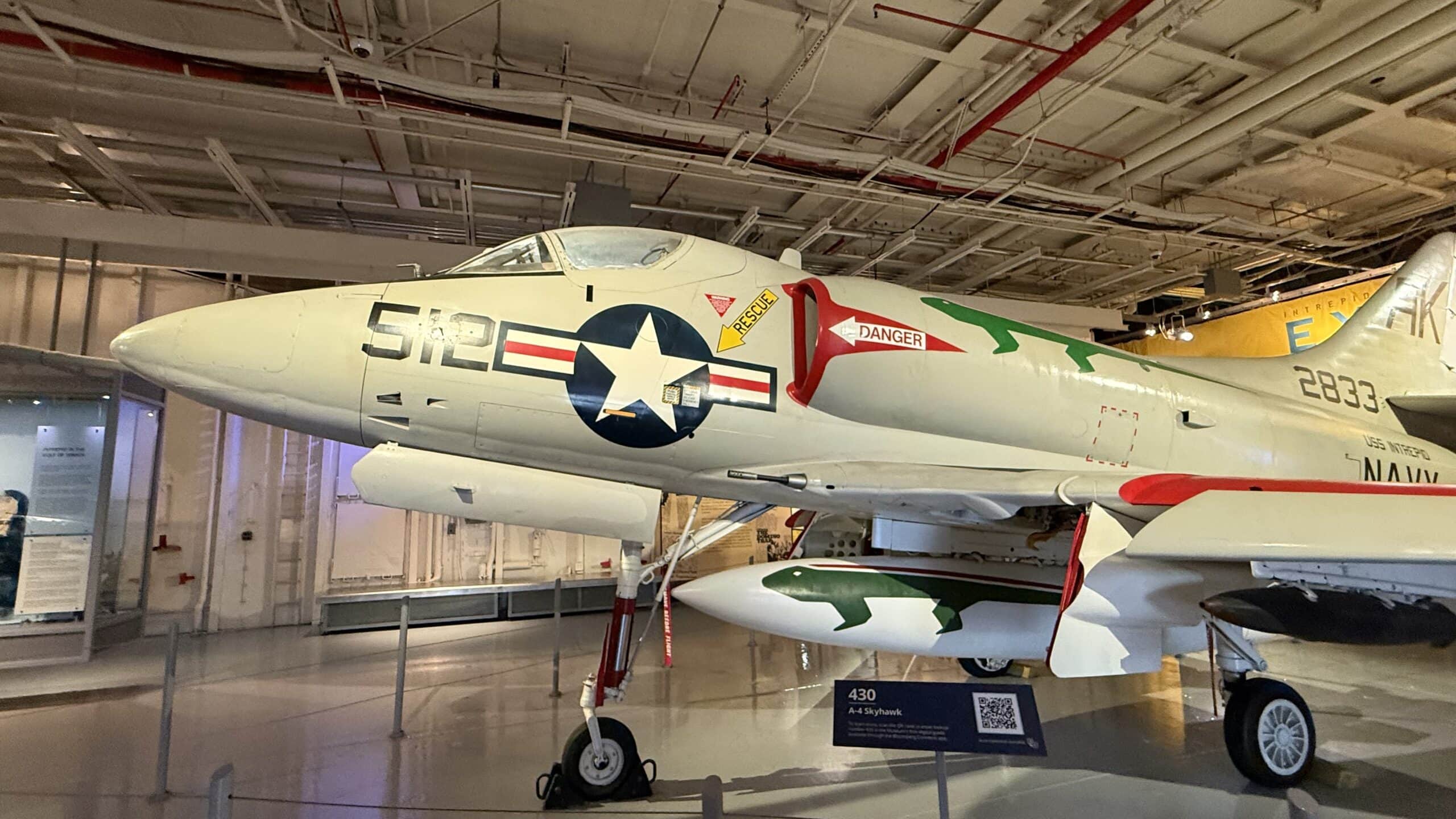
A-4 Skyhawk 19FortyFive Photo from USS Intrepid.
Ejecting at low-altitude, however, is not ideal.
The event took a serious physical toll on VanderHorst, though he recovered and returned to flight duty. “I had some burns and some serious flailing injuries, but survived. I later returned to flight duty.” His injuries were further exacerbated by the fact that he ejected while flying at over 500 mph. “At 500+ knots, your extremities get caught by the air blast and they ‘flail’ around. Injured my left leg and left arm. I recovered and flew again. But I was warned that when I turn 60, my old injuries would come back to haunt me. I’m 70 this year, and now I understand what the flight surgeon meant. Lotsa issues,” he concluded.
Intro into the A-4 Skyhawk
The A-4 Skyhawk did not have the luxury of the latest and greatest technology from Martin-Baker. First designed in the 1950s by Douglas, the A-4 was a carrier-capable light attack aircraft meant to replace the propeller-driven A-1 Skyraider.
Despite being much smaller and lighter, the Skyhawk’s five hardpoints allowed it to carry the bomb equivalent of a B-17 Flying Fortress, and could even carry nuclear bombs.
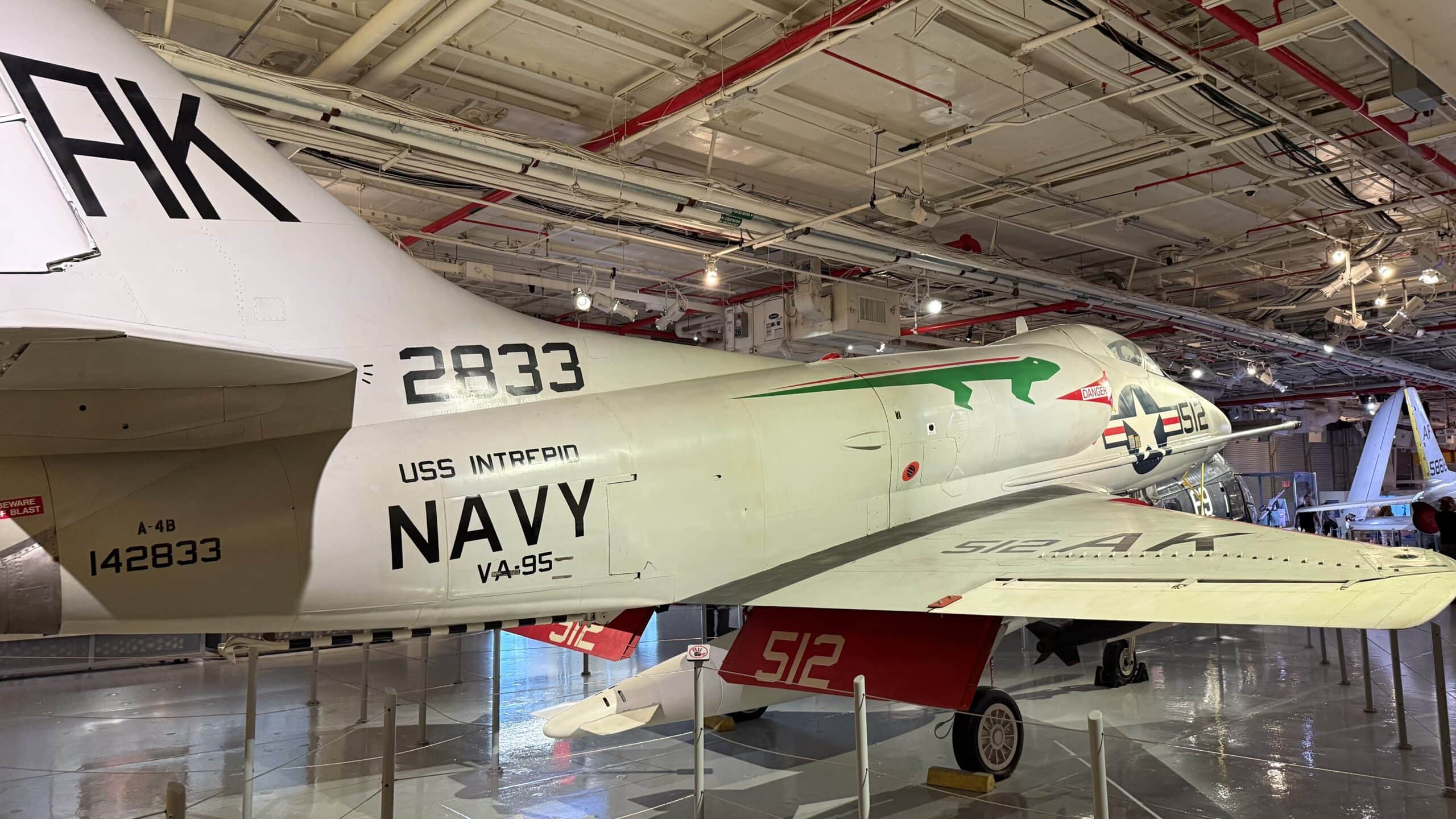
A-4 Skyhawk 19FortyFive Photo from USS Intrepid.
It was also one of the first aircraft to participate in “buddy” air-to-air refueling. Powered by a Pratt & Whitney 52-P-6A turbojet engine, the aircraft was subsonic—boasting a modest speed of only 673 mph and a range of 1,008 nautical miles.
With over 2,900 airframes built, the aircraft saw service worldwide.
The Skyhawk flew routinely throughout the Vietnam War and provided air-to-ground support for infantry, and although it scored only one air-to-air kill, it quickly became the Navy’s workhorse during the war.
The A-4 served many nations abroad, including the Israeli Air Force, the Argentinian Air Force, the Indonesian Air Force, and many others worldwide.
Although it was designed in the 50s, many air forces around the world continued to maintain and modernize the aircraft, keeping it in service well into the 2000s. Since the end of the Cold War, most air forces have retired the Skyhawk, though the Brazilian Air Force still maintains four modernized A-4s for training.
The Wonders of Modern Ejection Seats
The A-4 Skyhawk used the Douglas ESCAPAC series of ejection seats. This series was used in several aircraft, including the A-7 Corsair II, the S-3 Viking, and early iterations of the F-15 and the A-10 Warthog. The seat is attached to the rails with a set of rollers along the rear side of the seat.
The system is designed to break the aircraft’s canopy before the pilot’s helmet strikes it, minimizing the number of injuries during ejection.
As part of a new generation of ejection seats, later ESCAPACs incorporated rocket propulsion systems, which are especially helpful when ejecting from lower altitudes, as VanderHorst did.
Later versions were fitted with the DART stabilization system, which helped minimize whiplash during the initial ejection.
Since then, the technology has improved significantly. Martin Baker is a world leader in the ejection seat industry.
While the overall design has stayed the same, today’s technology allows safer ejections and reduces the risk of ejecting at all altitudes. The F-35, for example, is fitted with the US16E ejection seat.
This seat retains a similar layout to the ESCAPAC series, but is more refined to accommodate today’s needs. The headrest is designed to accommodate larger helmets used by F-35 pilots.
The seat features advanced stabilization to keep the pilot upright even when ejecting at awkward angles, and it incorporates life support and helmet-connected communication systems to keep the pilot in contact with command even after ejection. Thus far, the US16E has saved 12 lives during its tenure with the F-35.
About the Author: Isaac Seitz
Isaac Seitz, a Defense Columnist, graduated from Patrick Henry College’s Strategic Intelligence and National Security program. He has also studied Russian at Middlebury Language Schools and has worked as an intelligence Analyst in the private sector.