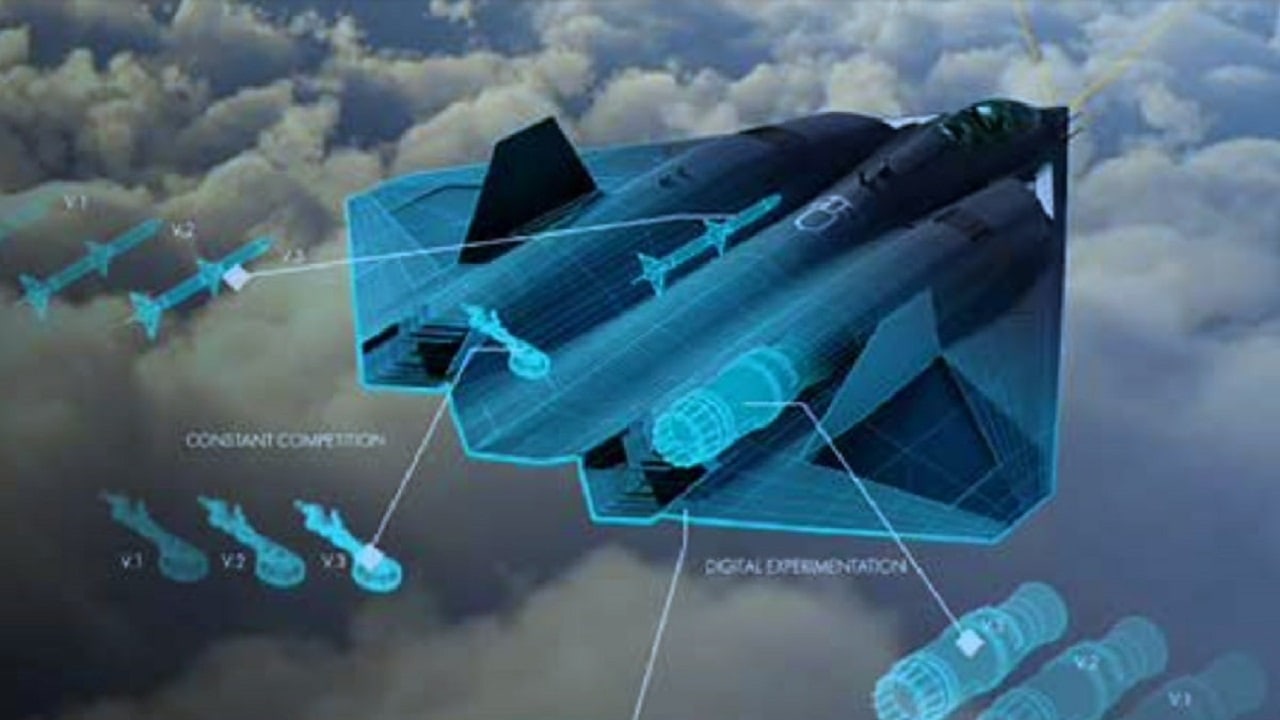
Before the F-22 Raptor fifth-generation air-superiority stealth fighter took to the skies for official duty, the Air Force tested another experimental system. Known as the X-44 Multi-Axis No-Tail Aircraft (MANTA), this plane was basically an F-22 without a tail.
In fact, some people have claimed that the X-44 MANTA, although it never moved beyond the planning stage, might have been the plane that the Air Force’s F-47 sixth-generation warplane was based upon.
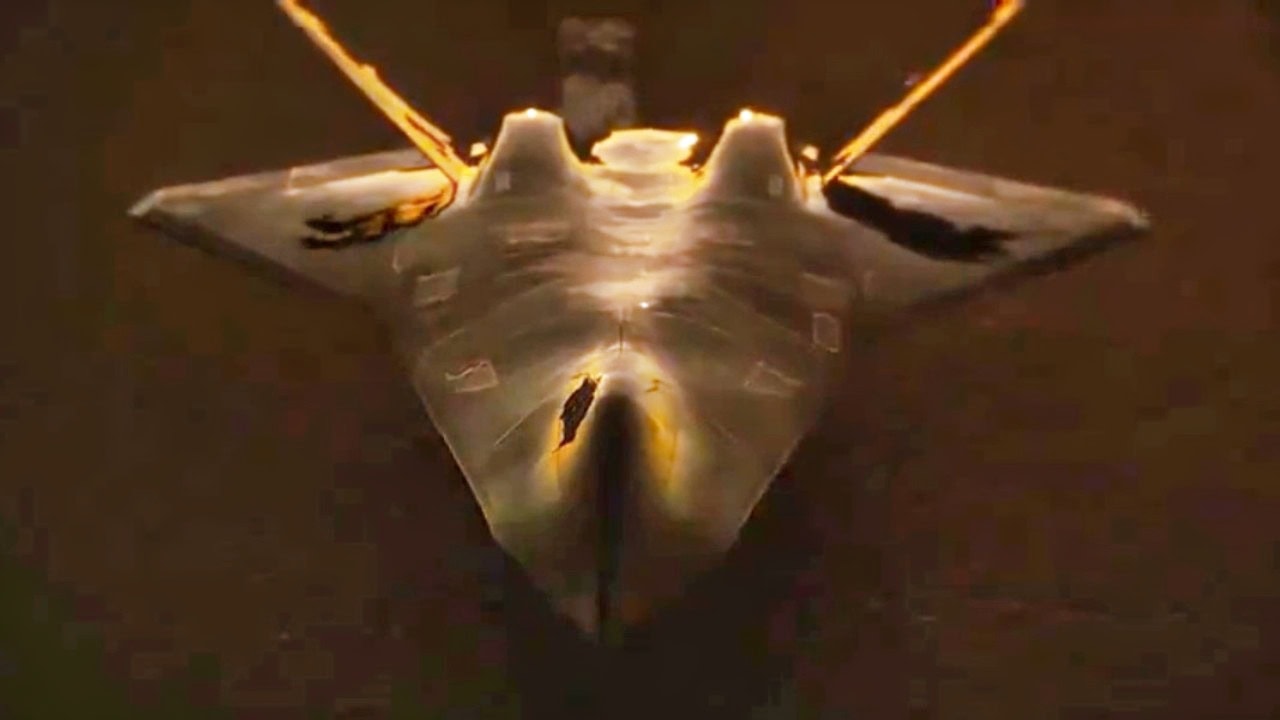
F-47 Fighter from Boeing. Image Credit: U.S. Air Force Screenshot.
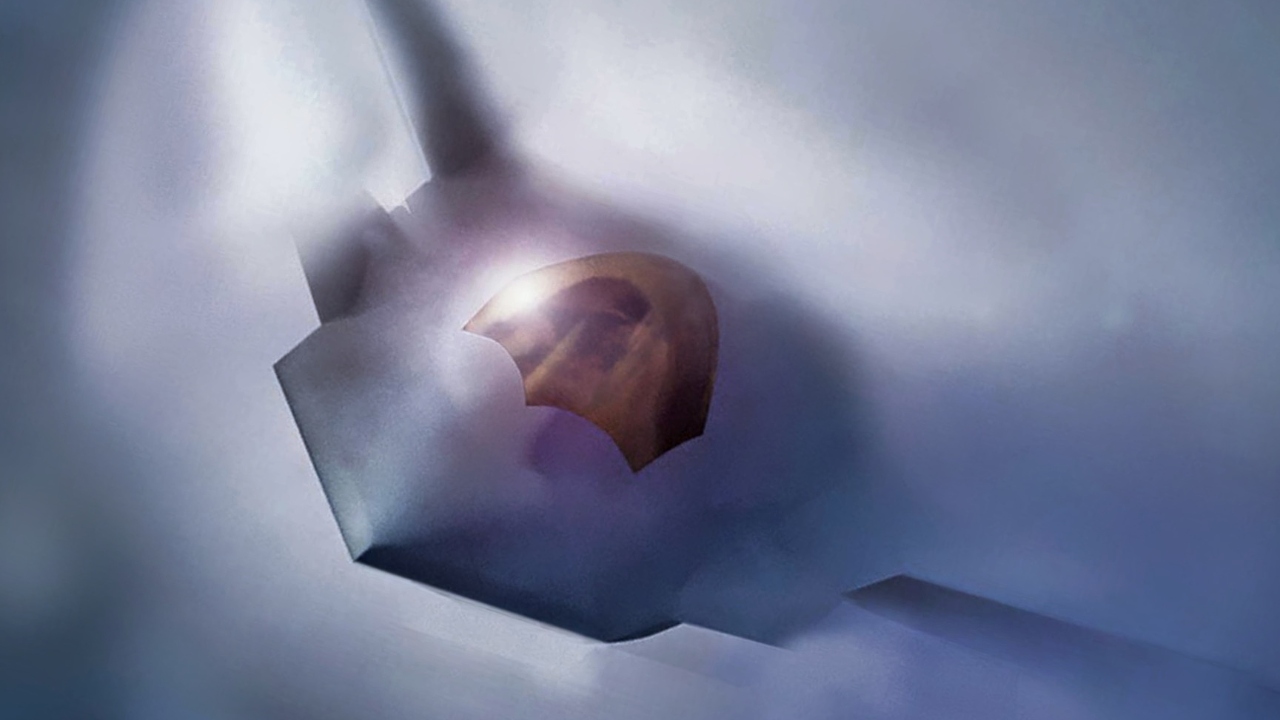
Shown is a graphical artist rendering of the Next Generation Air Dominance (NGAD) Platform. The rendering highlights the Air Force’s sixth generation fighter, the F-47. The NGAD Platform will bring lethal, next-generation technologies to ensure air superiority for the Joint Force in any conflict. (U.S. Air Force graphic)
Meet the X-44 MANTA
The late 1990s were a decade of hope and great innovation.
The Cold War ended in a bloodless victory for the West.
Hootie and the Blowfish reigned supreme. And the US Air Force, NASA, Lockheed Martin, and Pratt & Whitney were playing with some absolutely science fiction designs for potential warplanes, as the world moved toward the twenty-first century.
X-44 MANTA was a product of that time.
Using an early F-22 prototype as a starting point, the Raptor’s normal wings and arrangement would have been replaced with a much larger delta-type wing.
As noted above, the biggest difference was the tail. Conventional planes use aerodynamic control surfaces to manipulate pitch, yaw, and roll.
But the X-44 concept called for advanced thrust-vectoring nozzles capable of redirecting engine exhaust to generate the forces normally produced by rudders, stabilizers, and other key control surfaces.
Indeed, the F-22 had already demonstrated the importance of thrust vectoring. But its two-dimensional nozzles primarily contribute to pitch control.
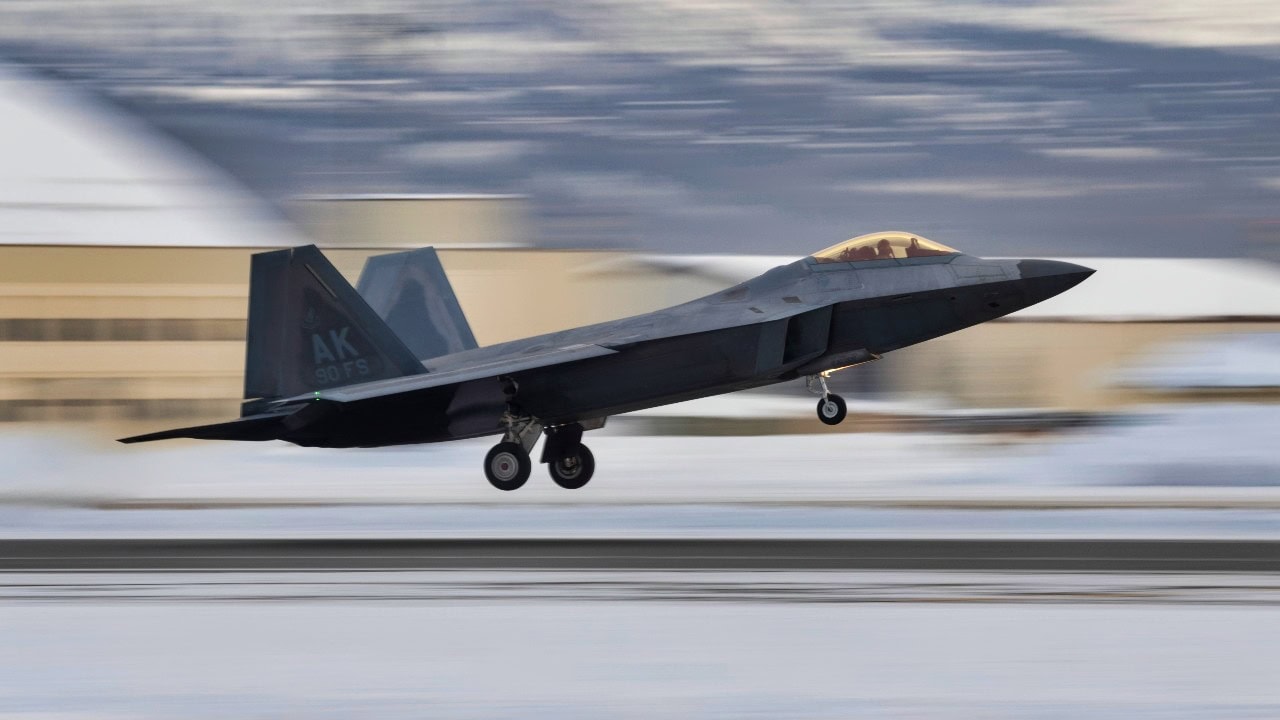
A U.S. Air Force F-22 Raptor assigned to the 3rd Wing takes off from Joint Base Elmendorf-Richardson, Alaska, Nov 21., 2023. The F-22 Raptor is a critical component of the Global Strike Task Force, and is designed to project dominance rapidly and at a great distance to defeat threats. (U.S. Air Force photo by Alejandro Peña)
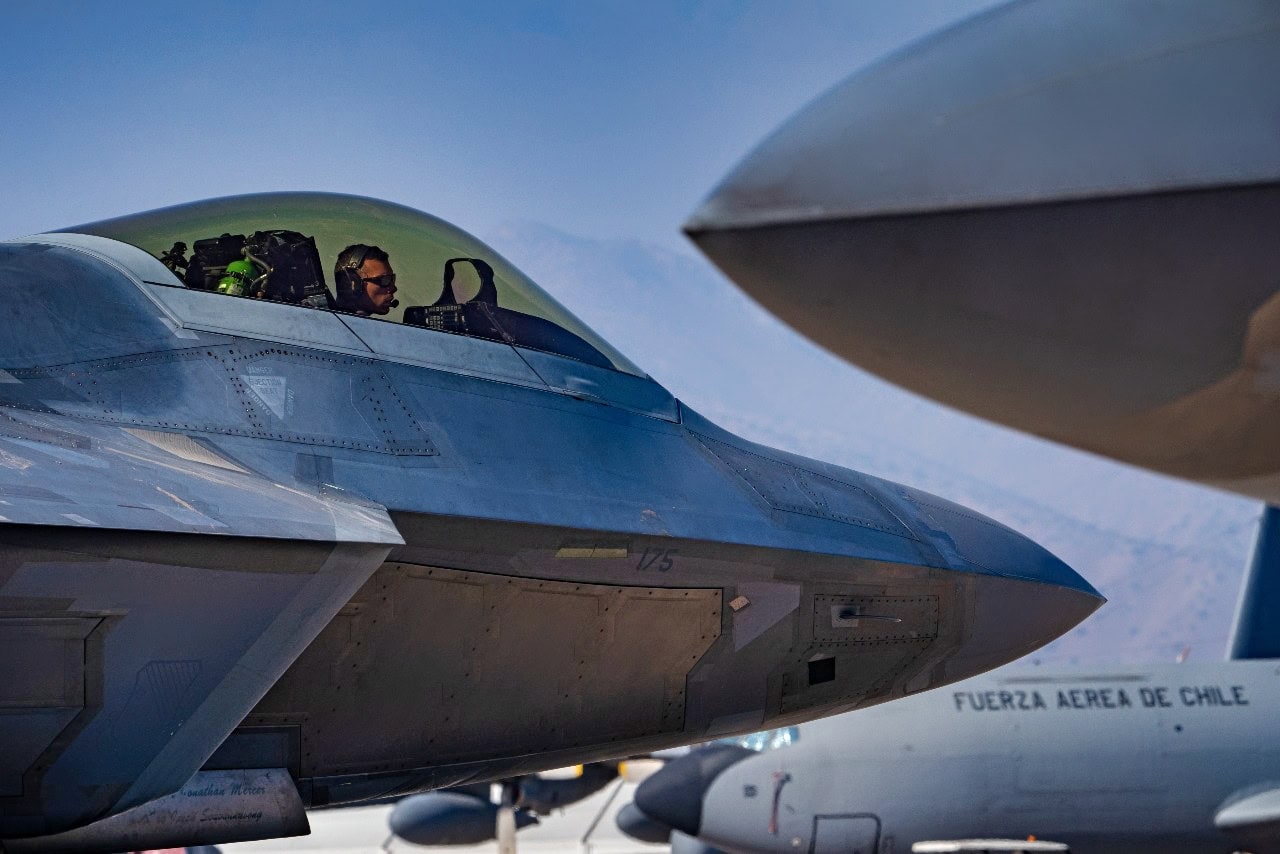
U.S. Air Force Technical Sgt. Fernando Llama, F-22 Demo Team avionics specialist, preforms an engine run to check all aircraft systems are good-to-go for the 2022 FIDAE Air & Trade Show, April 3, 2022 in Santiago, Chile. Avionics specialists like Llama are responsible for the maintenance of the onboard flight computers, integrated avionics, and many electrical systems and components. (U.S. Air Force photo by Staff Sgt. Don Hudson)
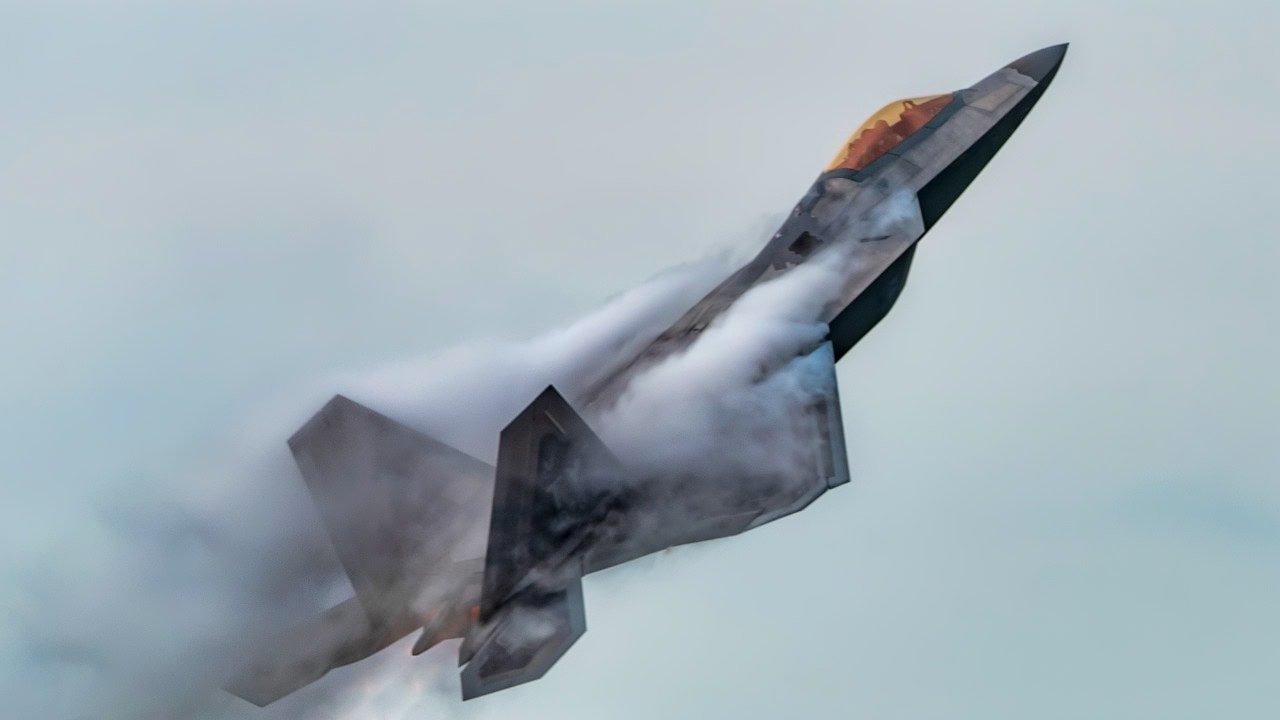
U.S. Air Force Maj. Paul Lopez, F-22 Demo Team commander, pulls into the vertical during the Battle Creek Field of Flight air show July 7, 2019. Maj. Lopez has over 1,500 hours flying both the F-15 Eagle and the F-22 Raptor and is in his second year as the commander of the F-22 Raptor Demonstration Team. (U.S. Air Force photo by 2nd Lt. Samuel Eckholm).
The X-44 used multidirectional thrust vectoring as a key component of controlling the aircraft along all three axes.
If successful, the arrangement potentially offered several advantages for the X-44.
By eliminating the tail, the designers of the X-44 believed they could reduce the weight and mechanical complexity of the proposed plane.
What’s more, a larger wing could provide additional internal volume for fuel, potentially increasing range. Removing vertical surfaces could also drastically reduce aerodynamic drag.
As with so many modern warplane designs in the United States’ arsenal, stealth was a key pull factor for the plane.
Vertical stabilizers and other protruding surfaces, even on the mighty F-22, produce radar reflections that reduce stealth.
Removing those structures entirely allowed designers to make a flatter aircraft with fewer features that could contribute to its radar signature.
The X-44 Never Left the Design Stage
MANTA remained a largely conceptual plane. In 2003, NASA even published a history of its experimental aircraft concepts, including the X-44 in that compendium of impressive designs.
However, NASA history indicates that the X-44 was kept in reserve for full-scale Air Force/NASA demonstrator development.
Researchers were still conducting feasibility studies in 2003, alongside engineers at Lockheed, Pratt & Whitney, and the Air Force Research Laboratory.
By 2000, though, the project had already lost key funding. Concept artwork showing a flattened, tailless Raptor with a massive delta-like wing remained.
And to further confuse matters, the military ultimately did create the X-44A, which is often mistaken for the X-44 MANTA.
The X-44A was a Lockheed-built small unmanned flying-wing technology demonstrator, built by Skunk Works around the same time the X-44 MANTA was being developed.
Anyway, the X-44A is not the same as the X-44 MANTA.
An Early Snapshot of the Future of US Airpower?
As noted above, the concept of a tailless stealth fighter plane never died. These designs have become favored among engineers of stealth warplanes.
The B-2 Spirit has already demonstrated the advantages of eliminating conventional tails. The new B-21 Raider, set to replace the B-2, continues in this long line of tailless stealth planes.
But those are long-range bombers. By applying the same shaping techniques to smaller fighters, the Air Force could revolutionize its stealth program.
Of course, applying these changes to fighters is harder because they require far greater maneuverability. The X-44 was meant to determine whether thrust-vectoring and modern flight-control systems could operate a stealth fighter.
And public renderings of America’s newest sixth-generation warplane, the F-47, indicate that there is at least a superficial resemblance between the X-44 MANTA of the 1990s and early 2000s and the plane currently being developed for the Air Force. However, no official link exists between the two planes.
Still, the X-44 demonstrates that basic engineering questions surrounding today’s next-generation fighters go back decades.
Ben Rich, formerly the man who led Skunk Works through some of its greatest years, allegedly told audiences in 1993 at UCLA’s School of Engineering that, “We already have the means to travel among the stars, but these technologies are locked up in black projects and it would take an Act of God ever to get them out to benefit humanity […] Anything you can imagine, we already know how to do […] We now can take E.T. back home.”
While those claims by the now-deceased former director of Skunk Works were largely written off at the time, many now think that Rich wasn’t lying or even exaggerating about our technological advantages being decades ahead of where many think they are.
The X-44 MANTA is more proof that Rich was not exaggerating. The F-47 today at least has some connections–no matter how superficial–to the X-44 MANTA of nearly 30 years ago, indicating that the Air Force and its preferred defense contractors have been playing with technologies in secret for decades before those technologies are revealed.
About the Author: Brandon J. Weichert
Brandon J. Weichert is the Senior National Security Editor at 19FortyFive.com. He also manages The Weichert Brief on Substack. Weichert also hosts “National Security Talk” on Rumble. He is the author of four bestselling national security books, the most recent of which is A Disaster of Our Own Making: How the West Lost Ukraine (Encounter Books). Follow him via Twitter/X @WeTheBrandon.