
One of the most impressive achievements of the war effort against Iran—known as Operation Epic Fury in the United States and Operation Roaring Lion (Mivtsá She’agát Ha’arí) in Israel—has been the near-total annihilation of the Islamic Republic of Iran Navy.
This was most dramatically demonstrated when the U.S. Navy Los Angeles-class submarine USS Charlotte (SSN-766) sank the frigate IRIN Dena, marking the first USN sinking of an enemy surface ship since World War II, and the first sinking of an enemy surface warfare vessel by a nuclear-powered submarine since the Royal Navy sub HMS Conqueror sank the Argentine flagship ARA General Belgrano during the 1982 Falklands War.
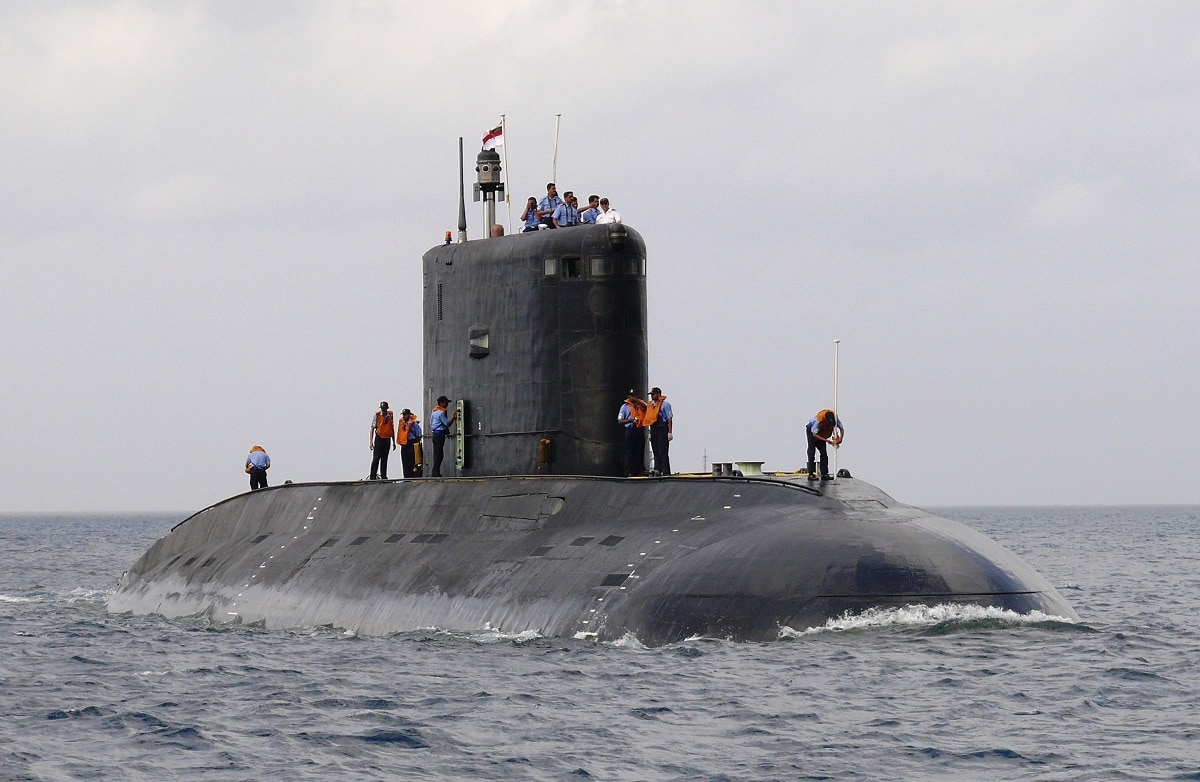
Image: Creative Commons.
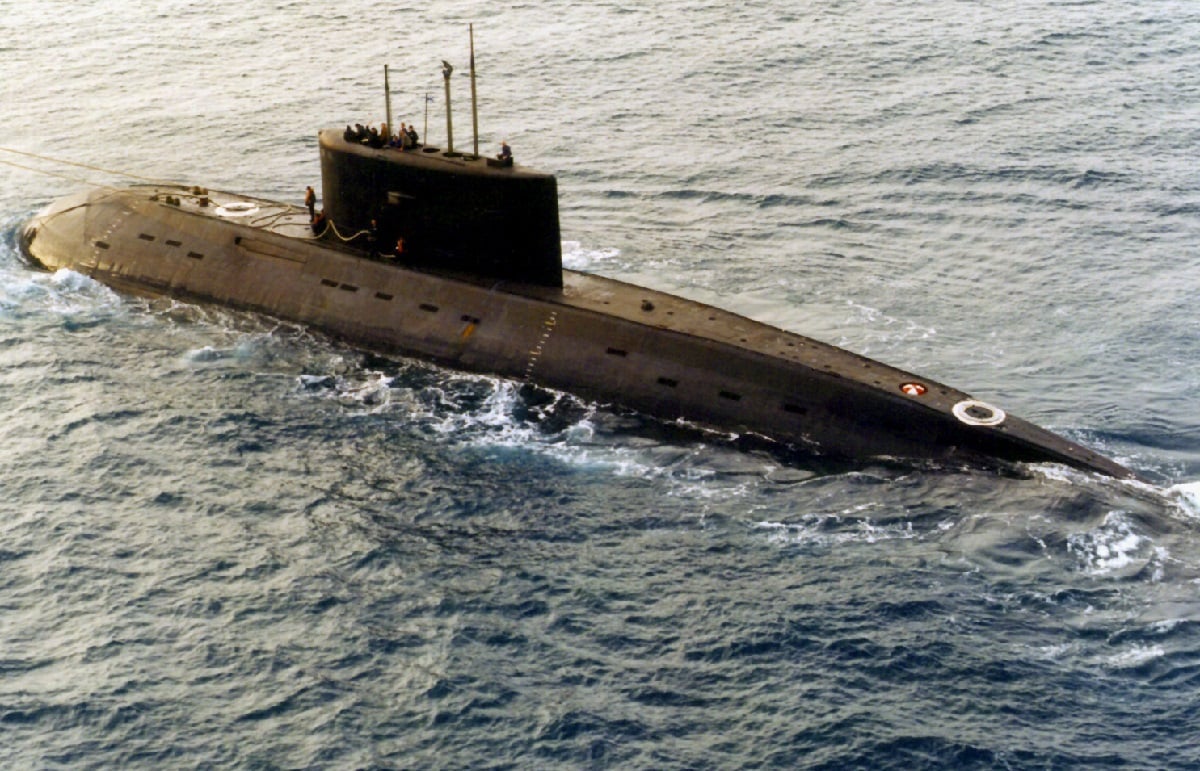
A Russian-built, Kilo-class diesel submarine recently purchased by Iran, is towed by a support vessel in this photograph taken in the central Mediterranean Sea during the week of December 23. The submarine and the support ship arrived at Port Said, Egypt, on Tuesday and were expected to begin transiting the Suez Canal today, Jan. 2, 1996. Ships and aircraft from the U.S. Navy’s Sixth Fleet are tracking the submarine, which has been making the transit on the surface. This is the third Kilo-class submarine the Iranians have purchased from Moscow. DoD photo
However, speaking of submarines, that’s one component of the IRIN—along with their speedboats—that, as far as we can tell, hasn’t been completely destroyed yet.
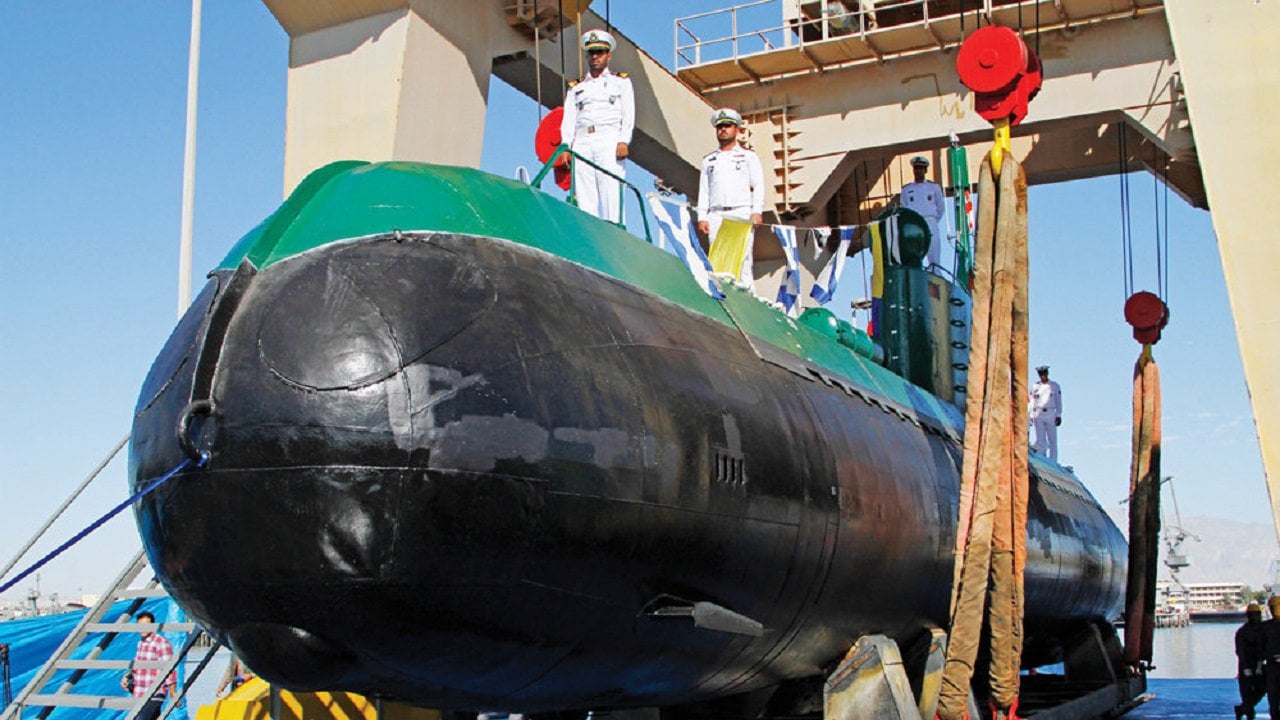
One of the key classes of the NEDAJA submarine fleet is the Ghadir-class midget submarines.
And the Ghadir story has a North Korean nexus attached.
The North Korean Nexus: Ghadir-Class Origins
Named for the Prophet Muhammad’s gathering & sermon of A.D. 632 and first becoming known to the Western intelligence community in 2004, the Ghadir-class boats are Iran’s successor to the indigenously built Nahang-class mini-subs.
Although the Ghadir is also locally produced— manufactured by the Marine Industries Organization, headquartered in Tehran—it is based heavily on the North Korean Yono-class diesel-electric midget submarine; some observers have also noted similarities to the North Korean Yugo and Sang-O classes. One new unit was reportedly commissioned as recently as 2022.
Indeed, by 1993, Tehran had reportedly imported up to nine submarines from Pyongyang.
Moreover, a declassified 2017 report by the Office of Naval Intelligence (ONI) indicated that Iran purchased at least one of the Yonos from the Democratic People’s Republic of Korea (DPRK).
This should come as no surprise to anyone who has paid attention to 21st-century international security affairs.
During his 2002 State of the Union Address, then-U.S. President George Walker Bush described Iran and North Korea, along with the Iraqi regime of then-strongman Saddam Hussein, as constituting an “Axis of Evil.”
Fast-forward to the present day, and though Saddam’s rule over Iraq is long gone, the communist DPRK and the Iranian regimes are still very much alive, this time forming what could reasonably be labeled a “New Axis of Evil” along with Russia, China, and Cuba; Venezuela also could’ve been included on that list prior to the January 2026 overthrow of communist dictator Nicolás Maduro.
Tech Specs and Vital Stats
The Ghadirs have a surface displacement of 117 tons and a submerged displacement of 125 tons, along with a hull length of 95 feet 2 inches, a beam width of 9 feet, and a draft of 8 feet 2 inches.
Carrying a crew complement of seven, the Ghadirs can attain a top speed of 10 knots on the surface and 8 knots submerged, with an armament consisting of two 21-inch torpedo tubes.
An estimated 20 of these warships have been completed.
Operational History and Status: Are There Any Left?
The Ghadirs have participated in multiple regional exercises and international deployments, including:
-The Ettehad-84 naval exercise; and
-A port call conducted by Ghadir 953 in Karachi, Pakistan, to participate in joint naval drills with the Pakistan Navy in May 2014; this should be eye-catching in light of Pakistan’s current efforts to broker a U.S.-Iran peace deal
Meanwhile, one of these vessels was reportedly lost in April 2014, with causes attributed to either an exercise accident or a collision during patrol.
At least one of these mini-subs was confirmed destroyed in a July 2026 strike on Bandar Abbas Naval Base, wherein U.S. Central Command (CENTCOM) utilized three Saronic Corsair unmanned surface vessels (USVs) in a first-of-its-kind operation.
As a side note, although “corsair” technically means a pirate, it’s also a proud name in U.S. Navy history, as it was bestowed upon the legendary—and deadly—Vought F4U Corsair fighter plane of World War II and the LTV A-7 Corsair II subsonic jet-powered attack aircraft of the Cold War era.
However, that still leaves 18 of the menacing maritime midgets unaccounted for, with the potential to attack both commercial and USN shipping.
If and when the Trump Administration finally decides to resume the war effort in earnest—as opposed to the on-again, off-again approach mixed with the frustratingly fallacious and futile hopes of working out a diplomatic deal—it will require a sustained effort to account for any remaining Ghadirs.
MORE – The US Navy Wants a New Nuclear Spy Submarine
About the Author: Christian D. Orr
Christian D. Orr is a Senior Defense Editor. He is a former Air Force Security Forces officer, Federal law enforcement officer, and private military contractor (with assignments worked in Iraq, the United Arab Emirates, Kosovo, Japan, Germany, and the Pentagon). Chris holds a B.A. in International Relations from the University of Southern California (USC) and an M.A. in Intelligence Studies (with a concentration in Terrorism Studies) from American Military University (AMU). He is also the author of the book “Five Decades of a Fabulous Firearm: Celebrating the 50th Anniversary of the Beretta 92 Pistol Series,” the second edition of which was recently published.