The Handley Page Victor was the third and final addition to the UK’s V-bombers to be operated by the Royal Air Force.
Entering service in the late 1950s, the Victor was designed to serve as the airborne component of Britain’s nuclear deterrence strategy.
However, just ten years later, the aircraft would be retired from nuclear bomber service due to airframe cracks caused by structural fatigue.
Instead of retiring the bomber outright, the UK decided to transfer the Victor fleet from frontline service.
The bombers were then converted into support aircraft, with some becoming aerial refuelers and others serving as strategic reconnaissance aircraft.
Design and Development
The Victor shares its origins with the rest of the UK’s “V-Force.” Following the end of the Second World War, the RAF sought a new type of bomber capable of flying long distances and delivering a strategic nuclear strike.
To that end, the Ministry of Supply issued Specification B.35/46 to multiple aviation designers throughout Britain, listing the RAF’s requirements for both medium-range and long-range bombers.
The new aircraft, as stipulated by the requirements, must be able to carry a 10,000-lb nuclear bomb, cruise at around 925 km/h, operate at an altitude between 35,000 and 50,000 ft, and have a combat range of around 1,500 nautical miles (2,000 nautical miles for long-range bombers).
Handley Page was one of the several manufacturers to answer the government’s call, along with Avro and Vickers.
To meet the RAF’s requirements, the designers settled on a crescent-shaped swept-wing configuration, which they reasoned was the most efficient subsonic configuration available.
The aircraft adopted a high-mounted full tailplane, in contrast to some of the tailless designs that were thrown around in the conceptual stage.
The initial design, HP.80, along with Avro’s Type 698—which eventually became the Avro Vulcan—was considered by the RAF to be the most promising of all the proposed designs.
However, both Avro and Handley Page’s designs were risky and unconventional for the time.
As such, two prototypes were ordered and subjected to rigorous testing. In 1952, the government officially designated HP.80 as the Victor.
Specs and Capabilities
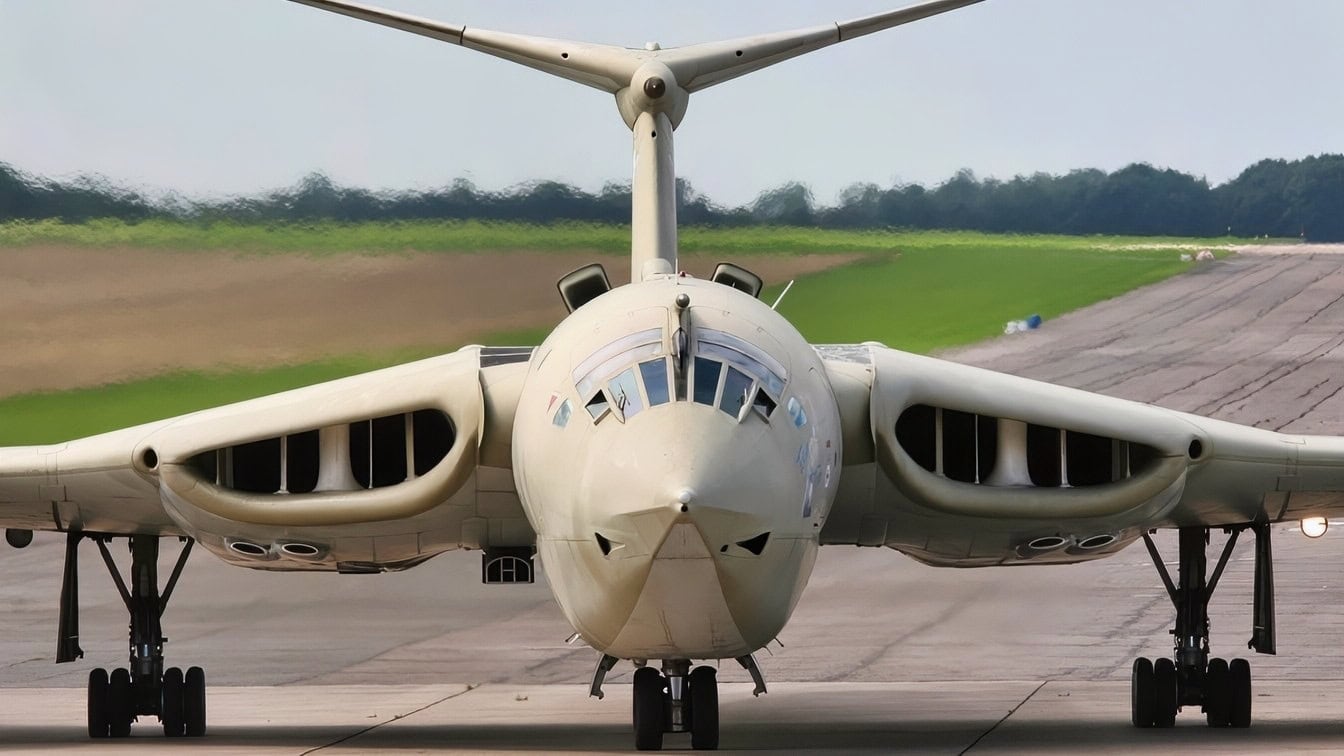
The Handley Page Victor was officially accepted into service in 1958. The bomber sports a sleek, heavily streamlined design.
Its four engines are buried deep into its wing roots, with the air intakes also heavily integrated into its wing structure, a common feature of all the UK’s V-bombers.
The airframe features a prominent chin bulge that houses the onboard radar, the forward landing gear, and a forward position for the bomb aimer.
The bomber operates with a five-man crew comprising two pilots, two navigators, and an air electronics officer (AEO).
The aircraft was also fitted with a complex electronic countermeasures suite, which was operated by the AEO.
These systems were reportedly quite effective for their time and were capable of jamming most radar-guided missiles of the period.
In terms of size, the Victor measured 114 ft in length with a wingspan of 110 ft. Powered by four Armstrong Siddeley Sapphire turbojet engines, the bomber had a top speed of 1,009 km/h with a service ceiling of 56,000 ft, and a combat range of 5,217 nautical miles.
The Victor also had the largest bomb bay of all V-bombers, allowing it to carry the heaviest payload.
As with the other V-bombers, Victors were later fitted with Blue Steel stand-off cruise missiles.
These missiles had a range of 926 km and could be equipped with a conventional or nuclear payload.
They allowed the bombers to operate outside the range of Soviet air defenses at a time when surface-to-air missiles were becoming an increasing threat to high-altitude aircraft.
Operational History and Retirement
Despite being the last bomber to enter service, its service life was relatively short compared to that of the Avro Vulcan.
Just a few years after its acceptance into the RAF, cracks were discovered on many airframes due to high stress.
Part of the reason for this was that the bombers had been forced to fly at lower altitudes than they were designed for.
Originally intended for high-altitude use, the emergence of Soviet SAMs forced the RAF to switch from high-altitude missions to low-altitude bombing runs to avoid radar detection.
Consequently, Victors were often forced to fly lower than they were designed for and literally cracked under the pressure. In 1968, the RAF decided to retire the Vulcan from frontline service.
In total, 86 aircraft were produced, most of which were still in serviceable condition despite fatigue.
Rather than retiring the Victor outright, the UK repurposed the bomber as a support aircraft.
Many Victors were converted into aerial refuelers, while some were transformed into strategic reconnaissance aircraft.
During the Falklands War, Victor refuelers often operated alongside Avro Vulcan bombers, supporting some of the longest bombing flights of the period.
In the 90s, the UK again deployed Victors to refuel British and other coalition aircraft during the Gulf War, mainly servicing the Panavia Tornado.
In 1993, the last of the Victors was withdrawn from service, marking the final end of the V-Force. Today, only four aircraft remain preserved in museums, none of which are in flyable condition.
MORE – Japan Really Lost at Pearl Harbor
About the Author: Isaac Seitz
Isaac Seitz, a Defense Columnist, graduated from Patrick Henry College’s Strategic Intelligence and National Security program. He has also studied Russian at Middlebury Language Schools and has worked as an intelligence Analyst in the private sector.