
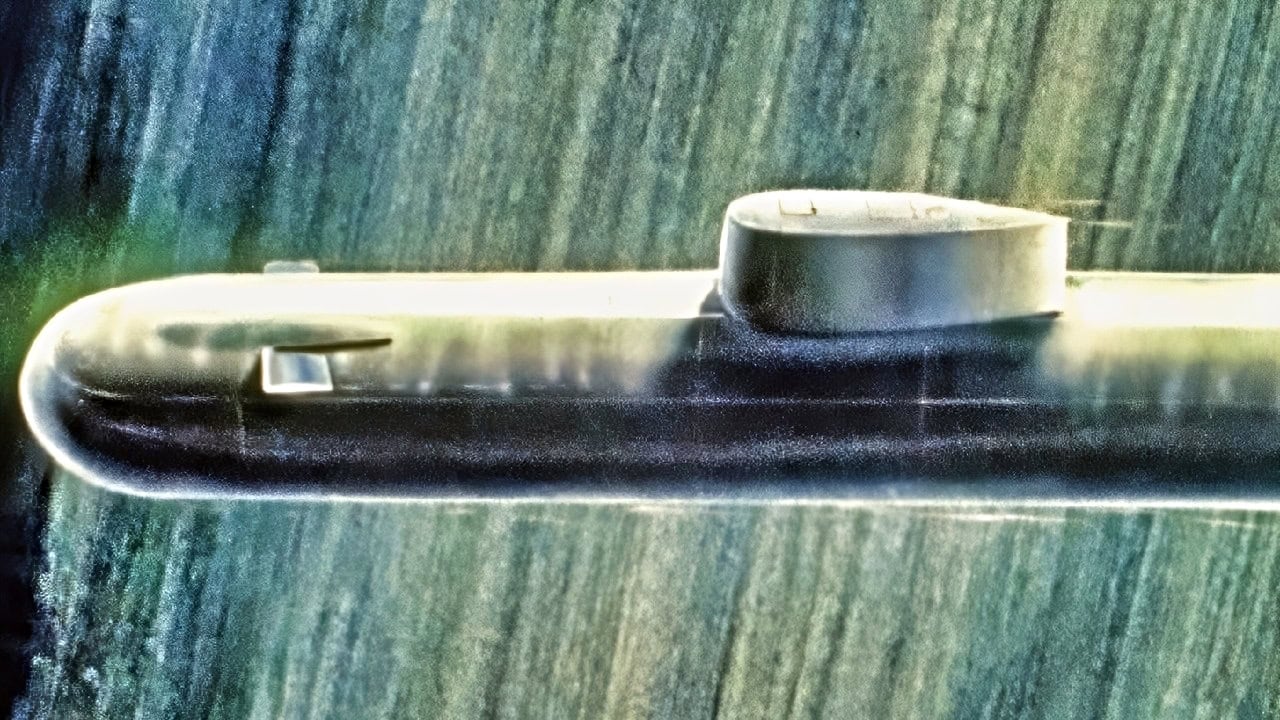
On August 4, 1984, a Soviet nuclear attack submarine went down to 1,020 meters in the Norwegian Sea, roughly 3,350 feet, and came back up. No military submarine is known to have matched that dive in the forty-two years since. The boat was K-278, later named Komsomolets, the only Project 685 Plavnik ever built and the vessel NATO called the Mike-class. Five years after the record, she was on the bottom of the same sea with 42 of her 69 crew dead, a nuclear reactor in her hull, and two nuclear-armed torpedoes in her tubes. She is still there. Norway still samples the water around her every summer.
The Mike-Class or K-278 Disaster Explained
The Soviet Navy ordered the design in 1966, and Rubin, the Leningrad bureau behind most Soviet submarines, did not finish it until 1974, held up for years by the metallurgy the concept required. The premise was depth as sanctuary. A submarine that could operate below a thousand meters would sit beneath the reach of every anti-submarine torpedo NATO had; American boats of the period had test depths in the range of 400 to 450 meters, and their weapons were built for that world. K-278 was also a laboratory, a single-hull vessel intended to test technologies for the Soviet Union’s fourth generation of submarines. She was laid down at Severodvinsk in April 1978, launched in June 1983, and joined the Northern Fleet in early 1984.
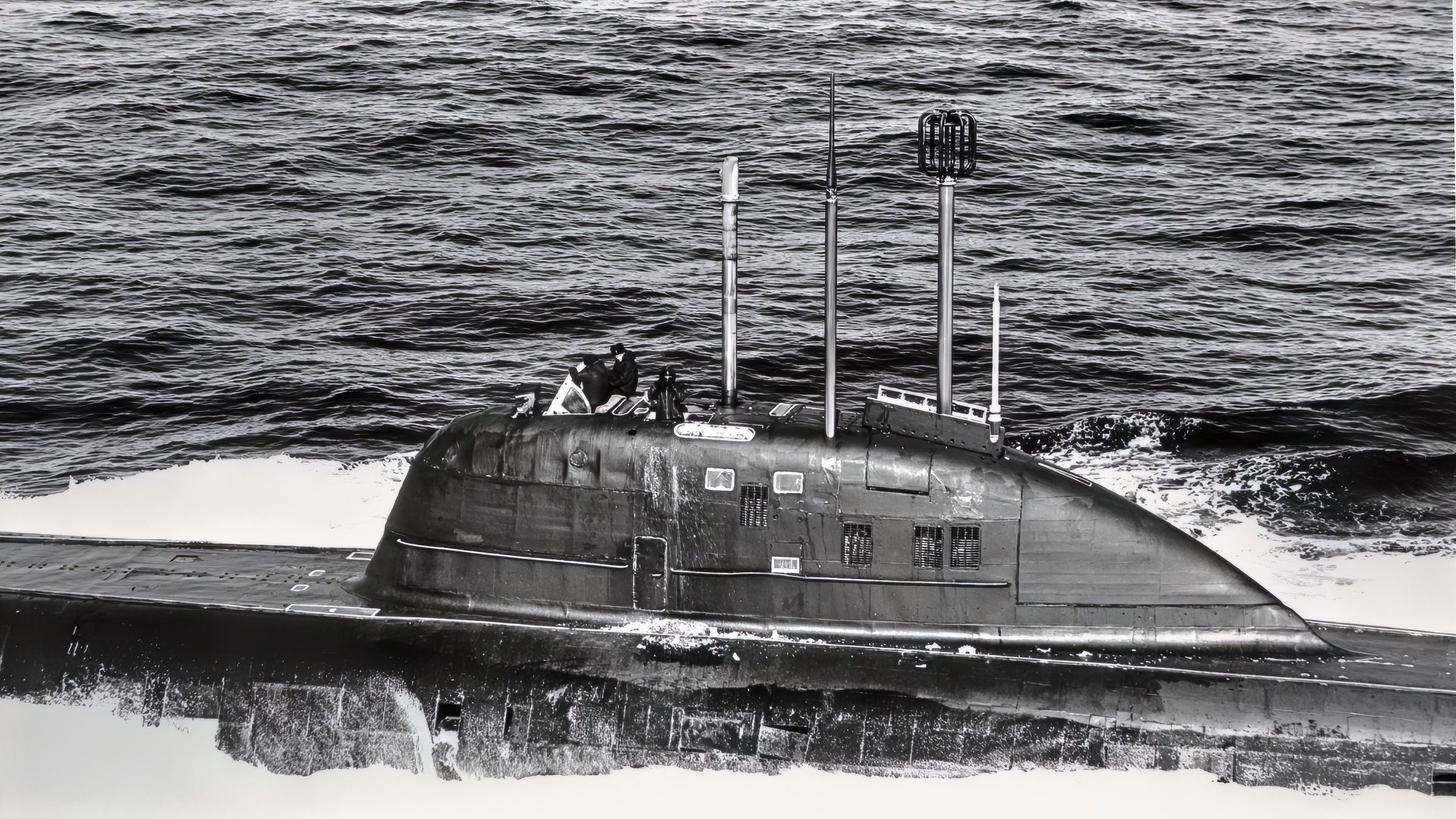
A port view of the sail of a Soviet Victor-II class nuclear-powered attack submarine underway.

An artist’s concept of a Soviet Yankee-class nuclear-powered ballistic missile submarine after conversion into a test platform for the SS-NX-24 cruise missile.
For her first years, she worked as a trials platform, which is what she had been built to be. In 1988 the navy gave her the name Komsomolets, after the Soviet youth league, and reassigned her to frontline combat duty. That decision is the hinge of the whole story: an experimental hull, crewed and tasked like an operational warship, was sent out on a war patrol in the spring of 1989.
The Metal That Made Her and the Bill Nobody Published
Titanium is roughly half the weight of steel at comparable strength, and it resists saltwater corrosion, which is why the Soviet Union was the only country that ever built submarine pressure hulls out of it. K-278’s inner hull was titanium, rated for pressures no steel boat of her generation could survive, and it was brutally difficult to make. Titanium reacts with oxygen and nitrogen when hot, so hull sections had to be welded inside sealed halls flooded with inert argon gas, by welders in protective suits, in facilities built for that purpose alone.
The Soviets put eight titanium boats to sea between 1969 and the early 1990s across the Alfa, Sierra, Papa, and Mike designs, and the American and British navies, unable to match the depth and speed, answered by building better torpedoes instead.
No price for K-278 was ever published, and none exists in any Western accounting. What the record shows is the shape of the expense: one titanium prototype, the Papa-class K-222, is said to have consumed a full percent of Soviet gross domestic product, and the Soviet Navy built exactly one Mike, not a class. A country that has decided a design is worth building will usually build more than one. That it did not is the clearest available statement of what the boat cost.
Six Tubes and Two Warheads
Her armament was as advanced as her hull. Six 533-millimeter bow tubes carried homing torpedoes of the SAET-60 and USET-80 families, anti-submarine missiles, and, in the design’s most exotic capability, the rocket-propelled Shkval supercavitating torpedo.
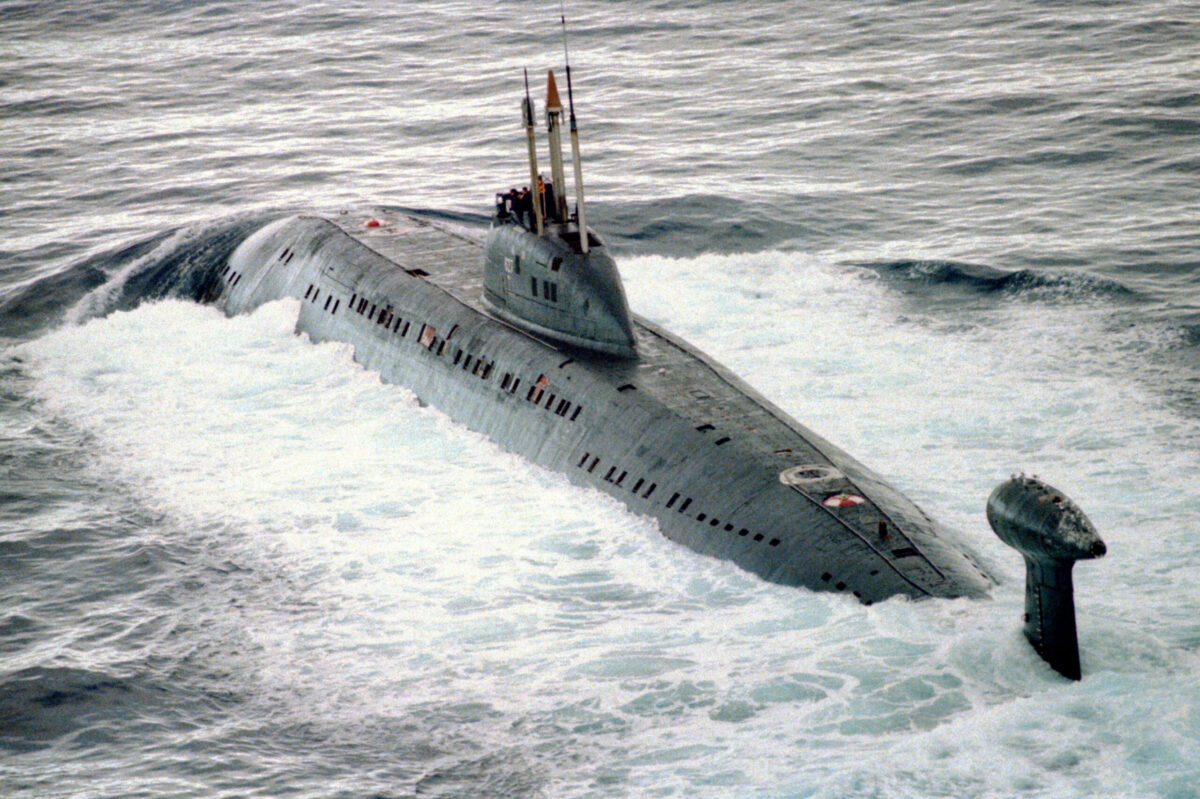
An aerial port quarter view of the Russian Northern Fleet VICTOR III class nuclear-powered attack submarine underway on the surface.
(Exact date unknown)
Two of the weapons aboard her final patrol carried nuclear warheads containing kilograms of weapons-grade plutonium. She was driven by a single pressurized-water reactor through one shaft, and she carried a whole-crew escape capsule built into her sail, which mattered a great deal in April 1989 and did not work.
April 7, 1989
She was on her first operational patrol, under Captain First Rank Yevgeny Vanin, running at 386 meters and eight knots in international waters when the crew noticed power fluctuations shortly before eleven in the morning. A fire started in the seventh compartment, the aft-most space, most likely an electrical short in a panel that ignited leaked hydraulic fluid or oil vapor. The submarine’s own emergency systems then made it worse in the specific way deep-diving submarines can. The reactor scrammed automatically.
The order came to surface, and when the boat blew ballast, the high-pressure air line feeding one of the main ballast tanks ruptured inside the burning compartment. The fire was no longer a fire in a steel box; it was a fire being fed compressed air at thousands of pounds per square inch, and it could not be put out.
K-278 surfaced within twenty minutes and stayed afloat for roughly five hours while the crew fought a blaze they could not reach. Hull integrity failed aft. She flooded, went down by the stern, and sank in the late afternoon in about 1,680 meters of water, more than a mile down, roughly 180 kilometers southwest of Norway’s Bear Island. Most of the crew got off the boat.
Why Forty-Two Men Died
The fire killed only a handful. What killed the rest was the water and the wait. Sea temperature was about 2 degrees Celsiu;, the men went into it without adequate immersion protection after hours of firefighting in a smoke-filled hull, and the nearest help was hours away. Aircraft reached the scene and dropped rafts, but sea conditions kept most of them from being used.
The floating fish factory Aleksey Khlobystov arrived roughly eighty minutes after the submarine went under and pulled aboard about two dozen survivors along with the bodies of men who had not lasted. Of the 42 dead, the great majority died of hypothermia in sight of rescue.
Vanin and four others were still inside when she went down, and they made for the escape capsule, the system designed for exactly this. It was released, apparently at or near the seabed, and reached the surface. The hatch blew open under pressure; one man was thrown clear and lived, and the capsule sank again with the others aboard. Vanin was among the dead. The single feature built to save a crew at depth is the reason the boat’s most senior officers are on the bottom, and that failed rescue, more than the fire, is what the disaster is remembered for in Russia.
Submarine Lost: The Reactor and the Warheads Are Still Down There
What sank with her is why the story did not end in 1989. The reactor and the two nuclear torpedoes went to the bottom intact, and the plutonium in those warheads has a half-life measured in tens of thousands of years.
The wreck also lies in one of the world’s most productive fishing regions, which is why Norway, rather than Russia, became the site’s most persistent monitor. Russia sent submersibles down in the early 1990s, found cracks in the hull, and in 1994 fitted covers over the torpedo tubes and the torpedo compartment to slow any release. Norway has watched the site since the 1990s, and Russian teams documented leaks at a ventilation duct in the 1990s and again in 2007.
In July 2019, a joint Norwegian and Russian expedition aboard the research vessel G.O. Sars put the remotely operated vehicle Ægir 6000 onto the wreck, the first close survey of its kind. The 1994 covers were still in place.
The first samples from the ventilation duct showed nothing. On a later dive, a visible cloud came out of the duct, and samples taken in it read as high as roughly 800 becquerels per liter of cesium-137 against a Norwegian Sea background near 0.001, a figure Norway’s Institute of Marine Research put at 800,000 times normal. Other samples from the same duct came back clean, which told the researchers the release comes in pulses varying with currents rather than as a steady plume.
The alarming number needs its context, and the scientists supplied it themselves. Nothing measurable was found half a meter away from the duct; at 1,700 meters in open ocean the dilution is enormous. Norway’s post-Chernobyl safety limit for cesium in food is 600 becquerels per kilogram, and the expedition leader stated plainly that the readings, while far above background, posed “no risk to people or fish.”
Research published in 2026 has since found that the wreck continues to release isotopes intermittently and that the contamination still dissipates rapidly, while the reactor and the warheads keep corroding on a timescale nobody has a plan for.
Norway’s institute will sample the site again this coming season, as it has nearly every year since the boat went down on her first operational patrol. One of the few objects ever recovered from K-278, her ship’s clock, sits in the Central Naval Museum. It stopped at 5:43 in the afternoon on April 7, 1989.
About the Author: Harry J. Kazianis
Harry J. Kazianis (@Grecianformula) was the former Senior Director of National Security Affairs at the Center for the National Interest (CFTNI), a foreign policy think tank founded by Richard Nixon based in Washington, DC. Harry has over a decade of experience in think tanks and national security publishing. His ideas have been published in the NY Times, The Washington Post, The Wall Street Journal, CNN, and many other outlets. He has held positions at CSIS, the Heritage Foundation, the University of Nottingham, and several other institutions related to national security research and studies. He is the former Executive Editor of the National Interest and the Diplomat. He holds a Master’s degree focusing on international affairs from Harvard University.

