
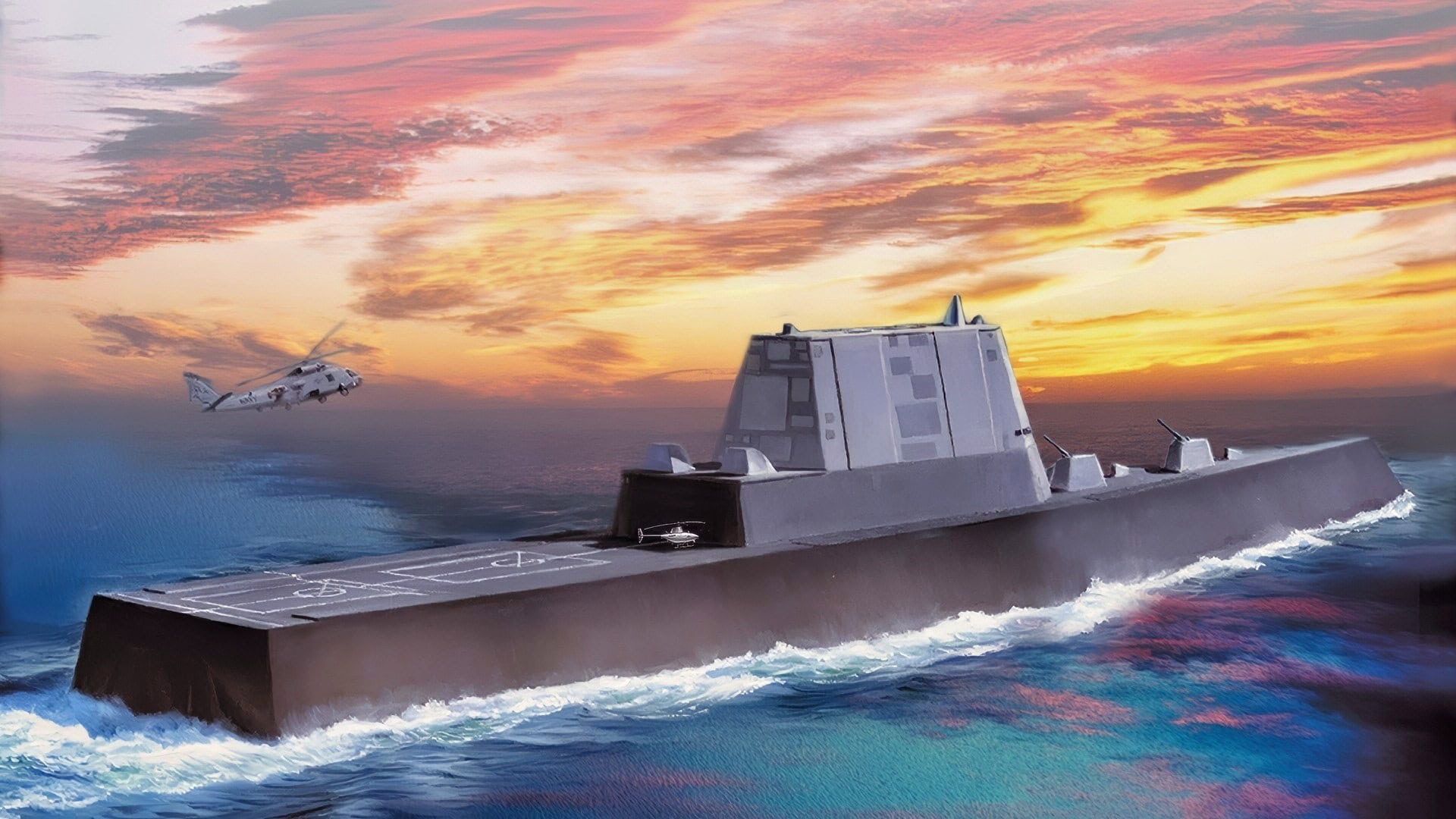
The USS Zumwalt was meant to usher in a new generation of American surface warfare. Originally, the expectation was for the vessel to offer a stealthy land-attack destroyer that could operate relatively close to hostile coastlines, bombarding targets far inland.
In the age of automation, the Zumwalt was meant to have a smaller crew, saving costs in the long term.
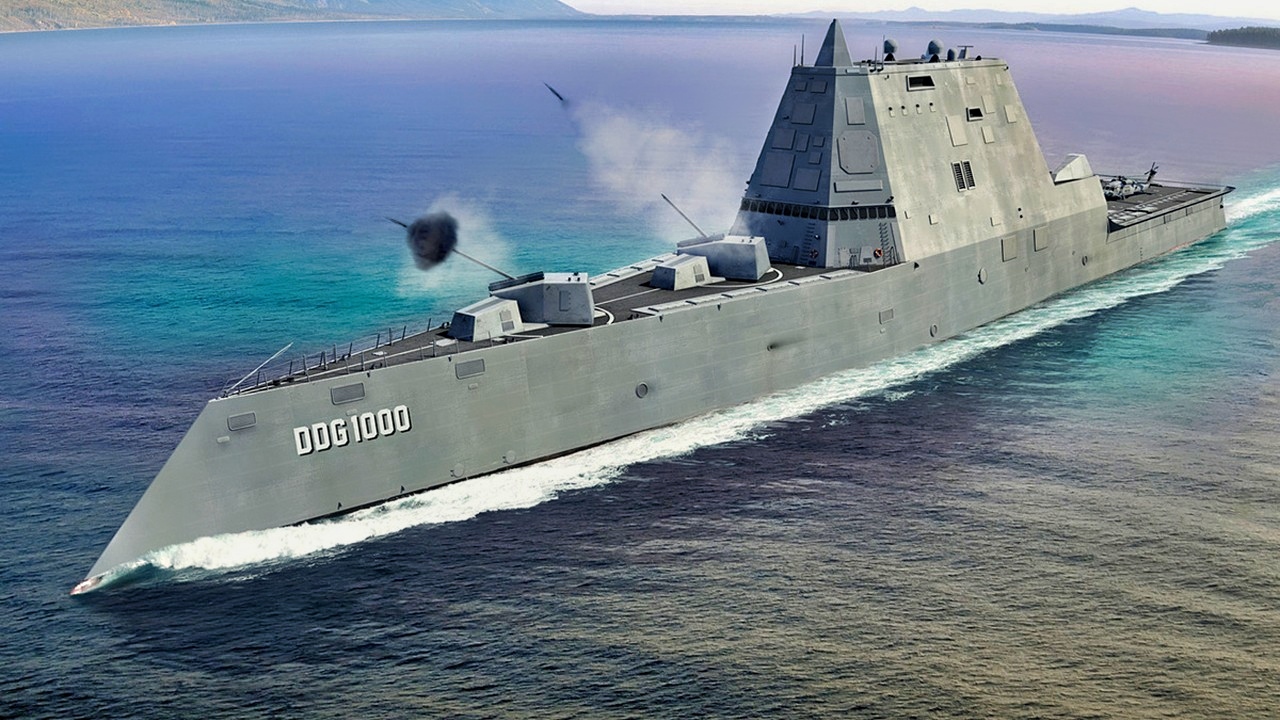
Zumwalt-Class U.S. Navy Destroyer. Image Credit: Creative Commons.
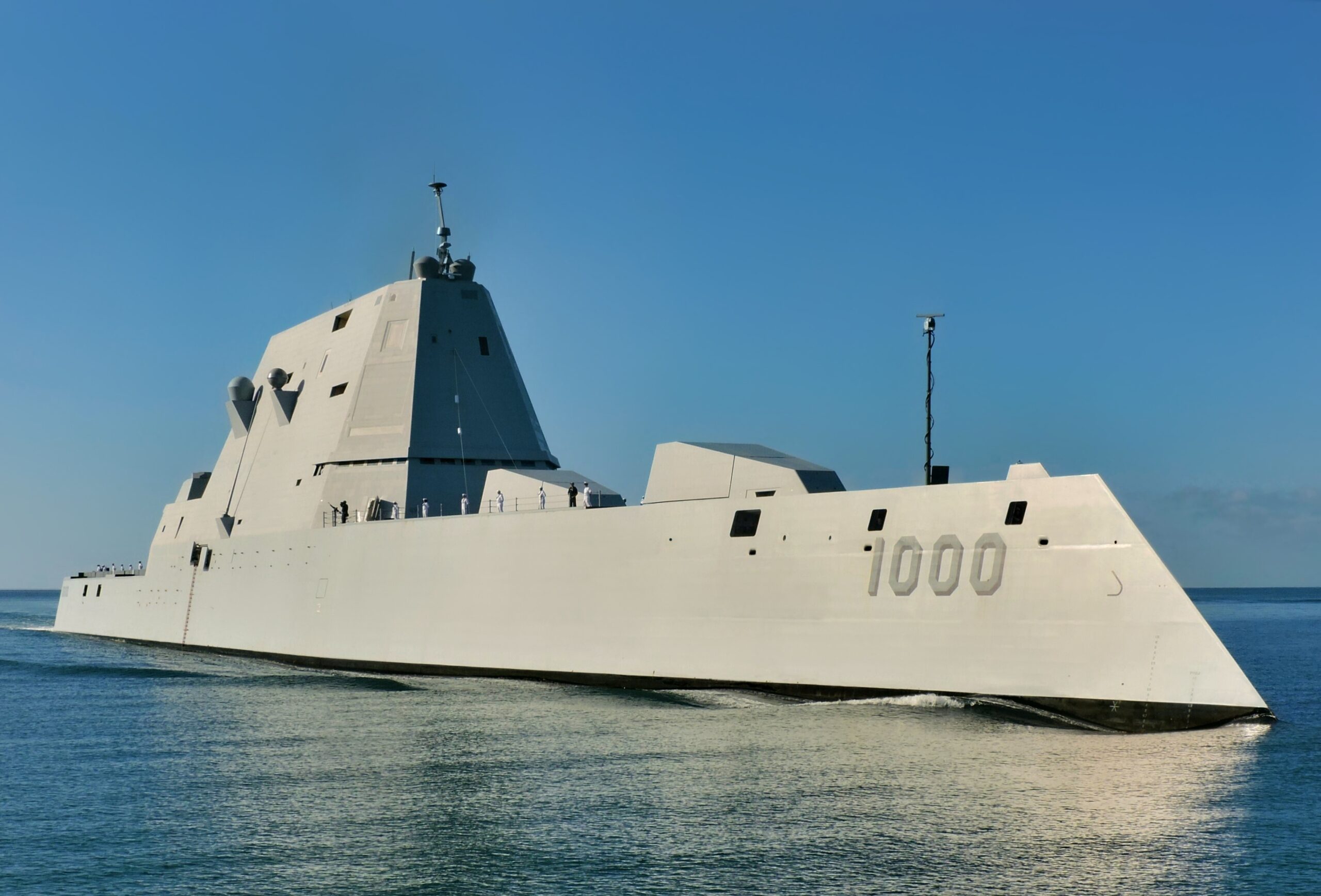
Zumwalt-Class Destroyer U.S. Navy. Image Credit: Creative Commons.
And with integrated electric propulsion, revolutionary radar, revolutionary guns, and eventually enough electrical power for future directed-energy weapons (aka lasers), the Zumwalt was supposed to be the ship of the future.
The Navy envisioned procuring roughly three dozen ships. That never happened. Instead, the Navy procured only three: the Zumwalt, Michael Monsoor, and Lyndon B. Johnson.
Because the program’s research and development costs were never distributed across multiple vessels and instead concentrated in just three, the cost per ship exceeded $20 billion (depending on what development costs are included).
This created a vicious cycle: higher per-unit costs led to fewer ships, and fewer ships led to higher per-unit costs. The program is now, functionally, dead. At least from a procurement standpoint.
Disappearing Mission
Zumwalt emerged from the post-Cold War assumption that the US Navy would operate close to hostile shores with relatively little opposition, as it did throughout the 1990s and early 2000s.
Accordingly, the Zumwalt’s central mission became Naval Surface Fire Support, which included approaching enemy coastlines stealthily, supporting Marines and Army ashore, and raining precision 155mm shells inland. That’s why the ship was outfitted with an enormous Advanced Gun System (AGS).
All was going well enough—but then the strategic environment shifted dramatically. China committed to a robust A2/AD system and built increasingly capable anti-ship ballistic missiles, long-range cruise missiles, submarines, stealth aircraft, satellites, and maritime surveillance networks.
In the face of such opposition, a giant destroyer lurking along the Chinese coastline to provide artillery support becomes much less feasible.
The Navy was forced to shift the Zumwalt’s mission toward blue-water surface warfare and long-range strike, which, of course, was not what the ship had been designed for.
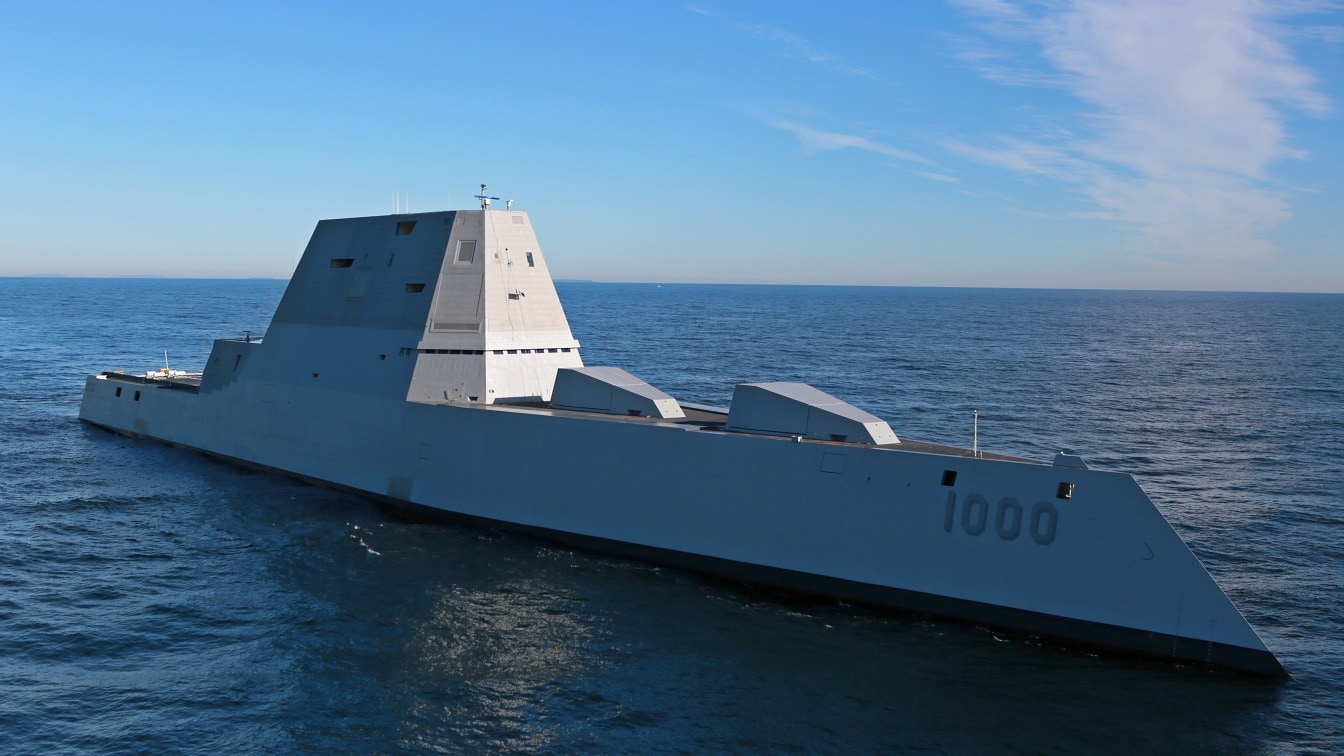
(Dec. 7, 2015) The future USS Zumwalt (DDG 1000) is underway for the first time conducting at-sea tests and trials in the Atlantic Ocean Dec. 7, 2015. The multimission ship will provide independent forward presence and deterrence, support special operations forces, and operate as an integral part of joint and combined expeditionary forces. (U.S. Navy photo courtesy of General Dynamics Bath Iron Works/Released). Zumwalt-Class
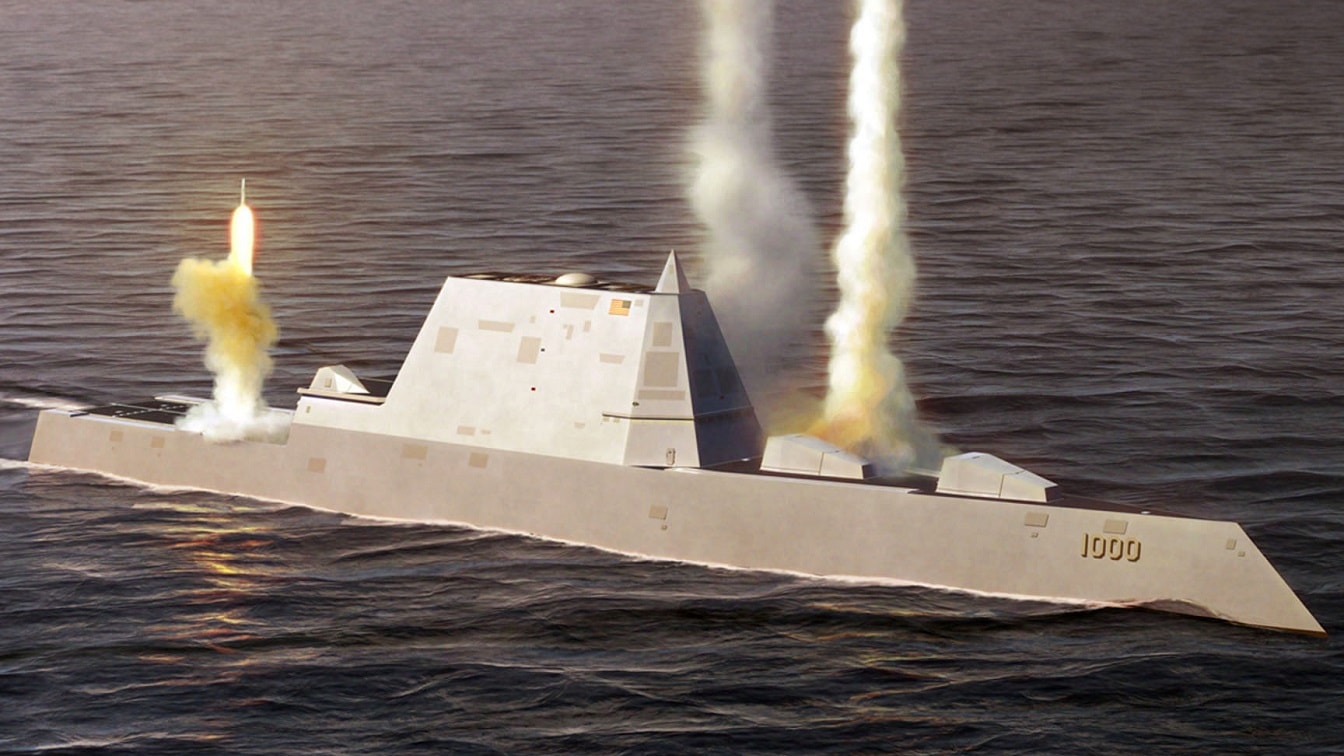
An artist rendering of the Zumwalt class destroyer DDG 1000, a new class of multi-mission U.S. Navy surface combatant ship designed to operate as part of a joint maritime fleet, assisting Marine strike forces ashore as well as performing littoral, air and sub-surface warfare.
In short, the Zumwalt suffered from the disappearance of the mission it was built to address.
The AGS Fiasco
Each Zumwalt carried two 155mm AGS guns. These were extremely sophisticated, automated loading guns, with magazines buried below deck, automated ammunition handling, and minimal human intervention.
They were, essentially, the naval guns of the future, capable of firing roughly 10 rounds per minute. The AGS was designed around the ammunition of the future, too: the Long Range Land Attack Projectile (LRLAP).
LRLAP was rocket-assisted, with GPS/inertial guidance, offering precision attack and a range of 70-plus miles. But this configuration revealed a small problem: the AGS could not fire standard 155mm Army ammunition, forcing the AGS gun and LRLAP ammunition to be part of a single interconnected weapons ecosystem.
So when Zumwalt production collapsed, LRLAP production collapsed, too. The estimated cost per projectile eventually reached roughly $800,000 to $1 million.
To emphasize: that’s one million dollars for a single round of ammunition. At that price, the vessel’s entire rationale disappeared.
If each round cost the same as a stand-off missile, yet had a shorter range and required a ship and crew to launch, then what was the point? Why not just produce more stand-off missiles?
It made no sense, which the Navy recognized, leading it to abandon LRLAP procurement in the process. The AGS has since been removed, allowing designers to install easier-to-supply guns.
Too Much at Once
The flaw of the Zumwalt is that it tried to introduce too much at once.
The Navy tried to pack a disorienting list of brand-new tech into one vessel; at the same time, the Navy tried to introduce the tumblehome hull, wave-piercing bow, reduced radar signature, automated crew architecture, integrated electric power, new propulsion motors, peripheral VLS, new radar, new computing systems, the AGS, and the LRLAP.
Many of these concepts were promising, yes, but collectively, they produced an insurmountable integration problem.
The Zumwalt tried to make a clean-sheet ship, propulsion plant, combat system, and principal weapon all accelerate from scratch to maturity, in unison, immediately.
It didn’t work.
While the program’s procurement was ultimately canceled after just three ships, the technology that doomed the ship was genuinely forward-looking and may eventually be appreciated for anticipating the direction naval warfare was taking.
MORE – The X-15 Hit Mach 6.7 All the Way Back in 1967
About the Author: Harrison Kass
Harrison Kass is a writer and attorney focused on national security, technology, and political culture. His work has appeared in Tablet, City Journal, The Hill, The Spectator, and The Cipher Brief. He holds a JD from the University of Oregon and a master’s in Global & Joint Program Studies from NYU. More at harrisonkass.com.