
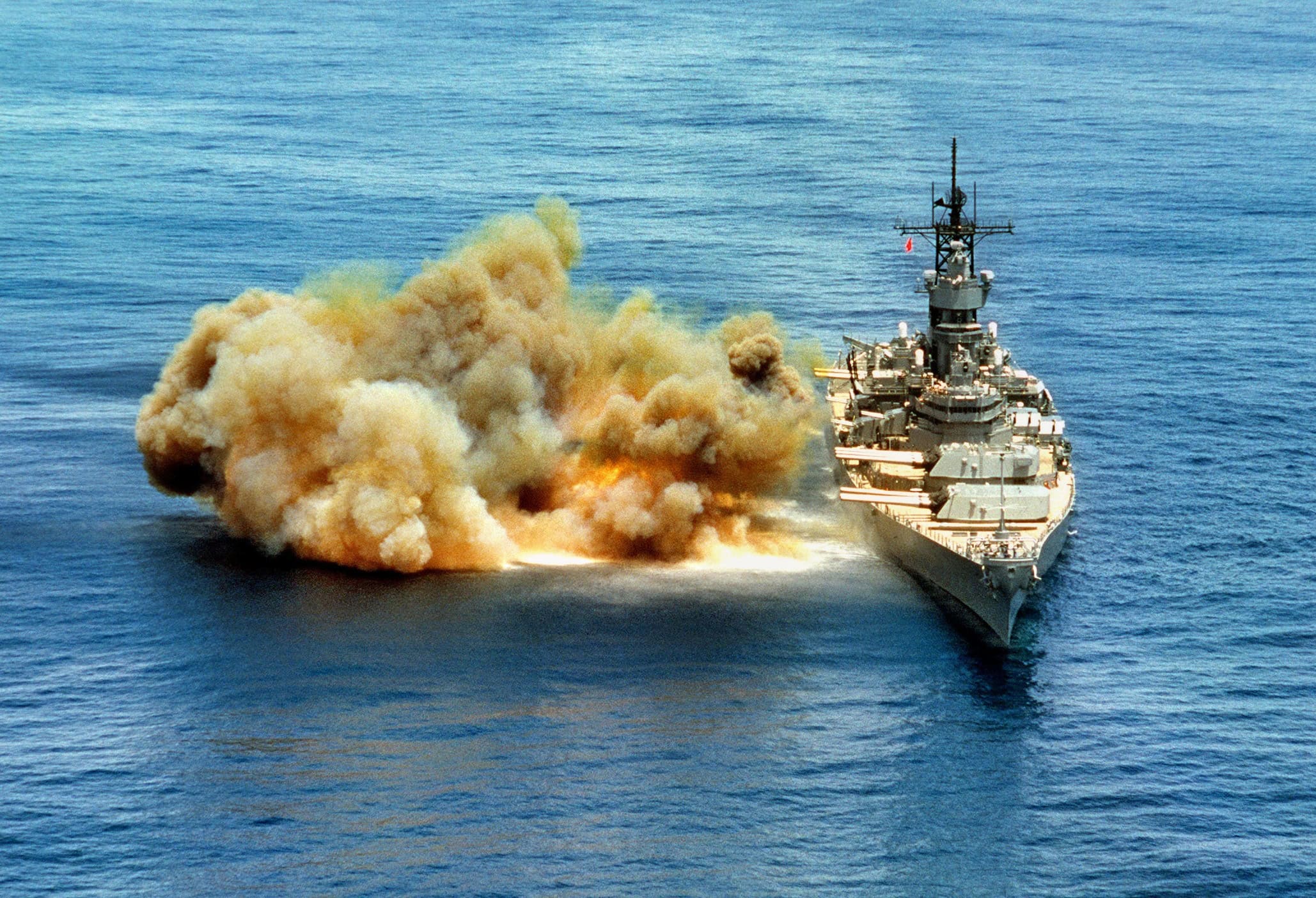
The Montana-Class Was the Only American Answer to Yamato. The Navy Canceled It Anyway: Every argument about American battleships ends at the Iowa class, the four fast leviathans that served from 1943 to the 1990s. The argument should end one class later. In the summer of 1940, Congress authorized five battleships that would have made the Iowas look like the compromise they were: the Montana class, the largest, best-protected, and most heavily armed capital ships the United States ever approved. The Navy’s own historians describe them as the only American ships that came close to equaling Japan’s Yamato. They were real enough that Japan redesigned its next battleships in response, and real enough that five state names, three shipyards, and a new set of Panama Canal locks were assigned to them. Then the Navy walked away. The case that it should not have is better than the cancellation’s defenders admit.
Born From the Treaties’ Collapse
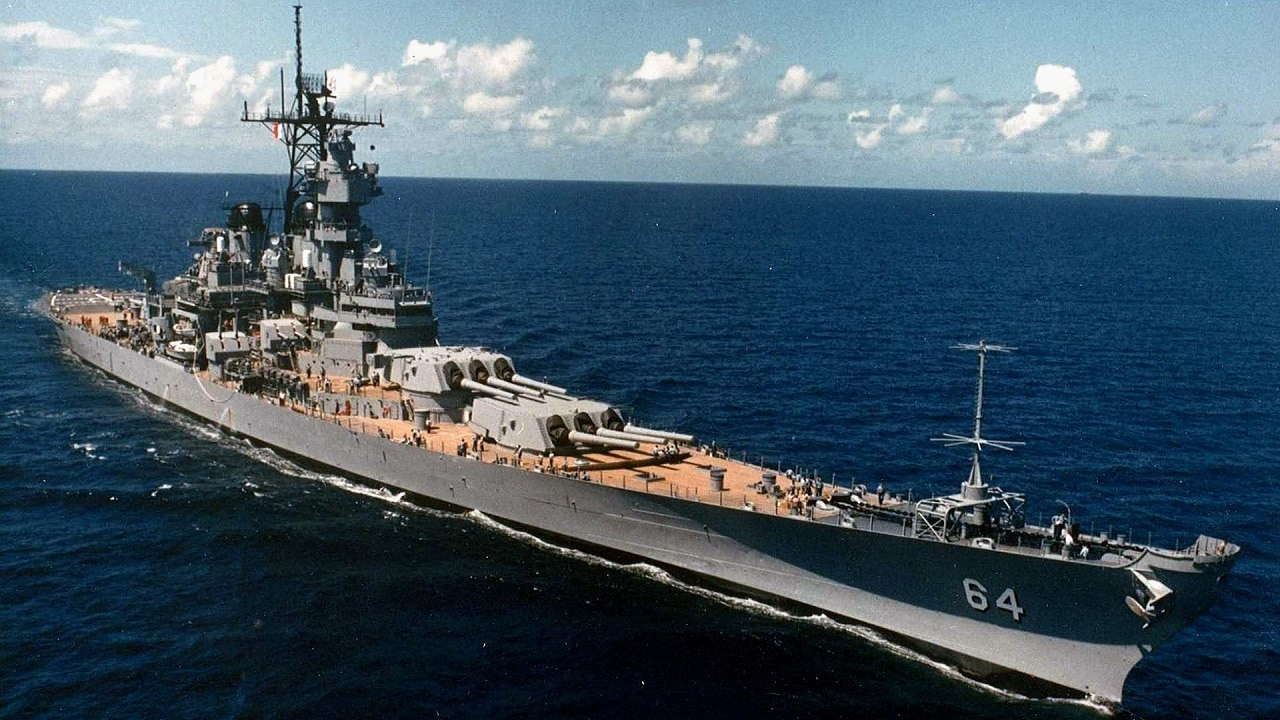
USS Wisconsin. Image Credit: Creative Commons.
The Montanas were the first American battleships designed with no treaty looking over the drafting table.
The Washington and London agreements had capped battleships at 35,000 tons and forced the compromises baked into the North Carolina and South Dakota classes; even the Iowas spent their tonnage on speed rather than protection.
By the late 1930s, the treaty system was dead, and intelligence pointed to enormous new Japanese ships, later revealed as Yamato and Musashi.
The Two-Ocean Navy Act of July 1940 answered with seven battleships: two more Iowas, and five ships of an entirely new class, redesignated BB-67 through BB-71 and named on December 28, 1940: Montana and Ohio for the Philadelphia Navy Yard, Maine and New Hampshire for Brooklyn, Louisiana for Norfolk. They were the last battleships the United States ever ordered.
What They Would Have Cost
No final price exists, because no keel was ever laid, and that fact is itself part of the cost story. The five ships were funded in Fiscal Year 1941 alongside the Iowas, whose completed hulls ran about $100 million apiece in the dollars of the day.
A Montana-class was a third more ship: a fourth main turret, half again the secondary battery, thousands more tons of armor, and a hull whose 121-foot beam abandoned the Panama Canal’s existing locks outright, on the assumption that the wider third set of locks then planned would be finished.
The honest accounting runs past money into steel, slipways, and crews, and that ledger, as this piece will come to, is exactly what killed them.
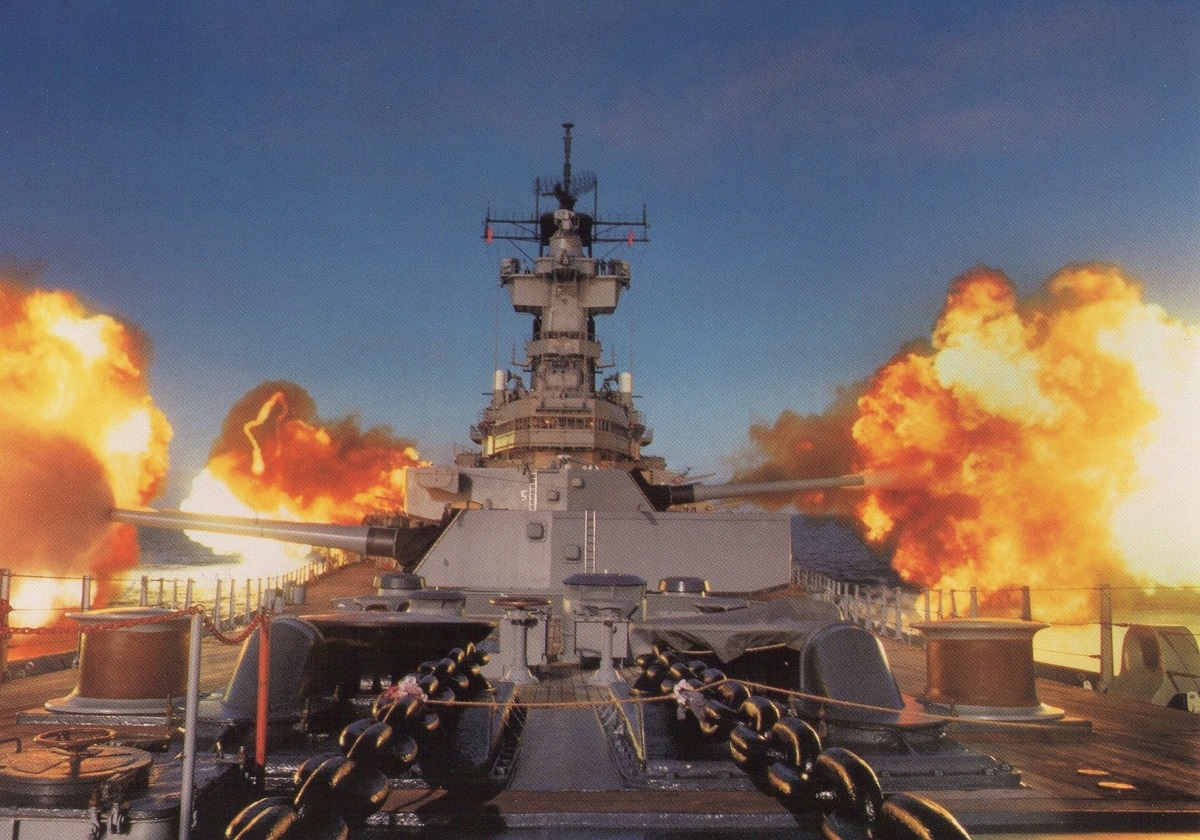
USS Wisconsin. Image: Creative Commons.
Seventy Thousand Tons Built to Survive Its Own Guns
The final design was enormous: 63,221 tons standard and 70,965 full load, 921 feet long, 28 knots on 172,000 horsepower, a 15,000-mile cruising range, and a crew of 2,355. The tonnage bought the one thing every previous American battleship had traded away.
The Navy’s historians state it plainly: the Montanas would have been the only new World War II American battleships “adequately armored against guns of the same power as their own.” The numbers behind that sentence are stark.
Against the Navy’s 2,700-pound Mark 8 superheavy shell, the Iowa class could claim an immune zone of only 23,600 to 27,400 yards; the Montana design, with its 16.1-inch inclined belt, 22.5-inch turret faces, and a second, deeper belt designed against diving shells, stretched that zone from 18,000 yards out to 31,000. Specialist analysis concludes only Yamato’s 18.1-inch guns posed a serious threat to it.
America designed exactly one battleship that could stand in its own shellfire, and it is the one that was never built.
Twelve Guns and a Secondary Battery Ahead of Its Time
The main battery was the Iowa’s excellent 16-inch/50 Mark 7, firing the same 2,700-pound superheavy shell to roughly 24 miles, but twelve of them in four triple turrets instead of nine in three: a third more broadside from a gun already rated among the finest at sea.
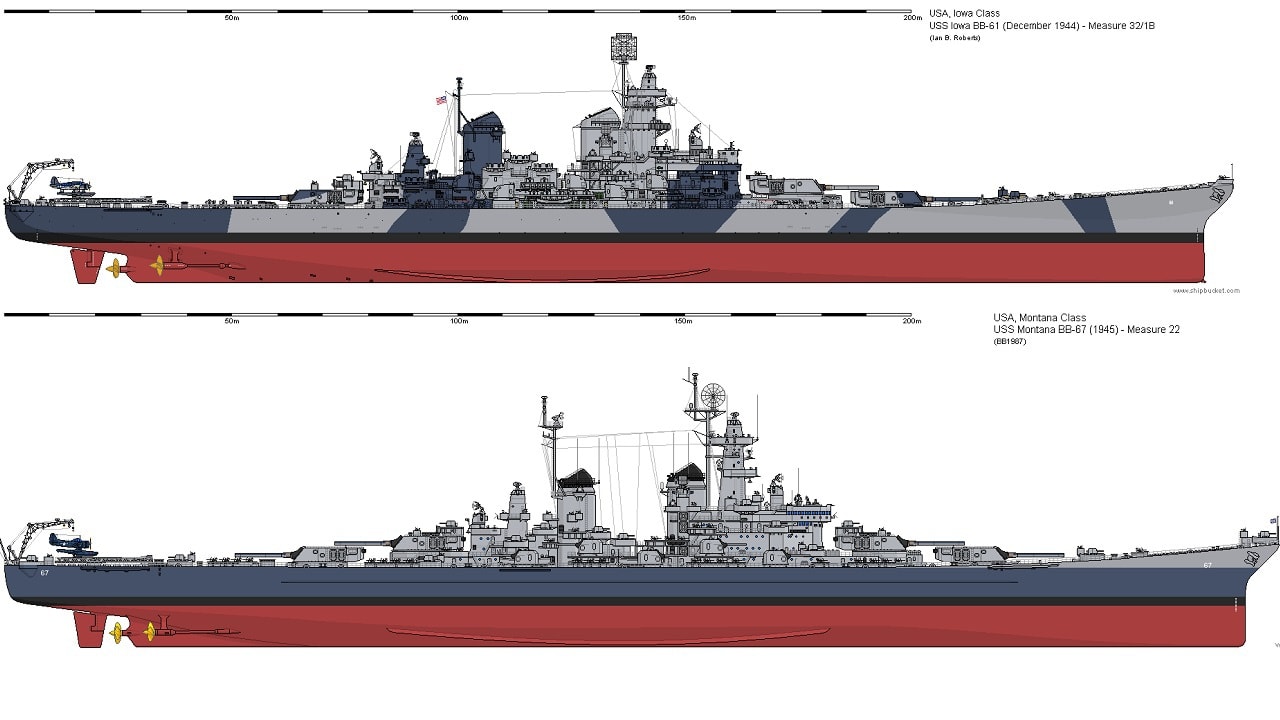
Image of Iowa-class battleship compared to Montana-class battleship that was never built. Image Credit: Creative Commons.
The secondary battery was new outright: twenty 5-inch/54 caliber Mark 16 guns, heavier-hitting and longer-reaching than the 5-inch/38s on every other American battleship, backed by dozens of 40mm and 20mm anti-aircraft barrels.
The 5-inch/54 was good enough that the Navy fielded it anyway after the cancellation, aboard the Midway-class carriers in 1945. And the bore diameter carried one more distinction into the future: the 16-inch gun family went on to make the Iowas the Navy’s nuclear-artillery ships, a mission four more hulls would have shared.
The Case That They Should Have Been Built
There is a case here that runs contrary to the normal narrative on the Montana-class.
The planned follow-on Yamatos were redesigned with deeper protection mainly in response to the Montana order, deterrence you can measure in an adversary’s blueprints. In the duel every naval historian games out, the American advantages in radar fire control, rate of fire, and crew training likely tip the fight, and the Montana carried the fire-control edge behind armor the Iowas never had.
Completion would have given the late-1940s Navy seventeen new battleships, by the historians’ count, against any combination of rivals. And the strongest version of the case is the one the Iowas themselves proved: America kept battleships for fifty more years, for Okinawa’s shore bombardment, Korea, Vietnam, and the 1980s reactivations, missions where a Montana does everything an Iowa did with a third more guns, tougher scantlings in the kamikaze and missile age, and the same nuclear shells.
The famous objection, 28 knots against the Iowas’ 33, mattered for screening fast carriers in 1944 and stopped mattering the day the war ended. Gunfire support has never once required 33 knots.
Monatna-Class: Why They Died Anyway
The dates tell the story with brutal economy. Construction was suspended on May 20, 1942, twelve days after the Battle of the Coral Sea and fifteen days before Midway, the two engagements in which opposing fleets never sighted each other.
By the time the suspension came up for review, four Japanese carriers were on the bottom of the Pacific, sunk by aircraft, and the question answered itself. The yards, steel, and 2,355-man crews a Montana demanded were the same yards, steel, and crews building Essex-class carriers, landing ships, and submarine escorts, and the 28-knot design could not screen the 33-knot carrier task forces that now decided the war, a job the Iowas could do.
On July 21, 1943, with no keel laid, the class was formally canceled as the battleship ceased to be the fleet’s dominant element; even the last two Iowas, Illinois and Kentucky, were never finished. This site has made the opposite argument, that the cancellation was strategic foresight, and 1943 agreed. The counterfactual above is what 1953 and 1983 would have said.
What the Experts Told Me
“I know we made a mistake that’s not fixable,” stated one British Naval officer who retired some years ago, whom I spoke with this week. “I always thought the Montana-class should have been built, as they would have been a battleship that had so much utility; she would have earned her place.”
What Remained
Pieces of the class went to sea without it. The 5-inch/54 guns armed the Midway-class carriers from 1945, and the design’s protection studies were applied to those same hulls. The name had the strangest afterlife: with BB-67 canceled, and the earlier Montana of 1920 killed by the Washington Treaty before her, Montana finished the battleship era as the only one of the 48 states never honored by a completed battleship.
The Navy finally closed the account in June 2022, when it commissioned USS Montana, SSN-794, a Virginia-class submarine, carrying no guns at all.
About the Author: Harry J. Kazanis
Harry J. Kazianis (@Grecianformula) was the former Senior Director of National Security Affairs at the Center for the National Interest (CFTNI), a foreign policy think tank founded by Richard Nixon based in Washington, DC. Harry has over a decade of experience in think tanks and national security publishing. His ideas have been published in the NY Times, The Washington Post, The Wall Street Journal, CNN, and many other outlets worldwide. He has held positions at CSIS, the Heritage Foundation, the University of Nottingham, and several other institutions related to national security research and studies. He is the former Executive Editor of the National Interest and the Diplomat. He holds a Master’s degree focusing on international affairs from Harvard University.

